Yesterday RealtyTrac published a good article talking about the debate currently going on in Washington D.C. about Freddie Mac and Fannie Mae. There are several moving parts in this whole ordeal that investors should be aware of. Rather than trying to regurgitate those for you here, we suggest you read the article from RealtyTrac.
It's mind boggling how much money the government is pulling in from Frannie and Freddie now. However, at the same time it feels like we've been down this road before. Mortgage rates can't stay this low forever, can they? Everything is rosy now, but what happens if this new real estate bubble that seems to be forming pops? As soon as mortgage rates start to go back to a normal range, what's going to happen to the housing market?
Housing values are being inflated thanks to historically low interest rates. When that 3.75% 30 year fix mortgage goes to 5%, all the sudden instead of being able to afford a $300,000 house, that same homebuyer will only be able to afford a $260,000 home. The housing market simply won't be able sustain current values once this rate increase happens. Then, just like we saw before, the snow ball effect will come into play and things will get exponentially worse.
If the government shuts down Freddie and Fannie, you can be that rates are going to increase a lot faster than they would otherwise. At the same time, though, this current model is not sustainable either, at some point it is going to crash, and the government is going to be on the hook. I suppose at least this time around the government gets to participate in the upside. Too bad they don't do a a better job of managing the profits.
Showing posts with label real estate. Show all posts
Showing posts with label real estate. Show all posts
Saturday, March 22, 2014

Saturday, September 21, 2013
Breaking Down Transactional Funding For Real Estate Investors
Investing in real estate offers a lot of opportunity for financial
growth. Flipping properties, the process of buying at low cost, quickly
renovating and selling at much higher cost, is an excellent way to make
fast profits. However, you may not always have funds readily available
to make purchases, and you don’t want to be in constant loan debt.
That’s when transactional funding can help.
What is transactional funding?
Transactional funding refers to a transaction-based short term loan that you use to purchase property that you will turn around and sell. The proceeds of that sale are then used to pay back the loan, allowing you to avoid a long-term debt. The loan is transaction-based because the purchase by you, called the A-B side of the transaction, as well as your subsequent sale to another buyer, the B-C side of the transaction, must already be arranged in order to obtain this type of loan.
What are the advantages?
You can enjoy several advantages from a transactional funding loan versus a regular hard money loan, including:
What types of transactions can be funded?
While the loan cannot be used for mobile homes or non-real estate transactions such as vehicle purchases, you can take advantage of the loan for most real estate properties. Qualifying properties include commercial real estate, for sale by owner homes, bank owned/foreclosed homes and apartment buildings. As a savvy investor, you can make an excellent profit purchasing properties at a discount, such as bank foreclosed homes, flipping and selling them at a higher profit margin.
This article was originally published on realestatemoney.com.
What is transactional funding?
Transactional funding refers to a transaction-based short term loan that you use to purchase property that you will turn around and sell. The proceeds of that sale are then used to pay back the loan, allowing you to avoid a long-term debt. The loan is transaction-based because the purchase by you, called the A-B side of the transaction, as well as your subsequent sale to another buyer, the B-C side of the transaction, must already be arranged in order to obtain this type of loan.
What are the advantages?
You can enjoy several advantages from a transactional funding loan versus a regular hard money loan, including:
- No credit checks
- No proof of income required
- No money down
- Loan covers closing costs
- Lower loan costs
What types of transactions can be funded?
While the loan cannot be used for mobile homes or non-real estate transactions such as vehicle purchases, you can take advantage of the loan for most real estate properties. Qualifying properties include commercial real estate, for sale by owner homes, bank owned/foreclosed homes and apartment buildings. As a savvy investor, you can make an excellent profit purchasing properties at a discount, such as bank foreclosed homes, flipping and selling them at a higher profit margin.
This article was originally published on realestatemoney.com.
Thursday, March 21, 2013
US Housing Starts Improve
The latest Commerce Department reports shows that U.S. housing starts are on the upswing, although experts note that basing predictions on data so early in the year may lead to drawing erroneous conclusions. Even so, single-family home construction starts have climbed more than 27% when compared to the same time last year, which competes with levels not seen since 2008. Permit issuance is also up and is tracking closely to starts, although both numbers still remain at one-third the amount seen prior to the start of the U.S. recession in 2006. For more on this continue reading the following article from Iacono Research.
This blog post was republished with permission from Tim Iacono.
The Commerce Department reported(.pdf)
that housing starts rose 0.8 percent in February to an annual rate of
917,000 units and permits for new construction, a key leading indicator
for the home building industry, jumped 4.6 percent to a rate of 946,000,
the highest level since June 2008.
From year ago levels, housing starts are up 27.7 percent and permit issuance is 33.8 percent higher.

Starts for single-family homes rose 0.5 percent to a rate of 618,000 units, also the highest level since 2008, accounting for about two-thirds of the overall total, however, home building remains about one-third below the pre-housing bubble pace of about 1.5 million units per year.
It is once again worth pointing out that not too much should be inferred from housing data at this time of the year due to dramatically lower activity in most of the country during the winter months and the outsized impact of seasonal adjustments. Nonetheless, this offers more evidence of ongoing improvement in the housing market as builders ramp up their plans for new construction in the months ahead.
From year ago levels, housing starts are up 27.7 percent and permit issuance is 33.8 percent higher.
Starts for single-family homes rose 0.5 percent to a rate of 618,000 units, also the highest level since 2008, accounting for about two-thirds of the overall total, however, home building remains about one-third below the pre-housing bubble pace of about 1.5 million units per year.
It is once again worth pointing out that not too much should be inferred from housing data at this time of the year due to dramatically lower activity in most of the country during the winter months and the outsized impact of seasonal adjustments. Nonetheless, this offers more evidence of ongoing improvement in the housing market as builders ramp up their plans for new construction in the months ahead.
This blog post was republished with permission from Tim Iacono.
Wednesday, September 26, 2012
US Home Price Index Continues Climb
All signs continue to point to a recovery in the U.S. residential real estate market The summer 20-City Case Shiller Home Price Index shows that property prices increased in June and July. Standard & Poor’s reported that the adjusted numbers were not as impressive, but they were still positive. All 20 cities, which included hard-hit towns like Atlanta and Las Vegas, all showed average gains throughout the summer. The news is dampened somewhat due to the fact that banks are still keeping many distressed homes off the market to juice prices, but experts believe that sales and prices will continue to rise through 2012. For more on this continue reading the following article from Iacono Research.
The nation’s housing market continued to rebound over the summer as Standard & Poor’s reported(.pdf)
that the Case-Shiller 20-City Home Price Index rose 1.6 percent in July
following a surge of 2.3 percent in June. The most respected measure of
U.S. home prices now indicates a gain of 1.2 percent from a year ago.
On a seasonally adjusted basis, prices rose for the sixth straight month with the July gain at a less impressive 0.4 percent, after an increase of 0.9 percent the month prior, however, there is no mistaking the fact that home values are rising steadily this year after languishing for nearly two years following the initial rebound from the 2008 financial crisis and the myriad of home buyer incentives from the U.S. government.

All 20 cities showed gains in July, paced by surges of 3.7 percent in Minneapolis and 3.3 percent in Detroit. Even Atlanta home prices are on a tear as June’s 4.4 percent jump was followed by a 2.6 percent advance in July. On a year-over-year basis, Atlanta is still the clear laggard at -9.9 percent, along with Chicago, Las Vegas, and New York one of only four cities where prices are lower than a year ago and one-time housing basket case Phoenix leads all cities with home price gains of 16.6 percent over last year.
Of course, recent gains are due in part to limited housing inventory as banks continue to hold distressed properties off the market and move slowly on new foreclosures at the same time that mortgage rates have become freakishly low, setting new records just about every day in the wake of the Federal Reserve’s latest money printing extravaganza in which they’ll buy $40+ billion in mortgage backed securities each month.
Don’t you just love it when a good asset re-flation plan comes together?
This blog post was republished with permission from Tim Iacono.
Thursday, August 2, 2012
Housing Stats Show Middling Performance
U.S. real estate analysts have been busy making positive prognostications for the struggling housing market these past few months, but a look at the 20 cities Case-Schiller tracks for its Home Price Index reveals a more modest truth. More reserved pundits who have eyed the most recent graph note that the uptick in prices could be explained away by seasonal trends that are likely push values higher. Harsher critics say slower foreclosure processes and low mortgage rates that may vanish overnight threaten to erase what little gain is causing the celebration. For more on this continue reading the following article from Iacono Research.
The U.S. housing market has had a good few months or so with
more and more pundits noting that this sector will finally, again make a
positive contribution to economic growth rather than being a drag,
however, when looking at the Case-Shiller Home Price Indexes for the 20
cities it tracks, the recent gains don’t appear all that impressive – so
far, just another small move higher that occurs regularly at this time
of the year.

Diana Olick throws a little cold water on the housing party in this story at CNBC, citing a temporary slowdown in foreclosures that has limited inventory and freakishly low mortgage rates that may not last forever.
I guess we’ll find out in a few months whether the housing recovery is real…
This blog post was republished with permission from Tim Iacono.
Thursday, May 31, 2012
Hope for Housing Comeback
Economist Richard Greene is taking an optimistic tack regarding his latest forecast for the beleaguered U.S. housing market. He points to the latest Case-Shiller report as a harbinger of good things to come, noting that housing inventories are low compared to historical standards, prices are lower than ever, and the Home Affordable Refinance Program can now accelerate amortization. For more on this continue reading the following article from Economist’s View.
Richard Green makes a prediction:
This blog post was republished with permission from Economist's View.
Maybe I am too eager to believe it, and...: ..I expect to be smote down for saying it, but I think the two month old, mediocre, Case-Shiller number that came out today is consistent with the idea that the housing market will really come back big this year (I said so in the paper and on the radio today, so I might as well say it here).
Inventories in many hard hit markets are now low by historical standards. Time on market has fallen. HARP II can accelerate amortization (which is its most important feature). Prices are really cheap, both when the user cost they produce is compared with rent, and when compared with incomes (by World standards).
Wednesday, February 8, 2012
US Housing Market Finding Bottom?
Economy watchdog Tim Iacono touts Bill McBride’s blog, Calculated Risk, as a reliable resource for housing market predictions, and McBride’s latest post – “The Housing Bottom Is Here” – has Iacono’s attention. Iacono notes that McBride’s blog was one of the few that identified and provided warning for the 2004-05 housing bubble that lifted Southern California home prices only to watch them plummet, giving supposed credence to more current predictions. Much like McBride in his own blog, however, Iacono stops short of suggesting that he, McBride or anyone else can predict what will happen in today’s U.S. housing market. For more on this continue reading the following article from Tim Iacono.
While the debate about whether the U.S. housing market has hit bottom is certainly heating up, hopefully it won’t rise to the current temperature of the brouhaha over whether last Friday’s labor market report was good, bad, indifferent, or just an outright fabrication by the Obama administration in an increasingly contentious election year.
I don’t know about you, but I can’t tell the politics from the statistics when trying to make sense of last Friday’s monthly jobs report and, at this point, I don’t care anymore.
As for the housing market, none other than Bill McBride at the wildly popular Calculated Risk blog weighed in on the subject yesterday declaring The Housing Bottom Is Here, a view that you find out at the end of the article isn’t quite as strongly held as you might think from just reading the title.
Bill notes there are two housing markets – new home construction and existing home sales – and, while the former has clearly made a bottom, the latter is likely to do so next month, though he qualifies that prediction with words like “I think that house prices are close to a bottom” and there being “a reasonable chance that the bottom is here”.
Now, caveats notwithstanding, this is still a big deal since Calculated Risk isn’t just an ordinary offering out there in the blogosphere. This particular blog happened to be calling the US housing market a bubble back when few had an inkling of the trouble to come and, for that reason alone, his is an opinion worth listening to.
It was back in late-2004 and early-2005 that a few people in Southern California – one of the many “ground zeros” for the late, great housing bubble – started writing about the remarkable rise in home prices and how it could not be sustained.
Yours truly was one of them and I’ve learned much from Bill over the years.
I recall reading commentary by Bill and Mish over at Silicon Valley insider as they set about creating what are two of the most influential financial blogs in the country today, so, it’s not as if any of us are “Johnny-come-latelies”.
Another of the original housing bubble bloggers was Rich Toscano at Piggington.com and, as long as we’ve begun to gather data points, it’s worth noting that Rich is in the process of buying a home in the San Diego area, something he characterized as Jumping the Shark.
Recall that San Diego was ahead of the crowd, housing-bubble-wise, over last decade and, today, it’s certainly no Las Vegas, where home prices just keep falling month after month, year after year.
According to the latest data from Case-Shiller, San Diego home prices are four or five percent above their recession lows in early 2009, and, when factoring in the Federal Reserve’s freakishly low interest rates and the reality that, to most people, it’s not the house price, but the monthly payment that is most important, a home purchased there at this time would seem to make good sense.
Of course, my wife and I purchased a home here in Montana just over a year ago, so, actions normally speaking louder than words, you have a pretty good idea about how we feel about property prices in this part of the country.
And if you go a few hundred miles or so east of here to where the shale energy boom is underway in North Dakota, you’d think it’s 2005 again.
In the Bay area, there’s Patrick Killelea of Patrick.net fame who has yet to fall in line with some of the other capitulating 2005-era housing bubble bloggers and, given his proximity to what appears to be another inflating Silicon Valley tech bubble, I wouldn’t expect him to do so anytime soon.
It’s funny to think back to about 12 years ago when I was working in Southern California and was visited by co-workers from Northern California who told tall tales of run-of-the-mill 1,000 square foot homes selling for a half million dollars.
Little did we know that large portions of the rest of the country would experience that same phenomenon just a few years later. As it turns out, Northern California seems to get a new bubble every five years or so, something that makes it particularly hard to call a housing market bottom there due to the spill-over effect of these non-housing bubble bubbles.
I don’t know – conditions are different depending on where you are and, in most cases, national home price trends have little meaning for an individual contemplating a home purchase.
Surely, with a couple years of home price history now in the books, housing bubble spotter Dean Baker was right to buy a house near Washington D.C. a few years back since the market there seemed to make a bottom just as the freshly printed and borrowed money started gushing from the nation’s capital.
One thing is certain, I’d much rather be writing about whether the housing market has hit bottom than whether the labor market has turned a corner as the November elections draw nearer because that discussion has become way too toxic for my tastes.
This blog post was republished with permission from Tim Iacono.
Thursday, February 2, 2012
US Housing Market Bottom Not Panacea
Many real estate forecasters tend to speak about the arrival of a bottom in the U.S. housing market as an answer to everyone’s woes, but a look to the past shows that may not be the case. Analyst Tim Iacono references economists Robert Shiller and Barry Ritholtz in a discussion about the dip in Los Angeles home prices in 1996. He notes that prices stayed low for four years following the dive, suggesting that any bottom that may come in 2012 will likely not be the answer everyone hopes it will be – at least in the near term. For more on this continue reading the following article from Tim Iacono.
Not surprisingly, I’m going to have to agree with both Yale Economist Robert Shiller in this Business Insider interview and Barry Ritholtz at his Big Picture blog in arguing that a housing bottom – if it does indeed arrive in 2012 – will prove disappointing for those expecting gains on their real estate investment in 2013 or 2014.

We happened to be living in Southern California at the time and had the good fortune to buy a house there in 1995, though, we were just looking for a place to live, not thinking of it as an investment.
I remember the price actually declined by another five percent or so in the year after we bought it and it wasn’t until five or six years later that we began to hear about rising home prices, a bit surprised to learn that the value of our place had increased by $100,000 or more.
But, for the first few years, you were better off not even thinking about home values.
Using the broad Los Angeles price index as an example, even if you had bought at the absolute bottom in February 1996, you’d have had less than a one percent gain a year later.
The index spent a full four years within five percent of the February 1996 low!
Anyone thinking that a housing market bottom in 2012 means that home prices will be higher next year or the year after that will probably be disappointed.
Moreover, given the size of the recent boom and the likelihood of the bust being of similar magnitude, I wouldn’t be surprised if home prices don’t post a substantive advance for the rest of the decade.
This blog post was republished with permission from Tim Iacono.
Friday, January 6, 2012
Fed Backs Conversion of Foreclosures into Rentals
The Federal Reserve’s latest report on the U.S. housing market indicates its advocacy for the bundling and selling of government-owned foreclosed homes to investors who can then convert the homes into rental properties. The report notes that the market is not expected to improve and that interest in rentals will continue to increase, thereby opening the door to a government investment opportunity. Some critics believe, however, that the ulterior motive here is to neutralize an area (rental costs) that accounts the for the Fed’s “core” inflation rate by placing more rentals on the market, thereby providing more room to print money in the event of a new fiscal emergency. For more on this continue reading the following article from Tim Iacono.
The Federal Reserve’s new white paper about the U.S. housing market released just yesterday – The U.S. Housing Market: Current Conditions and Policy Considerations (.pdf) – contains the following paragraph and a good deal of supporting rationale for their recommendation to sell GSE-owned foreclosed properties in bulk to investors so that they can be converted in bulk into rentals.
The price signals in the owner-occupied and rental housing markets–that is, the decline in house prices and the rise in rents–suggest that it might be appropriate in some cases to redeploy foreclosed homes as rental properties. In addition, the forces behind the decline in the homeownership rate, such as tight credit conditions, are unlikely to unwind significantly in the immediate future, indicating a longer-term need for an expanded stock of rental housing.
While, on the surface, this makes a good deal of sense after the nation painfully learned a few years ago that home ownership wasn’t what it was cracked up to be and, ever since, home prices have been falling while demand for rental properties has grown, a massive conversion of REO properties into rental properties would also have the convenient side effect of helping the Fed keep inflation low, giving it more leeway to print up another trillion dollars or so for the greater good, should the need arise.
How so?
Recall that, part of the reason that the housing bubble grew so big was that the inflation statistics include rental prices as a proxy for the cost of home ownership, a change that was made all the way back in 1983 and that forever changed how inflation is reported and how high home prices could rise (see this Seeking Alpha article on the subject from a few years back that still ranks quite high on a search of “owners’ equivalent rent”).
After years of being subdued because everyone wanted to own a home (and nearly did), lately, rents have been rising – up about 2 percent over the last year – and, since rents account for 40 percent of the Fed’s “core” inflation rate, you can see why lower rental prices might be in the central bank’s interest.
This blog post was republished with permission from Tim Iacono.
Wednesday, January 4, 2012
Farmland Values Soar in Heartland
Tim Iacono comments on a Brian Williams news segment detailing the rising prices of farmland across America’s heartland, particularly in Iowa, where Republican presidential candidates so recently debated. Prices in the area have risen more than 30% in Iowa and 25% on average throughout the Midwest. One land auction featured in the report resulted in a sale for more than $13,000 per acre – more than double the value from five years ago. Experts say the increases are driven by the rarity with which farmland comes on the market and the growing demand for agricultural products, particularly corn for the surging (and subsidized) ethanol market. For more on this continue reading the following article from Tim Iacono.
After today, we won’t be hearing much about Iowa anymore as aspiring presidential candidates pack up and leave town following today’s caucuses, but, this NBC report on the farmland boom there puts things in a slightly different perspective than you may have heard after listening to talking heads on MSNBC and Fox News for the last few months.
Visit msnbc.com for breaking news, world news, and news about the economy
There are some pretty impressive statistics associated with the boom – per acre prices in Iowa up over 30 percent from last year and, across the entire Midwest, up about 25 percent … and you thought the real estate bubble was over.
This blog post was republished with permission from Tim Iacono.
Wednesday, October 19, 2011
Canadian Housing Bubble Balloons Bigger
While other once robust housing markets like China and Australia begin to show signs of weakness and the U.S. continues to struggle, Canada continues to enjoy spectacular growth. Tim Iacono points out that prices and sales volume are up across the country, with the north’s largest cities competing for the biggest numbers. Iacono wonders, though, when the bubble will burst and whether the Canadian housing market will experience the fall from grace seen in so many other countries, including the U.S. For more on this continue reading the following article from Tim Iacono.

It looks like China’s housing bubble is teetering, sales this fall down by half from the level of a year ago, and the Australian housing market has looked shaky all year, but that Canadian housing bubble seems nearly indestructible, charts like the one below from this Globe & Mail report now a real head scratcher for those of us south of the border.

Having just visited Calgary two months ago, I can attest to the residential areas looking a lot like Southern California in about 2005, but Toronto and Vancouver are apparently experiencing even bigger booms, as noted in the Globe & Mail report above, about the only question for residents being which big city will beat the other in price gains this year.
Last month, Toronto home prices rose 6.5 percent from a year ago, down from a 9.3 percent pace the month before, and with annual price gains in Vancouver recently falling from 20+ percent to 10.6 percent, a real battle is brewing. They note that “overall the market continues to appear healthy” and an economist offers only a mild cautionary note, words that sound eerily familiar to us in the U.S.
This blog post was republished with permission from Tim Iacono.
Wednesday, September 21, 2011
Housing Market Shows Signs of Life
New Commerce Department data reveal that housing starts fell 5% for the month of August, suggesting more bad news in the near term for construction and new-home growth in the U.S. housing market. The good news, however, is that permits were up 3.2%, which could indicate a small uptick in building for the coming months. Even so, construction levels remain 75% lower than during the housing boom seen in 2005, before the onset of the recession and the global financial crisis. For more on this continue reading the following article from Tim Iacono.
The Commerce Department reported(.pdf) that housing starts fell in August and permits for new construction rose, however, instead of showing the same old chart of how the residential construction has been dead and will likely continue to be that way for the foreseeable future, this approximation better expresses the current reality.

When looking at the actual data below, it’s clear to see that there’s not a whole lot of difference between the two charts, the only real question being if and when a zombie housing market will someday arise.
The official data is as follows. Housing starts fell 5.0 percent in August to an annual rate of 571,000 units and permits for new construction, a key leading indicator for the housing market, rose 3.2 percent to a 620,000 annual rate.

Current levels of home building activity in the U.S. represent a decline of about 75 percent from the highs in 2005 and remain near record lows for a data series that goes back a half century, one that is not adjusted for population growth.
This blog post was republished with permission from Tim Iacono.
Monday, September 12, 2011
Solving the Foreclosure Crisis: Should We Use the Band-aid Principle?
The foreclosure crisis – the record-breaking glut of foreclosed homes that began in 2006-2007 – has rocked the nation’s economy and littered entire city blocks with vacant and/or abandoned homes due to delinquent home loans. These foreclosures act like a black hole on the surrounding property values of nearby properties, further contributing to financial hardship and blighting entire communities.
Now, four years after the crisis kicked off, we are still dealing with a foreclosure market that is far from fading.
News released recently revealed that approximately 31% of all home sales in the second quarter of 2011 were foreclosures or short sales. Year over year, that represents a 7% increase. Additionally, the average loan in foreclosure has been delinquent for a mind-numbing 599 days. Factor in the well-documented trend of lenders putting a screeching halt to their foreclosure processes due to nasty legal fights that still aren’t over and you have a troubling foundation for the housing market.
This leads some to ask the question: Do we invoke the “Band-aid Principle”?
Solving the Foreclosure Crisis Slowly Vs. Quickly
We all know the analogy. If you have a Band-aid on a wound, do you pull it off slowly, or do you rip it off quickly and limit the pain to just a second or two?
Each philosophy has its advocates for the foreclosure crisis. Proponents of the first approach – keeping as many foreclosures from entering the market as possible through loan modification programs like HAMP and loan programs like EHLP while creating tough, anti-foreclosure legislation – point to the sheer number of underwater homes on the market and say that any solution needs to slow the impact of so many foreclosures so the fragile market doesn’t collapse further.
Opponents of this approach disagree, stating that it is far more important to get it over with quickly by processing foreclosures as rapidly as reasonably possible and remove these unproductive and burdensome properties from bank ledgers – so that banks, in turn, can resume residential lending to qualified applicants. The faster foreclosures are sold, they argue, the faster home prices can stabilize.
Where to Go From Here
The argument over solving the foreclosure crisis is more complicated than just whether or not to rip the Band-aid off. Even if loan modification programs work – and many believe they don’t – you still have 4.1 million loans either in foreclosure or seriously delinquent that you have to resolve.
One solution is to aggressively push serious principal loan modifications that essentially “reset”, to an extent, the value of a mortgage loan by cutting the principal owed on the balance. That plan has its merits – some kind of loan modification has to occur – but there is nothing to suggest that banks will participate unless forced.
What needs to happen is to speed up foreclosure processing so that more foreclosures can be sold as fast as possible – a variation of the Band-aid principle. Home loans valued at pre-bubble values are unsustainable, and as long as they persist, home values will suffer and it will be more difficult for homeowners and lenders alike.
One immediate step we can take to speed up these processes and unclog the blocked foreclosure pipeline is to resolve the foreclosure settlement that is currently mired down in squabbling over legal immunity from further lawsuits against four of the nation’s largest banks. While making sure foreclosures are conducted properly with the correct paperwork is vital – legally and morally – we can’t go to the extreme and believe that foreclosures should never happen.
A healthy market depends on the ability to correct deficiencies, and foreclosure is one tool to do just that. The Band-aid principle may be in effect after all, at least when it comes to dealing with foreclosures that are waiting in line.
This was a guest post by John E. Miller:
Miller is a Real Estate Professional who has spent the last 10 years writing for several magazines and online publications. Miller is a regular contributor to Businessinsider.com as well as being the team leader of Content Acquisition and Analysis of new business development for Foreclosure Deals, where he also serves as a real estate agent expert.
Wednesday, August 17, 2011
Report Shows Housing Starts Fall Flat
The Commerce Department has reported that housing starts fell 1.5% and permit applications fell 3.2%. The result is a slow crawl in new home construction that matches the historical three-year low that seems to be the new norm following the housing boom and subsequent recession. Economist Tim Iacono speculates that at the current rate Fannie Mae and Freddie Mac will become a nationwide landlord, collecting titles to foreclosed homes or buying them from struggling banks, with no new homes on the market to offset the balance of power. For more on this continue reading the following article from Tim Iacono.
You’d have to think that, at some point, the Commerce Department is going to lose interest in reporting the monthly housing starts data since, if the graphic below were an EKG, the patient would clearly be dead. Nonetheless, they push on, today’s report(.pdf) indicating that housing starts fell 1.5 percent to an annual rate of 604,000, right around the historically low average level of the last three years since the housing boom went decidedly bust.
Permits for new construction fell 3.2 percent to an annual rate of 597,000, but, nobody really cares. Of more interest to housing market observers these days is whether wards of the state Fannie Mae and Freddie Mac will continue to exist in their current form and if they might someday soon turn into the nation’s largest landlord, renting out the millions of foreclosed homes that they either already own or will take back in the years ahead.
This blog post was republished with permission from Tim Iacono.
Friday, July 29, 2011
New Research Predicts Housing Construction Recovery in 2014
Analysts at the San Francisco Branch of the Federal Reserve have authored a research paper detailing their position that the U.S. housing construction market will not fully recover until 2014. Even this estimate, however, is based upon a generous assumption that the number of foreclosed homes will decline by 50,000 every quarter starting in 2012. The estimate also assumes the adoption of policies that will help homeowners avoid foreclosures as the market moves forward. House prices must stabilize and then begin rising before housing starts can start to improve, because it is harder for new home prices to compete with those of distressed resale homes. For more on this continue reading the following article from Economist’s View. 
There's a new paper from the San Francisco Fed discussing how long it will take for residential construction to rebound to normal levels. Here's the abstract:
When Will Residential Construction Rebound?, by William Hedberg and John Krainer, FRBSF Economic Letter: Over the past several years, U.S. housing starts have dropped to around 400,000 units at an annualized rate, the lowest level in decades. A simple model of housing supply that takes into account residential mortgage foreclosures suggests that housing starts will return to their long-run average by about 2014 if house prices first stabilize and then begin appreciating, and the bloated inventory of foreclosed properties declines.
The paper notes that price adjustment alone is not enough, "a significant easing of the drag on housing stemming from the inventory of foreclosed homes is also needed." For example, in this graph showing the predicted path for housing starts, the red line assumes a 50,000 per quarter decline in the inventory of foreclosed homes starting in 2012, which as the paper notes is an optimistic assumption. The black line assumes no decline at all. When foreclosures decline as assumed for the red line, the recovery time improves substantially (but note that the prediction of a recovery by 2014 depends upon the optimistic assumption about how fast foreclosures will drop):

An implication of this research is that polices that help homeowners escape foreclosure would speed the recovery of the housing market.
This blog post was republished with permission from The Economist's View.
Friday, May 27, 2011
Short Sales Raise Suspicion
Short sales are now a common part of housing market landscape, especially in areas of the country where foreclosures have hit hard, like California and Arizona. Suspicions have been raised that some of these short sales involve banks selling homes to “investors” who then immediately resell the homes to buyers for a large markup. The problem is that often the profits for the investor (who may be funded by the bank doing the selling) exceed 100%, and often these sales are made on the same day. For more on this continue reading the following article from Tim Iacono.
Given the recent trajectory of home prices and the number of mortgages that are already delinquent, the term “short sale” is one that is likely to stick around for at least another few years and it was in the news again today.First, the Orange County Register reports on a Corelogic study showing an exceptionally high level of “suspicious” short sales in California and a disproportionate share where investment companies are involved.
In the “suspicious” transactions, a short sale is quickly followed by a resale for a substantially higher price, sometimes on the same day.
This study reveals that short sales that show another sale transaction closing on the same day account for 16 percent of all suspicious short sales in the industry,” said Tim Grace, senior vice president of Product Management and Analytics at CoreLogic. “These same-day resales are on average $50,000 greater than the lender agreed upon short sale price.”
Investment companies are involved in a “largely disproportionate amount” of suspicious short sale transactions, the report states. Investors in limited liability companies are the buyers in 2% of all short sale transactions, but in 28% of the suspicious cases.
Trying to avoid this sort of thing is just one more reason why it takes so long for short sales to get done. I recall that we had to sign a document pledging that we would live in the short sale house we bought last fall for at least six months. It’s not clear whether the “suspicious” short sale buyers are violating this agreement or if they’re not bound to it. My impression was that these were standard short-sale terms (along with the right of the bank to pull out of the deal at any time, for any reason, right up to the day of closing).
For a look back at our short sale odyssey, see this item from last October.
And it seems that Sarah Palin was involved in what might be viewed as a “suspicious” short-sale, recently purchasing this 4.4 acre Scottsdale, Arizona property for $1.7 million after it had been sold for less than half that amount as a short sale some time ago. Details are provided in this Zero Hedge story:
Let’s recall the math on Ms. Palin’s purchase: Whitmore buys the short sale from JPMorgan in March 2010 for $805,000. He then flips it just about one year later to Ms. Palin for… $1,750,000. A profit of 118%. Surely, this transaction should set off dozens of “suspicious” red flags at JP Morgan.
Ironically, Palin, who in this case is completely innocent of any wrongdoing, may have tripped the alarm switch on a trick that is being used by mortgage “investors” across the country (with who knows what sources of capital – arguably money from the likes of… JPM?), which are buying up wholesale REOs only to flip them to end buyers at up to 100% profits shortly thereafter.
Then again, it would not surprise us if it was none other than JP Morgan who provided the financing to “real estate investor” Platinum First Realty to purchase the property in the first place and to keep it off the market with a substantially above market price. At this point, it is clear that if any aspect of the housing market can be manipulated, it will be.
One look at the before-and-after images of the distressed property and the one that was recently sold would indicate that the investors did a huge amount of work on the place, not the least of which was to put a nice big pool in the backyard. Moreover, Zillow puts the home’s value at $1.2 million, meaning that Ms. Palin might have paid a bit too much, so, this deal is not nearly as “suspicious” as you might first think.
Whatever the case, we’ll likely be hearing short sale stories like these for years to come.
This blog post was republished with permission from Tim Iacono.
Thursday, April 14, 2011
House Prices in Southern California Slip Further
Southern California real estate prices are still falling due to tight credit, high unemployment and economic uncertainty. Read more about this in the full blog post from The Mess That Greenspan Made.
It’s been a while since I’ve looked at Southern California real estate prices and it looks as though things aren’t getting any better there, Jon Lansner at the Orange County Register filing this report on the latest findings from DataQuick.
There have been no mentions of DataQuick here at the new blog over the last year, but, at the old blog, a simple search shows a ton of them, most referencing Marshall Prentice who, in 2005, promised that “most or all of of those gains are here to stay." Ah… memories...
This post was republished with permission from The Mess That Greenspan Made.
Wednesday, March 16, 2011
Housing Starts Down 22.5%
Housing starts fell 22.5% in February compared to January, as homebuilders anticipated weak demand. Considering the millions of homes out there still waiting to be sold, this is good news for the resale market, however, it shows how little confidence homebuilders have in demand recovering any time soon. For more on this, read Tim Iacono's post below.
The Commerce Department reported(.pdf) that housing starts plunged 22.5 percent last month, down from an annual rate of 618,000 in January to just 479,000 in February, a level just 2,000 above the record low seen in early-2009 during the financial market crisis.

Permits for new construction also fell, down 8.2 percent from a rate of 563,000 to a new all-time low of 517,000, as the nation’s homebuilders continue to be challenged by weak demand, tighter lending standards, and a glut of unsold homes due to a new wave of foreclosures after last year’s “robo-signing” fiasco that temporarily stemmed the flow.
This post was republished with permission from The Mess That Greenspan Made.
Wednesday, January 26, 2011
Recent New Home Sales Numbers Are Not As Great As They Seem
While recent new home sales numbers appear to be great, they really aren't as wonderful as everyone is making them out to be. As Tim Iacono points out in his blog post below, even with the huge increase in sales, we are still at near record lows - so there is a long way to go before we can talk about a real estate recovery. For more on this, continue reading Iacono's post...
The Commerce Department reported(.pdf) that new home sales rose 17.5 percent in December, up from an annual rate of 280,000 in November to 329,000, but, the increase comes from near record low levels, meaning that, this surge doesn’t amount to much.
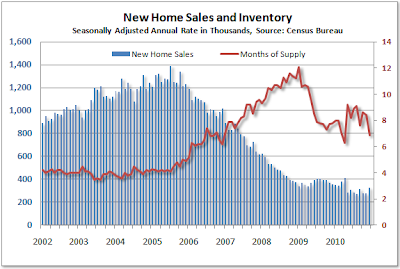
As shown above, new home sales are just a tiny fraction of what they were a few years ago, now running at about a third of the historical average as distressed property sales at much lower prices are expected to dampen demand for new homes for the foreseeable future.
This post was republished with permission from The Mess That Greenspan Made.
The Commerce Department reported(.pdf) that new home sales rose 17.5 percent in December, up from an annual rate of 280,000 in November to 329,000, but, the increase comes from near record low levels, meaning that, this surge doesn’t amount to much.

As shown above, new home sales are just a tiny fraction of what they were a few years ago, now running at about a third of the historical average as distressed property sales at much lower prices are expected to dampen demand for new homes for the foreseeable future.
This post was republished with permission from The Mess That Greenspan Made.
Wednesday, January 19, 2011
Housing Market Showing Another Sign Of Recovery, But Can We Believe This Time?
New building permits were up considerably last month - typically a sign of good things for the housing market. However, it feels like we have been down this path before at various points the last couple years. Can we truly believe that the recovery is in full swing? James Picerno from The Capital Spectator tackles this topic in the following post.
This article was republished with permission from The Capital Spectator.
The housing market has shown signs of recovery before, but to date it’s come to naught. Is there any reason to think that the latest rise in new building permits issued offers real hope this time? Unlikely, but the trend bears watching just the same.
New building permits ticked up sharply last month, the Census Bureau reports. The 16.7% rise in December is the highest monthly percentage increase in more than two years. Permits are considered a leading indicator that offers clues about the future. Permits, howver, aren’t a perfect measure of things to come. We’ve been here before, only to find disappointment. In June 2008, housing starts surged by nearly 19%. It turned out to be a statistical glitch, and the housing market resumed its descent in the months ahead.
But that was then. What’s changed since 2008? For one thing, the Great Recession isn’t raging as an all-out force of darkness. The blowback from the contraction still hobbles the housing market and other corners of the economy, but growth has a stronger footing, at least compared with 2008. Will that be enough to overcome the real estate’s markets various headwinds? Maybe, although it’s going to take a lot more digging to climb out of this hole. And even if permits have started to climb, that's only one statistic in an otherwise gloomy marketplace

As the chart above reminds, new housing starts continued to slump in December. In fact, starts continue to bounce around near all-time lows. This forward-looking measure of the housing market isn’t dead, but it’s still deep in slumber.
Some analysts say that housing is in the throes of an outright depression that will last for years. That’s probably going too far, but not by much. Nonetheless, the breadth of the headwinds in housing inspires the expectation that last month’s surge in newly issued permits is simply statistical noise rather than a sign of an impending turnaround.
“With sales still near record lows and a lot of unsold properties in the market, there’s very little reason for builders to add more homes to the supply,” Sal Guatieri, a senior economist at BMO Capital Markets, tells Bloomberg. “Housing remains a key downside risk to the economy.”
The challenge of housing is compounded by the still-weak growth in the labor market. Then again, compared with housing, it’s easier to be optimistic on the outlook for job creation. The Fed certainly is. According to the central bank’s Beige Book report released last week, “Labor markets appeared to be firming somewhat in most Districts, as some modest hiring beyond replacement was said to have occurred and/or was planned in a variety of sectors.”
Finding similarly optimistic observations for housing is quite a bit tougher these days, even after a five-year bear market in real estate. The best you can say with any confidence is that the housing correction appears to have stabilized, albeit at sharply lower levels compared with the pre-2006 era.
As for the upturn in permits, that’s encouraging, as far as it goes, but it’s going to take a lot more to convince the crowd that the housing market’s ready to grow again on a sustainable basis. Don’t hold your breath. With foreclosures still running high, job creation sluggish, and excess inventory keeping a lid on prices, this industry is still looking at a long, slow recovery—and that’s the optimistic view.
"We wouldn't be shocked to see home prices drop another 5% this year before starting to rebound," says Rick Sharga, a senior vice president at RealtyTrac via TheStreet.com. "Really, until you start to see the inventory levels start to become more manageable, it's going to be difficult to see the housing market come back appreciably."
This article was republished with permission from The Capital Spectator.
Subscribe to:
Posts (Atom)