Showing posts with label home sales. Show all posts

Wednesday, January 26, 2011

Recent New Home Sales Numbers Are Not As Great As They Seem

While recent new home sales numbers appear to be great, they really aren't as wonderful as everyone is making them out to be. As Tim Iacono points out in his blog post below, even with the huge increase in sales, we are still at near record lows - so there is a long way to go before we can talk about a real estate recovery. For more on this, continue reading Iacono's post...

The Commerce Department reported(.pdf) that new home sales rose 17.5 percent in December, up from an annual rate of 280,000 in November to 329,000, but, the increase comes from near record low levels, meaning that, this surge doesn’t amount to much.


As shown above, new home sales are just a tiny fraction of what they were a few years ago, now running at about a third of the historical average as distressed property sales at much lower prices are expected to dampen demand for new homes for the foreseeable future.

This post was republished with permission from The Mess That Greenspan Made.

Thursday, March 25, 2010

New Home Purchases Sink To Historic Lows

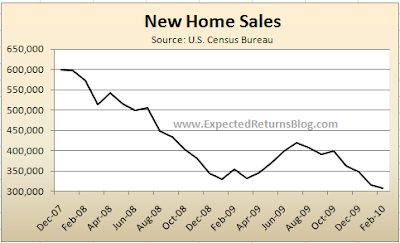
Commerce Department figures showed that new home sales in February fell to an all time low while inventory of homes-on-market posted its fourth straight month of increases. Although some sources placed the blame for this decline on severe winter weather, a more plausible explanation is that it was caused by 2009's severe job losses. See the following post by Moses Kim from Expected Returns.

"Green shoots" continue to bypass the housing sector, and the rest of the economy for that matter, as new home sales in America fall to a record low. From Bloomberg, Sales of New U.S. Homes Dropped to Lowest on Record:

Sales of new homes in the U.S. unexpectedly fell in February to a record low as blizzards, unemployment and foreclosures depressed the market.

Purchases decreased 2.2 percent to an annual pace of 308.000, figures from the Commerce Department showed today in Washington. The median sales price climbed by the most in more than two years.


The fall in new home sales was unexpected to only those who view the economy with rose-colored glasses. It is correct to blame the fall in new home sales on unemployment, but to blame it on blizzards is laughable. We lost over 4.1 million jobs in 2009, and it's a couple of blizzards that are putting pressure on housing? What a joke.

For your information, the 4.1 million jobs lost represents the largest number of job losses since the BLS started taking records in 1940. But with the combination of a dose of sophistry and some good old government spin, we have apparently pulled ourself out of this recession against all odds.

Supply Continues to Rise
The supply of homes at the current sales rate increased to 9.2 months’ worth, the highest since May, from 8.9 months in January.

Housing, the industry that triggered the worst recession in seven decades as the subprime mortgage market collapsed, showed signs of recovering in 2009 as an $8,000 first-time buyer tax credit boosted sales ahead of its originally scheduled expiration in November.

Extension of the credit for contracts signed by April and its expansion to include some current homeowners has failed to boost sales in recent months.

New-home purchases are considered a leading indicator because they are based on contract signings. Sales of previously owned homes, which make up the remainder, are compiled from closings and reflect contracts signed weeks or months earlier.

The weakness in new home sales will be reflected in weak existing home sale figures in the months ahead. Buyers aren't stepping in front of this train anymore. We need to see some inventory clearing, but inventories are now rising to levels from a year ago.

2010 will clearly be a year when housing comes under pressure once again. Let's not forget that the government is withdrawing from the direct purchase of MBS in a week. We should know very soon how mortgage rates react. In all probability, rates will rise significantly, which will deal a huge blow to the housing recovery that never was.

This article has been republished from Moses Kim's blog, Expected Returns.

Friday, March 5, 2010

Homes Sales Disappoint As Housing Stimulus Fades

The number of buyers placing homes under contract fell in January across the country due to what the media described as weather-related issues, obscuring the larger economic issues in place. As the economy continues to stutter without job creation and with the effect of government stimulus programs fading, the tight lending environment is preventing people from purchasing homes. See the following post from Expected Returns.

The short-lived economic "recovery" sure is running out of steam. I guess over $10 trillion dollars in in stimulus and pledges on behalf of taxpayers just doesn't buy what it used to. From Finance Yahoo, Pending home sales fall 7.6 percent in January:
The number of buyers who agreed to purchase a home fell sharply in January, a sign that demand for housing is sinking this winter as stormy weather slammed Eastern states.

Record snowstorms in January and February had many Americans shoveling sidewalks and driveways instead of combing through listings for open houses. Partly as result, seasonally adjusted index of sales agreements fell 7.6 percent from December to a January reading of 90.4, the National Association of Realtors said Thursday.

It was the lowest reading since last April and a disappointment to economists, who had expected it would rise to 97.6.

The weakness, however, was not confined to the wintry Northeast. The biggest month-to-month drop was in the West, where sales fell 13 percent. Sales fell almost 9 percent in the Northeast and Midwest and 2 percent in the South.
From the way the media spins things, you would think a couple of blizzards are doing more damage to our economy than decades of unsustainable debt accumulation. It's pretty comical, especially since the biggest month-to-month drop in home sales came in the West coast. But hey, let's not let facts get in the way.

The reason home sales are cratering is a matter of simple economics. The government merely shifted demand forward via its first-time homebuyer tax-credit, which provided a temporary boost to sales. There really is no free lunch- the tax-credit induced spike in demand must be balanced by weakness in demand in subsequent months.

Furthermore, without job creation, there can be no sustainable recovery in housing. Anyone who thinks otherwise is living in fantasy land.
The weather isn't the only culprit, wrote Jennifer Lee, an economist with BMOCapital Markets. "The impact of government incentives ... appears to be running out of steam, which is, frankly, a scary thought," she wrote.

The index is considered a barometer for future sales because typically there is a one- to two-month lag between a signed sales contract and a completed deal. A reading of 100 is equal to the average level of sales activity in 2001, when the index started.

The index has declined for two out of the past three months because home shoppers feel less rushed after a deadline for a homebuyer tax credit was extended from Nov. 30 to April 30.
Home shoppers aren't feeling "less rushed" because of the recent extension of the homebuyer tax credit- they're feeling "less rushed" because they're dead broke and have no access to credit. Please refer to the chart below, which shows real estate loans are contracting at an epic clip.


Notice how real estate loans stabilized and turned up in every single economic recovery since WWII. Apparently "this time is different" and the economy is magically recovering while access to credit is absolutely cratering. Sorry, but I'm not buying it.

This post has been republished from Moses Kim's blog, Expected Returns.