Showing posts with label consumer confidence. Show all posts

Thursday, November 15, 2012

Sandy Stalls Sales

The Commerce Department reported the first drop in consumer sales since June 2012 and analysts are blaming ‘Superstorm’ Sandy on the slip. The storm arrived at typically busy consumer period and auto sales in particular felt the brunt of the blow. Even so, insurance companies note that nearly 250,000 vehicles have been claimed as total losses, which automakers hope will boost sales in the near future. Meanwhile, REtail sales remained flat while gas station sales enjoyed a marginal 1.4% despite falling prices. For more on this continue reading the following article from Iacono Research. 

The Commerce Department reported(.pdf) that U.S. retail sales fell last month for the first time since June, down 0.3 percent in October following an upwardly revised gain of 1.3 percent in September, as Superstorm Sandy was cited as having both a positive and negative impact on the data.


Though the effects of the storm could not be isolated, it is believed that its arrival during the busy month-end period depressed East Coast auto sales leading to a decline of 1.5 percent in October auto sales nationally, this following a jump of 1.7 percent the month prior. Automakers said they expected lost sales to quickly be made up as nearly a quarter million vehicles were totaled during the storm.

Excluding autos, retail sales were flat last month after a gain of 1.2 percent in September as 8 of the 13 categories declined, paced by a surprising drop of 1.9 percent at home improvement stores. In the wake of the iPhone 5 launch the month before, electronic store sales fell 1.0 percent and nonstore retailers saw a drop of 1.8 percent. Gasoline station sales rose 1.4 percent even though pump prices fell throughout the month and food & beverage sales rose 0.8 percent, leading the advancing categories.

This blog post was republished with permission from Tim Iacono.

Tuesday, March 20, 2012

Stocks Up, Consumer Sentiment Down

Rising gas prices are having a negative impact on U.S. consumer sentiment, although projections suggest the feeling is temporary according to the Reuters/University of Michigan consumer sentiment index. The Energy Department noted prices edged up another $0.04 in the past week, keeping more money in the pump and leaving consumers with less to spend elsewhere. Meanwhile, improvements in the stock market have some wondering about inflation, including Federal Reserve chairman Ben Bernanke, despite gains being propped up by a strengthening labor market. For more on this continue reading the following article from Tim Iacono.

The Reuters/University of Michigan consumer sentiment index dipped from 75.3 in February to 74.3 in the first of two readings for March in a sign that rising gas prices may now be having in an impact on the mood of the consumer.

Based in large part on a recently improving labor market, the current conditions component remains firm, up from 83.0 to 84.2, however, the expectations component more than offset that gain, down from 70.3 to 68.0.

Consumer Sentiment

It’s a good think that equity markets don’t have a gas tank to fill every week or they too might think about pulling back but, so far, they show little sign of doing so, though that could soon change given that inflation expectations show signs of stirring to life.

Survey respondents ratcheted up their one-year outlook on consumer prices from an increase of 3.3 percent to 4.0 percent in a delayed reaction to rising pump prices that the Energy Department said gained another 4 cents over the last week, rising to a national average of $3.83 per gallon.

Five-year inflation expectations (the measure watched more closely by Fed economists) rose just one-tenth to 3.0 percent, indicating that, like Fed Chief Ben Bernanke, most Americans see rising gas prices as being temporary, a belief that, unlike Bernanke’s, could prove to be temporary itself.

This blog post was republished with permission from Tim Iacono.

Monday, December 12, 2011

Consumer Credit Trends Shifting

Tim Iacono reviews data compiled on EconomPicData that reveals American consumers are ratcheting down their use of credit cards, dropping toward 15% of personal income. Consumer debt has been rising for decades, but now it is being replaced by student loan debt, which has increased dramatically in the last 10 years to approach 5% of personal income. Iacono believes this will likely cause problems in the long term as getting an education begins to look less appealing and eventually impacts U.S. competitiveness in the global market. For more on this continue reading the following article from Tim Iacono.

From this item at Jake’s EconomPicData blog the other day comes the graphic below depicting dramatic changes in consumer credit trends over the years. Racking up revolving credit (e.g., credit cards) is not nearly as popular as it was for decades, what I’ve long called “the real Reagan Revolution” as individuals dramatically increased their use of credit cards to fuel consumption (i.e., buying things you don’t need with money you don’t have).


Consumer Credit

Taking up the slack for falling credit card balances are higher student loan balances that, already, are further separating the nation into have and have-nots (a.k.a. debt serfs) while making the whole idea of higher education less appealing when this is one the the things the country needs most to remain competitive with emerging economies in Asia.

This blog post was republished with permission from Tim Iacono.

Friday, September 23, 2011

Americans Losing Hope Economic Recovery

It is no secret that the U.S. public’s outlook on the economy has been suffering, but new Gallup polls indicate confidence is sinking even lower. One poll measuring sentiment from 2009 to 2011 shows that those who once believed the economy was getting better has fallen nearly 30%, while those who feel the economy is the same or worse has risen nearly 30% over two years. Another poll covering the same period indicates that fewer Republicans, Democrats and Independents feel the economy will get better “one year from now.” Moreover, the number of people who blame President Obama for the economic mess has risen 32% in the last two years. For more on this continue reading the following article from Tim Iacono.

It shouldn’t be too surprising to see the kind of polling data that Gallup has been reporting this week, given that, to many Americans, there never really was an economic recovery from the 2008 recession. From this survey published yesterday, it seems there is little optimism left out there as the hope that many had two years ago has faded.

Even more bad news for President Obama comes via this separate Gallup poll in which, for the first time ever, more than half the respondents blame him for the nation’s economic woes, up from 32 percent two years ago. Of course, 69 percent still blame former President George W. Bush, down from 80 percent in 2009, however, those trends are certainly not the friends of anyone in or near the White House.

This blog post was republished with permission from Tim Iacono.

Tuesday, August 16, 2011

Americans Display Little Economic Confidence

A new Gallup survey shows that Americans are not nearly as confident about the country’s economic outlook as politicians and pundits in Washington, D.C. like to think. The Economic Confidence Index indicates that, aside from people enjoying an energy industry boom in northern states and federal government dollars flowing in and around Virginia and Maryland, there is very little positive sentiment in the country. The majority of states display “average” to “below average” levels of confidence. For more on this continue reading the following article from Tim Iacono.


A new Gallup survey on how Americans see the economy is not likely to sit well with Iowa Republicans as the nation’s capital is acting as a “confidence vacuum” for the rest of the country. Though it’s hard to see in the graphic below, it seems Washington D.C. has been hoovering up whatever good mood was left in the rest of the country, it being the only region posting a positive number in the survey, far outdistancing the 50 states.

Times are also good in the northern energy boom states and there is a clear federal government spillover effect in Virgina and Maryland, but, other than that it’s pretty grim.

This blog post was republished with permission from Tim Iacono.

Wednesday, February 24, 2010

Confidence Among US Consumers Moves Lower

Even in the face of potential economic recovery, consumer confidence, a leading indicator, has continued to fall and has reached its lowest level in ten months, indicating that the double dip recession may be approaching. The cause of this continuing decline appears to be the ongoing lack of job creation in today's economy. See the following post from Economist's View.

So much for the economic recovery- consumer confidence is falling, and it's falling fast. As I've been expecting, consumer confidence is plunging, reflecting the inflection point we have likely reached in our economy. There is no doubt in my mind the double dip is coming. From Bloomberg, Consumer Confidence in U.S. Falls More Than Forecast:

Confidence among U.S. consumers fell more than anticipated in February to the lowest level since April 2009 as the outlook for jobs diminished, a sign spending may be slow to gain traction as the economy recovers.

The Conference Board’s confidence index declined to 46, exceeding the lowest forecast in a Bloomberg News survey of economists, from a revised 56.5 in January, a report from the New York-based private research group showed today. Concerns about the economy and the labor market pushed an index of current conditions to its lowest in 27 years.

The Consumer Confidence Index is a measure of consumer confidence based on responses to questions about the following:

  • Current business conditions
  • Business conditions for the next six months
  • Current employment conditions
  • Employment conditions for the next six months
  • Total family income for the next six months

The Consumer Confidence Index and the Expectations Index are leading indicators to the extent that perceptions shape future actions. With both indexes plunging to 10-month lows, there is every reason to believe the next few quarters will be weak on the consumer front. Remember: no consumer, no recovery.


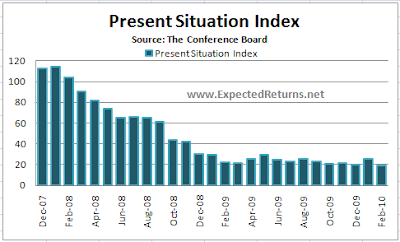
The following graph shows consumers' view of the present situation since the start of the recession. In February, the index fell to 19.4 from a January reading of 25.2. How anyone can claim we are in an economic recovery based on data points like these is beyond me. It is indeed axiomatic that if you repeat a lie enough times, it becomes accepted as truth. Many, including supposedly seasoned economists, are unwittingly being fooled by government lies about a clearly paradoxical "jobless recovery."


Jobs Still Scarce

The share of consumers who said jobs are plentiful fell to 3.6 percent from 4.4 percent, according to the Conference Board. The proportion of people who said jobs are hard to get increased to 47.7 percent from 46.5 percent.

The proportion of people who expect their incomes to increase over the next six months declined to 9.5 percent from 11 percent. The share expecting more jobs in the next six months fell to 13.4 percent from 15.8 percent.

I don't care how many jobs Obama randomly claims that he has saved, the fact remains that there are no jobs. Ask the average blind supporter of the "jobless recovery" theory about the last time we actually experienced one and they'll likely give you a blank stare. The blank stare is warranted, since the whole concept of a jobless recovery is a modern phenomenon that has no firm standing based on historical data.

Nearly every single data point shows the economy is in worse shape than it was at the onset of the recession. Get ready to hear the airwaves filled with news of an "unexpected" double-dip recession. As you all should know by now, I expect gold to explode as a result.

This post has been republished from Moses Kim's blog, Expected Returns.

Monday, November 23, 2009

Psychology's Role In Economic Recovery

Robert Shiller proposed an interesting argument in the NY Times in which he suggests that economic recovery can be attributed to the collective psychology of the crowd who expect the recession to end. However this goes against traditional economic thinking that puts little weight into consumer sentiment as a primary mover of the economy. See the following post from Economist's View.

Robert Shiller wonders if the recovery is based upon a self-fulfilling prophecy:

What if a Recovery Is All in Your Head?, by Robert J. Shiller, Commentary, NY Times: Beyond fiscal stimulus and government bailouts, the economic recovery that appears under way may be based on little more than self-fulfilling prophecy.

Consider this possibility: after all these months, people start to think it’s time for the recession to end. The very thought begins to renew confidence, and some people start spending again — in turn, generating visible signs of recovery. This may seem absurd, and is rarely mentioned... but economic theorists have long been fascinated by such a possibility.

The notion isn’t as farfetched as it may appear. As we all know, recessions generally last no more than a couple of years. The current recession ... is almost two years old. According to the standard schedule, we’re due for recovery. Given this knowledge, the mere passage of time may spur our confidence, though no formal statistical analysis can prove it.

Certainly, people did not always believe that there is a regular “business cycle” that starts and stops in a definite pattern. The idea began to spread in the popular consciousness in the 1920s and reached full bloom in the ’30s — with one major complication, the Great Depression... “Recession,” a kinder, gentler term, began to be used around the time of the 1937-38 contraction to refer to a normal downturn in the business cycle. ...

Recessions, as the term came to be used, implied timetables that mark their expected end. Uttering the word does not risk damaging confidence, at least not fundamentally. A diagnosis of a recession can be shrugged off as something from which you will recover... A depression came to be another matter entirely.

It wasn’t until 1948 that the Columbia University sociologist Robert K. Merton wrote an article ... titled “The Self-Fulfilling Prophecy,” using the Great Depression as his first example. He is often credited with having invented the “self-fulfilling prophesy” phrase...

In important ways, we are still using that 1930s pattern of thinking. We are instinctively fearful of reckless talk about depressions, and we try to support one another’s confidence. We like the idea that modern scientific economics seems to show that all recessions end in due course.

For now, our common efforts at building confidence appear to be working somewhat. But the economy has still not recovered, by any means. ...

The problem might be put this way: There is still a nagging doubt afloat that the current event is really just another example in that long sequence of recessions. In which mental category does the current contraction belong: recession or depression? We may still be at a tipping point. To the extent that the theory of the self-fulfilling prophecy is correct, there is a case for continued vigilance, to ensure that adverse events don’t encourage widespread talk of the second category.
Barry Ritholtz responds [Note: Updated version posted at Barry's request]:

How Overrated is Sentiment in Economics?, by Barry Ritholtz: There is a small cadre of Economists — original thinkers, contrarians, out of the box theorists — whom I respect a great deal. It is a modest list ranging from Richard Thaler to David Rosenberg to Robert Shiller, with lots of smart econ wonks in between.

This morning, however, I find myself somewhat disagreeing with one of the smarter of the economists, Professor Bob Shiller... Hence, it is with trepidation that I point out the flaws in Shiller’s discussion about the recovery, (titled “What if a Recovery Is All in Your Head?“). It is a thought provoking but unpersuasive argument... To be fair, he uses the column to incite a debate, rather than defend the position that the recovery is “mostly mental.”

I find numerous things worth challenging in the column... Let me offer 10 items..:


To read the rest of Barry's response, click here.

I find that I have a knee-jerk, negative reaction to explanations based upon mass psychology, sentiment, story-telling, and the like. I have to consciously force myself not to dismiss them. I'm not sure why that is, though it probably has something to do with a feeling that such explanations aren't scientific, and hence have no place in serious academic investigations. That is, prior to the crisis I thought that the real economy drove sentiment, and not the other way around. Sentiment could definitely provide a feedback loop that strengthens negative or positive economic shocks, but psychology was not the prime mover. Thus, sentiment changes that did not have evidence to support them would quickly die out before having much, if any effect.

But this crisis has caused me to reevaluate. I still find the Shiller-type animal spirits, psychology based explanations hard to swallow, but when the foundation supporting your beliefs is called into question (in this case modern macroeconomic models), it's important to open your mind and at least give alternative explanations a chance. That's particularly true when the person pushing the stories has a pretty darn good record of using them to warn of bubbles, as Shiller does. So I'm trying.

This post has been republished from Mark Thoma's blog, Economist's View.

Friday, September 11, 2009

Savings Rates Could Double or Triple

One of the reoccurring questions that keeps popping up is whether the recession has caused a long-term shift in American consumption patterns. Former Federal Reserve economist suggests that a $14 trillion loss in personal net worth and rising long-term costs like health care will lead to much higher savings rates. See the following post from The Street, to learn more.

Paul Ballew is a former Federal Reserve economist. He currently serves as senior vice president of Customer Insights & Analytics for Nationwide Mutual Insurance Co. in Columbus, Ohio. He has also worked as an executive for General Motors and J.D Power.

There's no arguing that the economy is beginning to recover. Green shoots are more numerous and the return to more normal conditions in financial markets is certainly comforting. So 12 months post-Lehman, it appears that there is light at the end of the tunnel.

However, the severe economic contraction was not just happenstance. The structural problems in the economy were substantial and some issues, like the de-leveraging of households, are still working themselves out. In addition, the policy environment complicates the situation and will, in all likelihood, place further restraint on the pace of the recovery and eventually the expansion.

Beyond the headlines about Wall Street and beyond the policy debate in Washington, substantial shifts in consumer behavior on Main Street are going to have the most significant impact on the direction of the economy over the next few years.

Everyone is speculating about how consumer consumption and saving will be altered by the events of the past 18 months. While weak labor markets are an issue for American households, an even more pressing concern involves the fundamental need to rebuild balance sheets under those same roofs in preparation for an uncertain future.

Conventional wisdom seems to conclude that we should expect a few quarters of higher savings and then a return to the pre-recession spend-and-borrow tendencies of the past decade or so. However, the need to rebuild personal savings and portfolios is no small matter. Households have seen their net worth decline by $14 trillion at a time when future obligations like long-term health-care costs continue to increase.

There is good reason to expect household savings rates will have to double, and maybe triple, to support the healing of consumer balance sheets. This process will take years, not months.

In hard numbers, it means going from saving roughly $150 billion a year to $400 billion to $500 billion a year. This assumes asset prices appreciate at a moderate pace over the next few years -- not something that is guaranteed given the pressures coming from Washington.

A shift of these proportions will not only impact the pace of the recovery, it also has implications on sectors of the economy.

Consumer-product companies are likely to face a more frugal consumer even as the recovery picks up speed. The recovery may not be the retail panacea some assume.

Additionally, the retirement-planning business may have never looked better. Now more than ever, there is a tremendous challenge and an opportunity for financial experts to help households navigate the waters and address their anxieties after a decade of underperformance.

And as we all know, Washington remains the most challenging wild card. Changes in tax and regulatory policy by Congress, high deficits absorbing higher personal savings, and future actions by the Fed are all question marks that may alter the operating environment.

We are on the front end of a recovery, but we shouldn't underestimate the depth of the recession's impact on consumer saving nor the consequences for the recovery.

This post has been republished from The Street, an investment news and analysis site.

Tuesday, June 16, 2009

Home Depot Raises Expectations As Consumer Confidence Grows

Home Depot raised profit expectations as consumer confidence continued to grow for the fourth straight month. Retail sales also exceeded expectations, which could mean that consumers are more optimistic about the economy. This could expedite economic recovery as consumers account for over two-thirds of US economic activity. For more, see the following post from our friends at Money Morning.

Are consumers’ happy days here again, or are the recent signs that growth in sales, confidence and an overall improvement in the economy just a mirage?

Confidence among U.S. consumers rose this month for a fourth straight time, according to the Reuters/University of Michigan (UM) preliminary index of consumer sentiment. The index increased to 69, which is less than what was forecast but still the highest level in nine months. May’s index was 68.7.

“Confidence is slowly but surely coming back,” James O’Sullivan, a senior economist at UBS Securities LLC told Bloomberg News. “In the next few months we should see more follow-through in the labor market, which in turn should give confidence a further boost, which in turn should lead to a sustained recovery in consumer spending.”

Another report from Investor’s Business Daily and TechnoMetrica Market Intelligence’s “Economic Optimism Index” shows consumer confidence rose to 50.8 this month from 48.6 in May. A figure above 50 indicates optimism, while one below 50 reflects pessimism.

“Consumer confidence is building on the momentum that it picked up in April, reflecting the strength we are seeing in the stock market," Raghavan Mayur, president of TechnoMetrica unit TIPP said in a Reuters interview. "Across the board, there is an optimistic feeling that the economy is recovering.”

The rise in consumer confidence is not just idle talk-consumers are backing it up at retail with their wallets.

Retail sales in May increased by 0.5% over April following four straight drops, according to a Commerce Department report released last week. Economists were anticipating a 0.2% gain, according to The Associated Press. The general merchandise, food stores and restaurant categories were the ones in the sector that posted significant gains.

Retailers like The Home Depot, Inc. (NYSE: HD) reflect consumers’ confidence and the increase in sales. The home improvement chain raised its forecast for the year, saying its profit would anywhere from flat to a 7% drop. It previously gave guidance that profits would be down 7%.

But the optimism should be tempered, as the “rules of engagement” will be different in the post-recession economy, according to Deloitte Strategic Advisor Richard Hyman.

Big financing promotions, which propelled a lot of consumer spending in the last 10 years, is all but gone now that credit is tighter, according to Hyman.

“Consumers were also able to spend more because of the easy availability of credit, most notably through mortgage equity withdrawal and they responded by buying more items,” Hyman said. “These conditions underpinned retail growth for the past 10 years but have now disappeared. However, it’s worse than that. They will clearly not return once the recession is over.”

The worst economic downfall has produced scars on the spending habits of consumers, and it’s likely that when the dust clears, most will demonstrate they have learned their lesson about reckless spending.

“This will produce polarization: needs-driven spending will gravitate towards retailers able to tick the most important consumer boxes like price and convenience,” said Hyman. “Although it will remain the engine of retail growth, wants-driven spend will slow and consumers will be much more choosy.”

This article has been reposted from Money Morning. You can view the article on Money Morning's investment news website here.

Wednesday, May 27, 2009

Consumer Confidence Shows Drastic Improvement

In past recessions consumers may have already started to rush back to the malls, but this time might be different. Instead of going back to the shopping centers, consumers may instead be sending their money to credit card companies to pay back their high levels of debt. So what should we make of consumer confidence increasing the most in six years? Tim Iacono from The Mess That Greenspan Made explains why a sudden improvement in consumer confidence may not be as significant as it first appears.

Reuters reports on the sharpest increase in U.S. consumer confidence in more than six years. But, don't get overly excited (like the stock market currently is), the American shopper is still quite depressed by historical measure.

The Conference Board, an industry group, said on Tuesday its index of consumer attitudes jumped to 54.9 in May from a revised 40.8 in April, the biggest one-month jump since April 2003. Economists had been looking for a much smaller rise to 42.0.

Fewer Americans said jobs were "hard to get," the survey found, with that measure slipping to 44.7 percent from 46.6 percent. Those saying jobs were plentiful climbed to a still meager 5.7 percent, but that was still higher than April's 4.9 percent.

"Consumers are considerably less pessimistic than they were earlier this year," said Lynn Franco, director of The Conference Board's Consumer Research Center.

Once again, less bad is the new good, the "considerably less pessimistic" assessment being cause for some to get out the bubbly and celebrate, at least for a little while.

More details...

The survey offered mixed messages regarding Americans' propensity to spend money. The proportion of those who said they planned on buying a car over the next six months rose to 5.5 percent, its highest in at least a year.

But fewer intended to buy homes -- only 2.3 percent, a tough break for one of the hardest hit sectors in the country's economic crisis. A separate report on Tuesday revealed U.S. home prices dropped 18.7 percent in March compared to a year earlier.


Here's a graphic from the Wall Street Journal showing how the expectations index has surged past the present conditions index in a manner similar to the 2003 bottom. Since confidence had sunk to such historic lows in recent months, like many other economic indicators, comparing recent developments to patterns seen in previous recessions may not provide all that much relevant insight.

This post can also be viewed on themessthatgreenspanmade.blogspot.com.