Thursday, September 30, 2010

The Fed May Introduce A $1 Trillion Treasury Purchase Program

Jeff Kleintop writes in The Street that The Federal Reserve has indicated that inflation is too low which suggests that it will likely take action to reflate the economy. In order to prevent deflation the Fed would likely pursue a strategy to increase the money supply and may introduce a $1 trillion Treasury purchase program at its next meeting, on Nov. 3. See the following article from The Street.

Last week, the official recession-dating committee, the National Bureau of Economic Research, announced that the recession was officially over in June of 2009. This was not surprising to most market participants.

In fact, the LPL Financial Current Conditions Index reflected at that time a move from contraction to growth. However, the question today that most investors want to see addressed is: Will the economy slip back into recession? On that note, the Federal Reserve's message last week implied the Fed was preparing to take action to help ensure the economy avoids a return to recession.

In a surprisingly transparent statement made last week, the Fed told us that inflation is so low it is not doing enough to promote growth. Specifically, the Fed's stated: "Measures of underlying inflation are currently at levels somewhat below those the Committee judges most consistent, over the longer run, with its mandate to promote maximum employment and price stability."

The Fed balances employment and prices by seeking growth that generates the highest level of employment without causing too much price inflation. The Fed has spent much of the past 30 years determining when to attempt to slow down an economy that is growing too rapidly in order to avoid the destructive effects of high inflation. However, when inflation gets too low, as the Fed has noted, it is a sign that growth needs a boost.

The Fed typically acts as a counterweight to Congress' inflationary spending impulses. But the Fed has communicated its view that inflation is too low. With Congress unlikely to pass another substantial spending package, the Fed is likely to take action.

Deflation Defined


If inflation is a bad thing, then how can inflation be too low?

Inflation results when too much money is chasing too few goods and services. This results in higher prices and usually happens when demand is strong but output is constrained in the form of shortages of materials or capacity. Deflation, or falling prices, is the opposite of inflation and generally occurs when the supply of goods rises faster than the supply of money.

The problem with deflation is that when prices fall as output exceeds demand it can become self-perpetuating as consumers and businesses postpone spending because they believe prices will fall further. Consumers and businesses delay buying expensive items like homes or cars because they believe these things will be cheaper in the future. As a result, spending and economic growth slows. But it does not stop there.

Businesses profits weaken straining their ability to pay their debts and leading them to cut production and workers. This, in turn, results in lower demand for goods which leads to even lower prices and so on as a destructive downward spiral takes root.

From Deflation to Reflation


To combat fears of a downward spiral of deflation the Fed is preparing a reflation strategy. Typically, the Fed lowers the cost of money, or interest rates, when it wants to promote growth. But with the Fed having already lowered rates effectively to zero, it intends to increase the supply of money by buying bonds in the market.

The Fed will likely be engaging in quantitative easing. That means it will expand the supply of money in the financial system in an effort to encourage lending and economic growth. This can counter deflationary fears by directly inflating the money supply. All else equal, this means that with more dollars in the system, the value of the dollar goes down and prices in dollar terms go up, resulting in a faster pace of inflation.

The Fed took a small step in the direction of providing more stimulus at its Aug. 10 meeting when it committed to increasing the quantity of money in the financial system by purchasing Treasuries as the housing debt the Fed holds matures.

Last week, at its Sept. 21 meeting, the Fed paved the way for another much larger quantitative easing at an upcoming meeting later this year. The Fed may introduce a $1 trillion Treasury purchase program at its next meeting, on Nov. 3.

Investing for Reflation

Incorporating the theme of reflation into your portfolio may be beneficial. Key positive effects of reflation are likely to be seen in precious metals, commodities, commodity-sensitive stocks, emerging markets, real estate and Treasuries. The dollar and the financial sector may be negatively impacted.

Precious metals: Gold may be the most obvious beneficiary of the Fed's intentions. Inflation and a falling dollar tend to lift gold investment demand as a way to preserve value. Gold prices made new all-time highs last week. This trend can continue as the dollar falls and inflation picks up.

Commodities: Commodity prices, including those of cotton, copper, and corn, just to name a few, may also benefit from the outlook for reflation and dollar depreciation. The potency of the reflation theme as it related to commodities can be seen in crude oil. Crude prices were up on the week despite the report of near record-breaking U.S. inventories.

Commodity-sensitive stocks: The Fed's intention to avoid a return to recession and the potential for another liquidity-fueled rally like that of 2009 argue in favor of stock market performance.

On the other hand, the effectiveness of the Fed's actions remains to be seen with liquidity already abundant in the financial system the inflationary consequences seem more assured than better growth prospects. Stocks gained 1% for the week following the Fed's announcement.

However, stocks generally slumped shortly after the Fed's announcement on Tuesday. The gains came on Friday as stronger-than-expected data on business spending were released. Not surprisingly, the commodity-driven Materials and Energy sectors outperformed the S&P 500.

Emerging Markets: If the dollar weakens, gains in investments denominated in foreign currencies translate into more dollars, boosting possible returns. Emerging Market stocks and bonds benefit from appreciating currencies relative to the dollar and the increasing value of their commodity-based output.

High-Yield bonds: High-yield bonds may benefit as yield hungry investors are forced to take on more credit risk to maintain yields.

Real estate: Reflation benefits real estate because property prices may rise. But to really boost Real Estate Investment Trust (REIT) performance, reflation must be successful and generate better U.S. economic growth and employment, which is less assured than the inflation consequences.

Treasuries: Purchasing Treasuries will be the primary way the Fed implements Operation Reflation. The price of the 10-year Treasury note rallied, pushing down the yield 10 basis points since the announcement by the Fed last week.

However, while there may be additional short-term gains for Treasuries, longer-term inflation risks are increasing as well. This risk is evident in the nearly record-breaking spread between 10- and 30-year Treasury bond yields at about 1.2 percentage points.

The better economic data reported in September have pushed prices down and the yield up on the 10-year Treasury by 14 basis points this month while the more inflation-sensitive, longer-term 30-year Treasury yields have increased 28 basis points. Direct beneficiaries of reflation are TIPS, or Treasury Inflation-Protected Securities. The principal of TIPS increases with inflation.


Dollar: The Fed's intentions are weighing on the greenback. As the Fed increases the quantity of dollars in the financial system the value of the dollar is likely to fall. The Fed's statement drove the dollar to its lowest level in nearly eight months. The dollar even strengthened against the euro despite news of deteriorating European economic growth and spiking Irish and Portuguese bond yields on rising default concerns.

Even more impressively, the move in the dollar eroded nearly all of the start of a downtrend in the yen versus the dollar that the Bank of Japan took great efforts to create in the week before the Fed meeting. A falling dollar and rising inflation puts pressure on cash as a long-term holding.

Financial stocks: Bank stocks may be negatively affected by the Fed's intentions. If five- to 10-year Treasury yields move lower on Fed buying, the profit margin banks earn by borrowing short-term and lending longer-term narrows, crimping profits.

On the other hand, investment banks may benefit from the additional credit to fuel profitable merger and acquisition deals and more bond underwriting as businesses look to refinance at lower rates. Nevertheless, since the Fed announcement, financials have been the worst performing sector.

Longer-Term Impact

While the near-term impacts of Operation Reflation are reasonably clear, the longer-term effects are not. Unlike during the financial crisis when liquidity was scarce, the benefits of adding more cash into the financial system on growth and employment may be very limited in the current environment given the already high cash balances at banks and corporations.

In addition, U.S. stimulus cash may wind up fueling emerging market-growth as U.S. companies deploy the cheap cash to fuel growth in markets with lower labor costs and stronger demand. The Fed also risks undermining the lower interest rates that are essential to growth by devaluing the dollar, making U.S. Treasury bonds less attractive to the foreign investors that we are increasingly dependent upon to fund our national debt.

We are cautious on the longer-term economic growth impact of another round of stimulus. However, we do not believe a return to recession is the most likely outcome and believe that the economy will muddle through with below-average growth in the coming quarters.

In the near-term, Operation Reflation provides us with an investment theme. And lastly, though we expect near-term weakness in the stock market, the timing of the mid-term elections on Nov. 2 and the Fed's next meeting on Nov. 3 could help to fuel a year-end rally for stocks.

This article by Jeff Kleintop has been republished from The Street, an investment news and analysis site.

Preparing Your Portfolio For A Declining Dollar

Professor Simon Johnson from MIT expects the dollar to trend lower due to several reasons including the likelihood of emerging nations diversifying their reserves away from the dollar. With signs pointing to a declining dollar, James Picerno advises that US investors would be prudent to hold some non-dollar allocations in their portfolios. See the following post from The Capital Spectator.

"Like it or not, significant dollar depreciation is more probable than most now suppose," writes Simon Johnson, a professor at MIT’s Sloan School of Management, in a Bloomberg column today. The market seems to be discounting no less. Certainly the gold market is roaring higher in part because the odds that the dollar will fall in the months (years?) ahead look quite a bit better than even.

Johnson, co-author of 13 Bankers: The Wall Street Takeover and the Next Financial Meltdown, sees three reasons why the dollar will trend lower: 1) worries over political gridlock in Washington as the country grapples with a huge budget deficit; 2) sluggish U.S. economic growth, which will compel the Fed to focus on lowering long-term interest rates, a.k.a., a new round of quantitative easing; and 3) the growing appetite of emerging market nations to diversify their large and growing foreign exchange reserves into currencies other than the greenback. "The dollar is, therefore, likely to depreciate against all floating currencies," Johnson predicts.

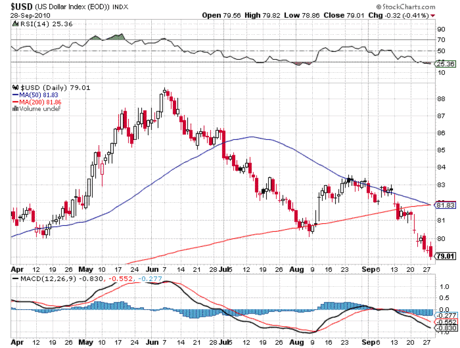
That's hardly a radical idea these days, considering that the buck has been more or less weakening since June, as the chart below shows. The previous rebound in the dollar that prevailed in the first half of this year now appears to be over. One reason is because of an increased appetite for risk in the global economy in recent months. When macro anxiety rises, liquidity tends to gravitate into dollars, the world's reserve currency. But as investors and governments have become convinced recently that the economic challenges aren't quite so acute, particularly outside of the developed economies, the appeal of non-dollar assets and currencies has taken flight once more.


"The safe bet is to keep selling the dollar, especially given reasonably supportive data from the euro," Peter Frank, currency analyst at Societe Generale, tells Reuters today.

Safe? Well, that's going too far. But certainly it's prudent for U.S. investors to hold some amount of non-dollar allocations in their portfolios. There are several options, including broad commodity funds. Commodities, which are generally priced in dollars, tend to move in the opposite direction of the buck. Two of the more popular exchange traded products in this corner: iShares S&P GSCI Commodity-Indexed Trust (GSG) and iPath DJ-UBS Commodity Index TR ETN (DJP). The underlying index designs are energy heavy, however. For a lesser emphasis on oil and gas, take a look at ELEMENTS Rogers Intl Commodity ETN (RJI) and GreenHaven Continuous Commodity Index (GCC).

Gold in particular is the leading commodity alternative to the dollar. The world generally sees the precious metal as the antidote to Washington's fiat currency, which is why the pair generally share a negative correlation. Two leading gold ETFs: SPDR Gold Shares (GLD) and iShares COMEX Gold Trust (IAU).

Foreign stocks and bonds priced in local currencies are another option, although each must be analyzed in concert with the underlying fundamentals of their respective markets along with the forex outlook. Although most non-U.S. stock ETFs and mutual funds don't hedge forex, foreign currency exposure is a bit tougher to find in foreign bond products. Harder, but not impossible. A small but growing list includes SPDR Barclays Capital International Treasury Bond (BWX) and iShares S&P/Citigroup Int'l Treasury Bond (IGOV) Meanwhile, consider too the first local currency emerging market bond ETF: Van Eck Market Vectors Emerging Markets (EMLC). Keep in mind that the forex factor tends to be much larger for bonds vs. stocks. Why? Bonds generally have a relatively low expected return vs. equities, which means that the forex factor can easily overwhelm the risk/return profile for foreign bond portfolios.

If you can stomach the volatility and have a taste for speculation, there's also a wide choice of foreign currency ETFs to capitalize on a weakening dollar, ranging from the PowerShares DB US Dollar Index Bearish (UDN), which is primarily a euro and yen play, to the emerging-market focused choices (WisdomTree Dreyfus Emerging Currency Fund (CEW) as well as individual country targets (WisdomTree Dreyfus Brazilian Real Fund (BZF) and WisdomTree Dreyfus Chinese Yuan Fund (CYB).

Investing in currencies comes with a high risk, of course, and so it's not for the faint of heart. Caveat emptor.

But even if you're a conservative investor with a long-term outlook, and your portfolio is missing equity and/or bond allocations denominated in foreign currencies, it's time to rethink what amounts to a huge bet in favor of everything going well in the U.S. I wouldn't discount the possibility, but neither would I bet the farm on that scenario either.

This post has been republished from James Picerno's blog, The Capital Spectator.

Wednesday, September 29, 2010

Is $1300 Gold Leading Up To A Collapse In Confidence?

Moses Kim, author of Expected Returns, says that the record gold price is being driven by a collapse in confidence. He predicts major public participation in the gold market which could send prices to between $2,000-$3,000 an ounce. See the following post from Expected Returns.

The annals of history are littered with examples of collapsing confidence sending the public flocking to gold. A collapsing currency is actually the norm in history. I think back to the Romans and how rising levels of expenditures and taxation led to a debasement of the currency and an utter collapse in confidence. I think back to John Law in France, whose moronic exploits as a central banker are rivaled by only Helicopter Ben Bernanke. I consider the Argentinian experience where collapsing confidence was directly correlated with currency collapse. This is not my imagination- these are events that have been recorded in history. Believe me, history is being made as we speak.

To preempt a truly drastic crash in the dollar, there will probably be a new global currency arrangement. The same geniuses who didn’t see what was coming in the first place are going to gain power. The public is going to be confused, and their frantic actions will give the term volatility a new meaning. These are the type of events you have to be prepared for mentally; you will not be able to react accordingly if you are taken by surprise.

Sometimes even I have to splash some cold water on my face and ask myself: Is this really happening? Are our leaders really as moronic as I thought? Is the bond market really on the verge of cracking? Did the government really implement a tax on gold transactions because they foresee a move out of the dollar? Is President Obama really as unpopular as I predicted in the midst of the madness over “hope and change”, reflecting the collapse in public confidence that is, in fact, unstoppable? The answer to all these questions is yes.

There is no doubt in my mind that gold should be trading at $2,000-$3,000. You can bet that a move to these levels will affect all of our lives. The government is going to be increasingly desperate because their coffers are running dry. Higher levels of taxation in all forms will force people to avoid paying taxes like our good friend Timothy Geithner. Trust me, governments are pretty stupid: they don’t realize that onerous levels of taxation will simply create a move into tangible assets and a trend towards tax evasion. They will learn this lesson the hard way in the years ahead. In the meantime, gold is going to fly.

The move today in gold is being driven by a collapse in confidence. You are witnessing a subtle move out of the dollar, which I have been warning you about. There is incessant talk about how the dollar is the prettiest pig in the trough. This is complete and utter nonsense. If this were true, gold would not be trading above $1300. The dollar would not be down 10% in the past couple of months. The facts are starting to appear in the light of day.

There is going to be major public participation in the gold market. It will only take about 10% of the population buying gold for some major monster moves to occur. At $1300, the veil of ignorance should have already removed from everyone’s eyes. Surprisingly, ignorance persists. Hence I will be buying the next pullback in a big way. There is nothing stopping gold from going where it needs to go. Events are converging perfectly. Confidence is on the verge of collapsing. Epic feedback loops are about to develop. The time for conjecture and forecasts is over. It is just time folks.

This post has been republished from Moses Kim's blog, Expected Returns.

Is The US Government Fueling Record Gold Prices?

Peter Morici, writing in The Street, says that diplomacy with China on trade issues has not worked and is leading to a growing trade deficit that is hurting the economy. Add to that the flood of dollars and Treasuries by the US government, and it is not surprising that gold prices have surged to record high levels. See the following post from The Street.

Gold trades around $1,300 an ounce for good reason. The Obama administration has flooded the world with greenbacks and Treasuries, global investors have little confidence in the management of the U.S. economy, and investors have taken refuge in gold.

Since President Obama took the helm, the U.S. trade deficit has increased 60%. At more than 3% of gross domestic product, the deficit drains off more demand for U.S.-made goods and services than the president's stimulus spending has added.

America's chronic trade imbalances stem from dysfunctional energy policies imposed by Democrats in Congress, and continuing tolerance for Chinese mercantilism. As the U.S. economy recovers, oil and Chinese consumer imports rise, choking the expansion. That's why demand and economic recovery are flagging, stocks can't sustain momentum, and industry won't invest or add jobs.

Democrats in Congress insist on energy policies that limit domestic oil and gas production, and rely on higher prices that instigate conservation. Those have failed to stem dependence on imported oil, the outflow of dollars, and the chokehold Middle East investors, and now China, have attained in global capital markets and on U.S. government finances.

Cheap imports from China have chased millions of Americans from manufacturing jobs, as the U.S. purchases from the Middle Kingdom exceed sales there by more than 4:1. The trade deficit with China is about $300 billion and continues growing year after year.

China has engineered this competitive conquest by keeping its yuan artificially inexpensive against the dollar and euro. It sells annually at deep discount about $450 billion worth of yuan for dollars, euro and other currencies in foreign exchange markets. That provides a 35% subsidy on Chinese exports and keeps Chinese goods deceptively cheap on U.S. store shelves.

The Bush and Obama administrations have sought changes in China's currency policies through diplomacy but have failed, and will continue failing as long as the rhetoric of appeasement and restraint from self-help are the cornerstones of American policy.

Instead of advocating strong U.S. action against Chinese mercantilism, the U.S. Treasury has tarred as protectionist those who propose substantive American responses.

The huge trade deficit must be financed by attracting foreign investment in new productive assets in the United States or by printing IOUs. Investments have only provided a small portion of the necessary cash so each year the United States sells currency, bank deposits, Treasury securities, bonds, and the like to foreigners. Those claims on the U.S. economy now are about $7 trillion.

That floods world financial markets with U.S. dollars and paper assets that function much like U.S. dollars -- what economists call liquidity. All that evokes an iron law of the universe: If a government prints too much money, it won't have any value.

Add federal budget deficits exceeding $1 trillion a year for several years to come, and an economy that can't produce enough to sustain Obama's appetite to tax and spend, and investors are simply smart to short the dollar by loading up on gold.

That's why gold is at $1,300 an ounce!

This article by Peter Morici has been republished from The Street.

Tuesday, September 28, 2010

Soros Versus Buffett: Who Is The Better Investor?

Warren Buffett and George Soros are among the greatest investors of all time, but who is better? According to Nassim Taleb, Soros's performance required more skill, however James Picerno says that it is difficult to know this without a reliable beta for Soros's investments. See the following post from The Capital Spectator.

Who has more talent for minting alpha? Warren Buffett or George Soros? Nassim Taleb, author of The Black Swan, thinks Soros has the edge.

“I am not saying Buffett isn’t as good as Soros,” Taleb explained at a conference last week, according to Bloomberg News. “I am saying that the probability Soros’s returns come from randomness is much smaller because he did almost everything: he bought currencies, he sold currencies, he did arbitrages. He made a lot more decisions. Buffett followed a strategy to buy companies that had a certain earnings profile, and it worked for him. There is a lot more luck involved in this strategy.”

Perhaps, although it's easier to analyze Buffett's historical results and decide if he truly added value. But before we get into that, I think Taleb raises an interesting point about beta and alpha. In particular, it's important to think about those risk premiums that are available for the taking vs. those that can be earned only through hard work. In other words, there’s a distinction between investment returns that anyone can earn vs. those that require talent. Every investor (and institution) should carefully think through these concepts before investing real money. In other words, your expectations matter.

The good news is that beta vs. alpha is a rather simple notion, although the details can get messy. Indeed, the word “beta” gets thrown around a lot, but it has a very specific meaning. The short definition: beta is the market’s return and risk profile. Anyone can tap beta. It's a commodity, and so you don't want to overpay. Mathematically, the calculation is straightforward, as any good finance book will explain, such as The Portable MBA in Finance and Accounting. Beta is computed as the covariance between a security and its relevant market, divided by the variance of that market. You can also analyze an asset class—U.S. stocks, for instance—and compare it with the multi-asset class “market” portfolio, as I do with the Global Market Index. If you have the price histories on the security (or asset class) and the market, you can easily calculate beta by dumping the data into Excel.

Another way to think of beta is that it’s a measure of a security’s (or asset class’s) sensitivity to the broad market. In that sense, beta is one of many risk measures. Forecasting returns directly is difficult, perhaps impossible. Estimating risk, by contrast, is somewhat easier, or at least modestly more reliable. We know, for example, that stocks are riskier than Treasuries. Exactly how much more risk we're talking about is debatable, but as a general proposition there’s a fair degree of confidence in that assumption. In turn, we can infer expected return via risk assumptions. But that raises the question: How reliable is beta as a risk measure? Or any risk measure, for that matter. They're all flawed, usually in different ways, and so we need to look at several. But back to beta.

Standard finance theory advises that higher (lower) betas are associated with higher (lower) returns. Technically, this is an ex ante framework. In other words, betas should be used to reverse engineer expected returns. But as critics have been pointing out for years (decades!), historical analysis of beta and return—the ex post perspective—don’t always measure up. Beta, in sum, doesn’t fully explain the relationship between risk and return.

A widely cited example is the small-cap and value effect. Stocks with relatively slight capitalizations and/or companies trading at discounts to book value generate substantially higher returns vs. the forecasts via beta. Does this mean that beta is worthless? No, but it reminds that a simplified view of asset pricing doesn’t fully capture all that’s going on, especially over the short-to-medium run.

In fact, a true reading of how the markets price securities reveals a bevy of betas. Instead of one all-controlling market beta, as per the capital asset pricing model, there’s a rainbow of lesser betas running the show. Small cap and value betas are merely the tip of the iceberg. Financial economists have turned up a broad list of factors, including momentum, liquidity, volatility, and others. And they're finding more all the time. It’s debatable how much real-world opportunity is associated with the full compliment of known factors. After adjusting for taxes and trading costs, some if not most of the factors that look productive on paper become a return drag.

There’s also a capacity issue. If too many investors chase small value stocks, the associated risk premium will fade. That opens the door to wondering if, in the very long run, all the various lesser betas end up being a wash relative to the big-picture market beta that standard finance theory focuses on?

Even in the short run, assume that minting alpha (anything other than beta), is hard. Buffett seems to have beaten the odds. Ditto for Soros, who also boasts an impressive track record, at least in the days when he was managing money. What of Taleb’s suggestion that Soros has more talent? Or that there's less randomness involved in Soros's track record? There’s some theoretical support for that view, based on the fundamental law of active management, as outlined in Grinold and Kahn’s book Active Portfolio Management: A Quantitative Approach for Producing Superior Returns and Controlling Risk. This law states that beating the benchmark (beta) depends on forecasting skill and the number of independent investment decisions you deploy. It’s all about skill and opportunity.

If you have a relatively lesser degree of skill, you can pick up the slack by making more bets. That can backfire, of course. But all things equal, if you’re trying to beat another active manager who’s smarter than you, your only hope is to make more bets. By contrast, if you’re smarter, you don’t need to make as many bets.

Consider an extreme example with two investors. One is average in terms of investment skill; the other's a genius. Now imagine two separate events that pit one against the other. In the first round, only one investment decision for each is allowed. In that case, we should expect that the genius has a huge advantage. In the second round, each investor can make 100 investment decisions. The genius probably still has an edge, but it's not as striking as it was before.

Meantime, it’s still hard to say for sure if Soros is truly the better investor. Yes, Buffett has piggybacked somewhat on equity beta’s run. Berkshire Hathaway, Buffett’s company, owns a portfolio of U.S. stocks, among other businesses. It’s hardly surprising the equity beta is embedded in Berkshire’s returns to a degree. But if you’re choosing stocks based on a methodology that looks for underpriced securities, as Buffett has clearly done at times, you can do well relative to beta. How well? For the past 15 years, Berkshire's shares have generated a roughly 10% annualized total return, according to Morningstar. That’s a tidy premium over the S&P 500’s 6.5% total return over that span. That's one clue that Buffett's adding value.

Soros hasn’t been involved in managing money in recent years, at least not in anything with publicly reported results, and so we can’t compare his performance to Buffett’s over the last 15 years. Even if we did have good numbers, it wouldn’t be clear if Soros was truly adding value (or not) compared with Buffett. Why? Because if Soros was trading currencies, commodities, stocks, bonds via long and short positions, perhaps adding leverage at times, it’s unclear what the benchmark should be. We don’t know what the relevant beta is.

We could label Soros as a global macro trader, of course, as many have over the years. That implies that we can compare Soros to a global macro benchmark, of which there are several available from the various index vendors. But that raises a host of new questions because there’s lots of moving parts in the design of hedge fund benchmarks vs. a cap-weighted equity index. How, for example, do you account for short positions and leverage? Or survivorship bias? There are no easy answers, and since small changes in assumptions can have big results, there are no reliable passive macro benchmarks that are the equivalent of the S&P 500, Russell 3000, etc. Measuring long-only equity beta is easy. Tally up the companies, weight them by their respective market values, and you're done.

Hedge fund betas, by contrast, are complicated. Yes, some are easier to define vs. others. But global macro isn’t one of them. If you had to define global macro as a rules-based investing process, you’d have a rough time. Among the dozen or so broad hedge fund styles, global macro is wide open to interpretation.

By contrast, there’s a hefty amount of small-cap and value risk premia available in beta form, i.e., index funds and ETFs targeting this area. Not surprisingly, those products do pretty good. You can capture a big part of the small-cap value factor by owning index funds.

Can you do the same with global macro? Maybe, but it’s complicated. So too is deciding if Soros added more value for a given unit of risk relative to Buffett. The problem is that there’s a good benchmark for comparing Berkshire’s performance and risk: the U.S. stock market. Or maybe we should upgrade that to a global measure of equities. Or add a value tilt. Soros, however, is another matter. What’s his benchmark? We don’t really know. Therein lies the allure and the hazards of global macro, and hedge funds generally. Quoting a high return is one thing. But if you can’t calculate the risk-adjusted return, you may be flying blind.

Then again, if you have a high degree of confidence that your manager is truly talented, faith is enough. But for some of us, faith isn't enough. Sure, you can engage in qualitative analysis--i.e., poring over the fund's trading history, talking to its managers, looking over its offices. But most investors aren't going to do that.

That leaves quantitative analysis. Granted, sometimes it's no help at all, depending on what you're trying to analyze. But it's the only game in town if faith isn't enough and you're not willing or able to spend a week at prospective manager's shop.

As for beta, there are limits here too. But in those cases where beta does a pretty good job of explaining risk and return (the major asset classes), and you can buy a proxy fund inexpensively, this is usually the superior choice on a work-adjusted basis.

This post has been republished from James Picerno's blog, The Capital Spectator.

Long-Term Charts Suggests That Silver Has Room To Grow

Jeff Nielson writing in The Street discusses what the long-term silver charts can teach us about where silver prices may go in the future. Keeping in mind the inherent flaws in technical analysis, the charts suggest that silver could go significantly higher. See the following post from The Street.

Regular readers will know that I shun short-term charts and "technical analysis." Such tools carry a low degree of reliability, since they are built upon numerous false assumptions (beginning with "free and open markets" and "perfect information"). I submit to readers that markets have never been less free and open, and information has never been so far from perfect.

Long-term charts, on the other hand, are an entirely different matter. The much, much higher level of reliability which is provided by a longer time horizon is a powerful compensating force vs. the margin of error caused from using flawed assumptions. Relying upon superior tools inevitably means greater clarity when analyzing any particular market.

In the case of silver, when we begin looking at longer-term charts, there are a few obvious facts which leap out at viewers, and some which are perhaps not so obvious. To begin with, unlike almost any other market, silver never goes sideways. It is either moving strongly upward, or strongly downward -- reflecting the "struggle" between market-rigging bankers looking to keep silver grossly under-valued, and the even more powerful force of supply-and-demand.


While such fundamentals can be temporarily negated through artificial intervention in markets, over any longer time horizon, such manipulation must fail as a simple matter of arithmetic.

Price any good too high, and eventually demand will collapse to a level which forces the price down toward its natural equilibrium. Under-price any good, and demand will relentlessly devour supply -- until the imbalance crushes anything and everything seeking to suppress that price.

Sadly, few bankers have any understanding of statistics and only a glimmer of understanding when it comes to supply and demand. They chuckle to themselves when their own relentless, brute-force manipulations give them short-term victories in driving the price of silver (and gold) to some ridiculous level -- totally failing to understand that the more they succeed over the short-term in these minor "battles" the sooner and more-total will be their defeat in the "war," since they are fueling demand while simultaneously obliterating supply.


Getting back to the charts, we see that this endless power-struggle has resulted in perhaps the most-jagged chart one will ever see with respect to a major commodity. However, if we look a little closer, we see that occasionally this very jagged line smooths out - and when it does, it means that silver is heading straight up or straight down.


By itself, this observation is not tremendously helpful, as we only know that silver has made a "smooth move" after some leap higher or lower, with no guidance as to whether any particular strong move will continue. What is more helpful is to note the striking similarity between two, major trends - which are visible when looking at the eight-year chart for silver.

Silver hit a short-term "top" in May 2006, at approximately $15/oz. It then proceeded to pull back all the way to about $10/oz -- a 33% retreat. From that bottom in July of 2006, it then proceeded to enter a very choppy period of consolidation between that time and January 2008 before making a near-vertical -- and smooth -- ascent to $21/oz in March 2008. The total gain from the July/06 trough to the medium-term peak in March/08 was roughly 110%. The last, vertical move from January/08 (at roughly $14/oz to $21/oz) was a 50% move.

From that peak in March of 2008, silver plunged to an even more dramatic bottom of $9/oz, in October of 2008. This collapse of nearly 60% was roughly twice as large in size, and nearly four times as long in duration, compared to the plunge in May 2006. Again looking at the eight-year chart, we see the build-up to the dramatic spike in silver in January of 2008 (and the smooth-ride to $21) looks very similar to the current period starting in October 2008 to the present --except this formation is obviously much bigger.

If we assume that this long-term pattern is about to repeat, we are presented with two price-targets in silver. If we compare the peak-to-bottom move from May/06 to July/06 to the move from March/08 to October/08 (and note that the move was nearly twice as large), this implies a subsequent ascent of almost twice the distance of that 110% move. This would lead us from $9/oz to about $27/oz.

The second period of comparison is to look at the "smooth ride" silver had from January to March of 2008, where it advanced roughly 50% -- and which looks very similar to the current advance. If we project this spike to be nearly twice as large as the spike at the beginning of 2008, it takes us from just under $18/oz to close to $35/oz. If we average these two comparisons, this puts us at about $31/oz.

I once again caution readers that given the inherent flaws in technical analysis and the imperfections of our current markets that we should never blindly (and boldly) plunk down our money solely on the basis of what the charts say. However, for those investors who have already decided that they want to begin or add to a position in silver, what the charts suggest is that silver's current bull run is a long ways from being over.

This post by Jeff Nielson has been republished from
The Street, an investment news and analysis site.
Monday, September 27, 2010

Solid Growth In Durable Goods Orders Is A Positive Sign For The Economy

Business capital spending remains a bright spot for the economy with new durable goods orders about 11 percent higher than a year ago. Strong durable goods growth is a positive indicator for economic growth since it suggests that companies are spending money. See the following post from The Capital Spectator.

New orders for durable goods fell 1.3% in August, the Census Bureau reported this morning. The drop more than reverses July’s 0.7% rise, which was the first since April. But the news isn’t quite as bad as the headline number suggests. Most of the decrease was due to a steep fall in orders from the volatile transportation sector. Excluding this group shows that new orders actually rose 2%. Meanwhile, new orders for capital equipment excluding aircraft jumped 4.1%, rebounding from the 5.3% drop in July. Corporate investment, in sum, rebounded last month.

Durable goods orders generally are a key sign of the business sector’s sentiment on the future for the economy and so we should pay close attention to the trend for this data series. Unfortunately, the month-to-month volatility in the series is often high, which complicates the analysis. That inspires looking at the longer-term trend. The 12-month rolling percentage change is a good place to start. On that score, new orders for durable goods have been rising sharply on a year-over-year basis, as the chart below shows. Even after August’s dip, new orders are higher by 11% vs. the year-ago figure. Of course, the percentage change looks impressive because the actual dollar level of new orders at this time last year was still depressed because of the recession, and so we shouldn't read too much into the recent pace.


In other words, the strong 12-month change in new orders of late was all but certain to trend lower after peaking at around 19% as of this past April, the highest in a decade. As year-over-year comparisons return to something closer to normal, so too will the annual trend.

The question, of course, is how much downshifting is coming? For some perspective, let's turn to the actual amount of money committed to new orders. As it stands now, the seasonally adjusted dollar value of new durable goods orders also peaked in April. As the second chart below shows, this measure of new orders have been more or less flat to slightly declining since the spring.


Expecting more of the same is probably a safe bet. Growth is likely to be sluggish, evaporating entirely at times. But a sharp decline from here on out looks unlikely. Short of a new shock to the economy of some magnitude, the economic recovery is likely to proceed, albeit slowly, tentatively and at times backtracking. As troubling as that outlook is, it’s not sufficient to expect big declines, if any, in the broad economic trend when over 90% of the labor market is still employed and interest rates are at or near historic nominal lows.

Is that enough to launch a new boom? Probably not, at least not any time soon, given the current climate of high debt on household balance sheets. But it’s probably enough to stave off a new recession.

"The double-dip seems to be off the table," Eric Mintz of Eagle Asset Management tells Bloomberg. "The durable goods report was strong, it supports the idea that companies are spending money which is important for overall economic growth, so it’s another bullish indicator."

"Though downshifting a tad, business capital spending remains one of the few consistent bright spots on the economic landscape," Sal Guatieri, senior economist at BMO Capital Markets, says via AP.

The problem is that there are offsetting factors to consider as well, starting with the weak growth in the labor market on a net basis. For the moment, it still all adds up to the new normal. What does that mean? Progress is going to come slowly in the months and quarters ahead. It'll be strong enough to fend off a new recession, but it's unclear how much more you can squeeze out of this stone.

This article has been republished from James Picerno's blog, The Capital Spectator.

Do Higher Taxes On The Rich Hurt Growth?

Economist Victor Claar says that higher taxes on those making over $250,000 may reduce long-term growth by discouraging effort, invention and discovery. Economist Mark Thoma points out that there is no reliable evidence that the returning to the past tax structure will hurt growth. See the following post from Economist's View.

Here we go again. Whenever there is discussion of raising taxes on the rich, the inevitable the charge that people in favor of raising taxes are suffering from "envy" of the success of others is levied. The argument is that the envious don't know what's good for them -- if the policies they favor are enacted, they will only hurt the economy and themselves. Further, the argument states, it's a mistake for the envious to suggest that "those making over $250,000 should feel guilty for the hard work they have done." You know, like the hard work Ben Stein did to inherit money from his parents:
Greed may not be good for the economy, but envy is worse, by Carlos Lozada, Commentary, Washington Post: ...[I]s greed capitalism's worst sin? Not so, argues economist Victor Claar. In a speech at the American Enterprise Institute last week, Claar posited that another deadly sin -- envy -- is an inherent part of the free-market system and can prove even more insidious.

Claar, a co-author of "Economics in Christian Perspective," relied on Thomas Aquinas's definition of envy: sadness at the good of another. He cited the biblical parable of the prodigal son, in which the older sibling is envious of his dissolute brother, whose return home sparks a big party. "It sounds like blue-collar frustrations that we hear today," Claar said. " 'I did everything the right way, I played by all of the right rules -- and here I am.' "

Whether because of differing intelligence, skill, ambition or luck, free markets produce different outcomes for different people, so envy is inevitable. And in democratic systems, "envious majorities" can push for policies that "narrow the gap between them and the targets of their envy."

But Claar worries that this road can lead to initiatives that, "in the guise of social justice," produce greater unemployment or less overall wealth. And those results in turn lead to "outrage at the system that generated the outcome."

Was Claar talking about President Obama's policies? "The current administration does seem to be keen on taking from the rich to give to the poor," he said in an e-mail. "Sometimes the tone is not mean -- 'spread the wealth around' -- yet at times it is, suggesting those making over $250,000 should feel guilty for the hard work they have done to contribute something others find valuable enough to voluntarily pay for. So our efforts to reduce envy may very well reduce long-term growth by discouraging effort, invention and discovery in the most talented among us." ...
Several points. First, the implicit assumption here is that the existing tax distribution is fair, and any deviation from the present distribution would be unfair to the wealthy. But why is the present tax structure more equitable than another? That question is not addressed, but there are plenty of reasons to believe that equitable taxes require a progressive structure. Whether it's too progressive or not progressive enough is worth asking, and I think a more progressive structure is quite consistent with equity -- partly for the reasons I'll outline below -- but the point is that there is nothing that says the current distribution is necessarily correct (and economics cannot speak to equity).

Second, there is an efficiency argument made in defense keeping taxes where they are. The argument is that if we raise taxes on the wealthy to levels where, in the past, growth was robust, it will harm growth. But at the tax rates being discussed presently, there's no reliable evidence that this is true. It's asserted to defend the existing tax structure, the 'you don't know what's good for you' defense, but again there is no basis for this assertion.

Third, the argument is that the wealthy deserve the income they receive as a reward for their for their skill, ambition, intelligence, hard work, and the resulting contribution to the social good. Consider, however, that most of the gains in recent years went to the financial industry, and mostly to the very, very top, and that the social gains from a huge financial meltdown and subsequent recession are hard to see. From this perspective, the efficiency argument rests on pretty shaky ground.

Fourth, the idea that incomes have nothing at all to do with inheritance and privilege, monopoly power, cronyism, and the like is not defensible. To the extent that higher taxes are clawing back unearned gains, as they do, there is nothing inequitable or inefficient about it. If anything, we are clawing back too little, not too much.

People aren't envious, they are frustrated and furious with a system that causes them to lose equity in their homes, have their retirement funds evaporate, have their employment prospects plummet, while at the same time bailing out those at the top who caused the problems. It's not envy, it's a plea for social justice, a plea for they typical household to get the same consideration as the wealthy on Wall Street. Just look at how quickly Washington moved to bailout Wall Street, and how much reluctance there is to tackle the unemployment problem. The argument is that it was necessary to save Wall Street to avoid an even bigger meltdown and a worse outcome for Main Street, and there is something to that, but the rewards could have been distributed differently. And if the ultimate goal was to help Main Street, why not offer more help directly instead of through a "help the big players and hope it trickles down" approach?

Most people do not begrudge income that is earned no matter how high that income is, but when it's clear that forces other than reward for hard work and contribution to the social good are behind the distribution of income, that's a different matter. When some households are struggling mightily just to keep up, let alone make gains, while others are rewarded in excess of their contribution to the social good, it's no wonder that people sense the system is set up to work against them, and that they are angry and frustrated with it.

This article has been republished from Mark Thoma's blog, Economist's View.

Friday, September 24, 2010

Slow Recovery Of Job Market Raises Concerns Of Structural Weakness

The labor market has remained relatively flat for an extended period, which raises concerns that the cause is structural unemployment. It is difficult to distinguish whether unemployment is structural or just recovering very slowly, and there are very limited policy options in the short-term for the former scenario. See the following post from The Capital Spectator.

Today’s update on new jobless claims for last week is a reminder that the labor market is still stuck in neutral. After a month of declines in new filings for unemployment benefits, the trend reversed last week. New claims jumped 12,000 for the week ending September 18, the government reported. That’s discouraging, but nothing’s really changed in terms of the broad trend this year. We're still going nowhere fast in the labor market.

As the chart below shows, seasonally adjusted jobless claims have been treading water this year by holding steady in roughly the 450,000-500,000 per week range. There's lots of volatility from week to week, but so far in 2010 there's nothing really new under this sun. That’s a sign that the labor market is struggling to generate new jobs on a net basis. That's discouraging news, but it's also old news.


But make no mistake: The longer the job market remains stuck in a rut, the stronger the case for arguing that we’re suffering a potent bout of structural unemployment. If so, the odds are lower--perhaps a lot lower--that a new round of monetary and/or fiscal stimulus (assuming they're tried) will provide any kick to the economy from here on out.

Is this a real and present danger? Is the high jobless rate even worse than it seems because of structural unemployment? Brad DeLong, an economics professor at the University of California at Berkeley, defines the problem and agrees that this particular disease is challenging. The good news (relatively speaking), he advised recently, is that fears of structural unemployment are overdone:
Let me be the first to say that structural unemployment is a true and severe danger. When people who in other circumstances could be happy, healthy, and productive members of the workforce lack the skills, confidence, social networks, and experience needed to find work worth paying for, we obviously have a problem. And if unemployment in Europe and North America stays elevated for two or three more years, it is highly likely that we will have to face it. For nothing converts cyclical unemployment into structural unemployment more certainly than prolonged unemployment.

But is that true today? Does it look right now as if the biggest problem facing the economies of Europe and North America is structural unemployment? It does not.
But lots of folks disagree. And for the moment, you can argue either side. “The economic recovery remains painfully slow and the proof of this is companies are still reluctant to hire,” Chris Rupkey, chief financial economist at Bank of Tokyo- Mitsubishi UFJ, tells Bloomberg News today. “Those who lost their jobs in this recession will have to wait because the economy’s wheels are not turning fast enough to employ them.”

Is that evidence of structural unemployment, or a sign that the cyclical jobless rate is rebounding slower than usual? It’s hard to say for sure at this point, which is why the structural unemployment debate is still alive and kicking.

“The distinction between cyclical and structural unemployment may be well defined in theory, but it is not at all clear in practice,” notes Adolfo Laurenti, deputy chief economist at Mesirow Financial, in a research note last week. “Jobs are being created and lost both during expansions and recessions, and the dynamics that may appear obvious at an aggregate level are far from obvious when look at micro-data. Structural changes may be more apparent when associated to secular shifts across sectors (e.g., the decline in manufacturing employment), but harder to detect when taking place within industries and firms (e.g., when new technologies and equipment change the mix of skills to operate plants).”

If structural unemployment is in fact upon us, are there no policy options? It’s not quite that bad, Laurenti reminds, but there are no easy or quick fixes. Overall, Laurenti advises against “short-term fixes that would make the labor market more rigid, preventing the market to adjust to the new economic realities.” Instead,
We should focus on programs that facilitate, rather than hinder, the underlying changes taking place in the economy. From re-training programs to the portability of healthcare benefits, from the revision of the way unemployment benefits are calculated, to having them progressively phased-out rather than abruptly interrupted, there are many options to make incentives more aligned with the dynamics of the market process. The preservation of flexibility in the U.S. job market is of paramount importance.
But all that takes time, and a fair amount of political horse trading. The new normal, it seems, isn’t about to fade away any time soon. Unless the struggling labor market really is just recovering a lot slower this time. Unfortunately, it’s hard to tell the difference at the moment.

This article has been republished from James Picerno's blog, The Capital Spectator.

Learning From Bull Markets From The Past

Moses Kim says that while many investors recognize bull markets, they often make the mistake of jumping ship way too early. Although investors were very bearish on gold in past decades when confidence was high in paper money and in leaders like Alan Greenspan, the change in confidence could fuel a bull market for gold. See the following post from Expected Returns.

Most people do not have what it takes to crush markets. They complain that the stock market is rigged and that it is a form of gambling. This is mildly amusing to me since the very people who complain that stocks are a form of gambling are the same people who don't read annual reports; don't do their due diligence; know nothing about accounting; and get their investment advice from CNBC. But alas, I digress.

I personally had no one to hold my hand and teach me how to invest. I was therefore able to objectively decide which investment approach was the best. I had my phase when I was positive technical analysis was the Holy Grail of investing. Then I realized that market makers know exactly what trend lines you are looking at and that they can easily break trend lines and prompt the herdlike reactions they seek from investors. Technical analysis works- until it doesn't.

There is really only one way to crush markets on a consistent basis, and that is to hop on a bull market and hold on for dear life. My experience and my reading of history tell me that while many investors recognize bull markets early on, most jump ship way too early. The reason? These investors don't realize bull markets are a whole different beast. While a 50% move in a normal stock would often justify taking profits, a 50% move in a bull market is common. It's child's play. It is an indication that the bull market is just getting revved up,

I always know who the real investors are who do their due diligence and who the armchair investors are. The armchair investor will inundate you with stories about how they made 200% on XYZ stock. This very well may be true. The only thing is, they'll conveniently ignore the huge losses they accrued by speculating on other high volatility stocks. Eventually, the speculative approach will end in tears. It always does.

Bull markets in any given asset are driven by fundamentals. They usually follow periods of intense hatred for said asset. For example, gold was just about the most hated asset on planet earth for about 2 decades. This corresponded with the peak in confidence in central bankers and paper money around the world. Remember when Alan Greenspan was revered globally for his seemingly flawless management of the U.S. economy? Well his reputation has taken a major hit and people are starting to open their eyes to the causes of this crisis. It's about damn time.

Understanding Bull Markets

There are two components to profiting in markets: 1) recognizing bull markets, and 2) holding on for dear life. If you study the history of markets, you'll notice that the recognition of bull markets is rather slow. This stems from the fact that bull markets follow bear markets. Investors who have grown accustomed to sustained weakness in a given asset will regard all rallies as a countertrend rally in the context of a bear market. You are seeing this very same phenomenon play out in the stock market as we speak. I've already told you, stocks will ironically rise in this debt crisis.

The holding on for dear life aspect of profiting from bull markets is made difficult by the inevitable monster corrections that have people convinced the bull market has concluded. The smart money sees these corrections as buying opportunities; speculators see this as the end of the bull market. Who's right? Well the smart money is called the smart money for a reason.

Below I've included charts from 3 different bull markets in 3 different assets: Stocks from 1982-2000; Crude oil from 1999 to 2008; and Gold from 2001 to the present. I've marked for you the respective periods of accumulation (bull market recognition) and the monster intermediate-term corrections (holding on for dear life).

Dow Jones 1982-2000


Crude Oil 1999-2008


Gold 2001-2010


As we approach a truly critical juncture in the bull market in gold, all of you will have to decide whether to be an investor or a speculator. I suspect those of you who go the speculating route will regret it in 10 years. I've tried to drill it into all your heads that the hardest thing to do in this next leg up will be holding. I've laid out repeatedly why buying and holding is the best approach. Now let's see how many of you can execute.

This article has been republished from Moses Kim's blog, Expected Returns.

Thursday, September 23, 2010

What Is The Next Move For The Federal Reserve?

As the economy continues to remain sluggish, speculation is growing on whether the Federal Reserve is preparing for the next round of quantitative easing. Vincent Reinhart brings up that the Fed faces risk to its reputation if it does not act in response to severe macro distress. See the following post from The Capital Spectator.

The Federal Reserve announced it would keep Fed funds at a target rate of zero to 0.25%. No surprise. The economy is weak and the central bank intends to hold nominal rates at virtually nada for the foreseeable future. Tell us something we didn't know. How about detailing more of the internal thinking on the contentious issue of whether the Fed is set to roll out more quantitative easing (QE), such as buying Treasuries. QE, in its various forms, is the only policy option left at the zero bound and Bernanke and company appear to be laying the groundwork for rolling out a new round of this monetary medicine…maybe. Okay, that's a bit more intriguing.

Today's FOMC statement noted that while inflation is currently "at levels somewhat below those the Committee judges most consistent, over the longer run, with its mandate to promote maximum employment and price stability," the bank made it clear that it's "prepared to provide additional accommodation if needed to support the economic recovery and to return inflation, over time, to levels consistent with its mandate."

By FOMC rhetorical standards, those are fightin' words. Of course, it remains to be seen if they remain all talk with no additional action.

Reacting to the Fed's commentary, economist David Beckworth wrote that "this afternoon a slumbering giant with a formidable arsenal of economic weapons began to awake."

In other words, deflation doesn't have a prayer. Does the crowd agree? "I think it’s still a close call and that in the end there will be enough positive signs to stop them" from deploying QE2, said Jim O’Sullivan, chief economist at MF Global, via FT.com. The numbers in the upcoming economic news, in sum, won't support an all-out fight against the D-risk.

Meantime, if the Fed's statement was designed to juice up the animal spirits on the inflationary front, there seems to be some reward for the effort. Gold popped today, with the SPDR Gold Trust (GLD) gaining 0.9% in Tuesday trading in New York. In sympathy, the dollar fell, with PowerShares DB US Dollar Index Bullish (UUP) slipping 1% on the day. In addition, the Treasury market's inflation outlook ticked up a bit, rising to 1.83% from 1.78%, based on the yield spread between the nominal and inflation-indexed 10-year Treasuries (using government numbers). That's still a long way from the 2.45% level of late-April, but for the moment at least the deflationary argument is a bit weaker.

Ultimately, much depends on the future trend in the labor market, opined Vincent Reinhart, a resident scholar at the American Enterprise Institute and a former director of the Fed's division of monetary affairs. Speaking on a Bloomberg radio show today he said: "If the unemployment rate does stay up in the neighborhood of 9.5%, ultimately Fed officials are going to say they’ve got a reputational risk, that if they’re not seen as acting in a time of severe macro distress their reputation will be impaired."

But without foresight of the economic numbers scheduled to roll out in the coming weeks, the guesses about what happens next, and whether it's prudent, are inevitably all over the map. Consider this sampling of commentary from dismal scientists on the Fed's FOMC statement today. No matter your outlook or monetary preference, a bit of window shopping is sure to provide something that you like, or not.

This post has been republished from James Picerno's blog, The Capital Spectator.

Gold Is Knocking At The Door Of $1300

The price of gold is nearing the $1300 level and may go significantly higher if a debt crisis occurs and inflation takes hold. A debt crisis would result in investors selling off bonds and moving significant capital into gold. See the following post from Expected Returns.

Economic events continue to play out more or less as I expected. Home prices have declined on a seasonally adjusted basis for two straight months, with prices down 3.3% year-over-year. New mortgage applications continue to come in weak amidst record low mortgage rates. Gold is knocking at the door of $1300. The dollar is weakening substantially and testing critical support. It's pretty clear folks: the next round of this debt crisis has begun.

The road to perdition begins and ends with the dollar. There is a direct correlation between the policies of Helicopter Ben and the value of the dollar, which was clearly expressed by the market's reaction to yesterday's FOMC announcement that more quantitative easing was ahead. I've said repeatedly that the Fed is in a bind, and the only way out is through dollar devaluation. Deflationists continue to argue this point, but you are starting to see they are dead wrong.

U.S. Dollar vs Gold


I've noted that gold can easily rise with the dollar. Some would say this is an example of having your cake and eating it too, but take a look at the price action in gold over the past year or so. Gold has risen both on dollar strength and dollar weakness. This is indicative of a flight to quality that is typical in a debt crisis. There is some major accumulation going on in the smart money crowd, and shorts better get out of the way.

The dollar has broken right through 80 on the dollar index this morning. This is a bearish signal. Eventually you will see substantial inflation from continued downward pressure on the dollar. Gold already has one rocket booster stemming from the collapse of public confidence; it will receive another when inflation arrives in earnest.


I continue to advise people to flee from the bond market. The early stages of a debt crisis are usually marked by a flight into "quality" government debt. It takes awhile, but market participants eventually say to themselves: "Geez, we're in a debt crisis- why the heck am I buying government debt?" They then head for the exits in unison and start moving their capital into gold in a big way. This process is well underway.

I know a lot has been made about the record highs in gold, but this is just the beginning of a major flight to safety. This is the monster move I've been preparing you for. I told you gold bubble experts were on the brink of extinction, and I was right. Where are they now? They are conspicuously silent, as they usually are when a major push in gold occurs.

It should be painfully obvious by now who is right and who is wrong. That many continue to argue with me even though they have made negative returns over the past couple of years is music to my ears. I love it. I will be dumping my gold on them when their emotions take over and they buy gold at any price. As a contrarian, I will know the worst is likely over for our country and I will be buying assets left and right. This is something to look for in the years ahead, but not yet. Timing is everything. For now, buy the dips, sell the rips, and take a vacation. You will thank me later.

This post has been republished from Moses Kim's blog, Expected Returns.

Wednesday, September 22, 2010

Is Public Confidence At Risk Of Collapsing?

Moses Kim from Expected Returns believes that a collapse in public confidence is pending for reasons like flawed economic reporting and poor predictions from the government. The record high food stamp usage and high unemployment undermines the government's claims of a recovery. See the following article from Expected Returns.

There are people who will never believe that financial crises can be driven by a loss of confidence. These are the type of people who have faith in the technocratic machine in the face of overwhelming evidence that it has failed miserably. Sure I would love to believe the world is orderly and that we can turn a couple of knobs to amend errors, but this notion is empirically false. What I am 99% sure we will see is a complete collapse in public confidence that will have our leaders in a state of panic.

Confidence underpins the dollar and bond markets, and determines whether people will take out 30-year forward money on a home. It will help determine rates of inflation. In times like these, confidence is everything.

The government is losing all credibility and is seriously undermining confidence. You can't take anything they say seriously anymore. Yesterday the NBER declared the end of the recession was in June of 2009. I must say, I'm curious to see what indicators they are using. I am confident this is going to be one of the great contrarian indicators of all time. On a scale of 1 to 100, the level of delusion right now is at about 150.

Average # of Weeks Unemployed


Employment-Population Ratio


Existing Home Sales


New Home Sales


Public Sector Bloodbath Coming

There is a direct correlation between the dramatic rise in our national debt and the expansion of the public sector. There is going to be a collapse in the public sector- guaranteed. When people lose their previously unassailable "safe" jobs, confidence will dip dramatically.

The interesting thing about the public sector bubble is that it is self-perpetuating. Salaries dispensed to public sector employees are included in the government spending component of GDP. But consumption expenditures by citizens are calculated into GDP without distinguishing between the public and private sector. In effect, an inflated public sector creates a distorted picture of the accounts of our economy. The government is essentially taking money out of one pocket, putting it in another, and magically creating two pockets that are full! This is the kind of bs only the government can pull off with a straight face. So for those of you wondering why GDP is rising even when the economy is obviously in the pits, this is one of the reasons. Flawed economic reporting creates a loss of confidence.

Those of us who are not mesmerized by esoteric nonsense coming from economists know that a major crisis is developing. You can label me whatever you want, but I am just telling you the truth. If anyone can point me to a time in history when a similar level of borrowing relative to expenditures and accumulated debt didn't eventually lead to a debt crisis, please do so. I would love to be enlightened. However, I know there is no enlightenment forthcoming.

It is axiomatic that you reap what you sow. There are consequences to the actions taken today. The economy will undoubtedly deteriorate due to government mismanagement. For example, President Obama is proposing an increase in taxes on higher incomes. Well guess what? You are taxing small business owners and removing any margin they had in a sterile credit environment. In an already feeble economy, the government is adding another layer of uncertainty. Policy makers live in a linear world where their decisions will not have real effects on the psychology and actions of people. The net effect of such stupidity? A loss of confidence.

You can believe all the nonsense about Obama creating 6 million jobs or whatever number he pulls out of his hat, but his comments are farcical when the unemployment rate is hovering around 10%. Please take a look at this NY Times article about unemployed Baby Boomers. This is truly a sad situation- and it's getting worse. There is a serious disconnect between our government and the average person on the street. Why is food stamp usage at record highs? Why did unemployment tick up in 27 states last month? How the government can get away with calling this an economic recovery is anyone's guess.

Conclusion


Nearly everything the government predicted about our economy last year has been wrong. It's no surprise then that confidence in President Obama and Congress is at historic lows. Anyone expecting a reversal in confidence to the upside is nuts. We haven't even seen the bond market bubble pop yet- when it does, then you all will understand what the collapse of confidence means.

I don't have time for sugarcoating and making overly optimistic forecasts; I am just going to tell you the truth. Some of you will recognize the truth, others will be baffled by it. It's not my fault if people lack discernment. What I see coming is as clear as day: Confidence will fall off a cliff and gold will go to record highs. All of you should get prepared for a wild ride.

This post has been republished from Moses Kim's blog, Expected Returns.

Tuesday, September 21, 2010

For Millions, It Doesn't Feel Like The Recession Ended In 2009

The National Bureau of Economic Research had finally announced an official end date of June 2009 for the Great Recession, which makes the past recession the longest since World War II. Despite the announcement, millions are still experiencing what still feels like a recession due to the sluggish growth and slow job growth. See the following post from The Capital Spectator.

They finally did it. The National Bureau of Economic Research today declared an official end to the Great Recession. The group announced that "a trough in business activity occurred in the U.S. economy in June 2009." According to NBER, the recession lasted 18 months, the longest in the post-World War II period. The previous records--16 months--were set in 1973-75 and again in 1981-82.

The announcement is hardly surprising. Many economists advised for much of the past year that the recession probably ended sometime in mid-2009. For the millions who remain unemployed, the recession roars on, of course, or at least something that looks and feels like one. But from the perspective of macroeconomics, at least as it's practiced by the cycle dating committee at NBER, the deepest economic contraction since the 1930s has been issued a formal death certificate.

Way back in March 2009, I wondered When Will It End? NBER has now offered the official response. It comes 15 months after the recession ended, but that's about par for the course with this group. Timely observations have never been its strong point.

In the March 2009 post, I noted that the initial jobless claims have a history of peaking well ahead of the official end of recessions. As I wrote at the time,
In the past six recessions, the four-week moving average of weekly jobless claims as a percentage of current nonfarm payrolls peaked either in the month the recession formally ended (as per NBER) or the month directly ahead of the recession's formal end. By this measure, in just one case since 1969 did the jobless claims peak arrive much earlier: the 1969-70 recession ended in November 1970; the jobless claims peak came in May 1970.
One incentive for considering initial jobless claims and other metrics for an early clue on when recessions end is the recognition that NBER takes its sweet time in making formal pronouncements about cyclical peaks and troughs. Today's news certainly doesn't change that standard.

Meanwhile, the simple four-week moving average of initial jobless claims (seasonally adjusted) proved its worth as a reliable early indicator of the cyclical trough. The four-week average peaked at 643,000 for the week through April 4, 2009—about two months ahead of the official end of the recession, as the chart below shows.


Unfortunately, learning of the official calendrical end of the recession doesn’t diminish the possibility that a new recession may be brewing. That risk may be low, but the odds that sluggish growth will prevail well into next year and perhaps beyond are uncomfortably high. The real danger is that there may little practical distinction between a new recession vs. an extended mediocre expansion. But at least we have closure about what NBER's thinking re: the cycle.

And in case you're wondering, NBER also advised that "any future downturn of the economy would be a new recession and not a continuation of the recession that began in December 2007." Hmmm. What are they trying to suggest? Whatever it is, we may have to wait a while for the official answer.

This post has been republished from James Picerno's blog, The Capital Spectator.

Americans May Not Really Be Paying Down Consumer Debt

While it may appear on the surface that Americans are deleveraging from consumer debt, a closer look reveals that this may not be the case. Any decline in consumer debt may be more due to defaults than actual belt tightening. See the following post from The Mess That Greenspan Made.

Well, so much for the idea that Americans are voluntarily shedding their debt and abandoning their spendthrift ways as part of a cultural shift toward a new, more responsible and frugal lifestyle. According to this story at the Wall Street Journal over the weekend, the massive reduction in outstanding credit over the last few years has been due to charge offs, not consumers digging their way out of debt by paying down their balances.

U.S. consumers might not be quite as virtuous as they seem.

The sharp decline in U.S. household debt over the past couple years has conjured up images of people across the country tightening their belts in order to pay down their mortgages and credit-card balances. A closer look, though, suggests a different picture: Some are defaulting, while the rest aren’t making much of a dent in their debts at all.

They note that, for those borrowers who have not defaulted, today’s freakishly low interest rates may have encouraged even more borrowing and even higher levels of debt, to some degree at least, offsetting the reduction in debt that millions of Americans have embarked upon after realizing that, in the wake of the burst housing and credit bubbles, “more prosperity through more debt” doesn’t work so well over the long run.

This post has been republished from Tim Iacono's blog, The Mess That Greenspan Made.