Gold prices are a funny thing, the more turmoil and uncertainty there is in the world, the higher the value goes. Gold is considered a 'safe haven' investment. For thousands of years, and from civilization to civilization, gold has retained monetary value. So if you're worried about the zombie apocalypse, or Russia taking over the world - gold should be your investment of choice (or guns I suppose). That being said, as a US based investor, should I be running to buy gold because of something going on thousands of miles away? Can I make some money investing in gold right now?
At the end of the day, we're investors, right? If there is an opportunity to make a good return, then it's at least worth looking at.
So, is there truly an opportunity to make money investing in Gold today? I'm not convinced, but let's do some quick internet searches and see what some of the 'Gold Investment Experts' have to say.
When you start doing research about why you should buy gold, interestingly enough, most of the commentary happens to be from companies that sell gold - that, and the doomsday publications that try to get you to pay for their investment newsletters. Typically that's not a good sign, but I carried on, and this is what I found:
Forbes - 3 Reasons To Buy Gold Now
Money Morning - 1,600 Reasons To Buy Gold Now (Just in case 3 wasn't enough)
WSJ - The Case For Gold
Okay, now for the other side of the argument:
DoughRoller - 6 Reasons Gold Is A Terrible Investment
MarketWatch - Why Buffett Thinks Investing In Gold Is Stupid
USA Today - Gold: The Investment Dog That's Not Hunting
Personally I'm still not convinced gold is the investment for me. The fact that it doesn't generate any income, has limited commercial use beyond jewelry, and is really expensive, are all pretty big turn offs. At the same time, I feel like I should have at least a small portion of my portfolio invested in precious metals and other commodities. After looking at some other precious metals options, I did come across one that seemed pretty intriguing.
If I'm going to start buying precious metals, that precious metal is going to be silver. Silver might not get as big a boost in value as gold when the world goes crazy, but it does get some. The kicker for me, though, is that silver has so many more practical applications. Gold is basically used for jewelry, and that's it. Silver is still used in jewelry, but it has a ton of other applications as well.
Silver is used in all sorts of manufacturing, including computers, smartphones and televisions, among many others. In addition to being one of the best conductors of electricity, silver also has antibiotic properties that make it vital to the medical industry. The more I learn about silver, the more interested I become. Gold might not be for me, but if I decide to diversify some of my portfolio into precious metals, it's good to know there is another option out there.
This guest post was contributed by Sam Jenkins.
This guest article does not represent the views or opinions of NuWire Investor, or any of its subsidiaries.
Showing posts with label precious metals. Show all posts
Showing posts with label precious metals. Show all posts
Tuesday, May 13, 2014

Thursday, March 7, 2013
Experts Say Gold Down, Not Out
Precious metals prices have been slowly trailing off for months, which is a sharp turn for what was once a bull market for gold and silver. Investment firms are downgrading their forecasts and the Federal Reserve is printing money left and right, and the combined effect has been hard on investor sentiment. One expert believes the metals can rally, however, especially if a trend toward inflation becomes evident. Actual inflation is admittedly unlikely in the near term, but if the money printing appears that it may cause inflation it could be followed by renewed interest in gold and silver. For more on this continue reading the following article from Iacano Research.
It’s no secret that precious metals have disappointed many
investors in recent months after prices failed to move higher following
the announcement of more money printing by the Federal Reserve late last
year.
So far in 2013, gold and silver have moved steadily lower based in large part on the idea that despite the central bank creating $85 billion per month in new money, inflation is not a near-term threat (and maybe not even a long-term concern).
In recent weeks, investment banks have been falling over themselves in an attempt to downgrade their precious metals price forecasts sooner and farther than their competitors and this has helped to sour sentiment. Also, record outflows from gold ETFs such as the SPDR Gold Shares (GLD) have added to the selling pressure.
Based on what you might read in the mainstream financial media these days, you may as well stick a fork in the secular gold bull market because it’s all but done (and maybe silver too), but there’s a very good argument to be made for why that is not so.
In short, now that the latest round of Fed money printing is causing the monetary base to grow, higher inflation is likely to follow. Then, perhaps suddenly, investors and traders will flock back to precious metals.
Allow me to explain.
[To continue reading this article, please visit Seeking Alpha.]
So far in 2013, gold and silver have moved steadily lower based in large part on the idea that despite the central bank creating $85 billion per month in new money, inflation is not a near-term threat (and maybe not even a long-term concern).
In recent weeks, investment banks have been falling over themselves in an attempt to downgrade their precious metals price forecasts sooner and farther than their competitors and this has helped to sour sentiment. Also, record outflows from gold ETFs such as the SPDR Gold Shares (GLD) have added to the selling pressure.
Based on what you might read in the mainstream financial media these days, you may as well stick a fork in the secular gold bull market because it’s all but done (and maybe silver too), but there’s a very good argument to be made for why that is not so.
In short, now that the latest round of Fed money printing is causing the monetary base to grow, higher inflation is likely to follow. Then, perhaps suddenly, investors and traders will flock back to precious metals.
Allow me to explain.
[To continue reading this article, please visit Seeking Alpha.]
Thursday, June 7, 2012
Is It Time To Buy Gold?
After last week's sell off, the stock market is rebounding, but don't let that fool you says one expert. According to Philip Silverman, investors should take advantage of the rally to sell out of their stock positions and buy gold. This is a dramatic shift from what some other experts are recommending. For more on this, continue reading the following blog post from Tim Iacono.
Following the remarkable rebound in the price of gold last Friday as other asset prices tumbled, a fresh round of mostly positive views of the metal as an investment have been popping up in the mainstream financial media (no word yet on any change in the views of Warren Buffett or Charlie Munger), highlighted this morning by a section title in this CNBC report that appears above and below.
It’s kind of stunning, actually, to see this sort of thing at CNBC, but it seems a good number of analysts think yesterday’s stock market rally will prove fleeting – more an opportunity to sell stocks than a reason to buy them – with some going so far as to suggest directing those proceeds toward the yellow metal.
The gold price is going up again today after China slashed interest rates and prior to Fed Chief Ben Bernanke telling Congress how he sees things. Given the change in sentiment expressed by Federal Reserve officials already this week, look for The Bernank to indicate his money printing trigger finger is getting itchy.
This blog post was republished with permission from Tim Iacono.
Following the remarkable rebound in the price of gold last Friday as other asset prices tumbled, a fresh round of mostly positive views of the metal as an investment have been popping up in the mainstream financial media (no word yet on any change in the views of Warren Buffett or Charlie Munger), highlighted this morning by a section title in this CNBC report that appears above and below.
It’s kind of stunning, actually, to see this sort of thing at CNBC, but it seems a good number of analysts think yesterday’s stock market rally will prove fleeting – more an opportunity to sell stocks than a reason to buy them – with some going so far as to suggest directing those proceeds toward the yellow metal.
Sell Everything Else and Buy GoldIt may turn out that last Friday’s labor report was more important for how people see gold than for how people see the U.S. economy as the months-long derision about the metal not being a safe haven seems to have quickly been forgotten after it went up on that day and everything else went down.
Philip Silverman, Managing Partner Kingsview Management, said investors should use the “snapback” rally to sell stocks and commodities.
The only thing that investors should be looking to add is gold, which will benefit from further monetary easing, Silverman said.
“We would expect that there is going to be some sort of movement out of the ECB… some sort of movement out of the U.S. to continue doing their stimulus, which really hasn’t done anything substantial but they’ll continue to try,” Silverman told CNBC Asia’s “Squawk Box.”
…
Burkhard Varnholt, Chief Investment Officer and Head of Asset Management at Sarasin Bank, also told CNBC he believes the precious metal will gain because of its status as an alternative currency.
“I think gold ultimately will hit $2,000 and there are two reasons behind that,” Varnholt said. “One is continued central bank buying from Asia who are looking to diversify out of euro zone dollars and then because investors are concerned about fiscal recklessness.”
The gold price is going up again today after China slashed interest rates and prior to Fed Chief Ben Bernanke telling Congress how he sees things. Given the change in sentiment expressed by Federal Reserve officials already this week, look for The Bernank to indicate his money printing trigger finger is getting itchy.
This blog post was republished with permission from Tim Iacono.
Friday, July 22, 2011
‘Mad Money’ Host Jim Cramer Discusses Gold
Economist Tim Iacono admits he does not base his investment strategy on the comments of Jim Cramer, the host of CNBC’s “Mad Money.” Even so, Iacono feels Cramer made some good points in a recent segment on gold investments, particularly that investing in physical gold is better than investing in gold stocks, and that having 25% of a portfolio tied up in gold bullion is not a bad thing. For more on this continue reading the following article from Tim Iacono.
I don’t normally take investment advice from CNBC Mad Money host Jim Cramer (and neither should you), but he makes some remarkably good points about gold in this short video, views that are very similar to my own.This blog post was republished with permission from Tim Iacono.
Thursday, July 14, 2011
eBay Silver Sales Outpacing Gold
Alix Steel, analyst for TheStreet.com, discusses the movement of gold and silver investment coins on eBay. A lack in investor confidence has raised interest in putting money into physical commodities like gold and silver; however, silver coin sales have been outpacing gold on eBay since 2007. Steel believes it is due to the accessibility of the investment in terms of pricing as well as the ease of acquiring it for close to spot price through online markets. She warns, however, that investors should be cautious of eBay vendors and only trust those with high ratings and a long history of transactions. For more on this continue reading the following article from The Prudent Investor.
In for the physical? Check out ebay. Sales of silver coins have been outpacing gold coin sales since 2007, according to ebay data. Alix Steel from TheStreet.com tells us further that only in the last quarter silver coin sales doubled again in volume.
This is reflected on the ebay USA website: Silver coin offers are roughly double the number of gold offers.
24hGold.com has a most handy tool to compare ebay prices and premiums above the pure metal value. Click here for gold coins and here for silver coins and remember that numismatic coins were exempt from confiscation in the Great Depression.
Bullion coins are not doing bad either: At the time of writing a one ounce gold eagle was bid at $1,625 or 3.6% above spot.This is reflected on the ebay USA website: Silver coin offers are roughly double the number of gold offers.
24hGold.com has a most handy tool to compare ebay prices and premiums above the pure metal value. Click here for gold coins and here for silver coins and remember that numismatic coins were exempt from confiscation in the Great Depression.
VIDEO: Alix Steel from TheStreet.com confirmed the white-hot silver market with other coin dealers.
A last note of caution: Only buy from sellers with a spotless transaction record and at least 100 ebay recommendations.
This blog post was republished with permission from The Prudent Investor.
Tuesday, April 26, 2011
Silver Sees Another Interesting Day
The silver price approached $50 an ounce and then fell back dramatically indicating that there could be future fireworks sparking. Read more in this full post by The Mess That Greenspan Made.
Let’s see… Trading volume for the iShares Silver Trust ETF (NYSE:SLV) reached a stunning 189 million shares yesterday (seven times that of the QQQ ETF) and options trading reached similar lofty heights as the silver price approached $50 an ounce and then fell back, all in dramatic fashion. After hours it was disclosed that the “tonnes in the trust” at SLV reached a new record high at 11,390 tonnes after a massive 240 tonne addition.
 It could be another interesting day ahead for the metal. Then again, markets may want to rest up a bit before tomorrow’s big press conference with Fed Chief Ben Bernanke, after which there may be some even bigger fireworks.
This article was republished with permission from The Mess That Greenspan Made.
Let’s see… Trading volume for the iShares Silver Trust ETF (NYSE:SLV) reached a stunning 189 million shares yesterday (seven times that of the QQQ ETF) and options trading reached similar lofty heights as the silver price approached $50 an ounce and then fell back, all in dramatic fashion. After hours it was disclosed that the “tonnes in the trust” at SLV reached a new record high at 11,390 tonnes after a massive 240 tonne addition.
 It could be another interesting day ahead for the metal. Then again, markets may want to rest up a bit before tomorrow’s big press conference with Fed Chief Ben Bernanke, after which there may be some even bigger fireworks.
This article was republished with permission from The Mess That Greenspan Made.
Thursday, January 20, 2011
Silver Getting Long Overdue Correction?
Silver, along with most other precious metals, has been riding a nice wave of late, however, all good things eventually come to an end. While Silver's run is probably not done yet, according to Tim Iacono, the metal was long overdue for a correction. For more on this, read the following blog post from The Mess That Greenspan Made.
Today’s action in the silver market (down almost $1 an ounce as this is written) will do little other than reinforce the recent trend for the “tonnes in the trust” at the world’s most popular silver ETF – the iShares Silver Trust (NYSE:SLV) – that is now almost 350 tonnes lighter than it was on the first day of the year.

Of course, this comes after 1,135 tonnes of silver were added in the fourth quarter with more than 1,700 tonnes entering the trust during the second half of 2010, so, thus far the exodus of metal has made only a small dent in the fund’s 10,575 tonne holdings.
This also comes at a time of record demand for silver coins at the U.S. Mint and exceptionally strong physical demand from Asia. The metal is long overdue for a good correction and it looks like one may now be underway.
Full Disclosure: Author was Long SLV at time of writing
This article was republished with permission from The Mess That Greenspan Made.Tuesday, May 26, 2009
Element 42: A Metal That The Entire Energy Industry Relies On
If you knew of a metal so crucial to energy creation that China restricts the amount that can leave the country, such an investment opportunity might pique your interest. Element 42, or molybdenum, has a very high melting point and improves the strength of steel at high temperatures which gives it useful applications in nuclear energy, oil refining, and aircraft production according to the Los Alamos National Labratory. To learn more about this precious metal and the potential returns from investing in it, see the following article by Chris Mayer from Daily Wealth.
When Carl Wilhelm Scheele discovered element 42 back in 1778, he could scarcely have imagined just how important this silvery-white metal would become one day.
Today, the entire energy complex relies on this metal – for everything from oil pipelines to nuclear reactors. Without this metal, the energy business would grind to a halt. Plus, as society gets all worked up over carbon emissions, element 42 is having a greater role to play here, too. Refineries, for instance, use it to remove the sulfur from gasoline and diesel fuels. It's also used in desalination plants, which turn saltwater into drinkable water.
Element 42's main gig is to strengthen steel. It makes steel more resistant to corrosion and extreme heat. As a result, it is incredibly important to just about every infrastructure project you can name and rides the coattails of the great infrastructure build in China, India, and other emerging markets. Globally, the steel industry uses about 85% of element 42 taken out of the ground.
Element 42 is also known as molybdenum, or moly for short. I've been a "moly bull" for several years, but a recent development has me even more bullish on this metal: For the first time in years, the Chinese have become net importers of moly.
China recently became a net importer of moly because its mines are too costly to run profitably at current low moly prices. Various estimates put about half of China's moly production at costs north of $13 a pound. The current moly price is only $8 and change – down from $30-plus last year, mainly as energy markets softened. So there have been a lot of shutdowns in China, as Chinese producers can't make any money.
China also has export quotas that restrict the amount of moly that can leave the country. China knows how important moly is to its growth. It wants to keep moly cheaper and readily available in China.
But you can sell all you want to China. That's the key. And China will need lots of moly. China is the world's largest producer of steel, by far. No one's even close. China produces nearly 40% of the world's steel. It makes twice as much steel as the No. 2 guy, the European Union. Much of that steel will need moly.
I think you can boil down the moly thesis as a sidecar on steel. As steel production rises, moly demand will also rise. In that, there is a long-term story worth hanging onto. China is only just entering its most metal-intensive phase of economic development. As China gets richer, its use of steel will rise at a much faster pace.
So any rebound in moly is bound up in the China growth story. In fact, over the past five years, Chinese demand for moly has grown 27% annually, compared with only 4% globally. China alone now makes up 25% of the global demand for moly – about 110 million pounds.
 The beauty of moly as a long-term investment lies in this portrait of long-term demand against a seemingly limited batch of high-grade moly deposits. The long-term demand has, so far, been a reliable upward march.
Molybdenum World Demand
Small resource stocks have explosive potential... and they're rising along with the big ones...
Also, when we think about supply, the ongoing credit crisis has basically quashed whatever new moly projects were on the board. The big New Hope project, owned by General Moly, is at least 20 months away after it gets financing. In this climate, I don't see it getting financing anytime soon. And other big projects by Freeport and Moly Mines have been pushed out to 2011 or canceled altogether.
To sum up: Molybdenum is a winner, albeit one that is temporarily resting, like a basketball player taking a breather before he steps back on the court. All the elements that pushed moly to $30-plus per pound in the first place are still in place for yet another run at three sawbucks or better. Molybdenum is cheap at $8 per pound.
Although the global economic crisis will sidetrack China for a while, the country is just entering its commodity-intensive growth phase. This phase will create terrific investment opportunities in energy, agriculture, and mining for us. "Moly" is just a chapter in a long story... one we'd all be wise to follow.
Dailywealth.com offers a free daily investment newsletter which focuses on contrarian investment opportunities.
When Carl Wilhelm Scheele discovered element 42 back in 1778, he could scarcely have imagined just how important this silvery-white metal would become one day.
Today, the entire energy complex relies on this metal – for everything from oil pipelines to nuclear reactors. Without this metal, the energy business would grind to a halt. Plus, as society gets all worked up over carbon emissions, element 42 is having a greater role to play here, too. Refineries, for instance, use it to remove the sulfur from gasoline and diesel fuels. It's also used in desalination plants, which turn saltwater into drinkable water.
Element 42's main gig is to strengthen steel. It makes steel more resistant to corrosion and extreme heat. As a result, it is incredibly important to just about every infrastructure project you can name and rides the coattails of the great infrastructure build in China, India, and other emerging markets. Globally, the steel industry uses about 85% of element 42 taken out of the ground.
Element 42 is also known as molybdenum, or moly for short. I've been a "moly bull" for several years, but a recent development has me even more bullish on this metal: For the first time in years, the Chinese have become net importers of moly.
China recently became a net importer of moly because its mines are too costly to run profitably at current low moly prices. Various estimates put about half of China's moly production at costs north of $13 a pound. The current moly price is only $8 and change – down from $30-plus last year, mainly as energy markets softened. So there have been a lot of shutdowns in China, as Chinese producers can't make any money.
China also has export quotas that restrict the amount of moly that can leave the country. China knows how important moly is to its growth. It wants to keep moly cheaper and readily available in China.
But you can sell all you want to China. That's the key. And China will need lots of moly. China is the world's largest producer of steel, by far. No one's even close. China produces nearly 40% of the world's steel. It makes twice as much steel as the No. 2 guy, the European Union. Much of that steel will need moly.
I think you can boil down the moly thesis as a sidecar on steel. As steel production rises, moly demand will also rise. In that, there is a long-term story worth hanging onto. China is only just entering its most metal-intensive phase of economic development. As China gets richer, its use of steel will rise at a much faster pace.
So any rebound in moly is bound up in the China growth story. In fact, over the past five years, Chinese demand for moly has grown 27% annually, compared with only 4% globally. China alone now makes up 25% of the global demand for moly – about 110 million pounds.
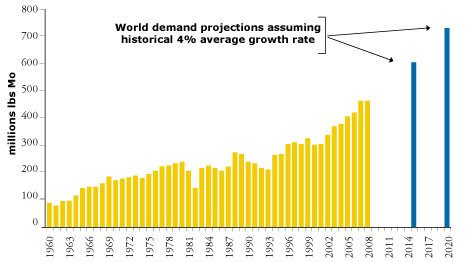 The beauty of moly as a long-term investment lies in this portrait of long-term demand against a seemingly limited batch of high-grade moly deposits. The long-term demand has, so far, been a reliable upward march.
Molybdenum World Demand
Small resource stocks have explosive potential... and they're rising along with the big ones...
Also, when we think about supply, the ongoing credit crisis has basically quashed whatever new moly projects were on the board. The big New Hope project, owned by General Moly, is at least 20 months away after it gets financing. In this climate, I don't see it getting financing anytime soon. And other big projects by Freeport and Moly Mines have been pushed out to 2011 or canceled altogether.
To sum up: Molybdenum is a winner, albeit one that is temporarily resting, like a basketball player taking a breather before he steps back on the court. All the elements that pushed moly to $30-plus per pound in the first place are still in place for yet another run at three sawbucks or better. Molybdenum is cheap at $8 per pound.
Although the global economic crisis will sidetrack China for a while, the country is just entering its commodity-intensive growth phase. This phase will create terrific investment opportunities in energy, agriculture, and mining for us. "Moly" is just a chapter in a long story... one we'd all be wise to follow.
Dailywealth.com offers a free daily investment newsletter which focuses on contrarian investment opportunities.
Subscribe to:
Posts (Atom)