Showing posts with label euro. Show all posts

Thursday, January 17, 2013

European Commission Addresses Economy

The European Commission’s 2012 report on employment and social development has impressed economists as an accurate summary of what has gone wrong with the Eurozone economy in the last year and what will become of it this year, although it’s still questionable whether the insights gleaned from the report will be used to help make the situation better. Economist Jonathon Portes’ interpretation of the report is that a lack of aggregate demand as the result of macroeconomic policy mismanagement as the source of current woes, and that the poorest countries are getting worse, even if other areas are recovering. For more on this continue reading the following article from Economist’s View. 

Jonathan Portes (he also provides discussion of each of these points):
European labor markets: six key lessons from the Commission report, by Jonathan Portes: I haven't always been complimentary about the European Commission - either its economic analysis or its policy advice. So it's nice to be able to be wholeheartedly positive about the excellent report "Employment and Social Developments in Europe 2012"...
The report is really worth reading. But it's close to 500 pages, and the main messages deserve as wide an audience as possible, so I thought I'd try to highlight them with some commentary. To my mind, the key ones are the following:
1. Economic weakness in Europe, and the consequent rise in unemployment, are mostly to do with a lack of aggregate demand, which in turn is the result of mistaken macroeconomic policies - especially aggressive fiscal consolidation...
2. Although financial markets may have stabilized - who knows for how long - things are getting worse, not better, in the real economy of the crisis countries...
3. Countries with more generous welfare states, but also more flexible labor markets, have fared best...
4. Following on from this, structural reforms in labor markets are required in many countries - but they need to be based on evidence! Segmented labor markets are a problem and raise youth unemployment...
..and even in recession, minimum wages at a sensible level do more good than harm. ...
5. Where they were allowed to operate, the "automatic stabilizers" worked...(in both macroeconomic and social terms)...
...while where they were overridden, in the pursuit of "self-defeating austerity", things have got worse...
6. Latvia, Ireland (and even Estonia) may look like "success stories" to some in the Commission, and perhaps to the financial markets (at present) but the reality in terms of jobs and incomes is rather different. ...
Too bad fiscal policymakers didn't do their homework and learn these lessons about austerity, social insurance, automatic stabilizers, and so on before putting harmful or ineffective policy in place (or failing to implement policy when action is called for, e.g. to reduce unemployment). Wish I thought they were doing their homework now.
 
This blog post was republished with permission from Economist's View.

Thursday, May 17, 2012

Greece EU Future Doomed, Says Economist

While many economists attempt to affect a balanced approach to speculating on Greece’s future in the European Union (EU), Tim Duy believes the country’s economic future a fait accompli. Its pace of deterioration is too fast and key players in the EU and the European Central Bank have waited too long to take the action necessary to save it, and may even have waited too long to save the euro. It is known that Greece will have difficulty meeting its cash obligations in June and will be near-leaderless until elections are held in the middle of the month. By then, it will surely be too far gone to save with a bailout that any lender would find reasonable. For more on this continue reading the following article from Economist’s View. 

Tim Duy:
Greece is Running Out of Time, by Tim Duy: I have repeatedly described myself as a Euroskeptic. The current combination of politics and economics looks likely to at worst doom the Euro to failure, at best to commit the Continent to a deep and long-lasting recession. Moreover, the pace of deterioration in Greece, combined with an economic structure that seems completely at odds with much of the rest of Europe, seems to make a Grexit all but impossible.
That said, I am horrified at the ongoing willingness of European policymakers to still be playing chicken at this point. I assumed that my skepticism would ultimately be proved wrong as the European Central Bank would ultimately cave and effectively monetize national debt across the Eurozone, and that Germany would come to this conclusion as necessary to save the single currency that they have long-championed. That ultimately, the Eurozone would step up and take greater responsibility for this mess, understanding that while the Greeks have mismanaged their economy, they should never have been admitted to the Eurozone in the first place.
Instead, Europe situation is now akin to two or three trains running full-speed at one another, and by the time someone finally pulls on the brakes, it will be too late. By the time key actors step into action, irreparable damage will have been done
Consider that one of those trains, Greece, has no driver, nor will it until June 17 when fresh elections are held. Combine that with a deteriorating fiscal situation - believe it or not, it actually continues to get worse. From Bloomberg:
The level of funds in Greece’s state coffers has fallen below 1.5 billion euros ($1.9 billion), Imerisia reported, citing “reliable information.”
If the state doesn’t receive predicted revenue for the rest of this month, it will find it difficult to pay for social services, pensions and public-sector wages, the newspaper said.
This was confirmed by the outgoing leader:
Greece's outgoing Prime Minister Lucas Papademos has warned the country's political leaders the government may have difficulty in meeting its cash obligations as of the start of June, a Greek newspaper reported Monday.
In a note Papademos sent to Greek President Karolos Papoulias and discussed in Sunday's meetings between the president and party leaders on forming a coalition government, the prime minister said it is likely Greece will have significant difficulties in covering its cash payments in June, according to newspaper Ta Nea, citing unnamed sources from Papoulias' office
Now, further consider one of the proximate causes of the new fiscal shortfall:
Greece' s budget revenues have reportedly dropped by 10.2% in April compared to the same month in 2011, as daily Kathimerini reports quoting provisional figures the Finance Ministry is studying. The election period did nothing to help state receipts as the tax collection and monitoring mechanism traditionally relaxes ahead of polls, and did so again this year despite the crisis.
It has been said before, but is worth saying again - how did this economy pass the bar to Euro membership in the first place? If officially sanctioned tax avoidance remains in effect, and we have another month until the new elections, I can't imagine that the fiscal picture is going to do anything but go from bad to worse. Or from worse to as worse as it can get.
Given the deteriorating fiscal position, Greece will eventually need a larger bailout if it is to stay in the Euro. Simply put, if they can't pay their bills with Euros, they will need to issue their own currency. Deep in a piece on the failed efforts to collect property taxes via electricity bills, the FT brings us this from a "friendly trader":
When we talk about Greece “running out of money” in coming weeks/months, the combination of dire recession, plus non compliance in Revenue collection will speed the day that Civil Servants and suppliers are paid in IOU’s or “New Drachma” in the absence of any funding from the EU/IMF…
Once IOU's start circulating, the clock will start ticking. Either they get replaced soon with actual Euros, or they start trading as currency. In other words, time is growing very, very short to find a solution that keeps Greece in the Eurozone.
Meanwhile, is the final run on Greece's banks underway? From the Wall Street Journal:
Greek depositors withdrew €700 million ($898 million) from local banks Monday, the country's president said, as he warned that the situation facing Greece's lenders was very difficult.
In a transcript of remarks by President Karolos Papoulias to Greek political leaders that was released Tuesday, Mr. Papoulias said that withdrawals plus buy orders received by Greek banks for German bunds totalled some 800 million.
A bank run in the absence of a functioning government. Is there anyone ready to push the button on a bank holiday with capital controls? Or is this about to devolve into a free-for-all flight of capital?
Meanwhile, Germany and France are holding to the official line. From the FT:
“We want Greece to stay in the euro,” Ms Merkel said. “We know that the majority of people in Greece see that.”
The Greek government had also agreed on a rescue programme with the IMF and the EU after lengthy negotiations, she said. “I believe that memorandum must be respected.”
This ignores the small point that the last bailout was certain to fail from the start. The message remains that no one but Greece is making the decision to leave the Euro:
“We have to respect that there will be new elections in Greece,” she added. “We will make it clear that we want Greece to remain in the eurozone, and that is what the citizens are voting on.”
But out comes the unspecified carrot:
That meant fulfilling the commitments in the EU and IMF programme, she said, but added: “We will also give proposals to Greece to encourage growth.”
Mr Hollande went further, saying that “I hope that we can say to the Greeks that Europe is ready to add measures to help growth and support economic activity, so that there is a return to growth in Greece.”More carrot with stick would have been helpful two years ago. Now it is looking like too little, too late. And what kind of measures are these? Direct bilateral transfers from Germany, which would be helpful? Or more loans to add to those that Greece can not already afford?
In other news, in the wake of its two LTRO operations, the ECB is back to neglecting its role as lender of last resort. As a consequence, Spanish yields are now solidly back above 6%, with Italian yields in close pursuit. Apparently, investors are not convinced that the supposed firewalls are sufficient to control contagion. European policymakers have fallen short of the mark. Again.
Bottom Line: I don't see how European policymakers can be anything but terrified that this whole experiment is unraveling at a frightening pace. Yet they keep barreling ahead on this disastrous path, ensuring that things continue to get worse before they get better.
Update: Three more from Tim Duy:
Central Bank FAIL - ECB Edition: From the Wall Street Journal:
The steady outflow of deposits from Greek banks hasn't yet turned into a full-blown bank run, and the European Central Bank has nearly limitless capacity to provide banks with additional liquidity. But economists have long warned that a run on banks could develop if the population fears Greece's departure from the euro is imminent and that their savings would evaporate. A bank run could trigger the euro exit if it reaches a scale that forces Greek authorities to freeze bank accounts and print their own currency to keep the financial system alive.
What is more, if Greece fails to comply with the conditions of its bailouts, the ECB would likely cut off the liquidity support for its banks, a move that could cause the banking system's collapse.
It is simply unbelievable that at this point in history, more than 100 years after Bagehot's Lomberd Street, that we could consider that the European Central Bank will not only fail in its role as lender of last resort for the fiscal authority, but also fail in its role as lender of last resort to the banking system.  Yet here we are.
Failure to Communicate: Yet another amazing quote from the same Wall Street Journal article:
Greece's renewed turmoil is putting Europe's leaders in a difficult position. Many hoped that the Greek election would result in a national consensus to push forward with the deep spending cuts Greece's previous governments committed to as a condition of the rescues. Instead, voters used the ballot to express deep dissatisfaction with the measures.
Really?  Did European policymakers really believe that the Greek people would never grow tired of the endless austerity?  If so, this is simply sad, because virtually everyone else in the rest of world saw that the Greek people were being pushed over the edge.
Questionable Assumptions: From the Financial Times:
Ms Merkel defended her belief that the common currency was "not just a monetary project, but a political project". It meant that the member states of the eurozone shared a common responsibility. "People who have a common currency will never fight a war against each other," she said.
Isn't this just plain wrong?  When people with a common currency fight a war, we call it a civil war.  Not exactly without historical precedent.
 This article was republished with permission from Economist's View.

Friday, October 28, 2011

European Leaders Continue Debt Negotiations

Tim Iacono provides a video clip rehashing the latest meeting between Eurozone leaders regarding how to solve the Greek debt crisis and wider concerns for the stability of the European currency union. Politicians have agreed the European Financial Stability Facility fund should be increased to $1.4 trillion to cover capital expenses that will be faced by banks and investors that are expected to take a as much as a 50% loss in a Greek bailout. The specific financial instrument that will facilitate this is still being debated, however, and one option may involve allowing China and Middle Eastern countries to buy into the debt. For more on this continue reading the following article from Tim Iacono.

It looks like they’ve agreed to something over in Europe, though it remains to be seen whether this deal will last any longer than any of the last half dozen or so agreements aimed at keeping the currency union from breaking apart.

Investors have reportedly agreed to take losses of 50 percent on Greek debt and French President Sarkozy told reporters that the EFSF bailout fund is about to be “leveraged up” to $1.4 trillion, the proverbial “bazooka” in the EU’s pocket. It looks like they’re on a roll…

This blog post was republished with permission from Tim Iacono.

Tuesday, October 25, 2011

Euro Doomed, Says Economist

Economist Paul Krugman is predicting the failure of the euro, and feels that no solution yet offered by Eurozone economic powers will solve the default problem. He points out that Greece is more of a red herring, and that the real problem is the shake financial position of Italy, the Eurozone’s third largest economy. Italy cannot borrow against its own debt to save itself and rigid statutes prevent the type of currency printing trick used by other superpowers to pull themselves out of debt. The only hope for the euro is if the European Central Bank backs Eurozone debt, say Krugman, but leaders have made it clear that option is not on the table and so have sealed the fate of the euro. For more on this continue reading the following article from Economist’s View.

Is the euro system doomed?:

The Hole in Europe’s Bucket, by Paul Krugman, Commentary, NYTimes: If it weren’t so tragic, the current European crisis would be funny, in a gallows-humor sort of way. ...
I’ll get to the tragedy in a minute. First, let’s talk about the pratfalls... Greece, where the crisis began, is no more than a grim sideshow. The clear and present danger comes instead from ... Italy, the euro area’s third-largest economy. Investors, fearing a possible default, are demanding high interest rates on Italian debt. And these high interest rates, by raising the burden of debt service, make default more likely. ...
To save the euro, this threat must be contained. But ... here’s the problem: All the various proposals ... ultimately require backing from major European governments, whose promises to investors must be credible for the plan to work. Yet Italy is one of those major governments; it can’t achieve a rescue by lending money to itself. And France, the euro area’s second-biggest economy, has been looking shaky lately... There’s a hole in the bucket, dear Liza, dear Liza. ...
What makes the story really painful is the fact that none of this had to happen. ... Britain, Japan and the United States ... have large debts and deficits yet remain able to borrow at low interest rates. What’s their secret? The answer, in large part, is that they retain their own currencies, and investors know that in a pinch they could finance their deficits by printing more of those currencies. If the European Central Bank were to similarly stand behind European debts, the crisis would ease dramatically. ...
But such action, we keep being told, is off the table. The statutes ... supposedly prohibit this kind of thing, although one suspects that clever lawyers could find a way to make it happen. The broader problem, however, is that the whole euro system was designed to fight the last economic war. It’s a Maginot Line built to prevent a replay of the 1970s, which is worse than useless when the real danger is a replay of the 1930s. ...
The ... European elite, in its arrogance, locked the Continent into a monetary system that recreated the rigidities of the gold standard, and — like the gold standard in the 1930s — has turned into a deadly trap.
Now maybe European leaders will come up with a truly credible rescue plan. I hope so, but I don’t expect it.
The bitter truth is that it’s looking more and more as if the euro system is doomed. And the even more bitter truth is that given the way that system has been performing, Europe might be better off if it collapses sooner rather than later.

This blog post was republished with permission from Economist's View.

Friday, October 14, 2011

Eurozone Collapse Halted, Still Threatening

Hugo Dixon of Reuters Breaking Views predicts a European Union (EU) financial disaster is still possible, but a more likely development is one where the EU experiences an extended period of zero or negative growth. Dixon argues there is no silver bullet; the situation has unraveled too much for politicians to save it with fiscal reform, and breaking up the EU would be a disaster in itself. The worst thing that could happen, Dixon says, is for the EU to shift toward protectionism in an effort to stimulate its economy, but he does not expect this to happen. For more on this continue reading the following article from Tim Iacono.

Those whose hopes of a much bigger crisis in Europe are about to be dashed after the final approval of the EFSF bailout fund by Slovakia can take heart in this view from Reuters Breaking Views founder Hugo Dixon that the chance of a “total disaster” still exists.


Muddling through with years of zero or negative growth is now seen as the most likely scenario, an outlook that, some time ago, would have been considered a disappointment, but, after the events of the last few months, seems much less of one now.

This blog post was republished with permission from Tim Iacono.

Tuesday, September 27, 2011

Eurozone Faces Possible Bank Run

Some market speculators are convinced the Eurozone is on the brink of collapse and that the EU may face an actual bank run as individuals, banks and investment houses scramble to secure actual funds, even from one another. The interlinking nature of modern banking and investment infrastructure may lead to a domino effect of collapse. Many feel that the time has come when physical possession of bullion is the only real measure against insolvency if banks begin closing and investment firms continue selling paper gold and silver. For more on this continue reading the following article from The Prudent Investor.

A comatose interbank market and corporate and fund money fleeing Eurozone banks in droves have rung in the countdown to the Eurozone bank run that could become reality as early as next Monday.

The free fall in all major markets and commodities was only negatively outperformed by European banks whose shares fell to new 2011 lows.

Gossip about major institutions like Lloyds of London withdrawing all deposits from Eurozone banks and countless stories in German media about corporations that follow suit are the first indicators about a bank run that may come as soon as Monday when one major Eurozone bank may have to announce its insolvency.

A cascade of downgrades is only more fuel to the market fornication as we have never seen it before. As we are closer to the Endsieg, banks are resorting to a dog-eat-dog strategy, scrambling to save their own skin in a world where the only providers of liquidity are central banks letting their money printing presses spin 24/7.

Mounting rumors expect the announcement of a major bank closing its doors as soon as Monday and market speculation focuses on Unicredit and Societe Generale.

Being asked about the ultimate safe haven I still have only one answer. Precious metals bullion are the only asset that is not the liability of someone else.

Never mind that silver FUTURES dropped 9% on Thursday and gold breached the 50-day moving average. As long as market participants with unlimited credit from the Federal Reserve can sell x,xxx tons of paper gold or paper silver within seconds in regular gold/silver slam scams the ride will be stormy but ultimately the holders of the physical will prevail.

This blog post was republished with permission from The Prudent Investor.

Tuesday, June 22, 2010

European Countries Aim To Bring Down Deficits

Faced with mounting deficits, some European countries have made recent moves to reduce government spending and raise taxes in order to stave off bankruptcy and restore confidence in their currencies. While the US continues to engage in deficit spending, that left unchecked can lead to unpalatable consequences. See the following article from Dollar Collapse for more on this.

On its long journey to the land of bankruptcy, the Western world recently arrived at the last and most important crossroad. One branch led to a 1930s-style collapse under the weight of already-accumulated debt, while the other led to hyperinflation, as printing presses ramp up to stave off collapse.

The U.S. didn’t even slow down; it instantly veered down Inflation Lane and has spent the past couple of years nationalizing everything in sight with newly created paper. Europe, on the other hand, has been vacillating. After keeping the U.S. company for a while, it got a little glimpse of what lies ahead: loss of confidence in the currency that’s being inflated away — and career change for the responsible politicians. With a plunging euro and pound threatening to make future borrowing prohibitively expensive, they’ve headed back to the crossroad and taken the other path, and are now cutting spending and raising taxes in an attempt to restore confidence in their currencies. See:

ECB’s Noyer Says French Deficit Targets Realistic

European Central Bank board member Christian Noyer on Sunday said France’s aim to bring its budget deficit down to 3 percent from 8 percent of GDP by 2013 was realistic.

Noyer was echoing a similar pledge by Prime Minister Francois Fillon at the weekend who said France planned to cut its deficit by 100 billion euros over the next three years, in part by slashing expenditures and eliminating tax exemptions.

Europe embraces the cult of austerity – but at what cost?

Eurozone finance ministers were still committed to spending their way to recovery only a few months ago. Then came the Greek debt crisis, which threatened to engulf the continent. Despite warnings from the US, Britain and its EU neighbours are braced for unprecedented public sector cuts

So the questions become:

Is it too late to stave off the collapse of systems burdened by debts and public pension obligations that dwarf the economies themselves?

Will the voters who lose benefits or pay higher taxes under the new austerity plans put up with it?

Will the slowdown that inevitably results from sucking 5%-8% of GDP out of the public sector lead panicked European governments to cut across the nearest open field to catch up with the U.S.?

Based on how much these guys owe and the immensity of their future obligations, it’s a near-certainty that all three questions will be answered in chaotic, unpleasant ways. Which illustrates the key truth of the modern world: When you borrow too much money your life becomes unmanageable and your choices unpalatable.

This article has been republished from John Rubino's blog, Dollar Collapse.

Thursday, May 27, 2010

The Euro Causes More Problems Than It Solves

Peter Morici at The Street argues that the Euro has also caused more problems than it has solved by taking away currency flexibility from poorer countries while rich countries like Germany prosper in the single continental market system. Poorer countries are having a difficult time convincing their citizens that they can afford the same extensive social benefits as other countries in the Eurozone. See the following post from The Street.

European banks and global financial markets have been roiled by needless artifacts of postmodern Europe: the euro and malignant social safety nets.

For decades, European population and economic growth have been perilously handicapped by overly generous social benefits that discourage individual risk-taking and business entrepreneurship.

On both sides of the pond, progressives blame inadequate taxation but concede some curtailment of benefits is needed in less-affluent European states.

In a modern market economy, only a fool would not acknowledge an appropriate tension exists between welfare -- assistance for the truly needy and aged -- and efficiency -- policies that empower the rest of us to work and invest vigorously. Excessive coddling and taxation discourage people from working their full productive lives. They also discourage business innovation.

Multiyear unemployment and huge severance benefits, guaranteed health care for the able-bodied who refuse to work and other affectations of Europe's sympathetic face of capitalism surely cross those lines. However, like an alcoholic who knows he must quit drinking, Europeans have avoided the cure for decades by peddling bogus schemes to rekindle growth.

The 1992 Maastricht Treaty, which considerably harmonized product and safety standards and methods of taxation across the continent, was supposed to remove untold barriers to growth. It didn't, because European labor laws and social benefits still make individual ambition and investment in Europe about as sensible as my still unfulfilled dream to be Italy's prime minister.

The single currency, the euro, introduced in 1999 to facilitate commerce across borders from Ireland to Greece, was heralded as the next great elixir.

The euro addressed a problem that didn't truly exist and created new ones. Before it's introduction, the European Currency Unit linked at fixed rates the national currencies of many of today's eurozone countries. The dollar and the ECU were accepted in international commercial transactions.

However, each country could print its domestic currency and occasionally devalue or revalue against the group as circumstances required. With the euro that flexibility was taken away from poorer countries like Portugal, Spain, Greece,and Ireland. Tough EU restrictions on national budget deficits, reminiscent of U.S. state constitutional requirements for balanced budgets, were supposed to avoid that necessity.

Sadly, although Germany, like New York, greatly prospers by participating in a huge single continental market, Brussels cannot tax Germany to subsidize Greece's welfare state in the same way Washington taxes New York to subsidize Mississippi's Medicaid. And that is not likely to happen anytime soon.

With all that wealth to itself, Germany provides gold-plated employment security and jobless benefits, short work weeks and the like, portrays itself a model of Euro-efficiency, and lectures Greece on Teutonic frugality.

Germany can only afford those benefits because it doesn't share its wealth with Greece. Athens can't scale back social benefits to truly affordable levels, without political upheaval, because its population does not understand why they can't enjoy the same perks as Germans.

The International Monetary Fund is telling Spain to radically overhaul labor laws, pensions and other social benefits or become the next Greece. Unfortunately, the less wealthy European countries cannot coexist in the eurozone with wealthier profligate states like Denmark, German and France -- domestic politics won't allow it -- and the rich states cannot perpetuate the fantasy that they pay for the benefits through their own productivity alone if the poorer ones spin off.

Once upon a time, the European Economic Community -- remember that quaint post-World War II institution? -- thrived without a single currency. A larger European Union can thrive again, but it needs to jettison the fantasy that the benefits of capitalism can be accomplished without adequate incentives to work hard and invest.

Free-market capitalism is the greatest engine of progress conceived by man -- unless, of course, it was divine inspiration -- but it cannot survive with the heresy that the benefits of capitalism can be accomplished without both risks and rewards.

This post has been republished from The Street, an investment news and analysis site.

Friday, May 14, 2010

Economic Leaders Express Concern Over Euro

The euro fell to its lowest level in a year as top economic leaders voiced concerns about the potential end to the currency. Paul Volcker commented on the lack of fiscal discipline of some countries in his speech in London. See the following post from The Mess That Greenspan Made.

Bloomberg reports that “Tall Paul” Volcker is a bit down on the prospects for the euro after the events of the last six months (a period of turmoil that seems like it’s been going on a lot longer than that) and the more recent $1 trillion bailout package announced on Sunday.
“You have the great problem of a potential disintegration of the euro,” Volcker, 82, said in a speech in London yesterday. “The essential element of discipline in economic policy and in fiscal policy that was hoped for” has “so far not been rewarded in some countries.”

European leaders pledged a rescue package of almost $1 trillion this week to counter a mounting debt crisis and restore confidence in the currency. Former U.S. Treasury Secretary John Snow said this week the euro may need a common fiscal policy to survive, a comment echoed by Norman Lamont, who was U.K. finance minister when Britain opted out from the euro in 1992.

“Will economic and financial distress finally be resolved by looking toward more integration in a closely integrated Europe, politically as well as economically?” said Volcker, who chairs President Barack Obama’s Economic Recovery Advisory Board. “I do have my hopes, as a believer in the euro.”
…
Volcker expressed hope that the euro will survive. “There is strong opinion to keep it going,” he told journalists after his speech at Mansion House, the residence of the lord mayor of the City, London’s financial district. “That does require, I think, changes in the structure of European economic policy.”
The euro hit a new low for the year earlier today against the dollar at just above $1.25, the lowest level in about 14 months. Sometimes it’s hard to believe that it touched the $1.60 mark in 2008, that is, just before all four wheels fell off the global economic wagon.

Of course, gold priced in euros continues to make new highs, yesterday threatening the €1,000 an ounce level before moving lower today to close at €984.

This article has been republished from Tim Iacono's blog, The Mess That Greenspan Made.

Monday, February 1, 2010

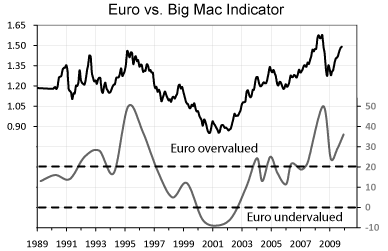
The Big Mac Index And Foreign Exchange Investment

Steve Sjuggerud believes that conditions in Europe will lead to a fall in the Euro this year. One indicator that the Euro is in trouble is the Big Mac index which suggests the Euro is way overvalued. See the following post from Daily Wealth.

It's time to bet against the euro...

That's the trade I recommended over a month ago in my True Wealth newsletter. And the trade is still as good... no, better... than it was when I first recommended it.

Here's why I recommended it in the first place... and why NOW is an even better time to make the trade than when I told my paid subscribers about it in mid-December...

First, as I'm sure you've already heard, Greece is at risk of falling out of the euro. But we have many other factors telling us the euro will continue to go down...

First off, we have the trend... In currencies in particular, once a trend gets going, it's hard to derail it.

Last year's trend was a crashing dollar. In 2010, it looks like the trend will be a crashing euro. No matter how you analyze trends, you'd have to say the euro is finally in a downtrend right now... It peaked in late November and is down more than 8% already. That's a huge move for such a short time in a major currency.

When I first recommended betting against the euro in mid-December, I wasn't certain we were in a downtrend yet. Now, it's absolutely clear... the euro fell into the $1.30s yesterday for the first time since last summer.

Also, importantly, the euro is WAY overvalued relative to the dollar.

One of my favorite simple indicators of whether a currency is overpriced or underpriced is the "Big Mac Index" from The Economist magazine... As the chart here shows, whenever a Big Mac in Europe is 50% more expensive than a Big Mac in the States, the euro crashes.


We're not at the 50% overvalued point anymore (which is a real extreme). But the euro is still very expensive... A Big Mac in euros is around 35% more expensive than a U.S. Big Mac.

We will also likely have interest rates in favor of the dollar in 2010...

If the European Union must save Greece and the other "PIGS" (Portugal, Italy, Greece, and Spain), then interest rates in Europe will stay low. But the U.S. is in recovery, where rates can rise. At the very least, Europe won't have any interest-rate advantage.

Other factors in the dollar's favor include a potential reversal of the Big Trade of 2009. In 2009, as risk abated, everything went up and the dollar went down. Now, risk is making a bit of a comeback – the dollar (the safe haven) could go up. Another factor is, with the troubles in Europe, the euro has little chance of competing with the dollar as the world's reserve currency.

I could go on... But in short, this type of opportunity doesn't come along often.

The euro is in a horrible situation right now. A mountain of factors is against it. It is overpriced. And in the last two months, a firm downtrend has been established. It is time to bet against the euro.

This post has been republished from Steve Sjuggerud's blog, Daily Wealth.

Tuesday, June 23, 2009

Big Week For US Dollar and Euro

How will the sell off of a record $104 billion in US Treasury notes affect the strength of the dollar? Meanwhile in Europe, Germany is facing a record debt of it's own. Forex expert Kathy Lien tells us what we should watch for this week in the foreign exchange market.

German business confidence improved marginally which should have been bullish for the euro, but unfortunately the most actively traded currency pair in the forex market has remained under pressure throughout the European and U.S. trading sessions. So if the EUR/USD is not responding to economic data then what is driving it lower?

Five factors:

1. U.S. Treasury Auction

One of the big focuses of foreign exchange traders this week is the massive Treasury auction. The U.S. government will be issuing a record $104 billion of 2 year, 5 year and 7 year Treasury notes between Tuesday and Thursday. The reason why currency traders are watching these auctions is because of its scale and also because it will shed some light on investor’s willingness to fund the U.S.’ large and growing budget deficit. The auctions will be a big hurdle for the U.S. dollar this week because if demand comes up short, the dollar could get hit but it is not that simple because at the same time, weak demand could drive up yields, which is dollar positive. Either way, over the next couple of days, there will be a lot of focus on the Treasury auctions.

2. First ever 12 month ECB refinancing

The ECB refinancing is the biggest story for the EUR/USD this week because the 12 month offer is seen by bond traders as a quasi quantitative easing effort by the ECB because the operations are most likely going to be collateralized by government bonds which can then be posted as collateral to the ECB for funding. Although ECB President Trichet warned that their monetary policy actions can be easily unwound if needed, he also said that policy makers must remain alert despite signs that the slump is decelerating because “there are still risks of a sudden emergence of unexpected financial turbulence.”

3. Fears that German Debt Could Explode

As for Germany, Deputy Finance Minister Werner Gatzer said that total new debt could exceed EUR100 billion next year, which would be much larger than this year’s record financing needs of EUR80 billion. Looking ahead, we could see further weakness in the EUR/USD if Tuesday’s PMI figures fall short of expectations. Despite the improvement in business confidence, which was driven entirely by the expectations component of the report, current conditions remain weak.

4. Comments from ECB President Trichet

Although ECB President Trichet warned that their monetary policy actions can be easily unwound if needed, he also said that policy makers must remain alert despite signs that the slump is decelerating because “there are still risks of a sudden emergence of unexpected financial turbulence.” These bearish comments came after ECB member Nowotny said this morning that interest rates could remain unchanged into 2010.

5. Tuesday’s PMI numbers

However in the near term, weaker economic data could keep the EUR/USD pressured. German industrial production, factory orders and retail sales have all declined which could prevent a meaningful pickup and possibly even deterioration in manufacturing and service sector PMI.

This article can also be viewed at Kathy Lien's foreign exchange blog.