Wednesday, June 30, 2010

Consumer Confidence Fell Sharply In June

US consumer confidence levels took a plunge in June 2010, as concerns about the economy and the slowdown in job growth increased. Analysts believe that until the job outlook starts to improve, its unlikely that consumer confidence will increase. See the following post from Expected Returns.

From the Conference Board:
The Conference Board Consumer Confidence Index which had been on the rise for three consecutive months, declined sharply in June. The Index now stands at 52.9 (1985=100), down from 62.7 in May. The Present Situation Index decreased to 25.5 from 29.8. The Expectations Index declined to 71.2 from 84.6 last month.


Says Lynn Franco, Director of The Conference Board Consumer Research Center: “Consumer confidence, which had posted three consecutive monthly gains and appeared to be gaining some traction, retreated sharply in June. Increasing uncertainty and apprehension about the future state of the economy and labor market, no doubt a result of the recent slowdown in job growth, are the primary reasons for the sharp reversal in confidence. Until the pace of job growth picks up, consumer confidence is not likely to pick up.”
The Consumer Confidence Index is a measure of consumer confidence based on responses to questions about the following:

* Current business conditions
* Business conditions for the next six months
* Current employment conditions
* Employment conditions for the next six months
* Total family income for the next six months

Consumer confidence rose for each of the past 3 months before falling in June. While one month's data does not make a trend, consumer confidence is worth keeping an eye on. People are just starting to recognize the double dip in our economy that has been developing over the first half of this year.

This post has been republished from Moses Kim's blog, Expected Returns.

The Risk Of Deflation Won't Go Away

With the job creation outlook grim and rate of inflation dropping, some analysts are projecting a double-dip recession with an increasing risk of deflation. The slow money velocity has some calling for an increase in money printing. See the following post from The Capital Spectator.

The Treasury market’s 10-year inflation forecast is slipping…again. That’s no surprise, given the renewed concerns of late on the deflation front (see here and here, for instance). Unsurprising, perhaps, but still troubling.

The inflation outlook dipped to 1.88% yesterday, based on the spread between the nominal and inflation-indexed yields on 10-year Treasuries, according to government numbers. It’s unclear if this is an accurate warning sign that deflationary winds are set to blow stronger, but considering the economic climate of late it’d be short-sighted to dismiss the trend.

As the chart below reminds, the market’s estimate of the inflation outlook slipped below 2% late last month, and it’s remained under that level ever since, save for a few brief but so far fleeting flirtations on the other side. Lower inflation is generally a good thing, of course, but until the economic signals are stronger—particularly in the labor market—the possibility of falling inflation at this point is a sign of trouble.


The jury’s still out on what comes next, but we'll know more in short order. On Thursday, we learn of the latest for the ISM Manufacturing Index, weekly jobless claims and construction spending. A more telling stat arrives on Friday, with the update on the jobs report for June. The headline number on jobs is expected to be negative, but the positive spin is that the trend in private payrolls is expected to show gains. Nothing less is required to counter the weakening outlook on inflation. Indeed, the jobs picture for May was disappointing and the hour is late for convincing the crowd that the labor market has some degree of sustainable upside momentum.

Meantime, the warning signs on monetary policy are becoming too obvious to ignore, according to some analysts. "We're heading towards a double-dip recession," Chris Whalen, head of Institutional Risk Analytics and a former official at the Federal Reserve, told The Telegraph last week. "The party is over from fiscal support. These hard-money men are fighting the last war: they don't recognize that money velocity has slowed and we are going into deflation. The only default option left is to crank up the printing presses again."

Economist Scott Sumner argues that "the Fed suffers from the same sort of paralysis as it did in the Great Depression." It's hard to argue otherwise when looking at the annual rate of change in MZM money supply (M2 money supply less small-denomination time deposits plus institutional money funds). As the chart below shows (courtesy of the St. Louis Fed), the annual rate of change for MZM has turned negative recently for the first time since 1995. Unfortunately, we're not in 1995 anymore.


This post has been republished from James Picerno's blog, The Capital Spectator.

Tuesday, June 29, 2010

Key Indicators To Watch For Gold Prices

Over the past ten years gold prices have shown an inverse relationship to jewelry demand, although it is often assumed that jewelry demand drives higher gold prices. Interestingly, net retail investment is a far better indicator of gold prices than jewelry demand, while human irrationality also plays an important role. See the following post from Expected Returns.

One of the hardest things to do as an investor is to think through investments without presuming anything. The data will tell a story and paint a picture for you that you can then interpret. Most people shun this obvious approach to investing and instead choose to invert the process by allowing their assumptions to cloud their analysis. This is simply not a sophisticated approach to investing.

A combination of history and quantitative data analysis will give you a perspective that 95% of investors do not have. For example, most people alive today have not lived through the gold exchange standard, and therefore have no clue how it functions. To most, it is a peculiarity of our ancestors; a relic of the past; and a product of a crude economic system. They cannot imagine the possibility of gold playing a role in the global monetary system. Their knowledge of history is small, and so is their sense of economic possibilities.

It is presumptuous to assume that gold will not eventually play a role in the international monetary system since it happened before in history. It is also presumptuous to assume sovereign nations will not default since sovereign defaults are prevalent throughout history. Most of the anti-gold arguments are based on assumptions that simply aren't true. Here are a few.

Jewelry Demand?

It is incredibly difficult to argue with someone who pulls the "jewelry demand" card on you. Why? The jewelry demand argument is so false that its defenders are invariably a special breed of stubborn. You can never win these kind of arguments.

Now as investors, let's test the assumption that there is some kind of relationship between jewelry demand and gold prices. As you can see below, if there is a relationship, it is a negative one.


If you invested based solely on an assumed relationship between gold and jewelry demand, you would have lost money 9 out of the past 10 years. While the data suggest we should change our assumptions, most people won't. This is the irrationality of human nature at play that allows a minority of investors to profit.

Investment Demand, Anyone?


The real demand is coming from institutional investors, retail investors, and governments. Chinese, Russian, and Indian central banks have recently become major buyers. This is a positive trend for gold since these governments hold so small a percentage of their reserves in the form of gold. Since the dollar dominates foreign reserves, diversification into gold is equivalent to dumping dollars.


Retail investors have also begun to protect themselves from spendthrift governments. Objectively speaking, retail investment is a far better indicator of gold prices than jewelry demand.


Marginal Demand, Human Irrationality, and Gold


A fundamental tenet of economics is that humans act rationally. Why I have no clue. Nothing in my experience has shown that people act rationally and to their best interest at all times.

Understanding human irrationality is central to understanding the future price movements of gold. For example, are people more likely to buy gold at $250 dollars after 20 years of being the most hated asset in the world or at $2500 dollars? You don't see lines around the block at gold shops at bottoms; they are an indicator of tops. This is a reflection of both gold's unique marginal demand characteristics and the nature of bubbles in general.

The marginal demand aspects of gold run contrary to those of most other assets. Generally speaking, a rise in price results in a decline in demand. For gold, a rise in prices results generally in an increase in demand. This is its natural state. Add to the mix human irrationality and the panic buying that is bound to come and you start to understand that the monster moves in gold are still ahead.

Financial experts are telling us the gold trade is crowded. Ironically, gold will become a crowded trade only when the "gold bubble" experts start buying. Not to be flippant, but this is one of the top 3 indicators I'm looking for to signal a top in gold. Fortunately, the gold bubble experts are still out in force expounding on the threats of deflation- an argument so riddled with holes that it should not be taken seriously. Making linear comparisons between fixed exchange and floating exchange systems is like comparing apples and oranges: It makes no sense and it is bound to result in flawed conclusions.

We should all try to test our assumptions against facts. That most investors don't is great news for gold bulls. We are on the precipice of a major move in gold that will make all blind assumptions concerning gold look foolish.

This post has been republished from Moses Kim's blog, Expected Returns.

The Short Sale Dilemma For Banks

Reducing loan principals present a dilemma for banks; while reducing a borrower's loan principal may prevent the bank from the costs of a short sale, large scale principal writedowns could have significant negative impact on a banks' balance sheets. While the political winds seem to lean towards employing more loan principal writedowns to keep Americans in their homes, the strategy is a slippery slope that could lead to unintended consequences. See the following article by Paul Jackson from HousingWire.

This past week, I received an email from one of my dearest friends that has really stuck with me. It illuminates perhaps one of the single largest shifts in borrower psychology likely to come from a push to short sales:

My neighbors are being foreclosed on. He is an civil engineer, and she is a retired banker. They are the most wonderful people I have ever met, and have been such sweet giving neighbors. She basically designed and built the house from scratch.

The house and land (1.3 acres) was valued at $1.8m a few years ago. Now, they are behind on payments and the bank wants to force a short sale for only $700k. She told me that she tried to modify the mortgage twice already, and has been turned down. She is willing and able to make payments on the $700k amount, but the bank is refusing and would rather sell to someone else.


The message paints an interesting picture of a potentially hidden angle to the recent short sale push by the Administration, banks, and Realtors: a renewed call for broad principal forgiveness.

It’s not too hard to see this sort of thinking quickly becoming the norm among many distressed homeowners, as a push for short sales grows ever stronger and many ask themselves why someone else is getting the better deal. More than 11 million borrowers currently owe more on their mortgage than it is worth, according to CoreLogic (CLGX: 18.09 +0.17%)—and this group of borrowers would love nothing more than to replace their current underwater mortgage with whatever the accepted “short sale price” is deemed to be.

I don’t know that such a response on the part of borrowers could be deemed irrational, either. Many will ask themselves why they have a mortgage at a higher amount, especially if the bank is willing to sell the house to another buyer for less money. Why does someone else get the lower purchase price? Isn’t easier for the bank to just give me that loan instead? I already live here.

It’s clearly a slippery slope, and not even a steep one, from a short sale push towards an outright push for the write down of mortgage principal to “short sale levels.” I suspect, in fact, that this is part of the reason some large commercial banks—Bank of America (BAC: 15.24 -1.17%) among them as of late—are working feverishly to get in front of this end game, announcing principal reduction programs that are great press exposure, and yet also protect their financial interests as much as possible.

Because the truth is that the bank and/or investor may not always have the luxury of defining their terms on principal write downs, especially not with elections looming this coming November. It’s only late June, after all.

Of course, reality is much more complicated. Generally speaking, the mortgage world can best be divided up into three sub-worlds: the GSEs, private-label securities, and whole loans. Depending on what class of mortgage asset you tend to hold, your viewpoints can differ dramatically; and if you hold all three, as most commercial banks tend to do, you’re facing more than a mild case of financial schizophrenia.

While the truth is many investors are in favor of principal write-downs, at least to a point—and many investors buying distressed whole loans are already forgiving significant amounts of principal, because they can—many commercial banks are hamstrung by such a maneuver. What’s more, plenty of consumers (rightfully) roil at the notion that financial rewards would ever accrue to the worst performers.

For most major commercial banks, for example, their whole loan portfolios present a distinct set of challenges apart from any securitized servicing they do—especially in the case of second liens (which I’ve written about before). Wide-scale principal reduction for these banks means recognizing massive losses on their second lien portfolios, losses that would blow a hole in their balance sheets so large that even the coziest of regulators wouldn’t be able to ignore it.

I’m pretty sure that right now, there isn’t the political will to fund another banking sector bailout. But the will to reduce principal is already embedded in our government’s short sale push—from there, it’s only a hop, skip and a jump into the broader use of principal reductions.

This article has been republished from HousingWire. You can also view this article at HousingWire, a mortgage and real estate news site.

Monday, June 28, 2010

GDP Growth Rate Decreases By Nearly Half In First Quarter

While US GDP growth estimates for the first quarter have been adjusted downward three times, manufacturing production inventories over the last three quarters have improved dramatically. Although consumer spending appears to be declining again, strong inventory rates are helping to sustain the US recovery. See the following post from The Mess That Greenspan Made.

In the last of three readings for U.S. economic activity during the first quarter, the Commerce Department reported that growth was revised downward, from a seasonally adjusted annual rate of 3.0 percent to 2.7 percent. This follows an impressive expansion at the rate of 5.6 percent during the fourth quarter of last year following the end of The Great Recession, now widely believed to have occurred sometime last summer.


The change for the first quarter was a result of downward revisions to personal consumption and net exports that more than offset upward revisions to inventory, what has been the primary driver for the U.S. economy since last summer as shown below.

Note how big a role the change in inventories has played in recent quarters. After being a major factor in the contraction as manufacturers slashed production amid great uncertainty about business conditions beginning in late-2008, inventories have been rising sharply for three quarters.


The change in inventories alone accounted for a full 1.75 percentage points of the just revised first quarter growth rate of 2.7 percent after contributing 0.54 percentage points to the overall 3rd quarter rate of 2.2 percent and then more than three-quarters of the 5.6 percent rate in the fourth quarter of last year.

Without the manufacturing rebound, this economic recovery would look very different, particularly now that the consumer appears to be fading again.

This article has been republished from Tim Iacono's blog, The Mess That Greenspan Made.

Emerging Economies Will Soon Surpass Developed Economies

Today non-OECD countries make up close to half of the world's purchasing power parity and have experienced more than tenfold growth in market capitalization; still, these countries command less than one-eighth of the world's total market capitalization. Investors looking for a long-term growth play should consider including emerging markets in their diversified investment portfolios. See the following post from The Capital Spectator.

"The rapid growth of emerging economies has led to a shift in economic power," the OECD reported earlier this month, offering quantitative support for what everyone already knows. "Forecasts based on analysis by late economist Angus Maddison suggest that the aggregate economic weight of developing and emerging economies is about to surpass that of the countries that currently make up the advanced world." The economic and financial turmoil of late is accelerating the trend, according to analysis from the OECD.

In 2000, non-member OECD economies (generally those nations outside the rich developed world) represented a 40% share of the global economy, based on purchasing power parity. This year, the share has risen to 49%, and it's projected to reach 57% by 2030.

But economic weight doesn't translate into market influence, at least not yet as measured by relative market capitalizations. At the end of last month, emerging market equities represented about 12% of global market cap, according to figures published by Standard & Poor's. That's up sharply from a decade ago, when emerging markets were a mere 1% of global equity capitalization. But 12% still falls short of the commensurate economic influence of so-called emerging markets.


Some of this mismatch is related to the varied evolution of each country's capital markets, which is dependent on local customs, preferences, and so on. For instance, China's equity market cap is still just 1% of its economy, based on purchasing power parity GDP estimates via the CIA World Factbook and S&P market data. By comparison, the U.S. stock market is valued at roughly 84% of its GDP.

In fact, emerging markets generally tend to post relatively low market caps vs. their economies while developed nations have richly valued stock markets in comparison with their GDPs. If the OECD forecast is correct for continued growth in emerging markets' relative share of global GDP, the trend implies that rebalancing of market cap in the world's equity markets will also roll on.

What does this mean for investing? One message is that global equity allocations should, at the very least, hold a dedicated stake in emerging market stocks as a strategic matter. Thanks to the proliferation of ETFs and mutual funds in this space, tapping this slice of the world's capital markets is inexpensive and precise. For instance, one of the leading broad-market indexing choices listed in a recent review of these funds in The Beta Investment Report highlighted Vanguard Emerging Markets (VWO).

Earlier this week, I wrote about the power of a broadly diversified, multi-asset class market strategy over the long haul. As it turns out, passively buying all the major asset classes and letting it run has done a decent if unspectacular job of turning a profit. Over the past decade, for instance, my newsletter's proprietary Global Market Index has returned about 3.6% a year. Not bad for the so-called dumb money compared with, say, a roughly flat return for U.S. stocks over the same stretch. In Monday's post I also noted that an updated view of modern portfolio suggests that we should intelligently customize the unmanaged market portfolio in the quest for earning a better return, lowering risk without sacrificing performance, or some of each. Holding an above-market-weight allocation to emerging markets is one possibility, and arguably a compelling one, in part based on the analysis above.

How much should we hold in emerging markets? If you had no view on this corner of the equity market you could argue that a 12% weight in these stocks within an overall equity allocation is neutral, as per the analysis above. Materially altering that allocation (up or down) is risky, perhaps productively so. The same can be said for many other factors that collectively make up the broadly defined market portfolio.

For many investors, however, this is putting the cart before the horse. A neutral weighting for emerging markets is 12% of a broad equity allocation at present. Yet many investors hold far less than that share, if any. Will that change? Probably, which is part of the reason why holding a market-weight allocation, if not more so, is compelling. As Ben Graham famously observed, in the short run the market's a voting machine; in the long run, it's a weighing machine. In other words, economic reality dictates prices eventually, but not always immediately. Or, if you prefer, the market's efficient in the long run, but provides opportunity (degrees of inefficiency relative to a long-term equilibrium perspective) in the short term. Emerging markets are but one of the possibilities in a world brimming with betas (or asset pricing anomalies, as some like to say).

Over time, more investors around the world will hold more emerging market equities. No guarantees, of course. But unless you're wildly pessimistic on the long-term growth trend in the developing world overall, the writing on the proverbial investment wall looks rather conspicious. What's the catch? Short-term volatility can be vicious. There's still no free lunch, but for those with nerves of steel, a disciplined investment strategy and a capacity for exploiting contrarian-based trends, there's still plenty of opportunity. Par for the course.

This post has been republished from James Picerno's blog, The Capital Spectator.

Friday, June 25, 2010

Is The Country Losing Confidence In Government's Management Of The Economy?

Only one-third of Americans surveyed by a Wall Street Journal/NBC News poll believe that the economy will improve over the next year, a sign of a growing loss of confidence in the government's ability to help the economy. The primary beneficiary of a trend in declining confidence is gold which some think is headed for a bull run. See the following post from Expected Returns.

There comes a point in time when reality sets in en masse and people awaken from their self-imposed slumber. The ongoing destruction in our economy is not something people want to believe, but it is something people regrettably have to face. President Obama too was granted the benefit of the doubt until it became impossible for even his most ardent supporters to defend his actions. There is clearly a collapse in confidence underway in America- one that I have been expecting for quite some time. The result of collapsing confidence will be new record highs in gold that will blow away mainstream projections. From the WSJ, Confidence Waning in Obama, U.S. Outlook:
Americans are more pessimistic about the state of the country and less confident in President Barack Obama's leadership than at any point since Mr. Obama entered the White House, according to a new Wall Street Journal/NBC News poll.

The survey also shows grave and growing concerns about the Gulf oil spill, with overwhelming majorities of adults favoring stronger regulation of the oil industry and believing that the spill will affect the nation's economy and environment.

Sixty-two percent of adults in the survey feel the country is on the wrong track, the highest level since before the 2008 election. Just one-third think the economy will get better over the next year, a 7-point drop from a month ago and the low point of Mr. Obama's tenure.
Confidence is currently in a trough, which reflects the mass realization that the "green shoots" economic recovery was a sham. Of course this was obvious last year, but the reality the data were projecting was lost in a sea of media overexuberance and emotionally-charged economic reporting. Invest with too much emotion and watch your capital disappear.

Now let's consider how waning public confidence relates to the economy. People without confidence are less prone to borrow money long term and buy a house since it is the most leveraged bet the average person can make. People without confidence are more likely to allocate a portion of their savings to forms of insurance, such as gold. People without confidence are one catalyst away from sending us into a self-reinforcing inflationary spiral that will be difficult to curtail.

The prime beneficiary of this irreversible trend is gold. Gold is consolidating for a move that will be so monsterish that mainstream reporters will be at a loss to explain it. They will look at CPI data that shows negative month over month prints and assume the gold market is overheated. They are stuck in one mode of thought and cannot reframe their beliefs to align with reality. This is why they will continue to be befuddled by gold's upward thrust.

The market is always relaying messages that are decipherable if you step back and open your eyes. Last year gold prices were making record highs at the same time everyone was jumping on the economic recovery bandwagon. Something was wrong: either the opinion of economists or the market. Guess what? It wasn't the market. With record low new home sales, falling stock prices, and persistently high unemployment, the economic recovery thesis is now as believable as the Easter Bunny.

The time to prepare for what is coming is now. Most people, of course, love inertia. It is only when gold is trading hundreds of dollars from today's levels that people will open their eyes. This suits me just fine. I have been adding aggressively since February in anticipation of a move that will leave little doubt in people's minds about the strength of this bull market.

This post has been republished from Moses Kim's blog, Expected Returns.

New Home Sales Fall To Historic Lows

The housing market remains is a weak state that appears to be getting worse following the end of the homebuyers tax credit. With new home sales falling to historic lows, there is little support for optimism. See the following post from The Mess That Greenspan Made.

It’s hard to believe that, after continuing clear evidence of an extraordinarily weak housing market that only improves temporarily when the government applies cardiac defibrillator paddles, some are still optimistic. The fact that consensus estimates were so far off the mark this week – by almost 10 percent for existing home sales and by a whopping 30 percent for new home sales – is a good indication of how wrong “the consensus” has been.

The latest slant on the data, uttered by Franklin Templeton’s Michael Materasso in this Bloomberg interview, is that if you average the data, somehow, things aren’t as bad as they seem. I don’t know, does this look any better to you?


However you look at it, new home sales aren’t improving from levels that – for more than two years now – have been below the pre-2008 low and that’s before adjusting for the growth in population. Prior to the housing boom going bust, the worst single month homebuilders saw was an annual sales rate of 400,000 in January of 1991 – that’s better than what we’ve had since late-2008 and today’s population is about 25 percent higher.

This post has been republished from Tim Iacono's blog, The Mess That Greenspan Made.

Thursday, June 24, 2010

Can Individual Investors Still Profit From Tax Certificates?

Investing in tax certificates can be a highly profitable and relatively low risk investment with interest rates as high as 18 percent. However, larger firms have started to take advantage of tax certificates in Florida and the flood of investors have driven down interest rates. See the following post from Daily Wealth.

"Florida was a bloodbath," my friend Brad Thomason told me over dinner in Orlando last week.

Or was it? That all depends on your perspective…

"It went very well," Brevard County Florida Tax Collector Lisa Cullen said. "We got 99.9% of the money," Orange County Florida Tax Collector Earl Wood said.

What am I talking about? The 2010 Florida Tax Certificate sale…

I've personally done well investing in tax certificates in Florida, earning 18% interest safely.

Here's the basic idea with tax certificates: If someone doesn't pay their property taxes, the county still needs that money. Investors (like you and me) can pay off that delinquent taxpayer's property taxes on their behalf. It's essentially a loan to a homeowner until that homeowner pays their taxes… But the local government administers the whole thing. Once the taxpayer pays the government, the government pays you your portion, plus interest.

Normally, the investor can earn a high rate of return… as high as 18% in Florida. But not this year!

I didn't end up buying any tax certificates this year. My friend Brad, who manages a large portfolio of tax certificates, didn't buy any in Florida this year either.

"I heard there were literally thousands of bidders bidding on single tax certificates," Brad told me. In Florida, the bidders bring down the interest rate they're willing to receive when the property taxes are paid. With lots of bidders, the interest rate gets bid down to an unattractively low level.

"It seems like a lot of big investors came down to Florida expecting to take advantage of the high rates in Florida – but it really didn't work out," Brad told me in Orlando, Florida, on Friday. Essentially, the big investors crowded each other out.

Consider Orlando, for example… According to the tax collector, 98.5% of tax-lien certificates were sold. That's shocking because – while a high number of them are safe opportunities to earn high rates of interest – plenty of tax liens are simply not worth the time or the investment.

Orange County raked in over $90 million in unpaid property taxes (that's apparently 99.9% of what was offered for sale, dollar-wise). Think about this for a minute… Let's say property taxes in Orange County are roughly 1.5% of the assessed value. That means $6 billion worth of property was delinquent on its taxes – in this one county alone!

"The previous two years were great in Florida for tax-certificate investors," Brad told me. And he would know... Brad is one of the most knowledgeable tax-certificate investors around. He is based in Alabama, and he buys millions worth of tax-certificates all over the U.S.

He had a hunch the Florida auctions would be over-run, so he didn't plan on bidding here.

But Brad still sees plenty of opportunities in tax certificates in other states…

He explained that Mom and Pop investors can do particularly well in tax certificates. It is a bit of work… but the potential is there for safe, big returns. Investors must simply take the time to understand how they can make money and learn the potential pitfalls.

Individual investors have an advantage… they know their local properties better than big investors flying in from places like New York. Individual investors have a big advantage particularly in smaller counties, because the big investors often avoid the smaller markets.

To educate yourself, this is one rare case where I'd say not to bother with the Internet. Buy a few books instead. The first few books that come up on Amazon.com when you type "tax certificate" are all worth a read. Buy 'em all… some of them cover different ground, and it's a small price to pay to get going.

From there, you can contact your local Clerk of Court to find out when your next local tax certificate sale is.

Florida's tax sale is over. But as far as high returns go, you didn't miss anything. Brad tells me he is getting the high rates he wants in other some other states where he's buying. For more on Brad, visit www.redmountainassetresearch.com.

This might sound like a bit of work… but the reward is more than worth it.

This post has been republished from Dr. Steve Sjuggerud's blog, Daily Wealth.

Home Sales Fall Below Expectations In May

The second round of home tax credits appear to be less effective than the original and some analysts are predicting a second dip the housing market. Economists had predicting existing home sales to increase 5.0 percent but instead they fell 2.2 percent. See the following post from Expected Returns.


From the NAR:
Existing-home sales remained at elevated levels in May on buyer response to the tax credit, characterized by stabilizing home prices and historically low mortgage interest rates, according to the National Association of Realtors. Gains in the West and South were offset by a decline in the Northeast; the Midwest was steady.

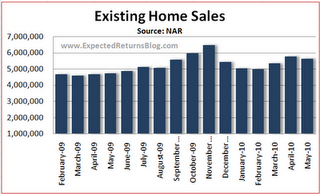
Existing-home sales, which are completed transactions that include single-family, townhomes, condominiums and co-ops, were at a seasonally adjusted annual rate of 5.66 million units in May, down 2.2 percent from an upwardly revised surge of 5.79 million units in April. May closings are 19.2 percent above the 4.75 million-unit level in May 2009; April sales were revised to show an 8.0 percent monthly gain.


Weak NAR report that reflects the lack of demand even with sub-5% mortgage rates and tax credits. Economists forecast existing home sales to rise 5% to 6.06 million, so this is a big miss.

The second round of housing stimulus has been underwhelming, lagging the peak in home sales seen in November. This after 6 months of a supposedly recovering economy.

Inventories and Months of Supply
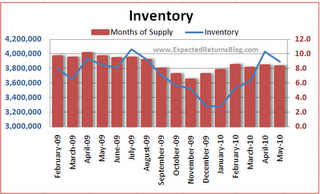
Total housing inventory at the end of May fell 3.4 percent to 3.89 million existing homes available for sale, which represents an 8.3-month supply at the current sales pace, compared with an 8.4-month supply in April. Raw unsold inventory is 1.1 percent above a year ago, but is still 14.9 percent below the record of 4.58 million in July 2008.


Inventories and months of supply remain elevated above healthy market levels. With home sales leveling off, we will likely see a supply shock in the second half of 2010.

As expected, we are starting to see the beginnings of the double dip in housing that will coincide with the double dip in the broader economy.

This post has been republished from Moses Kim's blog, Expected Returns.

Wednesday, June 23, 2010

What Can Be Learned From A Negative Decade For Stocks

Investors might be questioning the traditional approaches to investing after a decade of negative gains in stocks, however, the negative decade is not without precedent. By creating a diversified portfolio covering multiple asset classes and rebalancing their investments on a regular basis, investors will likely experience positive gains over the long-term. See the following post from The Capital Spectator.

Carl Richards, a financial planner who blogs for The New York Times, laments the fact the equity investing has been distinctly unimpressive over the past decade plus. Earning a risk premium in the stock market "is a function of pure luck," writes the founder of Prasada Capital.

It's easy to understand why investors might be frustrated. The S&P 500's annualized total return for the 10 years through the end of May 2010 is slightly negative: -0.82% a year, according to Morningstar Principia software.

Looking at such uninspiring results motivates Richards to write: "This is why so many of us who have been investing for 15 years feel as if we are about back where we started, even if we did everything right (assets allocated, properly diversified, didn’t bail out at the bottom and so on)."

But let's not be hasty in drawing hard and fast conclusions about asset allocation and strategic-minded investing. Let's start by recognizing that the S&P 500 does in fact post a positive annualized return of 6.8% over the past 15 years. A $10,000 investment in the S&P on June 1, 1995 would have grown to nearly 27,000 by the end of last month, based on Principia calculations. Back to where we started? Hardly.

If you've been investing for 15 years and "did everything right" and still don't have much, if anything to show for it, you're obviously doing something wrong. It's not hard to imagine what that might be. If a know-nothing strategy of buying and holding an S&P 500 index fund can generate a tidy gain over 15 years, it takes real effort to throw that away. What are the possible reasons for missing out on the S&P's rise? All the usual suspects come to mind, including going off the deep end in picking individual stocks and excessive trading in and out of the index.

But what about the last 10 years? A slightly negative return for stocks over a healthy stretch of time is a tough fact to swallow. How should we think about that dismal performance? Is there something strange going on in the land of equities? Not really. Annualized 10-year returns for the S&P 500 over various holding periods since the 1930s have ranged from nearly 20% down to roughly flat to slight losses, according to Ibbotson Associates. Granted, most of the time the return is in the 5-15% range, but history reminds that outliers do arrive. Expecting otherwise requires ignoring the historical record.

In any case, most investors should hold a portfolio comprised of multiple asset classes. The full range of investable assets for the average investor includes stocks, bonds, REITs and commodities. The first cut in breaking these broad asset definitions into a finer array of buckets might look something like this:


In fact, passively holding the broad array of asset classes weighted by market value would have delivered a 3.7% annualized total return over the past decade, based on the Global Market Index (GMI), the proprietary benchmark of The Beta Investment Report. Simply rebalancing the mix in the table above back to the passive weights on an annual basis would have boosted GMI's return to 4.6% over the past 10 years. Unusual? No, not at all. A number of studies over the years suggest that a basic rebalancing strategy of multiple asset classes can add 50 to 100 basis points of return vs. the identical portfolio that's otherwise unmanaged. It's not a sure thing, of course, but there's no convincing evidence that suggests you shouldn't expect a rebalancing bonus over the long haul.

The point is that every investor should start thinking about strategy by considering two simple techniques that require no skill or forecasting prowess: 1) diversifying across asset classes using index funds and/or broadly invested actively managed funds; and 2) rebalancing the mix on a regular basis. There are no guarantees that these techniques will always and forever deliver positive returns, much less stellar returns. And in the short term, anything's possible, including steep losses and equally steep gains. But history suggests that asset allocation and rebalancing are a powerful mix when used prudently.

Are there other things you can do to juice return, lessen risk, or tap a bit of both? Yes, but the choices beyond steps one and two entail more risk and some degree of skill is required, and perhaps luck as well. Deciding if you want (or need) to move beyond steps one and two requires careful thought and more than a little research.

By contrast, the first two steps are no-brainers. They're hardly a short cut to easy money, but asset allocation and rebalancing are powerful tools for minimizing the odds of saying you're sorry a decade down the line.

This article has been republished from James Picerno's blog, The Capital Spectator.

Lack Of Home Sale Surge In May Raises Concerns

Contrary to industry expectations, US housing sales declined in May 2010 and the inventory of unsold homes increased slightly. While the US median home sale price increased slightly, the outlook for the housing market remains in question. See the following post from The Mess That Greenspan Made.

Much to the surprise of those who thought the U.S. housing market would enjoy another buying surge during the final two months of the homebuyer tax credit, the National Association of Realtors reported that home sales fell last month and remain far below the levels reached late last year when the first round of tax credits expired.


Of course, seasonal adjustments play a big role in the November-May comparison shown above since, normally, late fall sees the beginning of a dramatic slowdown in buying activity and the raw data is typically adjusted upward. But, nevertheless, the comparison is still quite striking and one can only imagine where the sales totals will go in July when no government money gets handed out with each home purchase.

Existing home sales fell 2.2 percent last month, from an upwardly revised annual rate of 5.79 million in April to 5.66 million in May, and the inventory of unsold homes remains quite elevated, the months of supply metric falling only slightly from 8.4 to 8.3 months, well above the low of 6.5 months back in November.

The median sales price for all types of homes sold was $179,600, up 2.7 percent from a year ago, and the number of distressed home sales continued to slow, down from 33 percent in April to 31 percent in May, far below the peak level of 50 percent back in early-2009.

Living in some dreamworld located far, far away from planet Earth, NAR President Vicki Cox Golder, said that home prices are stabilizing:
With distressed sales at roughly the same level as a year ago, the gain in home prices is a hopeful sign that the market is in a good position to stand on its own without further government stimulus.
As for Chief Economist Lawrence Yun, he’s a bit less sanguine, more concerned about those homebuyers who may not meet the June closing deadline in order to get their government money:
We are witnessing the ongoing effects of the home buyer tax credit, which we’ll also see in June real estate closings. However, approximately 180,000 home buyers who signed a contract in good faith to receive the tax credit may not be able to finalize by the end of June due to delays in the mortgage process, particularly for short sales.

In addition, many potential sales are being delayed by an interruption in the National Flood Insurance Program. Florida and Louisiana, also impacted by the oil spill, have the highest percentage of homes that require flood insurance.
Naturally, the realtors’ trade group supports the efforts of Congress to extend the closing deadline by a few months, but, based on developments in Washington yesterday, this does not seem likely.

This post has been republished from Tim Iacono's blog, The Mess That Greenspan Made.

Tuesday, June 22, 2010

European Countries Aim To Bring Down Deficits

Faced with mounting deficits, some European countries have made recent moves to reduce government spending and raise taxes in order to stave off bankruptcy and restore confidence in their currencies. While the US continues to engage in deficit spending, that left unchecked can lead to unpalatable consequences. See the following article from Dollar Collapse for more on this.

On its long journey to the land of bankruptcy, the Western world recently arrived at the last and most important crossroad. One branch led to a 1930s-style collapse under the weight of already-accumulated debt, while the other led to hyperinflation, as printing presses ramp up to stave off collapse.

The U.S. didn’t even slow down; it instantly veered down Inflation Lane and has spent the past couple of years nationalizing everything in sight with newly created paper. Europe, on the other hand, has been vacillating. After keeping the U.S. company for a while, it got a little glimpse of what lies ahead: loss of confidence in the currency that’s being inflated away — and career change for the responsible politicians. With a plunging euro and pound threatening to make future borrowing prohibitively expensive, they’ve headed back to the crossroad and taken the other path, and are now cutting spending and raising taxes in an attempt to restore confidence in their currencies. See:

ECB’s Noyer Says French Deficit Targets Realistic

European Central Bank board member Christian Noyer on Sunday said France’s aim to bring its budget deficit down to 3 percent from 8 percent of GDP by 2013 was realistic.

Noyer was echoing a similar pledge by Prime Minister Francois Fillon at the weekend who said France planned to cut its deficit by 100 billion euros over the next three years, in part by slashing expenditures and eliminating tax exemptions.

Europe embraces the cult of austerity – but at what cost?

Eurozone finance ministers were still committed to spending their way to recovery only a few months ago. Then came the Greek debt crisis, which threatened to engulf the continent. Despite warnings from the US, Britain and its EU neighbours are braced for unprecedented public sector cuts

So the questions become:

Is it too late to stave off the collapse of systems burdened by debts and public pension obligations that dwarf the economies themselves?

Will the voters who lose benefits or pay higher taxes under the new austerity plans put up with it?

Will the slowdown that inevitably results from sucking 5%-8% of GDP out of the public sector lead panicked European governments to cut across the nearest open field to catch up with the U.S.?

Based on how much these guys owe and the immensity of their future obligations, it’s a near-certainty that all three questions will be answered in chaotic, unpleasant ways. Which illustrates the key truth of the modern world: When you borrow too much money your life becomes unmanageable and your choices unpalatable.

This article has been republished from John Rubino's blog, Dollar Collapse.

The Yuan Continues To Negatively Impact The Economic Recovery

The Chinese yuan continues to negatively impact the US economic recovery, even as the Federal Reserve acts to keep interest rates low. With the US dollar still artificially overvalued against the yuan, demand for US goods and services continues to decline and increase fears of US deflation. See the following article from The Street for more on this.

When the Federal Reserve Open Market Committee meets Wednesday, no one expects it to raise the federal funds rate -- the overnight bank rate that now hovers below 0.25%. However, businesses, politicians and prognosticators are eager, perhaps inappropriately so, to hear clues about when it will begin raising short-term interest rates to a more normal level.

Simply put, Fed policy is much less relevant to U.S. growth and price stability than in the days of Paul Volcker. That's because China's yuan policy has substantially limited the importance of Fed interest rate decisions by severing the historic link between short interest rates -- like the federal funds rate it targets -- and long rates on mortgages, corporate bonds, and the securities banks use to finance lending on cars and credit cards.

Through the boom years of the last decade, Beijing printed yuan to purchase hundreds of billions of dollars in foreign exchange markets. That made the yuan and Chinese products on U.S. store shelves artificially cheap, and imports from China, coupled with higher prices for imported oil, pushed the U.S. trade deficit to more than 5% of gross domestic product from 2004 to 2008.

When Americans spend that much more abroad than foreigners purchase in the United States, American goods pile up in warehouses and a steep recession will result, unless Americans spend much more than they earn or produce.

During the boom, China facilitated such folly by using its dollars to purchase U.S. Treasury securities, and that kept U.S. long interest rates artificially low even in the face of Federal Reserve efforts to rein in spending.

From 2003 to 2006, easy terms prevailed on mortgages, homeowner lines of credit, car loans, and credit cards even as the Fed raised the federal funds rate. Americans borrowed against their homes, pushed real estate prices to unreasonable levels and spent on Chinese goods at Wal-Mart (WMT) until the credit bubble burst in late 2007 and 2008.

China continues to recklessly print yuan to buy dollars and U.S. Treasuries, and all those yuan are creating inflation and real estate speculation in China that Beijing can't contain.

With the dollar still overvalued by some 40% or 50% against the yuan, the U.S. trade deficit with China, and other Asian countries practicing similar currency mercantilism, is growing again. This deficit saps demand for U.S. goods and services, slows U.S. recovery, suppresses U.S. land values and fuels fears of deflation in the United States, even though the U.S. banking system is flush with cheap credit from the Fed.

The fact is nothing the Fed does can appreciably accelerate U.S. economic recovery or stem deflation as long as China continues to print yuan, buy dollars and U.S. securities, and make its products woefully cheaper than its comparative advantage warrants in the United States and Europe.

Coupled with its high tariffs and administrative barriers to imports on anything the Chinese can make themselves, no matter how awkwardly or inefficiently, Beijing is hogging growth and jobs and spreading unemployment and budget misery among workers and governments from Sacramento to Athens.

This past weekend, Beijing announced it will permit some more exchange rate flexibility, but we have heard those words before. China will likely permit the yuan to rise slightly against the dollar -- much less than 6% a year -- while the true value of the yuan rises much more, thanks to Chinese modernization and productivity improvements.

China's announcement is a cynical ploy to assuage critics less than a week before G20 meetings, and without a substantial one-off revaluation of the yuan, Beijing's words are hypocritical and selfish.

China's yuan policy makes the Fed nearly irrelevant but for crisis management such as bailing out big banks and European governments that make fatal mistakes.

Worse, President Obama's failure to take strong action against Chinese currency manipulation -- for example, a tax on dollar-yuan conversion to make the price of Chinese products reflect their true underlying cost -- crippled the jobs creation effectiveness of his $787 billion stimulus package and delivers ineffective his broader efforts to resurrect the U.S. economy.

Obama's exclusive reliance on diplomacy forfeits U.S. monetary policy to Beijing, renders impotent U.S. fiscal policy, and visits enormous pain on American workers.

This article has been republished from The Street. You can also view this article at The Street, an investment news and analysis site.

Monday, June 21, 2010

The Erosion Of Public Faith In Currency

While politicians may steer away from comments that might result in creating panic about the potential long-term impact of governments' growing deficits, the reality is that public faith in the current currency systems is eroding. With governments continuing to print trillions of dollars to prop up short-term economic gains, individual investors are realizing the truth and buying gold. See the following post from The Mess That Greenspan Made.

If the price of gold were not soaring, baffling the likes of Fed Chief Ben Bernanke who seems to think it is just an ordinary commodity and a monetary relic, it might be a little more difficult to explain to economists like Paul Krugman why there is a big move toward austerity now sweeping the globe. But, it is, so it’s not.

Despite the best intentions of the dismal set that has cajoled governments into printing trillions of dollars in recent years in an ineffectual attempt to sustain that which is unsustainable, a lot of people are now more scared of a currency collapse or some other systemic breakdown of a failed system than they are of breadlines. Sadly, this reality seems beyond the grasp of some economists, the most recent example being this commentary where the author doesn’t even know why no one will explain it to them.
Press German officials to explain why they need to impose austerity on a depressed economy, and you get rationales that don’t add up. Point this out, and they come up with different rationales, which also don’t add up. Arguing with German deficit hawks feels more than a bit like arguing with U.S. Iraq hawks back in 2002: They know what they want to do, and every time you refute one argument, they just come up with another.

Here’s roughly how the typical conversation goes (this is based both on my own experience and that of other American economists):

German hawk: “We must cut deficits immediately, because we have to deal with the fiscal burden of an aging population.”

Ugly American: “But that doesn’t make sense. Even if you manage to save 80 billion euros — which you won’t, because the budget cuts will hurt your economy and reduce revenues — the interest payments on that much debt would be less than a tenth of a percent of your G.D.P. So the austerity you’re pursuing will threaten economic recovery while doing next to nothing to improve your long-run budget position.”
Only those who possesses an unwavering faith in paper money and its central bank stewards fail to see that people are losing faith in the current system and figure that maybe we ought to dial back on the money printing and borrowing because the only real good it’s done is to enrich those bankers who survived. The system is failing and people are realizing this – that’s why they’re buying gold and for a politician to come out and say this would only make the situation worse in the near-term. It’s really not that complicated.

This article has been republished from Tim Iacono's blog, The Mess That Greenspan Made.

The Long-Term Bullish Trend In Gold

Moving in and out of gold in response to short-term trends is a risky strategy. By examining long-term trends in the economy and the decline of public confidence, it is clear that gold is well positioned to rise in the near and foreseeable future. See the following post from Expected Returns.

It's that time of year again when gold bears go into a self-inflicted, shame-filled, multi-month hibernation. Gold continues to be the most "crowded" trade around as confidence in the global currency system collapses and as citizens riot around the globe. But oh wait, jewelry demand in India is down so it's time to sell gold!

Gold bears fancy themselves as contrarians, when in fact, they are stuck in the delusions of their mind. Investors who succeed in the long run constantly question their paradigms. I too had false preconceived notions about gold until I (gasp) opened a book and tried to understand its real underlying fundamentals. I soon figured out that most people had no idea what the hell they were talking about. As you can imagine, this is an investor's dream. Skepticism is fuel to the fire of any bull market.

Technically gold looks very strong. Most technical analysts would tell you the following chart is bullish. In the short run you have rising moving averages and a confirmed ascending triangle pattern.


Most people would also agree that the following long term chart is bullish. Gold has not gone parabolic yet.


So my question is: Why do people insist on fading this obvious bull market? It just makes no sense.

I hope my readers are thinking beyond the grade school level at this point. Don't give deflation and jewelry demand arguments any more thought than is warranted. Gold can rise in a deflationary environment and also when jewelry demand is weak. Gold also rises at turning points in public confidence. If confidence in our leaders were a stock, its current price action would resemble that of Fannie Mae, Lehman, and Bear Stearns before their respective collapses. In other words, confidence is on its way to 0.

I've been pretty firm for months now that this is the beginning of a monster intermediate term move. Don't get too cute trying to trade in and out of this market. The gold thesis is predicated on long-term fundamentals that are irreversible. Whenever you lose faith in the gold story, just listen to a Ben Bernanke speech; he is your number one ally. Bernanke is trying to prevent a Depression-style deflationary collapse when the conditions between then and now are different. This is a big mistake. The result will be an inflationary spiral and much higher gold prices.

This article has been republished from Moses Kim's blog, Expected Returns.

Friday, June 18, 2010

Five Major Cities Considering Bankruptcy

With pension and healthcare liabilities mounting to unsustainable levels, the city of San Diego is considering filing for bankruptcy protection so that it may restructure its assets and liabilities. A civil service system that allowed retired city employees to collect generous pension benefits and apply for and receive pay from city jobs is part of what helped to create the current financial mess the city is in. See the following post from The Mess That Greenspan Made.

Joe Mysak at Bloomberg files this report on how one California city might extricate itself from pension and benefit obligations that it has no realistic chance of ever meeting.
The city of San Diego should consider Chapter 9 municipal bankruptcy to help it reduce fringe benefits, pension and health obligations.

That’s one of the suggestions made by the San Diego County Grand Jury, which does the normal duties of recommending indictments as well as reporting on local governments and special districts.

San Diego is the fifth major city in the U.S. this year, and the second in California, where people are talking about bankruptcy as a means to “restructure and reorganize their assets and debts while providing relief from current and future obligations,” in the words of the grand jury’s 22-page report, published on June 8.

San Diego has unfunded liabilities of $2.2 billion in its pension plan and $1.3 billion for health care, which the report calls “unsustainable.”

More than two years of cutting budgets and the mounting public pension crisis have made the unthinkable an option, maybe even an attractive one.
Having lived in Southern California for many years, there were many stories to be heard about how you could get rich working for the City of San Diego and, apparently, a lot of people did. Double-dipping was common. Not the recession double-dip you hear so much about today, but the widely practiced “retire and then get rehired” career move where individuals collected both a retirement check and a regular paycheck while still in their 50s.

It’s not hard to understand why they now have such a mess on their hands.

This post has been republished from Tim Iacono's blog, The Mess That Greenspan Made.

Job Numbers Lack Any Significant Trend

New unemployment filing trends continue to bounce around as the US economy continues a sluggish recovery. While some see current trends as an indication that new job growth in nonfarm sectors is stalling or declining, analysts believe that it may take months before a clear trend in the labor market can be identified. See the following post from The Capital Spectator.

Today’s update on weekly jobless claims is more of the same. New filings for unemployment benefits continue to bounce around in the seasonally adjusted weekly range of 450,000-500,000. That’s been true all year, and today’s report doesn’t change anything. The longer this goes on, the stronger the case for thinking that the rebound in the labor market is going to be sluggish—perhaps more so than even the generally muted expectations of a month ago.

As for the number du jour, new claims rose by 12,000 last week to a seasonally adjusted 472,000, the Labor Department reported today. That’s obviously a change in the wrong direction, but we’ve been here before and we may be here for a while yet. As our chart below shows, the trend for jobless claims has been trendless since last November. The sideways action isn’t unprecedented in post-recession periods, but the potential for trouble this time is substantially higher, given the unusually steep losses in nonfarm payrolls over the past two years.

"We need faster growth in employment, and we’re not at that point yet," Michael Englund, chief economist at Action Economics LLC, told Bloomberg News in advance of today’s report. "Whether we have adequate economic growth to bring down the unemployment rate significantly remains to be seen."

Indeed. Economic data rolls out with a substantial lag, and it takes months to see signs of a robust trend, for good or ill. The labor market news of late has been mixed, at best. Today’s jobless claims suggest it’s best not to expect much more, if that, in the weeks ahead. The meandering of jobless claims signals that it may be time to downgrade expectations for growth in nonfarm payrolls. The May employment report said more or less the same thing.

And on the subject of downgrading expectations, don’t expect much of anything tomorrow in the way of fresh statistical meat. Friday’s scheduled lineup of economic updates is nil. Into this numerical abyss comes tomorrow's quadruple witching for the markets. The absence of economic news and the potential for lots of unwinding in derivatives approaches. It’s a perfect metaphor for the road ahead. Lots of noise, light and heat, but nothing really changes much.

"We're going to see a lot of back and forth action," predicts Brian Belski, chief investment strategist at Oppenheimer and Co. via CNBC.com. "It's a trader's paradise."

This post has been republished from James Picerno's blog, The Capital Spectator.

Thursday, June 17, 2010

Is Cutting Social Security On The Table For US Debt Reduction?

While deficit hawks declare that cutting Social Security and Medicare benefits must be part of any strategy to protect the US financial security, some analysts believe that it is unnecessary. History has shown that the US can survive high debt to GDP levels; what is really needed is a revamp of the banking system says James Galbraith. See the following post from Economist's View.

Jamie Galbraith says that "the 'national security' case for cutting Social Security and Medicare is bogus":

The national security shell game, by James K. Galbraith, Commentary, LA Times: Deficit hawks are using national security as an excuse to seek cuts in Social Security and in Medicare...

In late May, the Obama administration released its National Security Strategy... A few lines make passing reference to "medium-term deficit reduction." But when Secretary of State Hillary Rodham Clinton appeared at the ... Brookings Institution to discuss the National Security Strategy, three of the six questions she was asked harped on the deficit issue, with one questioner calling it "potentially, if not actually, the biggest single national security threat to the United States."

Clinton agreed, declaring that it is time to "make the national security case about reducing the deficit and getting the debt under control." ... On this, she and the Brookings deficit hawks are wrong. Was World War II, for example, won with balanced budgets? No. Deficits ran about 25% of GDP every year of the war, and the national debt had reached 121% of GDP by 1946. Was the United States weakened by this? Hardly. America had never been stronger than it was in 1946. And afterward, the economy didn't implode. The debt-to-GDP ratio merely declined, year after year...

"Everything must be on the table," we're told, as the Simpson-Bowles commission prepares to explain why Social Security and Medicare must be cut. But why? Social Security and Medicare are ... successful, popular programs that protect America's elderly from poverty. ... Social Security and Medicare are ... the most important bulwarks of middle-class life in America. And we can afford them. A rich nation can always afford modest retirement benefits and decent healthcare for its old. ...

The real cause of our deficits and rising public debt is our broken banking system. The debts our economic leaders deplore were largely due to the collapse of private credit, and to the vast giveaways the federal government made to banks to prevent their failure when credit collapsed. ...

The "national security" case for cutting Social Security and Medicare is bogus. In economic terms, it's just a smokescreen for those who would like to transfer the cost of all those bank failures onto the elderly and the sick.
The relationship between the deficit and defense spending doesn't get enough attention. The question for me is whether we can make cuts in defense spending without compromising security, and it's my view that we can.

This post has been republished from Mark Thoma's blog, Economist's View.

Banks Vow To Get Tougher On Strategic Defaults

As the volume of US foreclosures continues to rise, lenders are becoming more aggressive in pursuing home owners who purposely default despite being able to afford to pay the mortgages. In some cases lenders are seeking repayment if the amount owed was more than the sale price. See the following post from The Mess That Greenspan Made.

One of the latest development in the nation’s housing crisis looks like it will further erode the already strained relationship between borrower and lender as banks seem intent on collecting on the losses they’re taking when underwater borrowers sell their property in a short sale or are foreclosed on. This story in the Washington Post has the details:
Over the past year, lenders have become much more aggressive in trying to recoup money lost in foreclosures and other distressed sales, creating more grief for people who thought their real estate headaches were far behind.

In many localities — including Virginia, Maryland and the District — lenders have the right to pursue borrowers whose homes have sold at a loss to collect the difference between what the property sold for and what the borrower owed on it, also called a deficiency.

Before the housing bust, when the volume of foreclosures was relatively low, lenders seldom bothered to chase after deficiencies because borrowers had few remaining assets to claim and doing so involved hassles and costs. But with foreclosures soaring, lenders are more determined to get their money back, especially if they suspect borrowers are skipping out on loan they could afford, an increasingly common practice in areas where home values have tanked.

“Lenders are not going after people who face a hardship,” said John Mechem, a spokesman for the Mortgage Bankers Association. “If they can’t pay their mortgage because they have a loss of income, there is no point in going after them.

“Those who had a second mortgage, such as a home-equity line of credit, in addition to their primary mortgage may find themselves particularly vulnerable, especially if they tapped into the equity line for cash.
From the banks’ perspective, this makes good sense, particularly in those cases where borrowers really abused the system by taking all the money that was being offered a few years ago by the very same banks that are now seeking redress. Of course, this makes the banks look like angry crack dealers or loan sharks which, to some degree, they are.

This post has been republished from Tim Iacono's blog, The Mess That Greenspan Made.

Wednesday, June 16, 2010

How To Legally Own Gold Outside The US

According to Dr. Steve Sjuggerud, you can legally own gold outside the US in an account without having to report it since the government does not consider gold a financial asset. While some prefer to keep their gold where they can see it, holding gold in a Perth Mint Certificate can protect your investment from government confiscation. See the following post from Daily Wealth.

I got some terrible news yesterday...

My friend Glen Kirsch died.

I was surprised to hear it... Just three weeks ago, Glen and I were chatting about gold and how to hold it offshore. I wanted his ideas, and I wanted the specifics. Glen, as always, delivered.

Glen and his business partner Michael Checkan have been reliable contacts for me in the gold world since I started writing investment newsletters in the 1990s. They run a firm called Asset Strategies International and have helped pioneer a few interesting products, including one called the Perth Mint Certificate Program.

I've known about Perth Mint Certificates for many years... I know they're a simple, safe way to hold gold. But I never actually thought of these certificates as legally owning gold outside the U.S. However, that's exactly what they are... and that makes them extremely interesting now.

You see, the government really wants to know if you have money in a foreign bank account. When you mail in your taxes, you have to report if you have one. The fear is that by reporting those accounts, you've made it easy for the government to confiscate the money someday, even if it's held overseas.

But (and you might get a laugh out of this one) the government doesn't count gold as money.

It doesn't consider gold a financial asset. So holding gold in a foreign country doesn't count as owning a foreign bank account. There is no reporting requirement. This puts it out of the immediate grasp of the government. If it can't "see" what you have... it can't take it!

This "loophole" has been around for a long time. But to me, the idea of shipping a bunch of gold bullion overseas... and then storing it where? In a garage or a bank somewhere? It just didn't seem that practical.

So awhile back, I asked another friend of mine, Joel Nagel, "What's the most practical, easy way to hold gold overseas?"

Joel said, "Well, you could buy a Perth Mint Certificate."

I felt like a knucklehead... It was so obvious.

Buy a certificate, receive it in the mail, and boom! You now own gold offshore.

Specifically, with a Perth Mint Certificate, you own physical gold held at the Perth Mint in Australia. It's guaranteed by the government there, it's fully insured by Lloyd's of London, and it has both internal audits and independent audits. I've personally been to the Perth Mint and have seen the gold.

I wanted to verify the specifics, so a few weeks ago I got in touch with Glen... "Glen, can a Perth Mint Certificate be redeemed through you [at Asset Strategies International] in the States? Can someone get their cash through you?"

Glen replied, "The answer to both questions is YES!" Now that's convenient: Your gold is in Australia, out of reach of the U.S. government. But you can easily cash it in right here in the States.

Many people prefer to hold physical gold themselves, believing that the safest place for it is in their possession... And that's fine, too. To each his own. But Perth Mint Certificates are probably the easiest, safest way to buy gold and hold it overseas.

You are in full compliance with U.S. law. But at the same time, by holding gold offshore, you have made it more difficult for the government to reach into your account and take your wealth.

For more on Perth Mint Certificates, call Michael or Rich Checkan at Asset Strategies (800-831-0007) or e-mail info@assetstrategies.com.

This post has been republished from Dr. Steve Sjuggerud's blog, Daily Wealth.