Monday, May 31, 2010

Paper Money Versus Gold

Tim Iacono takes on the gold critics, including Warren Buffet who said gold has no utility. He argues that gold critics tend to ignore the weaknesses of paper money including its poor record of storing value. See the following post from The Mess That Greenspan Made.

How can you write an entire article that bashes gold (e.g., how it has no intrinsic value, pays no dividend, etc. ) and not once mention the negative attributes of paper money – what replaced gold for good (supposedly) about 40 years ago?

Really! Think about it for a second. You can’t.

Why? Because once you start talking about how you don’t really need a gold standard or anything backing a currency so long as governments and central banks act prudently, you realize that governments and central banks are completely incapable of doing so over long stretches of time and the end result will always be the destruction of the currency.

But that’s what Brett Arends does in this report on investing in gold and, in the process, he quotes famed investor Warren Buffett who also seems to be deficient in this area:

Warren Buffett put it well. “Gold gets dug out of the ground in Africa, or someplace,” he said. “Then we melt it down, dig another hole, bury it again and pay people to stand around guarding it. It has no utility. Anyone watching from Mars would be scratching their head.”

It’s a currency “substitute,” but it’s useless. In prison, at least, they use cigarettes: If all else fails, they can smoke them. Imagine a bunch of health nuts in a nonsmoking “facility” still trying to settle their debts with cigarettes. That’s gold. It doesn’t make sense.
Honestly, the Wall Street Journal has been one of the more enlightened mainstream media outlets when it comes to gold, but this really sets them back a few notches in my view.

This is like something that you’d read in Money Magazine.

With the help of Wikipedia, let’s review what’s sorely missing from this story by recalling the most important attributes of “money”, whether its pure fiat money or dumb ‘ol gold coins.

Medium of exchange
When money is used to intermediate the exchange of goods and services, it is performing a function as a medium of exchange. It thereby avoids the inefficiencies of a barter system, such as the ‘double coincidence of wants’ problem.

Unit of account
A unit of account is a standard numerical unit of measurement of the market value of goods, services, and other transactions. Also known as a “measure” or “standard” of relative worth and deferred payment, a unit of account is a necessary prerequisite for the formulation of commercial agreements that involve debt.

* Divisible into smaller units without loss of value; precious metals can be coined from bars, or melted down into bars again.
* Fungible: that is, one unit or piece must be perceived as equivalent to any other, which is why diamonds, works of art or real estate are not suitable as money.
* A specific weight, or measure, or size to be verifiably countable. For instance, coins are often made with ridges around the edges, so that any removal of material from the coin (lowering its commodity value) will be easy to detect.

Store of value
To act as a store of value, a money must be able to be reliably saved, stored, and retrieved – and be predictably usable as a medium of exchange when it is retrieved. The value of the money must also remain stable over time. In that sense, inflation by reducing the value of money, diminishes the ability of the money to function as a store of value.

While paper money does exceedingly well as both a medium of exchange and a unit of account, when governments and central banks are given free reign with a nation’s currency, it functions horribly as a store of value, a point that, somehow, is glossed over in every single negative story about gold.

Arend’s report uses the word “value” twice, first noting that “gold is hard to value”. Duh!

Then, the author does what every other gold-basher does and cites what happened in 1980 – when Fed chairman Paul Volcker crushed the gold price (along with inflation) by raising interest rates to almost 20 percent.

As for being a “store of value,” anyone who bought gold in the late 1970s and held on lost nearly all their purchasing power over the next 20 years.

Yes, the next twenty years were not kind to gold investors but they are not representative of the other 6,000 years since Man discovered the yellow metal, a period that is also notable for the dearth of responsible central bankers and elected officials.

As for Buffett’s comments, I suspect Martians – or any life form more advanced than ours – would be far more surprised that there is nothing backing any currency on this planet than they would be that a scarce commodity was used as money. They’d scratch their heads and say, “How do you prevent the government from printing too much of the stuff?”

This article has been republished from Tim Iacono's blog, The Mess That Greenspan Made.

The Relationship Between Government Debt And Economic Growth

While a prominent research paper has shown a relationship between high levels of government debt and slower growth, it is not known whether a causal relationship exists. The last time the US had a debt to GDP ratio was this high was following World War II. See the following post from The Capital Spectator for more on this.


Paul Krugman questions the central finding in a new Reinhart-Rogoff research paper that focuses on the apparent linkage between government debt and economic growth. The study ("Growth in a Time of Debt") has been cited in the discussions in Washington re: the budget deficit, as The Hill reported here. The central point in the paper: when debt rises to 90% of GDP, growth "deteriorates markedly," according to Carmen Reinhart, an economist at the University of Maryland and co-author of the paper. Krugman isn't so sure. "It’s based on a crude correlation," he charges, "and as soon as you look at specific examples, it starts to look all wrong."

Krugman argues that high debt doesn't cause slow growth; rather, it's the other way around. In the case of Japan, he writes: "surely we believe that Japan’s financial crisis is what both slowed growth and increased debt." Something similar applies to Europe, he adds.

As for the U.S., the country is now just under the 90% debt/GDP ratio threshold. Is this something to worry about? No, Krugman suggests, although he doesn't say that directly. But his comments suggest as much. Drawing lessons from history for the U.S. is complicated by the fact that the previous instance of a 90% debt/GDP ratio was just after World War Two, which did in fact witness slow growth. This is a bad example, Krugman advises, mainly because the country was winding down from a war stance.

The Reinhart and Rogoff study acknowledges that war tends to boost debt, explaining,

In principle, the manner in which debt builds up can be important. For example, war debts are arguably less problematic for future growth and inflation than large debts that are accumulated in peace time. Postwar growth tends to be high as war-time allocation of manpower and resources funnels to the civilian economy. Moreover, high war-time government spending, typically the cause of the debt buildup, comes to a natural close as peace returns. In contrast, a peacetime debt explosion often reflects unstable underlying political economy dynamics that can persist for very long periods.

It's hard to prove anything definitive in economics, and so there's always reason to doubt a given relationship. Consider the fierce debate over the business cycle and the stock market. The S&P 500 has a tendency to peak ahead of recessions. Some say this is evidence that the stock market anticipates a downturn in the economy. The implication: the market's pricing in a perceived threat of a future shock. But another school of thought charges that a falling stock market—the proverbial popping of "the bubble"—triggers the subsequent economic downturn, or at least is a contributing factor of some consequence.

Krugman and others worry that the debt/GDP ratio argument of Reinhart and Rogoff will give deficit hawks additional political influence in Washington. The possibility is a two-way street, however. If embracing Reinhart and Rogoff means letting the hawks have more say over fiscal policy, the opposite is true if the debt/GDP concept is minimized.

It's almost certainly wrong to say that reaching a 90% debt/GDP ratio always and forever guarantees slower growth. There are always exceptions, and perhaps the U.S. will beat the odds, as it so often has in its economic history. But we shouldn't be too quick about dismissing the relationship identified in the Reinhart and Rogoff paper. The study crunches the numbers on 44 countries going back 200 years. Clearly, there's a risk when debt rises. How much of a risk, and the exact relationship is debatable, but it's surely more than negligible.

Krugman's right that closer study is required to figure out if slow growth causes high debt vs. the other way around. But it's hard to imagine that relatively elevated levels of debt are immaterial to the prospects for growth.

Correlation isn't causation. But that doesn't mean that we should ignore correlation when it seems to make sense. The U.S. faces what may be a turning point of critical economic significance. The stakes are high, in part because the red ink is rising and the prospects for growth are questionable. Debt may not be fate when it comes to future growth, but it's a risk factor, and one that may be rising as we write.

The real challenge at the moment is finding the right balance between avoiding the mistakes of the Great Depression while doing all that's reasonable to ensure that the economic recovery continues. This is mostly a monetary policy issue. As Scott Sumner argues (persuasively, in my view), the Fed could be doing more to juice the economy.

Meantime, one has to ask if we're threatening growth prospects with higher levels of debt? Maybe. History seems to suggest as much. And since we haven't yet explored the full possibilities of monetary policy techniques, a la Sumner and others, maybe we ought to try before allowing the fiscal deficits to rise further on the assumption that Keynesian stimulus is the only lever left to pull.

This post has been republished from James Picerno's blog, The Capital Spectator.

Saturday, May 29, 2010

Falling Money Supply And Rising Debt Are Bad Signs For The US Economy

A rapid fall in M3 and M2 money supply and the decrease in the Treasury market's 10-year inflation forecast are reviving concerns about deflation. To make matters worse, the US debt is approaching 90 percent of GDP, a level that historically slows growth. See the following post from The Capital Spectator.

The pundits are buzzing about the rapid decline in the money supply of late. The latest catalyst for the chatter is a story yesterday in the Telegraph, which ran this provocative headline: “US money supply plunges at 1930s pace as Obama eyes fresh stimulus.”

The story goes on to report:
The M3 money supply in the United States is contracting at an accelerating rate that now matches the average decline seen from 1929 to 1933, despite near zero interest rates and the biggest fiscal blitz in history.
Monetary economist Tim Congdon from International Monetary Research tells the Telegraph that the descent in the money supply is "frightening." He says that "the plunge in M3 has no precedent since the Great Depression. The dominant reason for this is that regulators across the world are pressing banks to raise capital asset ratios and to shrink their risk assets. This is why the US is not recovering properly."

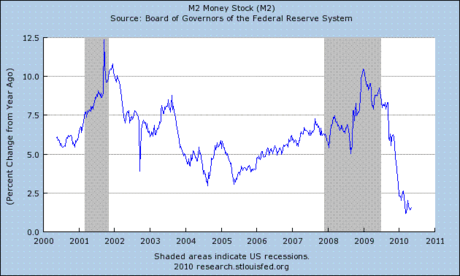
The Federal Reserve no longer publishes M3, although the underlying components are still available and so the series can be calculated by anyone inclined to do so. Unsurprisingly, other measures of money supply are falling too. The annual percentage change in M2, for instance, has been dropping like a rock for months, as the chart below shows.


The trend is more than a little worrisome, given the recent rise in deflation risk, albeit a mild rise and therefore one that may yet turn out to be a false alarm. The markets are constantly forecasting the future, but the forecasts aren't 100% accurate. Figuring out when they're wrong is the trick. That said, the Treasury market's 10-year inflation forecast has dipped under 2% over the past week or so for the first time since last October. So far, the market's inflation outlook is holding steady at around 1.9%, as the second chart below shows.


Did the Treasury market overreact? Is the threat of deflation overstated? Maybe, although the steep fall in the money supply is one reason for wondering. Another is looking around the world and seeing that the D risk is on the rise in Britain and Japan. Deflation in the U.S. and U.K. "cannot be ruled out," warned Adam Posen (external member of the Monetary Policy Committee and senior fellow at the Peterson Institute for International Economics) in a speech earlier this week.

Economist Carmen Reinhart, co-author of This Time Is Different: Eight Centuries of Financial Folly, made a similar observation yesterday. As the The Hill reported

The level of U.S. debt has reached a point at which economic growth traditionally begins to slow, a bipartisan fiscal commission making recommendations to the White House and Congress was told Wednesday.

The gross U.S. debt is approaching a level equivalent to 90 percent of the country's gross domestic product, the level at which growth has historically declined, said Carmen Reinhart, a University of Maryland economist.

When gross debt hits 90 percent of GDP, Reinhart told the commission during a hearing in the Capitol, growth "deteriorates markedly." Median growth rates fall by 1 percent, and average growth rates fall "considerably more," she said.

Reinhart said the commission shouldn't wait to put in place a plan to rein in deficits.

"I have no positive news to give," she said. "Fiscal austerity is something nobody wants, but it is a fact.

Gross debt is at 89 percent and will reach 90 percent by the end of the year, said Sen. Kent Conrad (D-N.D.), a member of the commission.
The warning signs are mounting. Much depends on how the Fed conducts monetary policy from here on out. Nominal interest rates are low, virtually zero in fact. But as Scott Sumner, an economist who blogs at The Money Illusion, has repeatedly counseled, it's still possible to have tight money and low nominal rates. As such, deflation may still be a risk at this point in the economic cycle. The solution? Growth. In particular, growth in a number of key economic metrics in May and beyond. But collecting and publishing the relevant data will take time. It'll be a while before we definitively figure out if all the deflation talk is really just talk.

This article has been republished from James Picerno's blog, The Capital Spectator.

Thursday, May 27, 2010

Government Debt Approaches "Point Of No Return"

Tim Iacono points out that governments must start facing the fact that the growing debt will need to be dealt with in ways that will likely be very painful. The alternative is to keep ignoring the problem which will inevitably lead to a dangerous "point of no return" in which no one believes that the debt can be serviced or paid back. See the following post from The Mess That Greenspan Made.

Recent developments in the euro zone that increasingly look like they will lead to the restructuring (if not the collapse) of one of the world’s major currencies and the potential for this “contagion” to move first north to the U.K. and then west to the U.S. have many people wondering what’s gone wrong with the global monetary system.

How could advanced Western economies have run into such trouble?

With trillions of dollars in debt now transferred from private sector balance sheets onto those of governments (where very different rules apply), could the problems seen in mainland Europe today spread to the British Isles and then to the U.S. where fiscal and economic conditions are, arguably, even worse?

Despite all the talk about slashing budgets in the former and upward revisions to economic growth forecasts in the latter, it seems clear that these two Anglo Saxon nations are not yet clear of danger and, if that danger comes, we may see something that rhymes not-so-nicely with the events of late-2008 as history is not prone to repeating exactly.

How did it come to this point of staring into the abyss and, perhaps, falling in?

In a word, the problem is “debt”.

Too much of it.

There are those who say that, like many things in life, a little debt is a good thing and this is very true.

Credit markets connect investors and entrepreneurs, both of whom presumably understand the risk that is involved, and when a good idea gets a little money behind it, wonderful things can happen – economic growth, job creation, and rising standards of living to name just a few.

And borrowing by governments is not necessarily a bad thing.

We all like new roads and bridges and, just like when a family buys a house, it’s difficult to make such big outlays with cash. Governments borrow to pay for costly infrastructure work just as households finance the purchase of new homes costing two or three times their annual income (at least that’s the way it used to be).
New Debt Not the Same as the Old Debt

Unfortunately, the borrowing and spending that has gone on over the last few decades in most of the Western world (not coincidentally, since the entire global monetary system lost its last tether to anything resembling a system of sound money) seems far removed from any of these “a little debt goes a long way” examples that, by and large, benefit society.

Over the last 30 years, a rapid expansion of credit and debt has been one of the major reasons why economies have grown at such an impressive pace and why asset prices have risen so high, but all the new debt hasn’t gone to build bridges and buy modest homes.

Up until recently, no one really seemed to notice the difference.

Having gone on for so long, it’s no wonder that most economists, analysts, and investors so quickly extrapolate these prior decade’s results into the future. But, a judgment like that assumes the system as we’ve come to it know since the days of the “Reagan Revolution” is sustainable and, after the events of the last few years, it should be clear that this is now at least a question that should be asked.

Sadly, too few are asking that question.

Now, just a year or so removed from the worst financial crisis since the Great Depression, we seem to be quickly approaching some sort of debt threshold – a “point of no return” that may have already been reached in parts of Europe – where no one believes that the massive amount of debt can still be serviced, let alone paid back.

Of course, unlike companies and individuals, sovereign governments with their own currencies have the option of paying back their debt with a currency that they can depreciate – by printing up more of it.

That certainly seems to be the explanation for why the “wolf pack” – those CDS, FOREX, and bond traders who insist on making ever larger bets against whichever country they deem the weakest – have left the U.K. and the U.S. alone.

At least, so far.

Anyone looking solely at deficits as a percent of GDP or debt-to-GDP ratios would surely have concluded that it’s not the eurozone (as a whole) that has a debt problem, it’s the U.K. and the U.S., both of whom seem happy to continue whistling past the graveyard.

Yes, there’s Japan too, but, as should be clear by now, being able to finance government deficits from domestic savings makes a big difference in when your “point of no return” starts to cause big problems.

Many claim that, under the stewardship of Ben Bernanke, we’ve avoided another Great Depression in the U.S. and that the borrowing and creation of trillions of dollars in order to do so is simply “the cost of doing business”.

Some say, “Hey, financial market panics happen every so often, and this one will just cost a little more to clean up than the previous ones.”

For today’s policymakers, the fact that trillions of dollars in debt have been transferred from the private sector to the public sector seems to be but a footnote to the history that is now being written and, while there is mounting concern about who’s going to bail out the central banks who bailed out the governments who bailed out the private sector, there’s far too little serious consideration of the possibility that all this amounts to simply rearranging the deck chairs on the Titanic.
A World of Debt Addicts

There is far too little admission of the basic problem here.

The entire West has become a group of debt addicts – governments, corporations, and individuals – and, instead of trying to have an intervention, we’re just giving lip service to the idea that we’ve spent too much money that we didn’t have and that we can’t continue to do so.

Like a true addict in desperate need of an intervention, current thinking is that, after being nursed back to health from what was a very nasty hangover – the worst yet – we’ll kick this habit for good, but, doing so now would just be too much to bear.

Unfortunately, we’ve heard that all before when the hangovers were far less extreme and, at this point in the discussion, perhaps the loss of brain cells due to excess consumption of alcohol is a more appropriate metaphor…

The current path is clearly unsustainable.

Why doesn’t someone just stand up and say, “Let’s just have a miserable next five years and clean up this mess rather than relegating the entire developed world to a lost decade … or two?”

Why?

Because the path back to a more reasonable lifestyle – where income better matches up with outlays and printing presses need not be run so often – is believed to be too hard.

Politicians have made promises that they can’t keep but they keep getting reelected because a lot of people in the world really believe that there is such a thing as a free lunch.

Now, that may be changing and one need look no further than in the U.S. where a growing percentage of the citizenry seem to like the idea of getting less from their government before the fact.

How they react when the cuts begin to affect them is a discussion for another day.

But, when you think about it, why should wealthy individuals collect social security when they don’t need it and why should public employees be so handsomely compensated when the government must borrow money to do so?

We’ve come to a crossroads where an unsustainable system of expanding credit and debt seems to have reached its upper bound and there are no pain-free ways to make the system sustainable again.

The problem is too much debt and the solution involves pain.

It’s time that we all got used to that idea.

This post has been republished from Tim Iacono's blog, The Mess That Greenspan Made.

The Euro Causes More Problems Than It Solves

Peter Morici at The Street argues that the Euro has also caused more problems than it has solved by taking away currency flexibility from poorer countries while rich countries like Germany prosper in the single continental market system. Poorer countries are having a difficult time convincing their citizens that they can afford the same extensive social benefits as other countries in the Eurozone. See the following post from The Street.

European banks and global financial markets have been roiled by needless artifacts of postmodern Europe: the euro and malignant social safety nets.

For decades, European population and economic growth have been perilously handicapped by overly generous social benefits that discourage individual risk-taking and business entrepreneurship.

On both sides of the pond, progressives blame inadequate taxation but concede some curtailment of benefits is needed in less-affluent European states.

In a modern market economy, only a fool would not acknowledge an appropriate tension exists between welfare -- assistance for the truly needy and aged -- and efficiency -- policies that empower the rest of us to work and invest vigorously. Excessive coddling and taxation discourage people from working their full productive lives. They also discourage business innovation.

Multiyear unemployment and huge severance benefits, guaranteed health care for the able-bodied who refuse to work and other affectations of Europe's sympathetic face of capitalism surely cross those lines. However, like an alcoholic who knows he must quit drinking, Europeans have avoided the cure for decades by peddling bogus schemes to rekindle growth.

The 1992 Maastricht Treaty, which considerably harmonized product and safety standards and methods of taxation across the continent, was supposed to remove untold barriers to growth. It didn't, because European labor laws and social benefits still make individual ambition and investment in Europe about as sensible as my still unfulfilled dream to be Italy's prime minister.

The single currency, the euro, introduced in 1999 to facilitate commerce across borders from Ireland to Greece, was heralded as the next great elixir.

The euro addressed a problem that didn't truly exist and created new ones. Before it's introduction, the European Currency Unit linked at fixed rates the national currencies of many of today's eurozone countries. The dollar and the ECU were accepted in international commercial transactions.

However, each country could print its domestic currency and occasionally devalue or revalue against the group as circumstances required. With the euro that flexibility was taken away from poorer countries like Portugal, Spain, Greece,and Ireland. Tough EU restrictions on national budget deficits, reminiscent of U.S. state constitutional requirements for balanced budgets, were supposed to avoid that necessity.

Sadly, although Germany, like New York, greatly prospers by participating in a huge single continental market, Brussels cannot tax Germany to subsidize Greece's welfare state in the same way Washington taxes New York to subsidize Mississippi's Medicaid. And that is not likely to happen anytime soon.

With all that wealth to itself, Germany provides gold-plated employment security and jobless benefits, short work weeks and the like, portrays itself a model of Euro-efficiency, and lectures Greece on Teutonic frugality.

Germany can only afford those benefits because it doesn't share its wealth with Greece. Athens can't scale back social benefits to truly affordable levels, without political upheaval, because its population does not understand why they can't enjoy the same perks as Germans.

The International Monetary Fund is telling Spain to radically overhaul labor laws, pensions and other social benefits or become the next Greece. Unfortunately, the less wealthy European countries cannot coexist in the eurozone with wealthier profligate states like Denmark, German and France -- domestic politics won't allow it -- and the rich states cannot perpetuate the fantasy that they pay for the benefits through their own productivity alone if the poorer ones spin off.

Once upon a time, the European Economic Community -- remember that quaint post-World War II institution? -- thrived without a single currency. A larger European Union can thrive again, but it needs to jettison the fantasy that the benefits of capitalism can be accomplished without adequate incentives to work hard and invest.

Free-market capitalism is the greatest engine of progress conceived by man -- unless, of course, it was divine inspiration -- but it cannot survive with the heresy that the benefits of capitalism can be accomplished without both risks and rewards.

This post has been republished from The Street, an investment news and analysis site.

Wednesday, May 26, 2010

Can A Value-Added Tax Solve The US Debt Problem?

At The Street, Peter Morici discusses how it's no longer far fetched to imagine a Greece-like debt crisis in the US. An unsustainable budget imbalance is prompting some in the government to suggest a value added tax to increase government revenues. See the following post from The Street.


Greece is insolvent -- no austerity or new taxes will pay its debts.

Like a homeowner owing four times income, belt-tightening and a longer repayment period aren't enough. Either the house is sold to clear the debt, or the bank takes back the house. Greek bondholders don't have that choice; they can't repossess the Parthenon.

Greece is a sovereign country and either it will be the recipient of endless German largess -- an unlikely scenario -- or European creditors, banks among them, will take a loss.

Now, the International Monetary Fund bluntly warns Spain to avoid becoming the next Greece. It must radically overhaul labor laws, pensions and consolidate banks; that's tough for a sovereign that doesn't print money in the midst of a market panic.

Germany and European banks can't take that hit.

The next financial tsunami is emerging and will ripple to America, just as our mortgage debacle gave Europe fits.

Liberals on Capitol Hill and at the New York Times interpret this to mean Europe needs to toughen up on tax scofflaws and fine-tune Euro socialism.

Wrong. If governments in Athens, Madrid and other European countries collected all the taxes levied, their populations would have to eat sand. Post-modern Europe is failing under the weight of its own financial self-abuse.

Despite huge deficits, officials of the Obama administration and the Federal Reserve say it can't happen here because we have lots more room to tax, and the United States prints dollars, which is the global currency.

Don't bet the ranch on that.

With the new health care law, the U.S. has a social safety net that rivals Europe, and is more expensive. For example, the U.S. spends 19% of gross domestic product on health care, while Germany spends 12% for essentially the same outcomes.

Now, liberals want a value-added tax. After all, the United States has a safety net like Europe so why not taxes like Europe?

Not so fast.

Europeans pay value-added taxes and income and corporate taxes too, but pay little for health care and higher education; the government uses taxes to pick up the tab.

With a VAT, U.S. individual and business taxpayers would have tax burdens comparable to Europeans but would still face hefty bills for private health insurance and college tuition that Europeans don't bear.

The health care law contains firm commitments about scope of coverage and benefits guaranteed each citizen, but it is soft about bringing down higher U.S. drug, medical professional fees, administrative costs, and malpractice costs into line with Europe.

No one wants to take on public or private universities -- professors are junk yard dogs imbedded in the media.

Unless Barack Obama and the governors want to take on those vested interests, the combination of higher taxes, health insurance premiums and college tuition will break the middle-class and make the country as ungovernable as Greece or Spain.

Excessive borrowing will cause the bond market to render the same judgment on Washington as it will for Athens and Madrid.

High interest rates will compel Washington to print so much money that the kind of hyper-inflation that brought down the German Weimar Republic will result.

After Spain, for whom does the bell toll?

It tolls for America!

This post has been republished from The Street, an investment news and analysis site.

Tuesday, May 25, 2010

Without Government Incentives, Housing Inventory Could Start Expanding

Moses Kim discusses the signals that suggest a pending double dip in housing including a growing inventory of REO homes. This trend is expected to continue as government stimulus for housing is winding down. See the following post from Expected Returns.

From the NAR:
Existing-home sales rose again in April with buyers motivated by the tax credit, improving consumer confidence and favorable affordability conditions, according to the National Association of Realtors.

Existing-home sales, which are completed transactions that include single-family, townhomes, condominiums and co-ops, increased 7.6 percent to a seasonally adjusted annual rate of 5.77 million units in April from an upwardly revised 5.36 million in March, and are 22.8 percent higher than the 4.70 million-unit pace in April 2009. Monthly sales rose 7.0 percent in March.


Home Sales

Homebuyers reacted predictably to low mortgage rates and tax credits by buying up existing homes. But also keep in mind that foreclosures are considered to be existing home sales. Since foreclosures are still rising, existing home sale figures are slightly skewed.

Inventories Rising
Total housing inventory at the end of April rose 11.5 percent to 4.04 million existing homes available for sale, which represents an 8.4-month supply at the current sales pace, up from an 8.1-month supply in March. Raw unsold inventory is 2.7 percent above a year ago, but remains 11.6 percent below the record of 4.58 million in July 2008.
Inventories have been on the steady uptrend, and this is very negative for housing moving forward. Only delay tactics from banks and tax incentives from the government have kept inventories from exploding. As REOs rise, we should see inventories increase considerably.


All the variables are in place for the double dip in housing to occur shortly. We have exhausted much of the buying power of potential homebuyers via government incentives, and the rising trend in inventories suggests supply and demand will meet at a lower price level.

This post has been republished from Moses Kim's blog, Expected Returns.

Long Term Versus Short Term Threats To The Economy

While US debt is expected to reach 60 percent of GDP this year, James Picerno describes the threat of a double-dip recession as a more urgent matter. The period following a deep recession tend to be dangerous times for a recovering economy, and the European debt crisis is making matters worse . See the following post from The Capital Spectator.

Everyone knows that the U.S., and most of the mature economies around the world, are swimming in a sea of red ink. The great unknown is the degree and form of the blowback. The optimistic view is that the pain will be relatively mild and that the recovery in the world economy will help nations grow their way out of the problem. But what if growth isn't sufficiently strong or durable? In that case, the future may be quite a bit less rosy than the optimists predict.

The bond market recently has been pricing in a somewhat darker outlook, as we discussed last week. Stock and commodities markets are now joining the party, as the selling bias of late suggests. The only thing worse than a load of debt weighing on the economy is a load of debt that triggers a general decline in prices. To the extent that a hefty debt load is a contributing catalyst, we can't yet rule out that possibility. As the sobering assessment of the Committee for a Responsible Federal Budget asserts,

The current fiscal path of the United States government is unsustainable. For the past forty years, our debt-to-GDP ratio has averaged around 40 percent. This year, it is projected to exceed 60 percent, the highest point since the early 1950s. Under the President’s budget proposals, the fiscal situation will continue to deteriorate even as the economy recovers. By the end of the decade, debt is projected to be 90 percent of GDP, approaching our record high of around 110 percent after World War II. Things will deteriorate further as the Baby Boom retirement accelerates. Ten years later, the debt is expected to be well over 150 percent of GDP. By 2050, it is projected to be over 300 percent and still heading upward.
But history reminds too that recoveries after unusually deep recessions are a precarious beast. Focusing on budget austerity at this juncture may be self defeating if deflationary risks are again percolating, as the Treasury market appears to be telling us. Yes, inflation is a long-run risk, but not now, not today. What's required now, more than ever, is growth. But as Robert Kuttner reminds, "Austerity does not produce prosperity." At least not at this point in the economic cycle, even if fiscal rectitude is necessary and essential for the years ahead.

Some analysts warn that we shouldn't rule out a double-dip recession. In fact, avoiding another leg down in the broad economy is priority one, two and three. The risk also looms for Britain and the eurozone.

Welcome to the proverbial rock and the hard place. A double-dip recession isn't fate, at least not yet. As we wrote yesterday, we still expect the economy to muddle through, although that may not suffice to keep the big risks at bay. In short, a sustainable economic recovery isn't guaranteed. Much depends on how governments and investors react in the weeks and months ahead.

The biggest test in the post-Great Recession era is... now. Forget the past 12 months. That was in many ways a misleading signal of what awaits. As we've argued many times on these pages and in The Beta Investment Report, bouncing off of end-of-the-world prices is a one-time affair. That's over and the real economic challenge is upon us. Exactly what that means has yet to be determined. The details are inextricably bound up with debt, and how much pressure it puts on the global economy.

There will be many twists and turns on the road ahead, rife with lots of questions that lack obvious and compelling answers in the here and now. The one that currently looms: Will the European fiscal crisis trigger a global retrenchment in economic activity? No, according to Treasury Secretary Timothy Geithner. But the markets aren't yet inclined to agree and prefer instead to discount the risk a bit more these days.

This Post has been republished from James Picerno's blog, The Capital Spectator.

Billionaire Investor Bets Majority Of Wealth On Gold And Precious Metals

While most investors in gold allocate just a small portion of their portfolio to precious metals, billionaire Thomas Kaplan has made a bold bet on gold. His strong belief that global economic instability will increase demand for gold has led him to invest a majority of his wealth in gold and other precious metals. See the following post from The Mess That Greenspan Made.

It looks like it’s going to be another wild week for financial markets. Stocks are tumbling around the world as another big bank failure in Spain echos the late-2008 U.S. banking crisis. The price of gold is rising smartly, right along with the trade-weighted dollar (which is almost never a good sign), as more and more investors around the world question the durability of the global monetary system that consists exclusively of paper money.

Here’s one more investor who doesn’t think much of the current system – mild mannered billionaire Thomas Kaplan - from a weekend feature article in the Wall Street Journal.

A Billionaire Goes All-In on Gold

Gold is setting records again, boosting the holdings of central banks, Armageddon worrywarts, and ordinary people who own gold bars, coins and jewelry.

But few individuals stand to benefit as much as low-profile billionaire Thomas Kaplan. A New York-born commodities magnate who earned a doctorate in British colonial history at Oxford, Mr. Kaplan oversees an empire devoted largely to gold.

Many fund managers and high-rollers have allocated small percentages of their portfolios to gold as a hedge against inflation. But Mr. Kaplan is the bull of bullion. He has gone further than perhaps any other major investor, betting the majority of his wealth on gold and other precious metals. And it reflects his deeply held conviction that global economic instability could bring rising demand for gold.

Through his firm, Tigris Financial Group, and affiliates, Mr. Kaplan has loaded up on bullion and bought up properties in 17 countries on five continents, where geologists are exploring for more.

Together, his holdings amount to a nearly $2 billion bet on gold, more than the Brazilian central bank’s bullion is currently worth.
It’s funny to think that, a few years ago, anyone saying, “I keep the bulk of my personal wealth in gold bullion and mining stocks” would have been looked upon as some sort of a nut – either of the tin-foil hat or black helicopter variety. But, not so much anymore.

This article has been republished from Tim Iacono's blog, The Mess That Greenspan Made.
Monday, May 24, 2010

Demand Falls For Purchases Of Foreclosed Homes

Homebuyers interested in purchasing foreclosed or distressed properties dropped in May 2010 compared with the same period last year. Concerns about risks associated with the buying process and the potential for home values declining were among the key reasons homebuyers cited as influencing their negative perception of purchasing a foreclosed or distressed property. See the following article from The Mess That Greenspan Made for more on this.

In this story at the Orange County Register’s Mortgage Insider blog, Marilyn Kalfus provides some shocking data on how potential homebuyers view distressed properties these days.
The public has less interest now in buying foreclosed homes than it did a year ago, a new survey shows, prompting concern about who will buy all the repossessed homes coming on the market and the effect on a housing recovery.

Consumers who would consider purchasing a foreclosure dropped to 45% this month from 55% last May, according to an online Harris Interactive survey conducted for Trulia.com and RealtyTrac.com

The survey showed that among those who cite a downside to buying a foreclosure — and there are actually somewhat fewer than last year: 78% vs 85% – more are worried about the risk and possible loss of value than a year ago:

Rick Sharga, senior vice president of Irvine-based RealtyTrac, a foreclosure website, suggested that potential homebuyers are becoming more realistic about the time and effort it can take to buy a foreclosure at an auction, renovate a foreclosed property or even pull off a short sale.
As someone who is actively shopping for a home (no word back from the bank yet on our short-sale offer) this comes as quite a surprise to me, but, then again, maybe paying cash and looking at the tens of thousands of dollars difference in asking price doesn’t have the same impact as when you’re looking at the more modest difference in monthly payments.

This post has been republished from Tim Iacono's blog, The Mess That Greenspan Made.

Data Suggests Higher Deflation Risk In Months Ahead

Although recent economic data is encouraging, concerns about the risk of deflation appear to be rising. While fundamentals have not changed, it will take more positive economic data and results to reduce investors concerns about global economic trends. See the following from The Capital Spectator for more on this.

Earlier this week we pondered the potential for higher deflation in the months ahead. One of the suggestive clues was the falling inflation forecast as implied by the shrinking spread between the yields on the nominal and inflation-indexed 10-year Treasuries. At the time, the market was priced for inflation at 2.13% for the decade ahead (as of May 18). A mere 48 hours later, the market-based forecast dropped sharply: Treasuries yesterday anticipated inflation at 1.89%--the first reading under 2% since last October.

The Treasury market is subject to all the usual imperfections when it comes to implied forecasts and so we should be cautious in reading too much into any one day's numbers. But this much is clear: the market's perceived risk of deflation is running higher these days. Given the magnitude of the change, we should think twice before dismissing the message. Indeed, as our chart below shows, there's been a sharp deterioration in sentiment this month in the market's inflation outlook. At the end of April, Treasuries expected 10-year inflation on the order of roughly 2.4%, or some 50 basis points higher vs. yesterday's numbers.


A new round of deflationary risk is unwelcome, of course. Although we're still a long way from a sustained decline in prices across the board, it's not too early to consider the hazard anew, as the latest rush into Treasuries suggests. That's a change for the worse relative to recent history. For six months or so, it looked like the deflation threat had been vanquished. It may yet prove to be so. But there are more than trivial doubts arising today.

Ironically, last month witnessed a long-awaited rise in new business loans. For the first time since October 2008, the monthly tally of commercial & industrial loans approved at commercial banks was higher, according to the Federal Reserve. Although the rise was slight, it was a step in the right direction for thinking that the central bank was finally inducing higher levels of lending again in the corporate sector—a necessary step for thinking that the economic expansion was taking root. Indeed, C&I loans were the last major holdout in the recovery over the past year in terms of showing positive change.


But suddenly there's a fresh wave of doubt. The apparent catalyst is Greece and the debt woes of Europe. But these concerns aren't new. In early February, for instance, we observed that the anxiety over debt and deflation was very much in the air. What's changed? Nothing, really, other than the market has reassessed the red ink challenge and decided the fallout may be worse than previously thought. Pricing risk for the threat du jour is invariably an imperfect science, and one subject to revision. That's been working to our advantage over the past year; now it's swinging the other way. Divining the future is a risky business, with the estimates forever in flux.

Meantime, the world awaits more economic data. The numbers that have been supporting the case for growth so far this year are suddenly ancient. The labor market's apparent return to minting new jobs on a net basis now requires a fresh batch of supporting data to fend off deflationary fears. Ditto for thinking that C&I loans are headed higher. In fact, everything may be reassessed in the days and weeks ahead. What's needed to stabilize sentiment and convince the crowd that the glass is half full rather than half empty? New numbers that show that the recent signs of economic growth were more than a statistical blip; more than a dead-cat bounce.

It was always the case that the apparent recovery was going to be tested. The massive slump that was the Great Recession was never going to fade away quickly and seamlessly. Instead, the restoration of growth was going to come in fits and starts, and keep everyone guessing at times. Back in January, considering the year ahead, we asked: "Will the economic rebound build a head of steam that's self sustaining?" Our forecast at the time: "It's going to a close call." That still looks like a reasonable prediction at the moment. Wiping away doubts born of the deepest recession since the 1930s was destined to take time. But as mere mortals, we're all subject to thinking positively when the recent data looks encouraging. We're not likely to make that mistake again any time soon.

The cause of recovery has taken a hit. It's not fatal, but it's not trivial either. For the moment, it's all about sentiment. And, perhaps, the sentiment is wrong. But for now, it takes a card-carrying contrarian to make the case that the optimism of recent months wasn't misplaced.

"The risk is skewed towards deflation right now," Dimitri Delis, fixed income strategist at BMO Capital Markets, warns. Until—and if—we see economic reports to the contrary, risk aversion is the new new thing…again.

This article has been republished from James Picerno's blog, The Capital Spectator.

Friday, May 21, 2010

Are We In The Middle Of A Megatrend In Gold?

More than just a hedge against inflation, the price of gold has served as a reflection on the level of public confidence throughout history. With a housing crash, record low approval rates of the US government, and global riots, the current decade has started on a note of low public confidence – which should translate into explosive growth for gold prices. The following post from Expected Returns has more on this.

As I've mentioned repeatedly in the past, gold is perhaps the most misunderstood asset in the world. Try to explain to people the true nature of gold and expect to be greeted with petulant disdain. It took more than a little arm twisting for me to convince people that gold is a currency and not a commodity. With a bona fide meltdown hitting Europe, people are starting to wake up and smell the roses.

Gold will eventually trade at obscene levels because of a collapse in public confidence. Only then will people realize that it was only public confidence that propped up our entire monetary system.

The confidence model suggests there will be a day of reckoning. The confidence model is dynamic, for it accounts for the vagaries of human nature. As Newton so famously quipped, "I can calculate the motion of heavenly bodies but not the madness of people."

Humans are slaves to false paradigms. We think in terms of bell curves and linear progressions. We presume order in markets when, in fact, chaos reigns supreme. Linear models fail to predict the truly monster moves because the world is dynamic. For example, models cannot predict stock market crashes because they are fueled by panic selling and human vicissitude. Likewise, you simply cannot model the type of panic buying that will come into the gold sector as public confidence collapses.

Gold is unique because it serves as a global referendum on public confidence. Humans always behave the same historically; they mimic the crazy behavior of others. Why do you think the French Revolution followed the American Revolution? It is this "contagion effect" that leads me to believe civil unrest will intensify around the world. With rising civil unrest comes collapsing public confidence.

Inflation Hedge or Government Stupidity Hedge?

Is gold an inflation hedge? Yes to an extent. But the inflation argument is far too simple for it doesn't explain the rise of gold in the 1930's - a clear deflationary period. It also doesn't explain the $1000 dollar rise in gold over the past 10 years in a period of mild inflation.

To truly understand gold, we must look at the 3 periods over the past century when gold made major moves: the 1930's, the 1970's, and the present. The 1930's was a period of deflation; the 1970's was a period of massive inflation; and the present is a period of neither inflaton nor deflation. So what theme unifies all three periods?

The collapse in public confidence.

Baby Boomers often remark that the last time they remember public confidence so low was the 1970's. You know what? They're right. Here's a quick rundown of the 1970's.

1970's


Failed war in Vietnam. Richard Nixon. Collapse of Bretton Woods. Watergate. Price controls. Oil price shocks. Hostage crisis in Iran. Jimmy Carter. Stagflation.

This was a period of low public confidence. Gold exploded.

The 80's and 90's

Ronald Reagan. Paul Volcker. 1989 and Fukuyama's "The End of History". The fall of Communism. Bill Clinton. Budget surpluses. Bull market in stocks. Mild price inflation.

This was a period of high public confidence. Gold promptly collapsed.

2000 to the present

9/11. Terrorists. George Bush. Bear market in stocks. Stock market crash. Housing crash. Bailouts. Budget deficits. Record low approval ratings for Congress. Tea party protests. Failed wars in Iraq and Afghanistan. Global riots.

We are in a period of low public confidence. Gold is flying.

Conclusion

What I'm trying to offer my readers is a different way of looking at the world. It is never so simple as inflation vs deflation, good economy vs bad economy, or high interest rates vs low interest rates. We live in a complex world. Most analysts, quite frankly, do not have even an elementary understanding of gold. Think big picture folks. There are way too many indicators pointing to much higher gold prices. Make no mistake about it, we are in the middle of a megatrend in gold that will be fueled by a collapse in confidence. All gold projections go out the window when human emotions are involved, and believe me, we will see panic buying eventually.

This article has been republished from Moses Kim's blog, Expected Returns.

Low Interest Rates Are Discouraging Americans From Saving

The likelihood that the Federal Reserve will continue to keep interest rates low through 2010 and possibly until 2012 is bad news for savers, who today are experiencing record low returns on their money. As interest rates continue to remain low, the irony is that borrowers – who were largely responsible for the high levels of consumer debt that contributed to the current economic situation – are being rewarded for their behavior, while savers must wait until the Fed starts boosting interest rates to recover. See the following post from The Mess That Greenspan Made.


In the decades ahead, it really will be interesting to look back at this era of economic and financial market stewardship by those with their hands on the interest rate levers and printing press controls as one of the most glaring examples of something that is fundamentally wrong at this stage in the debt collapse is this notion that, a low consumer price index provides a green light to help borrowers and, as a result, punish savers.

This AP report on the subject covers all the usual topics.
It’s a good time to buy a car, refinance a mortgage, hit the road or shop for clothes.

Invest in a saving account? Forget it.

Consumer inflation has all but disappeared, the government reported Wednesday. The Federal Reserve may now be emboldened to keep interest rates at record lows well into next year — and possibly into 2012.

Yet for savers, the prospect of persistent record-low rates is a downer. It means no relief from puny returns any time soon. The average yield on a one-year certificate of deposit has sunk to 0.7 percent, according to Bankrate.com. That’s the lowest since Bankrate starting tracking the figure in 1983. Rates hovered as high as 5.5 percent around 2000, according to Bankrate.

Unlike everyone else, savers won’t benefit until the Fed starts boosting interest rates. Yet prospects for the Fed to start pushing up rates in the fourth quarter of the year seem to be fading. More economists now think an increase won’t happen until next year…

The very idea that domestic savings is not a crucial component of the early 2000s U.S. economy will have them scratching their heads in the future. They’ll say, “I can’t believe they really just thought they could borrow and spend indefinitely – as if it was some sort of perpetual free lunch – and then when the economy went off its rails they could just borrow and print even more money to get things working again. What were they thinking?”

This post has been republished from Tim Iacono's blog, The Mess That Greenspan Made.

Thursday, May 20, 2010

Is There A Double Standard For Wall Street And Main Street?

Banks have responded to the taxpayers bailout by foreclosing on homeowners, raising credit card rates and tightening credit. This circumstance has unintentionally created an environment where it may make more sense for beleaguered homeowners to walk away from their underwater properties than spend years or even decades trying to recover. See the following article from The Street for more on this.

The story goes like this: Big financial institutions make risky bets that blow up. The government decides that many of these financial firms are "too big to fail" or present a "systemic risk" and organize the largest bailout in the history of mankind. Somehow (hmmm ... politics maybe? Nah, can't be), other companies outside the financial industry such as General Motors, Freddie Mac (FRE) and Fannie Mae (FNM) also get bailed out. Since the government is a referee of money and does not itself "make" money, it is "we the people" who bailed out these companies. We'll see how they say "thank you" in a little bit.

All of the money that you earned from Jan. 1 to April 9, 2010, went to federal, state, and local tax obligations, according to taxfoundation.org. . So you and me worked in the fields for three months so we could send enough money to the King to operate our government and keep us safe. Well, at least some of us sent that money. In 2009, 47% of Americans paid no federal income tax. But I digress, as I tend to do.

How do those big banks and financial institutions say "thank you" for the helping hand? By foreclosing on homeowners, raising credit card rates, and tightening credit.

As regular readers of this column know, I'm no socialist with a pitchfork but something has to give. The best part of a double standard is you're always on the winning side.

I decried the bailout because it would create, to use the dead horse buzzword, a "moral hazard." Translation: Instead of curbing the behavior that caused the crisis, financial institutions know going forward they have a "put" or a net underneath them that encourages more risk-taking, not less. (See the Family Guy episode where death takes a vacation. Classic).

When a business makes a bad decision and decides to cut a loss it's called a "prudent business decision," even if this decision violates a contract. The business knows the downside but after evaluating the pros and cons believes that walking away is the best course of action. "Why throw good money after bad?" is the business axiom. Shareholders clap and say, " Thank you, don't ever do that again."

In July 2008, Dow Chemical (DOW) announced it would acquire Rohm and Haas for $78 a share. Good times. Market going up, a whiff of something brewing about housing but no worries. Rock on!

Then all hell broke loose. Cue the financial crisis. Dow CEO Andrew Liveris, acting in his fiduciary duty to his shareholders, wanted to walk away from the deal. He was going to be underwater in a big way and couldn't let that happen. Rohm and Haas, of course, said "Deal with it. You made an agreement, live up to it. We don't care if our share price went down, eat it."

Welcome to the exact same situation millions of homeowners currently find themselves in today. The key difference is that many of the institutions telling homeowners to "eat it" are the ones that homeowners bailed out, just like the German soldier at the end of Saving Private Ryan.

Spoiler alert! I knew he was going to kill him.

What is an underwater homeowner to do? He bought at the height of the market but now his home is worth significantly less than what he paid. But the homeowner has a fiduciary duty to people more important than shareholders: his family. Financial firms tell the homeowners to pay anyway. The mortgage modification program has been a complete flop (see health care, future of) and many homeowners are getting crushed. Welcome to the new moral hazard that if not addressed now, will result in the freefall of the housing market and a dark future for consumers.

This debate is raging in the housing sector today. Some homeowners simply use "jingle mail," or send the keys back to the lender, knowing banks are loathe to foreclose and take the loss on their books. Other underwater homeowners, citing a "moral obligation," continue to pour money into a losing investment that may take years or even a decade to break even. I have news for these folks when they come down from their pedestal: There are no morals in business.

How do I know this? Simple. Everything would be done with a handshake. It's not. Contracts lay out what's "moral" and "immoral" so to speak in a business transaction and what happens when one side acts outside those lines. There are remedies for one side and penalties for the other.

I come from the U.S. military where your word was your bond. You trusted the people in your squadron with your life or they weren't in your organization. Period. Unfortunately, or fortunately, I learned that this same type of trust and morals didn't exist or were extremely rare in the business world. In some ways, business was mentally worse than combat; getting "shot" in the back by people I thought I trusted was devastating.

Oh and by the way, you wanna bet that these same financial institutions are using our borrowed money to bet against us, meaning that the debt "we" are taking on to loan "them" is unsustainable? Count on it. If I were the "Fabulous Fab" over at Goldman Sachs (GS) I certainly would be.

Firing Line: If there were morals in business, the institutions that we bailed out after the financial crisis would be a little more understanding with homeowners who made bad decisions like they did and work with them. It wasn't too long ago they were in the same situation. Now the shoe is on the other hand.

This post has been republished from The Street, an investment news and analysis site.

Potential Deflation Returns Following Dollar Rally

As the US consumer price index dropped last month amid earlier rallies in both the US dollar and gold, the possibility of deflation has returned. While long-term inflation remains a concern, James Picerno cautions that central banks and governments would be wise to focus first on curbing any deflationary risks that could more severely impair recovery from the global recession. See the following post from The Capital Spectator.

Last week, I advised that the unusual rallies in the dollar and gold this year may be a warning sign that deflationary winds are starting to blow harder. Historically, one falls as the other rises. The fact that both are climbing suggests the markets are worried about deflation...again. Today's report on April consumer prices only strengthens the case for thinking that the "D" risk is climbing once more. It may be a false warning, but it's getting harder to ignore.

The seasonally adjusted consumer price index (CPI) dropped 0.1% last month, the Bureau of Labor Statistics reported today. That's the first monthly fall in headline consumer prices in more than a year. The sharp drop in energy prices last month was a driving factor, but core CPI (which strips out food and energy prices) was flat in April, suggesting that there's more than a weak energy market to blame.

It's still too early to declare that deflation is again a broad and imminent threat, as it was in late-2008. But the "D" risk is higher, if only marginally. The primary catalyst: debt. The debt crisis in Greece has soured sentiment on the outlook for the eurozone and throughout the developed world. The world's attention has been refocused anew on the perils of debt and deficits in the new world financial order. As the mature economies struggle with rising levels of red ink, combined with less-than-robust forecasts for growth, the markets are turning cautious. That's inspired a new (and so far mini) flight to safety, which still means moving into dollars and, to a lesser extent, gold.

In a world where anxiety is once again on the march, if only slightly, it's no wonder that prices generally are weakening again. One month is hardly definitive proof of anything, of course, and so we can't draw hard and fast conclusions from a single monthly report on consumer prices. Rather, it's the trend that's important. Unfortunately, the trend offers little reason to think that disinflation (or its evil cousin deflation) is completely dead.

Consider the chart below, which shows the 12-month percentage change in core CPI. For the first time since 1966, the annual pace of core CPI last month dipped below 1%. More ominously, the 12-month change in core CPI has been falling sharply since December.


Headline inflation, which includes energy and food, offers a more reassuring trend, as the second chart below shows. Nonetheless, it's obvious that the reflation efforts have stalled of late. Headline CPI on a 12-month basis has rebounded sharply from last year's brief flirtation with outright deflation. The question before the house: Has it stabilized in the mid-2% range? Or is it poised to fall once again, dragged down by the deflationary winds that appear to be blowing?


The Treasury market seems inclined to expect more deflationary risk in the near future. The inflation forecast based on the yield spread for the nominal and inflation-indexed 10-year Notes was 2.13% yesterday—down from 2.45% on April 29, as the third chart below shows. Yes, that may be nothing more than the usual volatility in the Treasury market. But given the clues bubbling elsewhere in the global economy, we're not yet prepared to dismiss this forecast of falling inflation as statistical noise.


The next several weeks may prove crucial in confirming or rejecting the new deflationary worries. Indeed, it's still too early to dismiss the continuing liquidity creation by the world's central banks. In the long run, higher inflation is a virtual certainty. In fact, the risk of opening the door to overly high inflation for the generation ahead remains a concern. But not now. The path from here to there may yet be defined by fighting a new round of deflationary pressures.

Considering the hazards that outright deflation can impose on the prospects for economic recovery, it's obvious that keeping the "D" risk at bay is a battle that the central banks can't afford to lose. Growth is the only real hope of making progress in repairing the damage from the Great Recession. Everything from job creation to keeping the red ink from overwhelming national budgets is at stake. Even before the recent uptick in the deflationary threat, the outlook for economic growth was middling, at best, in the developed world. That somewhat uninspiring outlook now appears a bit more vulnerable. Exactly how vulnerable depends on what we learn in the economic reports in the weeks ahead.

For the moment, inflation is tame to nonexistent. Deciding if that's also a prelude to deflation is a live debate…again.

Even so, don't assume that the global economy can be summed up with one perspective. The hazards that lurk in the mature economies aren't always reflected in the developing world. "Chinese inflation might be out of control," warns Fortune.com today.

It's a complicated world. The common denominator: risk. There's still plenty to go around. Same old, same old. It just comes in a wider array of flavors these days.

This article has been republished from James Picerno's blog, The Capital Spectator.

Wednesday, May 19, 2010

Fears Of Global Inflation On The Rise

With European public debt on the rise, fears about inflation though out the world continue to increase. Top economists are not discounting hyperinflation as a potential outcome in Europe, while the Bank of England Governor stated expectations that inflation would recede. See the following post from The Mess That Greenspan Made.

Wow. You’d think that we all just did a time-warp back to the middle of 2008 based on today’s collection of inflation reports from around the world. Producer prices in the U.S. were down from March to April but are a full 5.4 percent higher than a year ago according to the Labor Department. It’s a good things those costs aren’t getting passed on to consumers because that would put real interest rates at … let’s not go there.

In Europe, where memories of hyperinflation from Weimar Germany are still vivid, they are petrified at the thought of where central bank money printing to fund the latest bailout might lead. Oh right, they say the bailout money is to be “sterilized” and won’t add to the money supply – we’ll see how that goes. Germany’s Der Spiegel notes in this report that the biggest danger from the bailout is a changed central bank.
There is a growing fear that a gigantic wave of debt will soon roll over Europe and the euro-zone countries will deal with it as elegantly and unscrupulously as they have so often done in the past — by allowing inflation to reduce their debts. These concerns are shared by more than just the notorious paper money skeptics who predict the return of hyperinflation.

Even serious experts like Joachim Fels, a top economist at Morgan Stanley, have no qualms about addressing the likelihood of such a development. Although it is an extreme scenario, says Fels, it certainly cannot be dismissed out of hand. At the very least, the central bank can apparently “no longer resist the temptation to use inflation to reduce the mounting public debt.”
The way things have been going lately, maybe it isn’t nearly as extreme as Mr. Fels thinks.

In the U.K., inflation just jumped to a 17-month high of 3.7 percent, up from an annual rate of 3.4 percent the month before, and you know what that means – Bank of England Governor Mervyn King has some ’splainin to do in the form of writing a letter new Chancellor George Osborne who surely has other things on his mind.

This story in the Telegraph has the details.

Mr King said today inflation was likely to fall back to its 2pc “within a year”, adding that inflation had been “somewhat higher than expected over the past year”.

The governor said the temporary factors were “masking the downward pressure on inflation” from the slack in the economy built up in a record recession.

Mr King added that policymakers had not ruled out further emergency support to the economy, potentially paving the way for more quantitative easing.

The retail price inflation gauge rose to 5.3pc from 4.4pc, versus forecasts for a rise to 4.9pc, the highest since July 1991. That was largely driven by base effects after the sharp fall in mortgage interest rates in 2009 was not repeated in 2010.

RPI includes more housing costs than CPI, which matches the European Union Harmonised Index of Consumer Prices (HICP), and is used to index many social security payments and some wages.
Yikes! When inflation hits five percent, maybe you ought to do more than just write a letter.

Over in China, Bloomberg reports that stock investors may run for the hills even faster than they’re already doing as rising prices are likely to kick off even more restrictions on what has been a veritable credit orgy that has succeeded in resuscitating one of the world’s most important economies – along with inflation.
The consumer price index may rise about 3 percent in both May and June, the National Development and Reform Commission said on its website today. That would compare with April’s 2.8 percent gain from a year earlier, the biggest jump in 18 months.

Barclays Capital said May 11 that interest rates may rise this quarter if inflation accelerates to 3 percent, the level targeted by the government as the maximum for the full year. Chinese policy makers are weighing overheating risks, including surging property prices, against the threat of a renewed global slump triggered by Europe’s sovereign-debt crisis.

“Inflation is very likely to surpass 3 percent this month, which will back the central bank’s arguments for raising interest rates to better control inflation expectations,” Liu Li-Gang, a Hong Kong-based economist at Australia and New Zealand Banking Group Ltd., said today. “Rates are likely to rise in June.”
Consumer price inflation in the U.S. will be reported tomorrow.

This post has been republished from Tim Iacono's blog, The Mess That Greenspan Made.

Debunking Talk About A Gold Bubble

Despite talks of a gold price bubble, a closer look at past bubbles would indicate that gold price growth is far from excessive. Moses Kim compares the current gold price run-up with bubbles in the past. See the following article from Expected Returns for more on this.

As gold climbs to new highs, you will get a real-time lesson in why most people make very little if any money investing. Gold is the most obvious bull market of our generation and the public still refuses to participate in force because of nominal prices. This is baffling, but I'm not complaining since this widespread inability to pull the trigger on gold has allowed me to accumulate at relatively cheap prices.

False collective beliefs ultimately drive bubbles to insane levels. Fundamentals don't propel bubbles; pure, raw emotions do. As such, bubbles exhibit unique characteristics that reflect the emotion of investors. When even the most risk averse person capitulates and buys, that's when you know we're in a bubble.

Gold is a different story. Most people can't even give you an elementary explanation of gold's historic monetary role. To wit, gold is misunderstood. Many fall into the trap of claiming gold has no intrinsic value because it is not subject to classic discounted cash flow analysis. This is just plain nonsense. Gold is a store of value. Gold is a currency. Gold is a hedge against government stupidity; it is the default currency when governments mismanage their finances.

People need to understand that each individual asset class is unique. An overextended price move in one market may be a normal cyclical move in another market. That's why it's important to understand the historic behavior of any market before jumping to any conclusions based purely on price.

That being said, I briefly examine the price characteristics of stocks and housing respectively before examining the gold market. Each of these markets is unique, and we must allow the data to draw a conclusion for us, not our preconceived notions.

The Nasdaq Bubble


The Nasdaq bubble is a great example of the truism that most bubbles are initially founded on fundamentals. The internet really was a gamechanger. Productivity really did rise tremendously. But when .coms without profits or viable business models (Pets.com anyone?) started garnering multi-million dollar valuations, the Nasdaq became a bubble. People officially lost their minds.

Study enough charts of stock bubbles and you will see a pattern. First comes the slow and steady rise in prices based on fundamentals. This is the bull market stage. Then comes the massive greed-driven spike that trumps previous price movements in one fell swoop. This is the bubble stage.

In the case of the Nasdaq, it took 10 years to go from 400 to 2500 and all of 7 months to double from 2500 to 5000. By the time the Nasdaq reached 4000, it was "obvious" we were seeing a bubble.


The U.S. Housing Bubble

The fundamental underpinnings of the housing bull market were as follows: 1) People need a place to live 2) There's a limited supply of land but an exponentially growing population 3) Home prices never go down nationally.

Each market has its own unique character. If you have ever actually looked at housing data in the U.S. going back a century, you would know that home prices simply track inflation. The whole home appreciation phenomenon was, for the most part, an illusion. That is, until recently, when homes suddenly became an "investment" to trade in and out of like stocks.

I've created the following chart showing inflation adjusted median home prices for the past 30+ years. Note that for about 20 years, inflation adjusted median home prices didn't budge. Then starting at the turn of the century, home prices effectively doubled. Bubble anyone?


The Gold Bubble?


People invariably believe gold is a bubble because it's "expensive." But I must counter by asking: according to what historical metrics? As you saw from the examples above, each market trades to its own rhythm. While an inflation adjusted doubling of home prices is evidence of a bubble, it would be normal price action for stocks.

So what about gold?


The best comparison to today's market I can make is the 1971-1980 gold bull market. The $850 peak gold price was very temporary. The majority of the bull market was priced in the sub-$300 dollar range. It was only when the public got involved- as evidenced by the lines around the block at gold shops- that gold started to bubble over. The public-driven gold frenzy in 1980 is clear from the charts.


Have we seen anything remotely resembling the 268% annual rise in gold prices in 1980? Far from it. Gold is up 23% in the past 2 years! Gold shares are still below their nominal all-time highs! This sure doesn't look like a bubble to me.


I must be missing something here. Gold tupperware parties are not evidence of a bubble. Why? Because the foolish public is selling. Cash for gold advertisements? Again, the public is selling. So many people miss this very important distinction that it baffles me. Yes there is some public excitement over gold, but it is mostly on the sell side.

I don't even have to talk about the fundamentals of gold to dismiss gold bubble arguments. On a pure price basis, gold can't be regarded as a bubble any more than wheat or oil can at current valuations. So why is there still so much skepticism? I have no idea. But I can assure you that this skepticism will fuel the price of gold higher.

This post has been republished from Moses Kim's blog, Expected Returns.