Friday, February 26, 2010

Uranium Industry Will Need To Double In Size To Meet Demand

Production of new uranium stock has, since the 1990's been below actual demand, and this trend is expected to continue for the foreseeable future. When one considers that the world will need to double its annual output to meet projected 2018 demand, and that all of the world's easiest uranium is already being mined, future pricing for uranium is likely to be significantly higher than it is today. See the following post by Chris Mayer at Daily Wealth.

In the most recent issue of my Special Situations advisory, I showed my readers the most compelling resource investment around. I've spent the past month digging into this story and looking for the best opportunities. Here's what I've found.

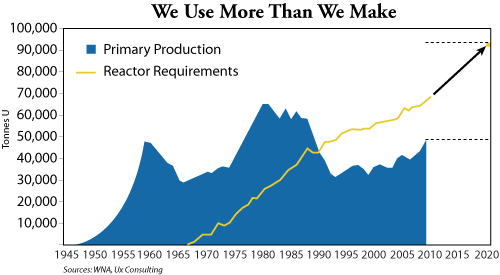
The most compelling thing about uranium is probably best expressed in the chart below...


The uranium market has been in deficit for several years, living off the stockpiles of the Cold War. Put simply, we use more than we make.

Looking out to 2018, we're about 400 million pounds short. To get some perspective on that number, here is a look at the top 10 producers of uranium in 2009 and the percentage each makes up of the total market.


The top producers, which make up nearly 90% of the market, produced about 110 million pounds of uranium last year. So essentially, the industry needs to produce almost four times that to meet the estimated new demand through 2018. On an annual basis, the industry will need to about double in size.

A sidelight to this is the fact that 63% of all uranium comes from just 10 mines. This means that the global supply of uranium is susceptible to supply shocks. If one big mine floods or goes down for whatever reason, it'll make a big wave in the uranium market.

It gets even more interesting...

Most of the best mines are already in production. As with everything else in the resource world these days, the low-hanging fruit is all gone. Future grades will be lower, meaning we'll have to mine a lot more ore to get a given amount of uranium. New mines are in more geologically challenging places. New supply is also coming from riskier places, such as Africa and Kazakhstan. All of this means that costs will go up.

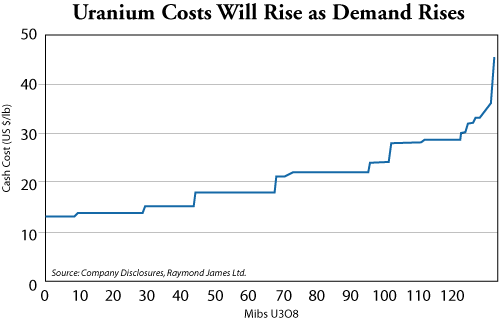
These facts are reflected in the industry's cost curve, as you can see in the chart below.


This tells you that at current production – about 130 million pounds – those last million pounds are a lot more expensive to produce than the first million pounds. It also means that as the industry ramps up beyond 130 million pounds to meet demand, costs will rise sharply.

This is not a perfect predictor, of course. There are new mines that will come online and produce uranium at low costs. But it bodes well for a higher uranium price in the future. The current spot price is around $45 a pound. Only around 10%–30% of the uranium traded in any year is sold on the spot market. Most uranium is sold to utilities via long-term contracts. The longer-term price of uranium is north of $60.

For some perspective on uranium pricing, consider that when uranium got hot in the summer of 2007, the spot price hit $136 a pound. It's done nothing but go down since then. If you are a contrarian thinker, which is to say a good investor, that fact will attract you. I can tell you with great certainty that the uranium price won't go to zero. That downward trend will reverse, and based on all the data I presented above, it looks like a higher uranium price over the next few years is a sure thing – or about as close to a sure thing as you can get in markets.

That's why the uranium price has to go up. If it doesn't, there is no incentive for producers to make more, and hence a lot of reactors are going to go without fuel. More importantly, it can go up. Simply put, the uranium price could double and it wouldn't affect the economics of a nuclear reactor much. This is not true with a lot of commodities. If the price of oil doubled, the global economy would double over in great pain and probably grind to a halt. Not so with uranium.

The biggest potential negative I see is the risk of some nuclear accident that derails this whole thesis as people abandon nuclear. But the industry has a clean safety record going back more than two decades now.

There are 436 reactors in the world that provide about 15% of the world's electricity. The new reactors have fewer moving parts and are much better than the old ones. And most of the world seems to be coming around to the green benefits of nuclear power; even President Obama's administration promises loan guarantees and other goodies for the builders of nuclear reactors. In our carbon-worried world, nuclear is a relatively clean source of energy.

For all these reasons, we see a massive buildup in reactors under construction, planned or proposed. The World Nuclear Association (WNA) says there are 52 reactors under construction, 135 reactors planned and 295 reactors proposed. This is what underpins that demand we talked about up top. Where are all those reactors going to be? Mostly, from China, India, Japan, and the U.S.

Once again, we have a resource story driven by China and India. Neither country produces much uranium. China produces less than 2% of the world's uranium. If you believe "buy what China needs," as I do, then uranium fits well with that worldview. In conclusion, I want to own uranium.

This post has been republished from Steve Sjuggerud's blog, Daily Wealth.

Promising Growth In New Orders For Durable Goods

With a three percent increase in January, new orders for durable goods appear to have continued their upward swing from the lows of this time last year. Even in the face of this overall good news, questions remain as to how long this trend can persist, especially in the face of the continuing job losses. See the following post from The Capital Spectator.

The labor market may be facing new challenges, but new orders for durable goods rose again last month. This leading indicator of future economic activity increased 3.0% in January, the Census Bureau reports this morning. That’s good news, of course, although we’re in no mood to celebrate, given the apparent reversal of fortunes in jobless claims, as we discussed in our previous post.

Nonetheless, as our chart below shows, new orders for durable goods have made some progress in bouncing off the lows from early 2009. We can debate the source of the rebound, ranging from the natural tendency of an economy to right itself after a shock to the various efforts by the government to juice spending. More importantly, it's debatable if this and other leading indicators are as valuable this time around as forward-looking metrics of the broad economic trend. But if we ignore all that for a moment, the rebound so far in this series is encouraging.


As Pimco’s Tony Crescenzi explained a few years back, it’s the trend in such measures that provide clues about the future. “Persistent strength in durable goods orders should be taken as a sign that both consumers and businesses are confident enough in the economy to engage in spending on big-ticket items,” he advises in The Strategic Bond Investor : Strategies and Tools to Unlock the Power of the Bond Market.

The broad trend for durable goods orders is unmistakably up in recent months. The question is whether the rise can persist if—if—the labor market is set to move sideways, or worse, in the foreseeable future? This debate is all more potent if we recognize that January’s strong rise in durable goods orders was largely driven by civilian aircraft orders, which are quite volatile from month to month. Alas, excluding transportation reveals that new orders for durable goods actually fell last month, slipping 0.2% from December’s level.

Yes, the overall durable goods trend is encouraging. But even if we take this at face value, we can't ignore that it’s a jobless recovery so far. As long as that qualification remains, the bullish aura surrounding leading indicators is suspect.

This post has been republished from James Picerno's blog, The Capital Spectator.

Thursday, February 25, 2010

While The Cause Of The Economic Collapse Is Debated Nothing Is Getting Done

Analysts still debate the main causes of the economic collapse as Alan Greenspan continues to deflect blame. While the debate continues, little is being done in Washington to change the system and stop the same mistakes from happening again. See the following post from The Mess That Greenspan Made.

One of the most disturbing aspects of the recent economic collapse and the ongoing financial market crisis is that there is still widespread disagreement over who or what caused it.

All too often, pundits say, "You can't lay all the blame for our current condition on one institution or one man" and that is true, but these same commentators oftentimes skirt answering the toughest of questions about what nearly brought the whole financial system down by distributing the blame among many players and many failings.

By arguing that the entire system must be reformed, nothing ends up being changed as we see now - almost eighteen months after the worst financial market crisis since the Great Depression and there have been no substantive changes to how the financial system works.

Many argue the system has become more crisis-prone.

An even more disheartening development is that there continues to be debate about whether the most fundamental aspect of credit markets - short-term interest rates - was a major factor in precipitating the late-2008 meltdown.

As evidenced by the musings of current Fed chief Ben Bernanke in early-January, the central bank - the group that controls short-term rates - suggests that people look elsewhere for the root cause of the biggest credit bubble and bust in the history of Mankind as the nation's central bankers did everything right in their conduct of monetary policy.

How could the central bank do everything right and then watch everything go so wrong?

Some of the most important debate over responsibility for the economic and financial market mess we now find ourselves in comes in the treatment of former Fed chief Alan Greenspan who, surprisingly, keeps popping up in the news after offering opinions to captive audiences as part of a quite lucrative post-Fed career as a public speaker.

What is most surprising about these accounts is that they no longer routinely carry the disclaimers that once adorned nearly every story about the former Fed chairman back in 2007 and 2008 - about how Alan Greenspan is thought to be largely responsible for our current predicament.

Typical of the lot is this report in Bloomberg by Joshua Zumbrun that treats yesterday's speech before a gathering of Credit Union representatives in Washington as the observations of an interested bystander rather than someone who was controlling the most important interest rate levers and directing the nation's regulatory bodies during the gestation period of the monstrous bubble.

We learn that the former Fed chairman thinks we've undergone "by far the greatest financial crisis globally ever" and that parts of the U.S. economy are now "dead in the water".

He didn't say who or what was responsible for their demise, but it's a pretty safe bet that his finger would not point inward if asked.

The crisis was caused by a "fundamental misjudgment in the marketplace," Greenspan said, going on to note that he'd like to see the return of a robust subprime mortgage market - once heralded as a great early-21st century financial market "innovation" - however, not with the securitization problems that contributed to the late-2008 meltdown.

As has been the case in other reports of Greenspan's recent speaking engagements, there were no references to short-term rates being held "too low for too long" early in the last decade or of an exceptionally light regulatory touch, omissions that just seem so wrong in so many ways.

It is as if the rewriting of history that sought to shift any blame for the events of the last few years away from the central bank has already been successful.

So, it comes as something of a surprise to learn that in some corners of the financial media there is still a good deal of resistance to what would otherwise seem to be a successful job of "reshaping a legacy" and the latest evidence comes in Alan Greenspan having been awarded the Dynamite Prize in Economics by the Real World Economics Review blog.

Now, to be perfectly honest, this is the first time that I've ever heard of this publication, but, based on their current findings, it's hard to disagree with the consensus that was reached by more than 18,000 votes cast in a recent poll.

I've taken the liberty of organizing the data in pie-chart form below.


By a fairly wide margin, Alan Greenspan was judged "the economist most responsible for causing the Global Financial Crisis" with Milton Friedman and Larry Summers finishing a distant second and third, respectively.

In the summary section for these three, the reasons are clear:

Alan Greenspan (5,061 votes): As Chairman of the Federal Reserve System from 1987 to 2006, Alan Greenspan both led the over expansion of money and credit that created the bubble that burst and aggressively promoted the view that financial markets are naturally efficient and in no need of regulation.

Milton Friedman (3,349 votes): Friedman propagated the delusion, through his misunderstanding of the scientific method, that an economy can be accurately modeled using counterfactual propositions about its nature. This, together with his simplistic model of money, encouraged the development of fantasy-based theories of economics and finance that facilitated the Global Financial Collapse.

Larry Summers (3,023 votes): As US Secretary of the Treasury (formerly an economist at Harvard and the World Bank), Summers worked successfully for the repeal of the Glass-Steagall Act, which since the Great Crash of 1929 had kept deposit banking separate from casino banking. He also helped Greenspan and Wall Street torpedo efforts to regulate derivatives.
What's most intriguing about the details provided above is that the three men finishing in the top spots cover the three critical factors, without which a financial market crash would not have been possible - flawed theories as espoused by neo-classical economists (Friedman), a powerful spokesman for Wall Street interests (Summers), and, most importantly, someone with his hand at the controls when the maximum amount of dynamite could be deployed (Greenspan).

A Dynamite Prize in Economics conducted some five or ten years from now may well put current Fed chief Ben Bernanke in the top spot. In fact, at this point, that seems all but assured since, looking back to early in the last decade, former Fed chief Alan Greenspan was widely believed to be the "greatest central banker of all time" as the dynamite was being laid. Fast forward to 2010 and Ben Bernanke becomes Time Magazine's Person of the Year.

In the meantime, the Real-World Economics Review blog is setting out to acknowledge those who saw the financial crisis coming in the inaugural "Revere Award in Economics", so named for Paul Revere's famous ride through Boston which, fortunately, more than 200 years ago, people listened to.

This post has been republished from Tim Iacono's blog, The Mess That Greenspan Made.

Nearly A Quarter Of Homeowners In Negative Equity Position

According to a recent report, over 11.3 million American homeowners, nearly one quarter of all homeowners with a mortgage, are now in a negative equity position, with forty percent of them upside down by at least twenty-five percent. In the face of this, home prices continue to fall and lenders are expected to continue tightening access to credit, which could lead to a currency crisis if the Federal Reserve prints additional money to stimulate the credit markets. See the following post from Expected Returns.

The meltdown in housing is moving along right on schedule unbeknownst to our politicians, who will have a huge crisis on their hands beginning sometime in 2010. From Marketwatch, 11.3 Million Homeowners Underwater on Mortgage:

More than 11.3 million homeowners -- nearly one-fourth of all Americans with a mortgage -- owe more on their loan than their home is now worth, according to a report released Tuesday by FirstAmerican CoreLogic.

More than 10% of people with mortgages owe 25% more than their home is worth.

The number of underwater mortgages increased by about 620,000 from the third quarter, the firm said. Another 2.3 million mortgages had less than 5% equity in their home, which could be wiped out if home prices fall further.
You will see foreclosures rise in 2010 across America. It is not a matter of if, but when. Home prices will not only have to stabilize, but they will have to effectively double in certain parts of the country for people to break even. I can tell you right now, that is not going to happen in real terms.

In the following chart of home prices, courtesy of David Rosenberg, you can see that home prices are still falling on a non-seasonally adjusted basis. This is a scary scenario given the government's intervention in the housing market and the historically narrow skew between long-term treasury rates and mortgage rates. In other words, even if treasury rates were to stay the same, mortgage rates would likely rise.


Even if the housing market was perceived by potential homebuyers to be stabilizing, where will buying power come from if lending is falling at an unprecedented rate?


If you thought 2009 was bad for regional banks, watch what happens in 2010 when the implosion in commercial real estate really picks up steam. I expect access to credit to contract in the next couple of years as regionals really hunker down and repair their balance sheets.


The only perceived recourse will be for the Fed to print unlimited amounts of money, which will result in a currency crisis. I believe this will be apparent in the next 2-3 years.

This post has been republished from Moses Kim's blog, Expected Returns.

Wednesday, February 24, 2010

Detrimental Effects Of The Recession Can Last A Lifetime

The detrimental effects of a recession on individuals can last indefinitely, as loss of job experience and accumulated assets can have a strong influence on the future. Also, some segments of the population such as young workers and minorities are more adversely affected than the general population. See the following discussion from Economist's View.

The distribution of the benefits in the run-up to the recession as reflected in growing inequality has been widely discussed, as has the distribution of benefits in terms of various bailouts once the recession was underway. But what hasn't received enough attention is the distribution of the costs of the financial meltdown and the subsequent recession.

For example, the costs of unemployment are never distributed equally when downturns occur, the young and minorities in particular experience much larger employment shocks than, say, white middle-aged males. As noted below, blacks in many areas are experiencing unemployment levels that equal or exceed 20%, and the damage from the unemployment will be permanent, it won't go away if and when jobs return.

The recession is taking away opportunity for the young to gain employment experience, and many who are employed are working below their abilities in jobs they are likely to get stuck in for many years, if not forever. The recession is wiping out the accumulated assets of the unemployed as they try to bridge the gap until jobs return, and since many of these are older workers, this will have a large detrimental effect that lasts throughout their retirement years. Recessions cause skills to depreciate, there are psychological costs, there are costs to family members, the loss of a job generally means loss of health care, the costs to working class households go on and on.

And there are other ways in which the costs have been distributed unequally, and in many cases these have not been thoroughly examined. For example, there is evidence that minority groups were given higher cost and highly profitable mortgages when lower cost but less profitable loans were available. This also served to wipe out accumulated assets of minority borrowers in addition to all the other problems that come when a high cost mortgage cannot be paid.

The fact that many of the costs were concentrated among those least able to pay them stands in contrast to the fact that the bailout benefits were concentrated among those at the opposite end of the income distribution. Government transfers to compensate low income groups for the costs they were forced to pay but had no hand in causing, transfers that are financed by those who received the benefits during the bubble years and the bailout money when the bubble popped, seem more than justified.

Here's a description of one group that has been hit particularly hard:

Recession hits older blacks in what should be their prime, by Tony Pugh, McClatchy: America's economic recession has hit African Americans who are middle age and older much harder over the last year than it has the general public, according to a new survey released Tuesday by the AARP.

In telephone surveys, more than twice as many African Americans ages 45 and older reported having trouble paying their mortgage or rent, having to cut back on medications and having borrowed money to pay living expenses in comparison to the general population.

Twice as many blacks also reported losing a job and having a spouse who either lost a job or had to take a second job. Nearly twice as many blacks had difficulty paying for essential items such as food and utilities.

These older, established black workers also lost their job-based health coverage at higher rates, were more likely to raid their retirement savings prematurely and provide financial help to their parents and children more often than their age-equivalent peers, the survey found.

The data reinforces what many experts have said for months: that the recession is really a depression for many blacks, particularly in areas where black unemployment has surpassed or hovers around 20 percent. ...

The troubling findings paint a gloomy financial picture for African-American workers during what should be some of their prime earning years, said Algernon Austin, who heads the Race, Ethnicity, and the Economy program at the Economic Policy Institute ... said ... "These findings suggest we shouldn't be surprised if we see increases in poverty rates for blacks 65 and older in the coming years because a number of them are spending down their retirement income to try to get past this Great Recession," he said. ...
This article has been republished from Mark Thoma's blog, Economist's View.

Confidence Among US Consumers Moves Lower

Even in the face of potential economic recovery, consumer confidence, a leading indicator, has continued to fall and has reached its lowest level in ten months, indicating that the double dip recession may be approaching. The cause of this continuing decline appears to be the ongoing lack of job creation in today's economy. See the following post from Economist's View.

So much for the economic recovery- consumer confidence is falling, and it's falling fast. As I've been expecting, consumer confidence is plunging, reflecting the inflection point we have likely reached in our economy. There is no doubt in my mind the double dip is coming. From Bloomberg, Consumer Confidence in U.S. Falls More Than Forecast:

Confidence among U.S. consumers fell more than anticipated in February to the lowest level since April 2009 as the outlook for jobs diminished, a sign spending may be slow to gain traction as the economy recovers.

The Conference Board’s confidence index declined to 46, exceeding the lowest forecast in a Bloomberg News survey of economists, from a revised 56.5 in January, a report from the New York-based private research group showed today. Concerns about the economy and the labor market pushed an index of current conditions to its lowest in 27 years.

The Consumer Confidence Index is a measure of consumer confidence based on responses to questions about the following:

  • Current business conditions
  • Business conditions for the next six months
  • Current employment conditions
  • Employment conditions for the next six months
  • Total family income for the next six months

The Consumer Confidence Index and the Expectations Index are leading indicators to the extent that perceptions shape future actions. With both indexes plunging to 10-month lows, there is every reason to believe the next few quarters will be weak on the consumer front. Remember: no consumer, no recovery.


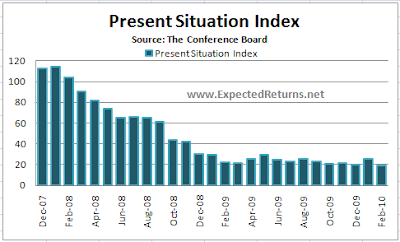
The following graph shows consumers' view of the present situation since the start of the recession. In February, the index fell to 19.4 from a January reading of 25.2. How anyone can claim we are in an economic recovery based on data points like these is beyond me. It is indeed axiomatic that if you repeat a lie enough times, it becomes accepted as truth. Many, including supposedly seasoned economists, are unwittingly being fooled by government lies about a clearly paradoxical "jobless recovery."


Jobs Still Scarce

The share of consumers who said jobs are plentiful fell to 3.6 percent from 4.4 percent, according to the Conference Board. The proportion of people who said jobs are hard to get increased to 47.7 percent from 46.5 percent.

The proportion of people who expect their incomes to increase over the next six months declined to 9.5 percent from 11 percent. The share expecting more jobs in the next six months fell to 13.4 percent from 15.8 percent.

I don't care how many jobs Obama randomly claims that he has saved, the fact remains that there are no jobs. Ask the average blind supporter of the "jobless recovery" theory about the last time we actually experienced one and they'll likely give you a blank stare. The blank stare is warranted, since the whole concept of a jobless recovery is a modern phenomenon that has no firm standing based on historical data.

Nearly every single data point shows the economy is in worse shape than it was at the onset of the recession. Get ready to hear the airwaves filled with news of an "unexpected" double-dip recession. As you all should know by now, I expect gold to explode as a result.

This post has been republished from Moses Kim's blog, Expected Returns.

Tuesday, February 23, 2010

Obama Refuses To Take Necessary Steps To Fix Economy

The US stock market has continued to adjust downwards in the face of the government's inability to reduce the country's economic woes, including the effective 17% unemployment rate. Peter Morici from The Street says the best solution to the situation would be growth in exports, but the government has neither provided appropriate programs nor provided appropriate pressure on China to bring down the United States' trade deficit. See the following post from The Street.

Stocks are tumbling as investors realize President Obama is simply not offering policies that will fix the U.S. and global economies.

Each week, more than 450,000 Americans apply for new unemployment benefits, and 17% of adults can't find a full-time job or have quit looking for work altogether.

Since Massachusetts voters sent Democrats a vote of no confidence, Obama has been doubling down on bigger government and class warfare as the road to prosperity.

Meanwhile, the two biggest problems that block economic recovery go unaddressed -- most businesses lack enough customers and access to bank credit to create jobs.

Just about everyone recognizes consumer spending won't come roaring back. Those few businesses that can increase sales often can't borrow from banks to expand.

Not surprisingly, the 5.7% growth in gross domestic product recorded in the fourth quarter was mostly an accounting adjustment, reflecting a slower pace of inventory depletion.

Domestic consumption and investment contributed a tepid 1.8% to growth, and that pace is simply not enough to sustain a recovery.

The government is all tapped out. Deficits, if pushed any higher, could cause an international run on the dollar and a financial calamity even Federal Reserve Chairman Ben Bernanke's printing press couldn't fix. Not surprisingly, the government added zero to fourth-quarter growth.

Salvation must come from bringing down the $440 billion trade deficit, and, in particular, the huge trade imbalance with China. Cutting that deficit in half would boost GDP by 3%, resurrect manufacturing and high wage jobs, and it's then off to the races -- healthy growth rivaling the Clinton years.

The president's new export promotion program and small businesses incentives are too little too late.

Obama needs to stop talking about Chinese mercantilism and do something about it. Instead, he whines America won't turn to protectionism.

Currency manipulation makes China the most protectionist bully on the planet, robbing growth and jobs from the United States and Europe and increasing the risk that troubled governments like Greece may default.

Meanwhile, after taking $2 trillion in government aid, the banks are doling out $150 billion in bonuses but are unwilling to loan most businesses the capital they need.

It is high time to separate the commercial banks that enjoy a government guarantee from investment banks like Goldman Sachs(GS Quote). Limit aid to commercial banks for the purposes of making loans, as opposed to trading currency, energy futures and other complex financial instruments.

The president expresses outrage about Chinese trade practices and bank bonuses but refuses to take substantive actions -- for example, countering Chinese protectionism with a tax on dollar-yuan conversions to raise the effective price of the yuan, and imposing a 50% tax on bank bonuses as Britain has done.

The markets have figured it out. Obama is a charismatic campaigner and eloquent speaker, but he simply doesn't have a grasp of the facts or lacks the courage to fix what is broken in the American economy.

Folly in Washington begets panic on Wall Street.

This post has been republished from The Street, an investment news and analysis site.

Why Didn't Economists See The Economic Collapse Coming?

Although economics has typically been viewed as a purveyor of truth and deep understanding about the role of money in society, a recent Wall Street Journal piece indicated that the global economic crisis could have been averted by higher inflation, running counter to the general view of economists over the past twenty-five years. As further proof of the lack of creative thinking among modern economists, a British thinker points out that the economic community failed to predict the systemic crash that occurred. See the following post from The Mess That Greenspan Made.


More evidence that the dismal science as currently practiced may be entering another leg down in what is now a decade long death spiral comes in two reports this morning, the first being this Wall Street Journal item where cutting edge economic thinking has it that higher inflation a few years back might have saved us all from the financial market crash and global economic meltdown eighteen months ago.

For the past quarter century, inflation has been a bogeyman that eats wealth and causes instability. But lately some smart people—including the chief economist at the International Monetary Fund and a senior Federal Reserve researcher—have been wondering aloud if a little more of it might actually be a good thing.
...
The new argument for inflation goes like this: Low inflation and the low interest rates that accompany it leave central banks little room to maneuver when shocks hit. After Lehman Brothers collapsed in 2008, for example, the U.S. Federal Reserve quickly cut interest rates to near zero, but couldn't go any lower even though the economy needed a lot more stimulus.

Economists call this the "zero bound" problem. If inflation were a little higher to begin with, and thus interest rates were a little higher, the argument goes, the Fed would have had more room to cut interest rates and provided more juice to the economy.

Yes, the problem was that inflation wasn't high enough...

Sadly, if economists had not been so dimwitted in making the disastrous mistake of thinking that real estate was more of an investment than a consumer good and then pulling home prices out of the official measure of inflation back in the 1980s, even they would have seen that there were serious problems beginning seven or eight years ago when something could have been done about a nascent housing bubble before it nearly destroyed the world.

In the world of dismal scientists, if something doesn't show up in the data, it doesn't exist, so, the housing bubble never existed - that is, until it burst.

Economists across the pond don't seem to be making any better progress in getting back in touch with the real world, though, the use of the word 'back' is, perhaps, being generous.

In the Telegraph today, Edmund Conway writes of being mystified by the ongoing debate about whether deficits should be cut sooner rather than later as it misses some very fundamental points about the current condition.

In short, I am dismayed by it. In fact, I would go further and say it illustrates why the economists’ profession simply hasn’t learnt from the atrocious intellectual and policy mess it made ahead of the crisis.
...
One of the things we learnt from the crisis is that there was a dearth of people propounding truly counterintuitive, counterfactual economic theories. And that those who did were simply ignored. The mainstream failed to see the woods from the trees. It became obsessed with far smaller debates (productivity, protectionism etc) but failed to step back and ask whether the entire edifice of financial economics was about to collapse, which, of course it did. But despite this neglect, the economists always seemed busy.

My feeling is that we’re in a similar position now. These letters represent a similar mirage of intellectual activity which disguises the fact that the economic mainstream is again neglecting deeper questions about where we’re heading. But then perhaps that’s what always happens when politics and economics collides.
It looks like it's going to be another bad year for the economics profession, though they remain an optimistic bunch, predicting just this morning that the U.S. recovery will grow steadily this year and next with jobs returning aplenty.

Lynn Reaser, president of the National Association for Business Economics, commented on the late-January survey of 48 economist noting, "We see a healthy expansion under way, although it will take time to reduce economic slack and repair damaged balance sheets."

We'll find out just how healthy the economic expansion is soon enough.

This post has been republished from Tim Iacono's blog, The Mess That Greenspan Made.

Monday, February 22, 2010

Government Doing Too Little For Jobs

Jamie Galbraith argues that creating jobs right now is more important than the deficit, as the state should act when the free market fails. However, government have failed to do what is necessary to cut unemployment to acceptable levels. See the following post from Economist's View.

Jamie Galbraith:

We need jobs, not deficit cuts, by James Galbraith, CIF: "Now that the immediate crisis has passed," Policy Network asks for "long-term strategies to shape our post-recession economies" and "to promote economic growth".

But the immediate crisis hasn't passed. It is not over for the jobless. It is not over for those losing their homes. It is not over for Greece, Spain, Portugal, or Iceland, facing ruin in the capital markets. ...

People need work. We face the challenge of climate change. The broad outline of a program is therefore plain. There is no mystery about it. In 1929, Keynes wrote, "there is work to do; there are men to do it. Why not bring them together?" Today as then, it is that simple.

Do we need to "rethink the relation between the market and the state"? A futile hope! Those who once thought the market could flourish without the state have either already "rethought", or they cannot think. They are our own Stanley Baldwins and when they discourse on this subject, "it not only is nonsense … but it looks like nonsense to any simpleminded person who considers it with a fresh, unprejudiced mind".

In the crisis, the financial sector collapsed. It hasn't recovered. ... In this situation, the state must act. It can act through the banking system by mandate, as it does in China and as it used to do in Japan and France. Or it can bypass the banks and go to work directly – as it did in America in the New Deal and as Keynes proposed for Britain in 1929.

A jobs program? Keynes again: "No, says Baldwin. There are mysterious, unintelligible reasons of high finance and economic theory as to why this is impossible. It would be most rash. It would probably ruin the country. Abra would rise, cadabra would fall… No, cries Baldwin. It would be most unjust… Unemployment is the lot of man… For the more the fewer, the higher the less."

The question facing world leaders today is not what to do. It is whether to do it. There are two goals to meet: full employment and sustainable energy. That's technically complex. But the complexities are complexities of engineering, organization and politics. They are not complexities of economics or finance.

The question is posed as though it involved deep questions and high obstacles, whose true nature the uninitiated cannot be expected to grasp. Thus the hue and cry over public debt and deficits – projected to be unsustainable – for reasons never stated – in the long run. Our papers and our television speak of almost nothing else. But if they are right – as all the voices of Wall Street and the City say – then how come the long-term interest rate on the government bonds of the rich countries remains so low? ...

In truth, the deficit/debt uproar is a deliberate effort to sidetrack attention, to defeat the will of the electorates in the US, as well as Greece among others, who stubbornly insist on effective action, economic recovery and financial reform. Those behind the uproar never foresaw the financial crisis. They never warned against the dangers of excessive private debt. Their interest is plain: they profit from private debts. So it pays to make believe that private is productive and public is sterile, that private is stable and public is not, when the reality is the other way around.

A final word from Keynes: "It may seem very wise to sit back and wag the head. But while we wait, the unused labor of the workless is not piling up to our credit in a bank, ready to be used at some later time. It is running irrevocably to waste; it is irretrievably lost. Every puff of Mr Baldwin's pipe costs us thousands of pounds."
Every day that goes by with unemployment higher than it needs to be means that people are struggling needlessly. People need jobs. And not at some point in the future when Congress gets around to it (if they ever do), this can't wait another day. It should have been done months and months ago.

Congress ought to have the same urgency in dealing with the unemployment problem as it had when banks were in trouble. Collectively the unemployed are too big to remain jobless, and the millions of individual struggles among the unemployed shouldn't be tolerated. But Congress doesn't seem to be in much of a hurry to do anything about it, or give any sign that it much cares.

This post has been republished from Mark Thoma's blog, Economist's View.

Sunday, February 21, 2010

US Bonds Versus Gold In The Past Year

Although the current size of the US government's debt is so large that it is extremely hard to conceptualize, it is nevertheless likely to have significant effects on the value of the US dollar moving forward. Over the past year, as the government's debt has grown, there has been a relative decline in the value of long-term bonds and an increase in the value of gold, which indicates falling confidence in the dollar. See the following post from Daily Wealth.

To most people, any talk of the U.S. government debt simply doesn't mean anything.

For instance, I could tell you the annual funding costs of our national debt are approaching $4 trillion per year – that's $1.5 trillion in new annual deficits, plus $2 trillion-$3 trillion a year in short-term obligations coming due that need to be refinanced. Foreigners hold roughly half of this debt. Thus, we have about $2 trillion in foreign debt that must be repaid or refinanced each year.

But this obligation is so large that it's meaningless to most people. I could also tell you $2 trillion is 20% of our GDP, but even then, most people won't understand just how much money this is. So think of it this way...

If you spent $1 million per day from the time of the founding of Rome – roughly 2,700 years ago – until today, you would have accumulated about $1 trillion in debt. Now, double that amount. And that's the size of our annual foreign borrowing obligation.

(Thanks to Eric Margolis for the trillion-dollar metaphor. See his essay "Spending America Into Ruin" here.)

But more important than understanding the size of this debt, it's vital that you understand its effects. In this essay, I'll show you the easiest way to track those effects... and the actions you must take to protect yourself from them.

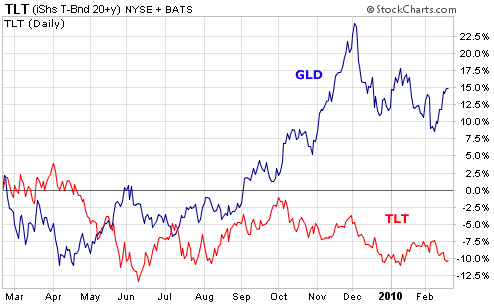
The Barclays iShares 20+ Year Treasury ETF (TLT) tracks the value of the U.S. government long-bond market. This is the primary market the Fed was trying to support over the last year. Gold, on the other hand, is the best market-based judge of the soundness of the U.S. dollar and our creditors. The SPDR Gold Shares ETF (GLD) is an accurate proxy for the price of gold.

Look what happened to U.S. bonds (TLT) and gold (GLD) over the past year. This occurred even as the Fed was massively intervening in the credit markets.


Note the value of the U.S. long-bond market fell by more than 10% despite the government support. And the value of gold increased by more than 10% as investors fled the dollar.

It's interesting the relative moves were nearly identical. There's no free lunch. For every penny the government prints or borrows and uses to manipulate long-term interest rates, that same penny is being taken out of the value of the U.S. dollar, as is revealed in the price of gold.

You will see lots of debates about what the coming currency crisis means. But if you can simply understand this chart, you will grasp what's happening and how to protect yourself. It's simple: The value of the dollar is collapsing as the un-creditworthiness of the United States becomes evident. That means the price of hard assets – like gold – will keep rising and the value our government's long-term obligations will fall.

The safest thing to do right now is split your savings between short-term Treasuries and gold. That's the equivalent of a "cash" position, as the gold will hedge your dollar exposure and the short-term Treasuries will mitigate the volatility of gold. You can do this through ETFs. The Barclay's iShares 1-3 Year Treasury ETF is an easy way to own short-term Treasuries. The symbol is SHY. And GLD is the most liquid gold ETF.

I personally hold my gold in bullion coins and recommend you do the same. It's better and safer than the ETF. But for lots of people, the ETF is simply more convenient.

However you decide to take a position in gold, do it soon. I expect the divergence you see above – of U.S. debt decreasing in value, while gold increases in value – to get much bigger in the coming years.

This post has been republished from Steve Sjuggerud's blog, Daily Wealth.

Friday, February 19, 2010

Why Fixing The Housing Market Should Be Job Number One

Stephen A. Myrow, chief operating officer of ACG Analytics, argues that job number one for the government should be a focus on repairing the housing crisis. He points out that unless the root of the economic meltdown is fixed, the broader economy will continue to be weighed down by the problems in the housing market. See the following post from The Street.

With health care reform stuck in purgatory, the focus in Washington has shifted to financial regulatory reform "to avert the next crisis."

Without question, smarter regulation crafted with an eye toward the modernized structure of the financial system could have at least mitigated the present financial crisis. This, in turn, could have prevented the onset of the ongoing economic crisis. However, it would not have stopped the incipient cause of our current precarious situation -- the housing crisis.

After all, to refer to the cause of our collective predicament as the "financial crisis" is a misnomer. The financial crisis is only one of three distinct, yet interconnected crises -- wedged between the "housing crisis" and the "economic crisis" -- that continue to weigh on both Main Street and Wall Street.

The housing crisis started on Main Street. It was a traditional asset bubble with many catalysts, including politicians aggressively promoting homeownership, mortgage brokers focused solely on commissions and homebuyers with desires larger than their wallets.

Wall Street, primarily banks -- with the help of excessive leverage, under-regulated securitization markets, poor risk management, lax regulators, credit rating agencies and investors in search of greater yield -- misplayed the housing bubble and created the financial crisis.

The financial crisis clogged the gears of our credit economy. This exponentially amplified the adverse impact of the housing crisis, creating a broader economic crisis that spilled back on to Main Street in the form of the Great Recession, complete with double-digit unemployment.

Some analysts have prematurely declared the housing sector stabilized. As the song from Crazy Heart goes, "It's funny how falling feels like flying, even for a little while." At best, the housing crisis is in a pause before it enters the next phase. Several key indicators raise concern, such as rising negative equity, increasing delinquencies and foreclosures, approaching option-ARM resets and sustained high unemployment.

Furthermore, the apparent stabilization of the housing market is based on an unprecedented level of government support, which is facing significant headwinds in the coming months. From the termination of the Federal Reserve's mortgage-backed securities purchase program to the expiration of the homebuyer tax credit and the Federal Housing Administration's dwindling reserves, monetary and fiscal stimulus measures are falling prey to waning political support and limited budgetary resources.

While the housing, financial and economic crises emerged in serial fashion, they remain contemporaneous and inter-related problems. As the housing crisis lurches into the next phase, it will continue to adversely feedback into the financial sector and the broader economy.

This will put more pressure on the Obama administration and congressional incumbents to demonstrate some level of meaningful response, particularly as the mid-term elections draw near. Many in the nation's capital will be lured to increase populist rhetoric aimed at an easy target -- Wall Street.

Regardless of the responsibility that some financial firms bear for exacerbating the fallout of the housing crisis, populist attacks on Wall Street will not abate the economic pain that Main Street will continue to endure. Like the aftermath of Hurricane Katrina, there is a real risk that the personal catastrophe of the housing crisis will create a political catastrophe for the Obama administration and incumbents in November.

As I regularly drilled into my students, the most critical aspect of crisis management is recognizing where its true roots lie. Although it has not been politically expedient for Washington to recognize that our economic plight is ultimately held hostage to the housing problem, investors get it. As one portfolio manager recently told me, "If you figure out housing, you've figured out the whole financial market."

Stephen A. Myrow is managing director and chief operating officer of ACG Analytics, Inc., an independent investment research firm that provides public policy analysis to institutional investors. He previously served as chief of staff to the deputy secretary of the Treasury from March 2008 to January 2009 and taught crisis management at Johns Hopkins University's School of Advanced International Studies.

This post has been republished from The Street, an investment news and analysis site.

State Pension Programs Are Underfunded By $1 Trillion

Moses Kim argues that even in light of the modest indications of economic growth, the United States economy still remains in severe trouble, as indicated by high debt levels and low employment, among other things. The ultimate solution for the economy's problems may be far off, as many of them are being caused by the combination of the demographic issues caused the impending retirement of the Baby Boom Generation and by an ongoing tendency among politicians to spend at unsustainable levels. See the following post from Expected Returns.

Economic historians will no doubt look back on this era and wonder aloud how anyone could have possibly believed we were in an economic recovery. After all, economic recoveries simply don't occur with 10% annual deficit to GDP ratios, rising unemployment, long-term joblessness at record levels, and record rates of contraction in bank lending.

As we teeter on the brink of an economic implosion, the WSJ reports that municipalities are considering Chapter 9 Bankruptcy Filings. To even consider Chapter 9 bankruptcy, which carries with it huge implications for future debt issuance, municipalities must be in truly dire straits. Yet we are apparently humming along in an economic recovery based on a farcical 5.7% GDP figure that had me considering the existence of Santa Claus. Simply amazing.

If this were an ordinary business cycle recession, I would be much more bullish on the prospects for America. I would be buying stocks, real estate, and any number of assets in anticipation of a cyclical economic recovery. One of the main reasons I'm hesitant to is because of demographics. The coming wave of retirees will exacerbate our debt crisis at the private and public level.

Social Security is one obvious problem we must soon face head on. However, state pensions are in huge trouble too. The following report by Pew Center on the States details the crisis in underfunded state pensions.
A $1 trillion gap. That is what exists between the $3.35 trillion in pension, health care and other retirement benefits states have promised their current and retired workers as of fiscal year 2008 and the $2.35 trillion they have on hand to pay for them, according to a new report by the Pew Center on the States.

In fact, this figure likely underestimates the bill coming due for states’ public sector retirement benefit obligations: Because most states assess their retirement plans on June 30, our calculation does not fully reflect severe investment declines in pension funds in the second half of 2008 before the modest recovery in 2009.
As the report states, $1 trillion dollars could very well be an understatement of the current budget shortfall. These pensions rely heavily on gains in the stock market for funding. Dare we even consider the consequences to state pensions, and by extension states' budgets, if stocks were to decline meaningfully from here on out?

In order to cover this shortfall, states will have to raise taxes at a time people are struggling to get by. This includes property taxes, which is one of the reasons real estate will be under pressure for quite some time. Another reason related to demographics is that Boomers are sizing down, not sizing up like they were in middle age.

Stop the Spending!


Fundamentally, our fiscal problems are a product of excessive spending by politicians who are more concerned with reelection than long-term fiscal health. Most of our leaders did not take a stand against unions and the incredibly bloated public sector. We are now facing the consequences of the lack of political courage by our leaders.

I suggest you all watch this interview with the newly elected Republican Governor of New Jersey. We need more leaders like him with the courage to make the tough and correct choices. Notice the non-stop jabbering of the CNBC commentators to spend, spend, spend our way out of this crisis. When will we learn?

This post has been republished from Moses Kim's blog, Expected Returns.

Thursday, February 18, 2010

Is The Fed Right To Discuss An Exit Strategy When The Economy Is Weak?

Tim Iacono discusses whether all the talk by the Federal Reserve of plans for an "exit strategy" is premature with the poor state of jobs, consumer confidence, and the housing market. While the economy is far from full strength, could winding down monetary stimulus be a preemptive strike necessary to prevent runaway inflation? See the following post from The Mess That Greenspan Made.

Boy, for a group of policymakers at the nation's central bank who, in a best case scenario, are going to just sit on their hands for at least the rest of the year, there sure has been a lot of talk about an "exit strategy".

That is, how the Federal Reserve plans to withdrawal the trillions of dollars in asset purchases, emergency lending facilities, and liquidity measures that have been undertaken over the last year that purportedly saved us from another Great Depression.

While it's probably a good idea to begin thinking about this sort of thing, the way Fed chief Ben Bernanke and others at the central bank have been talking lately, you'd think that the economy is about ready to fire on all cylinders again and that there's a pressing need to begin dialing back on some of the aid they've been providing.

What they should probably be worried about instead is the massive wave of foreclosures now washing up onto shore and the waning inventory rebuilding cycle that, when combined, will require more assistance in the form of money printing in the year ahead, not less.

Just this morning, Philadelphia Federal Reserve Bank President Charles Plosser said that he would favor selling some of the $1.25 trillion in mortgage-backed securities that have been piling up on the Fed's balance sheet "sooner rather than later", as if, he really thinks that the economic recovery we've been experiencing over the last six months - built mostly on government bailouts and handouts - is going to last.

Last week, it was Chairman Ben Bernanke who detailed a plan to Congress that would have the central bank adjusting the interest paid on "excess reserves" - money held by member banks at the Fed - in order to keep credit from expanding too rapidly and realizing the worst of the inflation hawks' fears - runaway inflation.

Shouldn't the question of what will happen to the market for home loans when the Fed stops their monthly purchases of between $60 to $100 billion worth of mortgage-backed securities next month be a more pressing concern?

Sure, they now own a considerable amount of the souring mortgage debt in the U.S., but they'll probably have to buy at least another trillion dollars or so to keep the housing market propped up, that is, unless there is some other plan in the works where, with their loss limits recently removed, wards of the state Fannie Mae and Freddie Mac can take on the job.


[The graphic above is from Standard and Poor's report on troubled mortgages]

Goldman Sachs weighed in last week with something about the Fed not raising interest rates until 2012 and there are more than a few who think that we'll be turning Japanese this decade in a very big way, as in, ZIRP (Zero Interest Rate Policy) for as far as the eye can see.

Maybe all this talk about "exit strategies" is simply a way for policymakers to generate confidence that might not otherwise be there.

For example, anyone looking at consumer spending, consumer confidence, or the unemployment rate could easily come to the conclusion that we've got a long way to go before the economy begins to grow again in any substantive sort of way.

But, if they were to listen to the Federal Reserve talking about how they're going to get out of the business of printing money on a scale never before seen by Mankind, then maybe they'll think that, just maybe, the Fed knows something that they don't know.

Then again, the more likely explanation is that economists at the central bank are just as clueless about where the economy is headed today as they were a few years ago before we all experienced the worst financial market crisis and the sharpest economic contraction since the end of World War II.

In case anyone needs to be reminded, here's what Fed chief Ben Bernanke thought about the economy and financial markets back in the middle of the last decade.

Is there any reason to think that he'll do any better in this decade than he did in the last one?

Isn't this talk of the Fed's "exit strategy" way too premature?

This post has been republished from Tim Iacono's blog, The Mess That Greenspan Made.

George Soros Shows Confidence In Gold With Investment

George Soros, one of the most astute investors in the market, has recently doubled his holdings in a gold-based ETF, even though he has recently referred to a gold bubble. Given the lack of market conditions similar to the 1980's (the last gold bubble), and the strong interest in gold, many agree that the bull market in gold will continue. See the following post from Expected Returns.


From the NY Times, Soros Doubled Gold ETF Investment:
Billionaire investor George Soros' hedge fund more than doubled its bet on the price of gold during the fourth quarter, a portion of the firm's total U.S.-listed equity holdings of $8.8 billion at the end of 2009.

Soros Fund Management owned 6.2 million shares of SPDR Gold Trust -- an exchange-traded fund that owns gold bullion -- at the end of the year worth $663 million. That was up from 2.5 million shares at the end of the third quarter.

Soros and other noted investors like John Paulson have previously touted gold as a hedge against inflation, further economic turmoil or a decline in the value of the U.S. dollar. Last month at the World Economic Forum in Davos, Soros said "the ultimate asset bubble is gold," but he declined to say whether he was investing in the precious metal.
George Soros is undeniably one of the best investors in the world. His truly global and dynamic (i.e. theory of reflexivity) view of markets definitely puts him a step ahead of most fund managers. So when Soros picks up on an investment theme, most people listen.

Much was made of Soros calling gold the "ultimate asset bubble" last month. Gold bears latched onto this statement as evidence of the top being in for gold. Of course he didn't give a time frame for when gold would reach bubble valuations, which led me to believe he was buying. Based on Soros' 4th quarter filings, my hunch was correct.

Central bankers from China and South Korea have made similar statements over that past couple of months, which means they are probably buying as well. After all, they manage billions of dollars in capital- so every dollar they can talk down the gold price, before buying, is substantial.

It bears repeating that gold will not be a bubble until people stop giving you blank stares every time you mention the "barbaric relic." We need to see lines around the block in gold bullion stores across the country like we did in the 1980's. We need gold shares to explode past their all-time highs in short order. We are seeing nothing of the sort yet.

The small money has no clue gold is in a bull market. The big money already has huge physical positions in the yellow metal. Which side do you want to be on?

This article has been republished from Moses Kim's blog, Expected Returns.

Wednesday, February 17, 2010

No Regulation Can Prevent Future Failures Of A Free-Market System

James Picerno from The Capital Spectator discusses the idea that boom and bust cycles are inevitable in a free-market economy and no amount of regulation will be able to prevent the next downturn. While we now know that specific financial regulation may have prevented the financial collapse, it is very difficult to predict future market failures or pop asset bubbles at exactly the right time. See the following post from Capital Spectator.

Hyman Minsky is a popular guy these days. An economist who studied under Joseph Schumpeter, Minsky has become the dismal scientist of choice in the wake of the Great Recession as the man who told us so.

Robert Barbera in The Cost of Capitalism: Understanding Market Mayhem and Stabilizing our Economic Future identifies a key theme in Minsky's oeuvre by explaining that the "renegade financial economist…insisted that finance was always the key force for mayhem in capitalist economies." Barbera goes on to observe that Minsky advanced two ideas that were central to his view of the economic world:
First, the persistence of benign real economy circumstance invites belief in its permanence. Second, growing confidence invites riskier finance. Minsky combined these two insights and asserted that boom and bust cycles were inescapable in a free market economy—even if central bankers were able to tame big swings for inflation.
John Cassidy is no less effusive in profiling Minsky. In last year's How Markets Fail: The Logic of Economic Calamities, Cassidy writes:
From the early 1960s until shortly before his death in 1996, Minsky advanced the view that free market capitalism is inherently unstable, and that the primary source of this instability is the irresponsible actions of bankers, traders, and other financial types. Should the government fail to regulate the financial sector effectively, Minsky warned, it would be subject to periodic blowups, some of which could plunge the entire economy into lengthy recessions.
There is much to admire in Minsky's sober-eyed view of business cycles, even if some of it is self-evident. The idea that stability breeds instability, as he preached, is just another way of saying that business cycles persist. At times, these cycles "have have the potential to spin out of control," as Minsky wrote in the early 1990s.

Recognizing the challenge of macroeconomics is one thing; solving the challenge is something else. Surely there are broad principles upon which all (or at least most) students of economic theory can agree, with the first being that an unfettered, totally free and unregulated market system can't dispense economic nirvana at all times under all conditions. To quote Minsky again from the above paper, the various economic seizures throughout history "are evidence supporting the view that the economy does not always conform to the classic precepts of Smith and Walras: they implied that the economy can best be understood by assuming that it is constantly an equilibrium seeking and sustaining system."

Perfection does not exist, in economics, investing or anything else. But what does that imply? For some, the temptation to regulate the markets is the obvious response. Indeed, it is now the cause celebre to argue over the details of how to embrace so-called financial reform. For all the rhetoric and popularity of invoking Minsky of late, success won't be anywhere near as easy as the Monday morning quarterbacking suggests.

For one thing, financial markets are already regulated, and they have been for decades. Yes, there's a furious debate over the details, including when, how and if regulation in recent years has failed and what should be done about it. But it's naïve to expect that some obvious piece of new financial regulation can be enacted and, voilà, Minsky's ghost will rest easy for all of eternity. Washington has been tinkering with regulation for decades and it's not always clear that progress is inevitable. Countless numbers of economists of all stripes have weighed in. The system has leaned toward relatively light regulation to heavy handed regulation to something in between since the government took up the cause in the 1930s. It should be lost on no one that despite the best (and worst) efforts of regulators, the business cycle is not yet tamed.

In the grand scheme of macroeconomics lies the basic conundrum of deciding how to integrate government's hand with the principles of free markets. We've known since at least Bagehot's Lombard Street. A Description of the Money Market, first published in 1873, that the banking system requires a lender of last resort from time to time.

We've also learned that seemingly easy solutions to what are ultimately complex economic paradigms can give temporary relief but perhaps at the cost of delaying the inevitable, and paying through the nose for the procrastination. Liaquat Ahamed's magnificent tome from last year—Lords of Finance: The Bankers Who Broke the World--spells out this pitfall as practiced during the 1920s and early 1930s by way of embracing the gold standard as the all-season answer to the surviving the business cycle. But as Ahamed's book reminds, nothing works all of the time. Every solution in economics has a glitch. Everything fails at times. Should we expect the approaching solutions to the crisis du jour to fare any better?

As we await for an answer, the crowd wants blood. The popular idea that the market has failed is intuitively appealing. But is that really how we should explain price fluctuations? Clearly, investors, business people, government regulators, and the rest of the human species are prone to error. It's not always obvious in advance what distinguishes enlightened decisions from folly. In the end, the market will instill discipline by lowering or raising prices to reflect new information. Still, delusion at times is possible if not inevitable. Bidding up the price of houses and stocks above "fair value" isn't beyond the pale. The trick is defining fair value and estimating when the market will reprice assets to move closer to this idealized state of valuation. Unfortunately, markets don't come with instructions, leaving mere mortals to reverse engineer the laws in real time, and at times with great difficulty.

Among the various trends du jour in Washington is one of forcing the Federal Reserve to prick "bubbles" in order to sidestep the troubles of the last several years the next time out. But it's not obvious how this should be done in real time, even if the general concept is appealing. Stating a general case for pricking bubbles won't suffice. Details, man, give us details. When? Under what conditions? Perhaps this mandate is warranted, but writing the rules in advance will be torture. And in the end, there's still likely to be mistakes. Pricking too early, or too late. Pricking bubbles that seemed to exist but didn't. And on and on.

Meantime, didn't Minsky tell us that the business cycle is endemic to capitalism? If so, are we simply chasing our own tails by assuming that the business cycle can be tamed to a degree that satisfies the quest for stable growth without the nasty side effects?

Barbera is correct when he identifies a crucial change in the nature of business cycles over the past 30 years. A sharp rise in wages and inflation didn't precede the great cyclical episodes since the early 1990s. That's in contrast to recessions in previous years. "From 1945 to 1985," he writes, "there was no recession caused by the instability of investment prompted by financial speculation—and since 1985 there has been no recession that has not been caused by these factors."

The trouble, Barbera argues, is that central bankers were fighting the proverbial last war in the last two decades, i.e., keeping inflation at bay without paying heed to financial bubbles. "Surging asset prices and increasingly dubious finance define excess in the modern day cycle," he explains.

Maybe so, although one might wonder if that will remain true in the years ahead. Are we doomed to always fight the last war? There's a reason why so many smart economists thought the Great Moderation was durable in the 1990s and early 2000s: It was, at least until it wasn't.

In fact, we're always fighting the last war for the simple reason that the future is uncertain. Despite more than two centuries of central banking, the best and brightest are still trying to figure out how to optimize the management of the economic cycle. The first 8 million books and research papers were only a prelude to the real insight that's surely lying just around the corner.

To be sure, there are some very definite things we should be doing now that we weren't doing before, such as putting a lid on the capacity of financial institutions to sell insurance contracts (i.e., certain derivatives) without an appropriate level of collateral to offset the associated liabilities. In fact, coming up with a laundry list of things we should have done is easy, as it always is after the fact. We've been doing no less since the 1930s. So why isn't there more progress to show for all our efforts at trying to tame of the cycle? And just how much should we try?

One can argue that the Greenspan/Bernanke approach to central banking was all about moderating the business cycle. It seemed to work, until it didn't. How much confidence should we have that tomorrow's solution will bring salvation? The jury's always out on that one, but for our money we're forever skeptical. The same wetware that brings us to each mess is also asked to get us out. The human mind is capable of many things, but finding perfect solutions to the business cycle is hopelessly elusive. That doesn't mean we shouldn’t try. But we must also beware that the apparent answers have consequences too.

The seemingly productive goal of minimizing recessions may have long-run costs. As James Grant outlined in The Trouble With Prosperity: The Loss of Fear, the Rise of Speculation, and the Risk to American Savings, "…the attempted suppression of the business cycle has hurt economies through the industrialized world."

Not everyone agrees, of course. But this is economics and so definitive proof is always lacking, one way or the other. Economics, in other words, is all about juggling risk. Sometimes we do well, sometimes not. On that note, Grant quotes Clement Juglar, father of business cycle theory: "Where economic growth is slow and calm, crises are less noticeable and very short; where it is rapid or feverish, violent and deep depressions upset all business for a time. It is necessary to choose one or the other of those conditions, and the latter, in spite of the risks which accompany it, still appears the more favorable."

There are many poisons to pick, of course. But having tried the others, the free market poison is still the least worst of all the alternatives. Can we improve it? Perhaps, but it's not going to be easy. It's not even clear that well-intentioned efforts at a solution in the coming months and years will be successful, or that the reported solutions won't end up causing more pain. Nonetheless, the great experiment in macroecononmics rolls on! Just be careful if some wide-eyed pundit tells you it'll be different the next time, or that enduring progress is just one more piece of legislation away.

This post has been republished from James Picerno's blog, The Capital Spectator.
Warren Buffett Defends Bank Bailout

Although Warren Buffett has historically been opposed to deficit spending, he nevertheless supported the recent bailout, as confirmed in a recent discussion he had with Hank Paulson at a meeting of the Greater Omaha Chamber of Commerce. According to Dan Dion from The Street, the bailout directly assisted him by helping a number of companies (Wells Fargo, US Bancorp, American Express, Goldman Sachs) in which his company, Berkshire Hathaway, was a major investor. See the following post from The Street for more on this.

Omaha hosted two of the most influential players of the recent financial crisis this week.

Hometown hero Warren Buffett sat down with former Treasury Secretary Hank Paulson to discuss Paulson's new book, On the Brink: Inside the Race to Stop the Collapse of the Global Financial System, at the annual meeting of the Greater Omaha Chamber of Commerce.

During the nearly hour-long discussion, Buffett and Paulson touched on a number of topics concerning not only the book but Paulson's personal life as well. However, what seemed to gain the most media attention was the discussion geared towards the actions taken by Washington to combat the financial meltdown.

Though the two men have not always taken the same stance on political issues, when discussion centered on the government's bailout of the U.S. financial crisis in 2008, both enthusiastically voiced their support.

Buffett's approval of the government's decision to inject $700 billion into the U.S. economy once again brings to mind an interesting contradiction concerning the Oracle's views on debt.

While Buffett commends the government's actions in the time of crisis, he has traditionally been opposed to increasing government deficits. These concerns were highlighted in a New York Times op-ed he wrote last August. In the piece, Buffett explained that if the government continues to issue excessive quantities of "greenback emissions" into the economy, the U.S. will lose its financial integrity.

Despite Buffett's apparent contradiction, highlighted by his views on the bailout and our growing deficit, his approval of the actions taken to save the U.S. financial system from collapse is hardly surprising.

After all, for Buffett, benefits of the bailout are direct, while the costs are indirect or borne by the public.

When the U.S. financial system was teetering on the edge of collapse, Warren Buffett had a lot of chips on the table. Berkshire Hathaway's(BRK.A Quote) portfolio contains a large number of U.S. financial companies, including Wells Fargo(WFC Quote), US Bancorp(USB Quote) and American Express(AXP Quote).

Additionally, prior to the government bailout, Buffett decided to make a large bet on Goldman Sachs(GS Quote) whose future at the time was uncertain.

Buffett needed the government bailout to ensure that all of these companies could weather the economic storm. Luckily for the investor, not only did the injection of funds help all of his firms survive, but with victims of the collapse like Lehman Brothers, Bear Stearns and Merrill Lynch out of the picture, Buffett-backed Goldman Sachs was able to take up the uncontested throne as the king of Wall Street. In return, Goldman, Buffett, and Berkshire Hathaway have been able to pocket billions.

When it comes to the government bailout of the financial system, Buffett can't help but find himself torn. While the injection of funds raises concerns about rising debt, the investor would have broken his number one rule, "don't lose money," if no action had been taken.

In the end, given the losses that were at stake and the profits earned as a result of the government's bailout, it is no wonder that Buffett supported it.

This post has been republished from The Street, an investment news and analysis site.

Image from Wikipedia Commons by Mark Hirschey

Pullback Of Government Support For Housing Could Cause Tailspin

Moses Kim argues that as government stimulus programs for the housing market begin to end, it is extremely likely we will enter the second leg of a double-dip recession, starting with housing and expanding to reach the entire economy. As government ends purchases of mortgage-backed securities, we can expect to see a significant rise in interest rates and as a result, declining demand. See the following post from Expected Returns.

People will be wise to prepare for the coming double dip in housing and in the broader economy. What we experienced was merely a reprieve from the secular downturn in housing. As the government eases away from its stimulus programs, the effect on housing should be substantial. From the New York Times, U.S. Housing Aid Winds Down, and Cities Worry:
Over the next six months, the federal government plans to wind down many of its emergency programs for housing. Then it will become clear if the market can function on its own.

People here are pretty sure the answer will be no.

President Obama has traveled twice to this beleaguered manufacturing city to spotlight the government’s economic stimulus program. The employment picture here has indeed begun to improve over the last nine months.

But Elkhart also symbolizes the failure of federal efforts to turn around the housing slump at the heart of the economic crisis. Housing in this community has become almost entirely dependent on a string of federal support programs, which are nonetheless failing to prevent a fall in prices and a rise in mortgage delinquencies.
It's pretty clear now that the much-hyped stimulus efforts of the government have been largely ineffective. Without the constant propaganda of "green shoots" propagated by our government, most people would not even entertain the thought of an economic recovery.

The Stimulus-Led Housing Recovery Flatlining

To the extent that the real estate market is functioning at all, people here say, it is doing so only because of the emergency programs, which have pushed down interest rates on mortgages and offered buyers a substantial tax credit.

Equally important is an expanded mortgage insurance program run by the Federal Housing Administration, which encourages private lenders to accept borrowers with small down payments. The government takes the risk of default.
I don't think people appreciate the magnitude of the government's programs to support housing. The government will eventually own $1.25 trillion dollars in agency debt. In effect, they have been the only buyer of these "toxic securities."

Given the massive input of stimulus, the "output", as reflected by housing prices, has been disappointing. If the Fed follows through on its plan to end MBS purchases, how will that affect housing?

Tax Credit Distortions

The government programs, however crucial, are distorting the market. The tax credit produced sales last fall, but some lenders here say it has troubling implications.

“People are buying to get that tax credit, to get some reserve money. They’re saying, ‘If something happens, I will have a little bit of money to fall back on,’ ” said Denny Davis of Horizon Bank in Elkhart. That’s not healthy.”

The programs favor first-time buyers, who have the fewest resources to bring to a deal. Heather Stevens, a 23-year-old nurse here, is closing on a three-bedroom house this week. Since her loan was insured by the Federal Housing Administration, she had to put down only 3.5 percent of the $74,900 purchase price.

“It was a breeze to get approved,” she said.

The sellers are covering her closing costs, which agents say is often the case here. That meant Ms. Stevens had to come up with only the $2,600 down payment, which still took all her savings.

But the best part is the $7,500 tax credit. She will use that to remodel the kitchen. “If it wasn’t for the credit, we would have waited to buy,” said Ms. Stevens, who is getting married this year
The key point to take away from this account is that this young couple would not have bought a home without the homebuyer tax credit and favorable FHA loan terms. This is just the type of government intervention (read: community reinvestment act, artificially low Fed Funds rates) that got us in this mess in the first place. I expect the consequences of government stupidity to be a prolonged depression.

Unwinding Stimulus

“There has been all kinds of help for housing. I’m not unappreciative,” said Barb Swartley, president of the Elkhart County Board of Realtors. “But you can’t turn real estate into a government-sponsored operation forever.”

Many in Washington agree. With worries about the deficit intensifying, the government is eager to start withdrawing some of its support programs.

The first step could happen as early as next month, when the Federal Reserve has said it will end its trillion-dollar program to buy up mortgage securities. That program has driven mortgage interest rates to lows not seen since the 1950s.

Yet it is uncertain whether the government can really pull back without sending housing markets into another tailspin. “A rise in rates would kill us all by itself,” Ms. Swartley said.
The most visible effect of the Fed's direct MBS purchases has been on mortgage rates. With mortgage rates still hovering near historic lows, prospective home buyers have bought homes at favorable terms. Throw in a tax credit and subprime level FHA loans, and you start seeing the government's hand everywhere.

Starting in March, when the Fed is ostensibly eliminating MBS purchases, mortgage rates will likely rise. As mortgage rates rise, consumers will be more hesitant to invest, and bankers will increasingly balk at lending. As people in the banking industry know, the servicing costs of 30-year fixed loans increase substantially with even a small rise in interest rates.

The synergy of tighter FHA loan standards, rising mortgage rates, and expiring tax credits will be enormous in an economy where people still aren't finding jobs. The likely drop in home prices nationally will further depress the net worths of individuals who are banking on a housing recovery to remain solvent. Baby Boomers are the demographic that concern me, as the majority were not prepared for retirement even at the peak of the housing bubble. Boomers don't have the luxury of waiting out this storm, which means distressed sales will increase and defaults will rise.

The prevent this scenario from unfolding, the government is now looking abroad for support to the MBS market. But as most of you know, the rest of the world is mired in economic crises of their own. When our agency debt is "unexpectedly" shunned by foreigners, expect the government to step in with another round of massive stimulus programs. The consequence? Levels of inflation we haven't seen in some time.

This post has been republished from Moses Kim's blog, Expected Returns.