Friday, January 29, 2010

Gold Investment: Gold Is Well Positioned To Make A Run

When fear in the market is high, gold is in a good position to grow in value. While energy prices could fall if the global economy weakens, gold may ready for another bull run. See the following post from Expected Returns.

Over the past couple of months, gold has slowly retreated from all-time high prices, losing mainstream media coverage in the process. As veterans of the gold market know, gold makes its major moves when no one is paying attention. I don't know whether gold will explode higher today or 6 months from now, but I believe it is time to accumulate.

U.S. Dollar


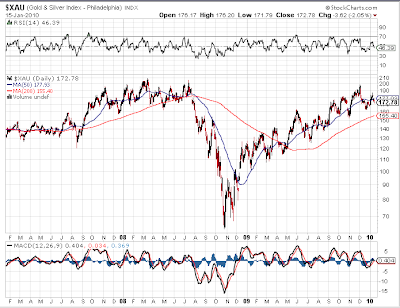
Weakness in gold has, not surprisingly, coincided with dollar strength. The dollar is solidly above its 50-day moving average and has just broken through its 200-day moving average. If the dollar can hold above 78.5 on the dollar index, expect to see further strength.


Gold is firming up a bit here at the same time the dollar is showing strength. Gold is sitting in the lower range of a multi-week consolidation pattern, which suggests gold is a buy right now. Until we bust out of this range in either direction, I will use all pullbacks in gold to add to positions.


Gold Stocks

If I were looking to enter the gold space right now, I would turn to gold stocks. Gold stocks have taken a beating along with the general market. Most people are concerned about the effect of potential crash conditions in the stock market on gold stocks.

While these concerns are valid, I believe one should buy when value presents itself. Relative to the value of gold, gold stocks are very cheap. The rising gold:xau ratio demonstrates the relative undervaluation of gold stocks.

In valuing gold stocks, keep in mind that energy costs are likely to remain depressed relative to gold as the global economy weakens. Although gold and oil are lumped together in the general category of commodities, they are driven by different fundamental factors. While both commodities are subject to the rules of supply and demand, only gold shines in an atmosphere of fear. After all, people don't store barrels of crude oil when they mistrust governments or currencies.

Once fear reenters the system, gold stocks will explode.


We are currently at an interesting juncture where both the dollar and gold are showing strength. Perhaps gold and the dollar are close to decoupling for good, which I believe will be the signal that confirms we are now entering the most powerful phase of the gold bull market.

I understand that it is hard for investors right now to pull the trigger on gold stocks, especially given the obvious weakness in the general stock market. However, gold shares will likely decouple from the general market in the same way they did during the Great Depression, and more recently, in the first half of 2009. I will continue to buy on weakness, and hopefully, ride this bull market to its conclusion.

This post has been republished from Moses Kim's blog, Expected Returns.

Thursday, January 28, 2010

Limits On Bank Risk Taking Could Be Good For Everyone

While the explanation by Obama on plans to introduce the "Volcker Rule" may have been poorly communicated, the limitations to bank risk taking could improve the financial system in the end. Eric Jackson from The Street discusses why the negatives of lower bank profits, lower liquidity would be greatly outweighed by the reduced risk for the US financial system. See the following article from The Street for more on this.

The proposed "Volcker Rule" isn't about being anti-business, it's about letting market actors do what they're best at.

Let banks bank, and let hedge funds trade. When either one does a poor job, let it go under and not pull the rest of the system with it. That's capitalism.

If bankers want to throw their own profits down a rat-hole with poor risk management, that's their right. Just don't do it with depositors' money

Last week, President Obama announced a series of planned reforms for the financial industry to prevent "too-big-to-fail" bank failures.

The centerpiece of these reforms was the so-called Volcker Rule, which restricts banks from getting into proprietary trading and owning, investing or sponsoring hedge funds or private-equity funds.

There has been much concern and hand-wringing about the long-term impact of these proposed changes since the announcement. The market -- and especially large bank stocks -- took a major hit following the announcement. The fears expressed were that Obama is anti-business and his misguided policies were going to kill off a nascent recovery just as it is starting to gain strength.

Hang on. First, we blame Obama that he, Treasury Secretary Tim Geithner, and Fed Chairman Ben Bernanke are too cozy with Wall Street, and no rules have been changed since the economic crisis began. Now, he's anti-business and his moves to reform the system to prevent systemwide risks are going too far.

Obama, generally regarded as a master communicator, did a horrendous job announcing the Volcker Rule. He came out, made an eight-minute speech, had no documentation to back it up and left after taking no questions.

Worse, his language was imprecise. The vacuum of information has directly led to the gnashing of teeth we've heard since then. Even now, a week later, we don't have further clarification. It's allowed pundits to surmise that the announcement was a knee-jerk reaction to last Tuesday's Massachusetts Senate loss. According to them, he's trying to be the left's populist version of Glenn Beck.

What was also confusing was that, after saying that banks couldn't do proprietary trading or even invest in a hedge fund or private equity fund, he said the following:

"If financial firms want to trade for profit, that's something they're free to do. Indeed, doing so responsibly is a good thing for the markets and the economy. But these firms should not be allowed to run these hedge funds and private equities -- funds while running a bank backed by the American people."

I think we're all speculating -- he meant to say it was fine for banks to take some of their own money (as opposed to depositors' money) and trade it. What is not OK is taking in depositors' capital, that which is federally protected by the Federal Deposit Insurance Corp. and then levering it up 40-1 and making big bets.

As I argued in an article last month, why is it that hedge funds have to trade their own money or go out and justify to skeptical outside investors why their strategies and risk management are worthy of receiving capital -- and yet banks get to take in deposits from mom and pop and then trade them without having to justify anything?

I believe that it was big bankers' desire to keep their talent, maximize their profits and maximize their take-home pay that encouraged them to make bigger and riskier trading bets as last decade rolled on.

Those with the best risk management -- like Goldman Sachs(GS Quote) -- did well. Those with the poorest risk management - like Citigroup(C Quote) -- did the worst and have cost U.S. taxpayers the most.

The Volcker Rule is saying that banks can trade their own profits if they want but it should be their money -- not depositors' -- and stupid losses shouldn't bring down the whole enterprise and infect the system.

The arguments against the Volcker Rule are that: (1) it's not defined, (2) proprietary trading represents "only 10%" of banks' profits, and (3) doing this will reduce liquidity in the marketplace. In other words, the bankers are saying, "We're doing God's work, by buying positions from clients and putting them on our balance sheets -- and what will these poor souls do without us?"

First, it is not well-defined. This brief and vague announcement reminds me of Geithner's first public comments after being sworn in as Treasury secretary in February 2009. He said he was going to do something, but he didn't say what, and he had no staff to do anything anyway. The markets tanked for another month on fears he had no control of the situation. Finally, he released a more detailed policy paper and the criticisms of him slowed down.

On the point of this only being a small part of the banks' profits, well, then, they should have no problem giving this up. The truth is that these banks rely on these profits. Why would they want to give them up if they didn't have to? The question is: Does taking their right to trade depositors' money make the system stronger? I think the answer is clearly yes. (And, a note to Goldman Sachs: if you don't like these rules, don't classify yourself as a bank holding company, allowing you to borrow money from the Federal Reserve for free.)

As for reduced liquidity, just as when you divert a river, you can't stop the flow of a current. Capital will find a place to trade what it needs to. Hedge funds will likely step up to fill any hole left over from the banks.

What are the long-term impacts here of this rule, if it is enacted? Bank profitability will go down. Talent and assets will flow to hedge funds, away from big banks. Liquidity will find a home and be served. And the systemwide risk of big banks will be lowered, which most would agree is a good thing after 2008.

You can't make an omelet without breaking some eggs. And you can't reform Wall Street without actually putting some reforms in place. This rule will be a good thing for all market participants in the long run.

This post has been republished from
The Street.

Does Bernanke Deserve Credit For Averting Another Great Depression

Glenn Hall from The Street points out that Bernanke did not have the advantage of hindsight like many of the individuals who are criticizing his actions. While mistakes were certainly made, the decisive action taken by the Fed was successful in averting a collapse into another Great Depression. See the following post from The Street.

I'm sick of hearing all the backseat drivers in the Senate with their 20/20 rearview vision taking potshots at Fed Chairman Ben Bernanke.

It's so easy for them to roll out the "woulda, coulda, shoulda" rhetoric now, when the financial crisis is under control and the economy is stabilizing.

I don't remember hearing so many brilliant ideas flowing from Congress when the crisis hit, when Bernanke and his team at the Fed sprang into action to prevent a repeat of the Great Depression. I do, however, remember the Fed taking decisive action quickly.

Are there things that could have been done differently? Of course. Bernanke himself acknowledges there are things he would have done another way if he had known then what he knows now. But he didn't. How could he? This was an unprecedented catastrophe stoked in no small measure by political and regulatory forces beyond the Fed's control.

That's right -- the very senators throwing stones today from their glass houses are complicit in creating the conditions that caused the financial collapse.

The support for loosening mortgage requirements came from both parties in both houses of Congress along with a decade's worth of White House occupants from Clinton to Bush.

Everyone wanted to make it easier for all Americans to own a home. Sounds good, but it turns out that not every American is ready for that responsibility.

How about this for a little back-seat driving -- why didn't lawmakers realize that loosening restrictions on lending requirements could snowball into such a disaster?

Why didn't the Senate question the risk of encouraging the likes of Bank of America (BAC Quote), Wells Fargo (WFC Quote), Citigroup (C Quote), JPMorgan Chase (JPM Quote) and other mortgage originators to provide more subprime loans.

Why didn't they question the loosening of restrictions on financial backing provided by the quasi-government (now fully government) agencies known as Fannie Mae (FNM Quote) and Freddie Mac (FRE Quote).

All of that excess, which Congress fully embraced, led to an unprecedented situation that required the unprecedented actions Bernanke took.

It's easy now to reconsider whether AIG (AIG Quote) should have been allowed to fail or whether the Fed should have begun offering essentially free money to everyone from Goldman Sachs (GS Quote) to General Motors' GMAC unit.

But all of this brilliant hindsight ignores the fact that the only reason we have the luxury today to second guess the emergency actions Bernanke took back then is because Bernanke's approach worked. However flawed some of the individual reactions may have been, there's no questioning that we're better off today than we were a year ago.

So I say thank you, Ben Bernanke. You've earned the right to show what you can do for the economy when there isn't a crisis.

This post has been republished from The Street.

Wednesday, January 27, 2010

How Obama's Budget Freeze Could Backfire

Mark Thoma from Economist's View discusses his disappointment in Obama's new plan for a three-year spending freeze that is reported by the New York Times to be a main component in the State of the Union. Other economists think that this is a short-term band aid to America's deficit problems that could backfire with a negative impact on the economy and jobs. See the following post from Economist's View.

Here's the administration's latest bright idea:
Obama Seeks Freeze on Many Domestic Programs, by Jackie Calmes, NY Times: President Obama will call for a three-year freeze in spending on many domestic programs... The officials said the proposal would be a major component both of Mr. Obama’s State of the Union address...
Brad DeLong reacts (see here too):
Barack Herbert Hoover Obama?, by Brad DeLong: For some time I have been worried about fifty little Herbert Hoovers at the state level. Right now it looks like I have to worry about one big one...

What we are talking about is $25 billion of fiscal drag in 2011, $50 billion in 2012, and $75 billion in 2013. By 2013 things will hopefully be better enough that the Federal Reserve will be raising interest rates and will be able to offset the damage to employment and output. But in 2011 GDP will be lower by $35 billion--employment lower by 350,000 or so--and in 2012 GDP will be lower by $70 billion--employment lower by 700,000 or so--than it would have been had non-defense discretionary grown at its normal rate. (And if you think, as I do, that the federal government really ought to be filling state budget deficit gaps over the next two years to the tune of $200 billion per year, the employment numbers are more like 3.3 and 3.7 million in 2011 and 2012, respectively.) ...

As one deficit-hawk journalist of my acquaintance says this evening, this is a perfect example of the fundamental unseriousness of Barack Obama and his administration: rather than make proposals that will actually tackle the long-term deficit in a serious way--either through future tax increases triggered by excessive deficits or through future entitlement spending caps triggered by excessive deficits--he comes up with a proposal that does short-term harm to the economy as an alternative to tackling the deficit in any serious and significant way.

As another points out, it is hard to imagine a less competent legislative operation: it would be one thing to offer a short-term discretionary spending freeze (or long-run entitlement caps) in return for fifteen Republican senators signing on to revenue enhancement triggers. It's quite another to negotiate against yourself by attacking employment in the short term. ...
I can't disagree at all. This is pretty disappointing.

The long-term budget problem is due to primarily one thing, rising health care costs. Everything else is dwarfed by that problem. If we solve the health care cost problem, the rest is easy. If we don't solve it the rest won't matter.

This was an opportunity for Obama to explain the importance of health care reform and how it relates to the long-term debt problem. Why not emphasize this?:
Sam Stein: Orszag Calls Senate Health Care Bill Biggest Cost-Container Ever Considered: The health care bill before the Senate would cut costs and reform health-care delivery more than any piece of legislation in American history, White House budget director Peter Orszag declared on Wednesday. "The bottom line is the bill that is currently on the Senate floor contains more cost containment and delivery system reforms in its current form than any bill that has ever been considered on the Senate floor period," the Office of Management and Budget director told reporters...
Instead we get cheap political tricks that are likely to backfire. How will this look, for example, if there's a double dip recession, or if unemployment follows the dismal path that the administration itself has forecast?

This seems to be a case of the former Clinton people in the administration (or wannabees) trying to relive their glory days instead of realizing that those days are gone, the world is different now and it calls for different solutions.

I wasn't in favor of having so many Clinton administration people in this administration, and nothing so far has caused me to change that assessment. They're nothing but trouble.

Update: Here's an updated interpretation of the policy.

This post has been republished from Mark Thoma's blog, Economist's View.

Housing Market Data Indicates Price Trend Improvement

John Lounsbury from The Street analyzes the home price data from Case-Shiller, NAR, and FHA to conclude that housing recovery is still far off. Housing prices and sales of existing homes are showing an overall trend of improvement, while sales of new homes is heading downward. See the following post from The Street.

The widely followed Case-Shiller Home Price Index out this morning showed a decline for November compared to October, but just barely.

The Composite-10 Index, covering 10 of the largest metropolitan housing markets, was $158,490 in November, down from $158,820 in October. The broader Composite-20 showed similar results, with a decline from October of 0.2%, the same as the Composite-10.

Compared to a year ago, prices for the two indexes were down 4.5% (Comp-10) and 5.3% (Comp-20). The year-over-year rates of price decline continue to improve, as shown in the graph provided by S&P Case-Shiller below.


Because the Case-Shiller (C-S) index reports a three-month moving average, the effect of the end of the 2009 first-time home buyers tax credit is muted compared to the data from the NAR (National Association of Realtors).

The November declines in the NAR existing home prices were -1.2% from October and -5.7% year over year. When the NAR data is viewed through the prism of a 3-month moving average, the numbers are even more different from the C-S results. The 3-month moving average changes are -1.4% month to month and -7.2% year over year for the NAR data.

I can only attribute this to the geographic scope of the two surveys: C-S monthly surveys cover only 10- and 20-city markets, whereas NAR is a national survey. The implication is that the improvement trends (declining more slowly) are lagging outside of the 20 major markets.

Another monthly housing price index was also published today by the Federal Housing Finance Agency. This report, which covers homes sold with FHA conforming mortgages, found that prices rose 0.7% for November from October. Year over year, November was up 0.5%. This indicates that homes with FHA mortgages are behaving better than the complete market. The FHA conforming market is restricted to mortgages less than about $420,000, the limit for most areas of the country.

The fourth home price measurement is the New Home Median Price compiled by the U.S. Census Bureau. That report for December will be issued Wednesday.

The following graph shows the behavior of all four indexes since the housing market prices peaked in early 2007.


The messages from this data are mixed. Key observations:

  • The quadratic trend lines for C-S and FHFA are cupped (curving toward the up side) indicating price trend improvement.
  • The NAR quadratic trend line is domed (curving downward) indicating price trend degradation.
  • The new home price quadratic trend line is nearly linear indicating little trend change. The seasonal cycling effect is obvious in the NAR data.
  • All four curves are above their quadratic trend lines, a positive situation.
  • The three-month moving averages are all very close to the 12-month moving averages. This is a neutral situation.

Sales volumes are much more problematic. Last week's bombshell was the dramatic drop in existing home sales reported for December by the NAR. The established trend in sales volume had appeared to be headed up, as shown in the following graph. It appears that the December sales volumes for existing homes may have returned to an extension of the gradual up slope that existed before the market was distorted by the first time home owners' tax credit.


Meanwhile, new home sales volume has declined throughout the second half of the year, even in the face of the tax credit. It looks very much as if new home sales may again reach the low levels of early 2009.

The December data due from the Census Bureau Wednesday will go a long way toward determining how likely the lows in numbers of new homes may not yet have been reached.

This is not good news for the home builders, such as Toll Brothers(TOL Quote), D.R. Horton(DHI Quote), Hovnavian(HOV Quote), Pulte Homes(PHM Quote), KB Home(KBH Quote)and Lennar(LEN Quote).

Has housing stabilized? Maybe in some regards, but it remains to be seen how an additional two to three million foreclosure homes becoming available in 2010 will impact the market. It is unlikely that the new home segment of the market will stabilize until the wave of foreclosures comes to an end, which may well after 2010.

What we may see is the existing home market continuing to slow its decline and going through a broad bottom over the next one to two years, but the new home market may well not bottom for some time.

For new homes, which have a higher cost per square foot, it's all a matter of supply and demand. New homes will continue to face an over supply of existing homes and a weak demand based on price point.

This post has been republished from The Street.

Tuesday, January 26, 2010

Housing Sales Slide Shows Flaws In Tax Credits

The biggest December decrease in housing sales on record was a result of the end of the original homebuyer tax-credit which encouraged first time homebuyers to rush to beat the Nov 30th deadline. Moses Kim from discusses why artificially propping up the housing market doesn't work in the long term. See the following post from Expected Returns.

No surprise here. This is just a glimpse of what will happen when the government removes the homebuyer tax-credit permanently. Our government specializes in temporary solutions to long-term structural problems- solutions that make problems worse in the long run. This will end badly, especially since the Federal Reserve has essentially become the sole buyer of toxic waste from Fannie Mae and Freddie Mac. Housing is getting propped up from all directions, and yet there is hardly any effect. This is concerning. From Bloomberg, Existing U.S. Home Sales Decreased More than Forecast:
Sales of existing U.S. homes plunged in December more than anticipated, the month after a government tax credit was originally due to expire.

Purchases decreased 17 percent, the biggest decline since records began in 1968, to a 5.45 million annual rate from 6.54 million pace the prior month, the National Association of Realtors said today in Washington. The median sales price increased for the first time in two years, reflecting fewer first-time buyers, the group said.

First-time buyers rushed to complete deals before the $8,000 government incentive was expected to end on Nov. 30. The subsequent extension and expansion of the credit, together with the one- to two-month delay between contract signings and closings, signals demand will pick up again in the first half of this year.
You don't necessarily want homebuyers, especially first-time homebuyers, rushing to close deals simply to receive a tax credit. The steep decline in home sales immediately after the expected expiration of the tax-credit shows you how artificial the demand for housing in previous months was. This is still a weak housing market- after all, if the housing market were really stabilizing, the government would not have to step in with a tax credit, let alone extend it.

When the dust settles, there will be an army of homeowners who had no business owning a home in the first place. Sound familiar?

Tax Credit Extension- Prolonging the Agony
President Barack Obama and Congress extended the first-time buyer credit to cover deals signed by April 30 and closed by June 30, and expanded it to include current homeowners. Even so, some economists believe the original measure pulled sales forward, restraining demand for a few months.

After rebounding early this year, sales will probably fall off again after June, Yun said in the press conference. The degree of the decline will depend on the state of the job market, he said.

Yun said he was “generally pleased” with the December outcome since he was fearing an even larger drop following the expiration of the tax credit. “There is an increase in home- buyer confidence,” he said, adding “there is some sustainable momentum” in sales. Even with the decline, sales were still up 15 percent from the same month last year, signaling the general improvement, he said.
We might as well just make the tax credit permanent and effectively raise the price of all homes by $8,000. Let's throw more taxpayer money at homebuyers who would have bought homes even without tax credits. After all, we are becoming experts at wasting taxpayer money, why stop now?

There is no recovery in unemployment, which means there will be no recovery in housing. In the context of previous bounces off lows in economic activity, we are experiencing a very weak recovery. This suggests the second dip in our economy will be pretty nasty. Very few sectors of our economy will survive unscathed, and this includes housing.

This post has been republished from Moses Kim's blog, Expected Returns.

Obama Needs To Refocus On Job Creation

Glenn Hall from The Street points out that the number one priority for Obama should not be healthcare or financial reform but rather generating jobs. Unless Obama can start creating jobs, his approval rating will continue to fall. See the following post from The Street.

As President Obama prepares to deliver his first state of the union speech this week, there is only one thing he needs to do -- persuade Americans that he can create new jobs.

Little else matters. Obama can yammer on all he wants about punishing bankers and vilifying fat cat lobbyists who threaten his health care agenda, but what America really needs is an economic recovery that puts the 15 million unemployed Americans back to work and gives the additional millions of Americans who've dropped out of the workforce a reason to try again.

So far, the employment numbers keep going down, and so do Obama's approval ratings.

The U.S. lost 85,000 more jobs in December and just today Wal-Mart (WMT Quote) said it will shed about 11,200 jobs at its Sam's Club warehouse, primarily by outsourcing in-store demonstrations to a marketing company.

Meanwhile, 53% of respondents disapprove and 41% strongly disapprove of Obama's job performance in the Rasmussen Reports daily Presidential Tracking Poll for today.

Now, just like a year ago, the public's priorities for Obama and Congress are to shore up the economy, rev up the job creation engine and defend us from terrorists, according to a recent Pew poll.

Nothing else comes close, not even health care or financial regulation.

The bottom line is that beating up on Bank of America (BAC Quote), Goldman Sachs (GS Quote) or Citigroup (C Quote) won't score as many points with the public as hunkering down on some good old-fashioned economic packages.

Job creation is the surest indicator of whether economic improvements are underway, and so far we're not seeing the results.

This post has been republished from The Street.

Monday, January 25, 2010

China Cuts Purchases Of US Debt

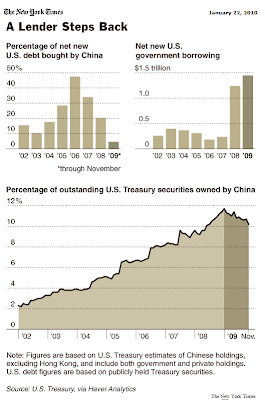
Foreign countries are buying less US debt especially China who significantly cut their purchases of US treasury securities. With the US borrowing more money than ever, this could lead to a US funding crisis. See the following from Expected Returns for more on this.

As America heads down the road to insolvency, its creditors will attempt a stealth exit from the Treasury market. From the looks of the latest Treasury data, it looks like China is going to lead the move away from U.S. debt. From the New York Times, Debt Burden Now Rests More on U.S. Shoulders:
THE United States government borrowed more money than ever before in 2009, but its largest lender — China — sharply reduced the amount it was willing to lend.

The United States Treasury estimated this week that during the first 11 months of last year China raised its holdings of Treasury securities by just $62 billion. That was less than 5 percent of the money the Treasury had to raise.

That raised its holdings to $790 billion, leaving it the largest foreign holder of Treasury securities — Japan is second at $757 billion and Britain a distant third at $278 billion. But China’s holdings at the end of November were lower than they were at the end of July.
As America's current account deficit declines, especially with China, there will be a scarcity of dollars to support the Treasury market. This is one of the many reasons why the Fed has taken on the onus of directly buying debt. The graph below shows the troubling trend of our #1 banker giving us the cold shoulder.


The Mythical "Household Sector"
During the full year of 2009, the volume of outstanding Treasury securities owned by the public — as opposed to United States government agencies like the Federal Reserve or the Social Security Administration — rose by $1.4 trillion, a 23 percent gain, to $7.8 trillion. In dollar terms, that was the largest annual increase ever, but as a percentage increase it slightly trailed 2008.

But total foreign purchases in the 11 months financed only 39 percent of the borrowing, leaving American investors to purchase the remainder. As recently as 2007, foreigners were buying more Treasuries than the government was issuing, enabling Americans to reduce their Treasury holdings even as the government borrowed hundreds of billions of dollars.
The public sector is very broad, and includes a household sector that isn't adequately defined. Essentially, the household sector, which accounted for about half of the growth in public ownership of debt, is comprised of all Treasury purchases outside of the standard categories (government, foreign, pension funds, money market funds etc.). In all likelihood, the household sector is a front for direct government purchases.

Foreign governments around the world are dealing with their own domestic economic issues, which obviously weakens their ability to purchase our debt. This will exacerbate the funding crisis in America as our issuance of debt increases.

The debt situation is a lot more delicate than most people realize. I don't know how much longer the Fed can get away with this con game, but I suspect it will come to an end soon via a sharp increase in yields.

This post has been republished from Moses Kim's blog, Expected Returns.

What To Do About Fannie And Freddie

The potential half a trillion cost to keep Fannie and Freddie alive has led to questions about whether the government-sponsored-enterprises should be replaced. The government's controversial agreement to absorb unlimited losses for the next three years from the mortgage giants could add to the unsustainable budget deficit. See the following post from The Mess That Greenspan Made for more on this.

Wow. Elected officials are really getting carried away in their response to the loss of Ted Kennedy's seat in Massachusetts. There's reform in the air all over the nation's capital, Bloomberg now reporting that Rep. Barney Frank (D-MA) is recommending that wards of the state Fannie Mae and Freddie Mac should be abolished

“The committee will be recommending abolishing Fannie Mae and Freddie Mac in their current form and coming up with a whole new system of housing finance,” Frank, a Massachusetts Democrat and chairman of the House Financial Services Committee, said at a hearing in Washington today. “That’s the approach, rather than a piecemeal one.”

The companies, the largest sources of money for U.S. home loans, were seized by regulators almost 17 months ago because of their risk of failing and have since survived on $110.6 billion in taxpayer-funded aid.
Wasn't it Barney Frank who said a couple years back that the GSEs needed to do more to help the housing market recover (on a temporary basis).

Earlier today, a story in the Wall Street Journal indicated that the Government Accounting Office wants to combine Fannie and Freddie's books with the government's books, a move that would cause U.S. deficits and the national debt to rise - maybe a lot.

The U.S. government's move to deepen its ties to mortgage-finance giants Fannie Mae and Freddie Mac by agreeing to absorb unlimited losses for the next three years is igniting a debate over whether it should bring the business operations of the companies onto its books.

A decision on how the government treats Fannie and Freddie could have broader political implications. So far, the White House has resisted calls by Republicans to bring Fannie's and Freddie's obligations onto the government's books, a move that could boost the federal deficit by tens of billions of dollars.
Recent estimates have put overall losses at Fannie and Freddie at almost a half a trillion dollars. Can the U.S. government absorb all those losses?

This post has been republished from Tim Iacono's blog, The Mess That Greenspan Made.

Friday, January 22, 2010

Long-Term Bull Market For Gold Investment

Moses Kim explains why gold equals money and the value of gold will inevitably increase when the excess money printing policies finally catches up with us. A government default, high inflation, or a general panic could send gold values soaring. See the following post from Expected Returns.

The volatility we are currently witnessing in the gold market, especially in gold shares, is something we have not seen in some time. This reminds me a lot of 2008 when gold shares would have 10-20% days both on the upside and the downside. Newcomers to the gold market are no doubt throwing in the towel.

In five years, current prices will look like a gift. With that being said, I want the new money in gold out. I want the media to start bashing gold. I want Nouriel Roubini to pat himself on the back on National TV and convince even more people to sell. Then I'll know we're close to reversing.

Gold will eventually start basing, perhaps at the $1,050-$1,070 dollar level, and start the next phase of this bull market. When it does, I want to have a large position in place. This means buying on weakness, however hard that may be at the time.

I assume most of my readers are "gold bugs". But even so, it pays to have occasional reminders of why we are invested in gold. With that in mind, I present you with one of the best gold quotes of all time from the Maestro himself, Alan Greenspan:
"In the absence of the gold standard, there is no way to protect savings from confiscation through inflation. ... This is the shabby secret of the welfare statists' tirades against gold. Deficit spending is simply a scheme for the confiscation of wealth. Gold stands in the way of this insidious process. It stands as a protector of property rights. If one grasps this, one has no difficulty in understanding the statists' antagonism toward the gold standard."
Make no mistake about, the attacks against gold are colored by a bias against what gold offers- namely protection against governments and their #1 ally, the printing press. Governments always make promises that they cannot possibly keep. Two mammoth promises, Social Security and Medicare, are about to be broken. The political backlash will be quite severe. Gold will rise in response.

Long-Term Bull Market

Gold is in a very healthy upward trend, even in the following arithmetic chart. As long as we hold above $800 dollars, the long-term bull market remains intact. This means you should be buying every dip.


Loss of Confidence= Gold Explosion

Although many Americans are starting to wake up to the corruption of our government officials, most Americans are still asleep. Anyone who criticizes the government is labeled a right-wing extremist or conspiracy theorist. The uneducated masses nod in zombie-like agreement while getting robbed in broad daylight. As an American, this is very sad to see.

Eventually, there will be a general panic that will send gold prices flying. I am just unsure about what the catalyst will be. Perhaps it will be a mini run on banks once mark-to-fantasy accounting is removed. People who have been conditioned into believing that paper is money will then find out what "gold bugs" have known all along: gold is money.

Bring out the Helicopters Ben

What people need to understand is that our economy is exhibiting incredible weakness, especially when you account for the stimulus the Fed has pumped into the system. Jobless claims are rising again, housing starts are down, and consumer confidence is falling. Once residential real estate starts falling again, things will get messy. Refer to the chart below to get a glimpse of the massive resets that lie ahead. Folks, get ready for the double dip.


Serious cracks will emerge in our economy soon. "Unexpected" economic weakness will be met by "extraordinary" measures by the Fed. Helicopter Ben will use high-brow economic jargon to mask what he is really doing, which is printing money. From his perspective, there is no other way out of this debt crisis. Default is not an option.


Gold Outlook

I would like to see gold reverse in the next week or two- otherwise I think we're in for a more prolonged decline, which I believe will be measured in months. Nonetheless every sell-off is a buying opportunity for those with eyes to see. Prepare while every one is sleeping.

This post has been republished from Moses Kim's blog, Expected Returns.

Obama Teams With Volcker For New Financial Regulation

Obama introduced a new proposal for financial reform that would aim to limit risks and size of the nation's banks. The plan is championed by former Fed chairman Paul Volcker aims to prohibit certain risky trading behavior by commercial banks. See the following from Economist's View.

It looks like the political winds have shifted away from Tim Geithner/Larry Summers and toward Paul Volcker/Elizabeth Warren:

Obama to Propose Limits on Risks Taken by Banks, by Jackie Calmes and Louis Uchitelle, NYTimes: President Obama on Thursday will publicly propose giving bank regulators the power to limit the size of the nation’s largest banks and the scope of their risk-taking activities...

The president, for the first time, will throw his weight behind an approach long championed by Paul A. Volcker... The proposal will put limits on bank size and prohibit commercial banks from trading for their own accounts — known as proprietary trading. ...

Mr. Volcker flew to Washington for the announcement on Thursday. His chief goal has been to prohibit proprietary trading of financial securities, including mortgage-backed securities, by commercial banks using deposits in their commercial banking sectors. ...[T]he concern is a new type of activity in which financial giants like Citigroup, Bank of America and JPMorgan Chase ... operate on two fronts. On the one hand, they are commercial banks, taking deposits, making standard loans and managing the nation’s payment system. On the other hand, they trade securities for their own accounts, a hugely profitable endeavor. This proprietary trading, mainly in risky mortgage-backed securities, precipitated the credit crisis in 2008 and the federal bailout.

Mr. Volcker ... has gradually lined up big-name support for restrictions on such trading. ... Under the new approach, commercial banks would no longer be allowed to engage in proprietary trading, using customers’ deposits and borrowed money to carry out these trades. ...
I want more details, these proposals don't exhaust the needed changes, and who knows what Congress will actually do -- I don't think we'll get anywhere near the amount of change we need when all is mostly said and little actually gets done -- but this is a move in the right direction. Too bad it didn't happen months ago. [dual posted]

This post has been republished from Mark Thoma's blog, Economist's View.

Thursday, January 21, 2010

A Mountain Of Commercial Real Estate Debt Is Coming Due

$566 billion in commercial real-estate debt comes due in 2010 and 2011 and already 20% of construction loans are past due. A flood of commercial property defaults could significantly devalue commercial property and put banks in serious trouble. See the following discusses from Moses Kim from Expected Returns.

A lot has been made about the plight of commercial real estate. With prices off over 30% from peak levels, there's not much to be optimistic about: commercial property sales are plummeting, and vacancies are rising along with unemployment. This does not bode well for future bank earnings. From the WSJ, Unfinished Real Estate Projects Weigh on Banks:
For its neighbors in the city's wealthiest area, the Streets of Buckhead is an unfinished eyesore, not the glitzy shopping district promised at the height of the real-estate boom.

For Bank of America Corp., the project's biggest lender, it is a microcosm of commercial-real-estate problems faced by banks nationwide as builders default on loans and valuations tumble.

The project's developer is in talks to raise $200 million to complete the stalled project. As part of the deal, Bank of America is negotiating to potentially swallow a loss on the $160 million loan it made to the developer before construction began, people familiar with the matter said.

The bank is not alone. Lenders across the country are being forced to make unpalatable choices, including putting up more cash, extending loans or agreeing to lower their rights to collect on the debts, as they try to keep projects afloat.
Extend and pretend at its finest. Although certain types of commercial real estate have been firming up, properties under construction are very vulnerable to sustained weakness in the economy. There will come a point when banks will have to face reality and take losses, but of course, not before taking one last dip into the bonus cookie jar.

Non-Performing Loans Rising
Today, Streets of Buckhead is one of many high-profile developments in the country halted by the economic downturn and financing drought. Real-estate developments are among the biggest headaches for banks because they are huge capital drains and, in most instances, demand for space and rents in their markets are falling below projections. As of the fourth quarter, about 20% of $440 billion of construction loans outstanding were more than 30 days past due, according to Foresight Analytics, compared to 11.4 % a year ago.
Delinquencies are still rising for commercial real estate properties. Note that tremendous weakness in commercial real estate is occurring against a backdrop of massive governmental support (TARP). This does not augur a quick recovery in commercial real estate valuations.

Praying for a Recovery

Banks will have their hands full in the coming months. About $566 billion in commercial real-estate debt, the majority of which was provided by banks, comes due in 2010 and 2011, according to Oakland, Calif., research firm Foresight Analytics LLC. The struggling commercial real-estate loan market is increasingly cited by bank regulators as a growing concern. The Federal Reserve's Jan. 13 "beige book" survey of regional economies said commercial property markets remained weak.

The report highlighted loan restructurings, noting, "There is still some concern over how commercial-real-estate loans will be worked out as they come due, given the decline in collateral value."
If the commercial real estate market remains at depressed levels, there will be a cascade of defaults, since loans are collateralized by the value of the property. Rising defaults will further pressure commercial real estate valuations.

Either commercial real estate prices start rising soon, which is heavily dependent on the employment picture, or we are primed for the next leg down in commercial real estate. It will be interesting to see how long banks can hold out before capitulating.

This post has been republished from Moses Kim's blog, Expected Returns.

Putting The Increase In Building Permits Into Perspective

Although housing starts surged in November and new building permits increased in December, if you take a 30,000 foot view it is relatively insignificant. Tim Iacono points out that the current annual rate of permits issued is far below the previous lows in 1975 when adjusted for population. See the following from The Mess That Greenspan Made.

The Census Bureau reported(.pdf) that housing starts declined but permits for new construction surged during the month of December in what continues to be a difficult period for the home building industry as new home construction remains near record lows.


Housing starts fell 4.0 percent after jumping 10.7 percent the month prior while the number of permits issued, a leading indicator for home building activity, jumped 10.9 percent in December after rising 6.9 percent in November.

Anyone interpreting the surge in permits as a sign of recovery should be reminded that this is very much a case of "one is greater than zero" since, for housing starts and permits, the entire year of 2009 was spent in record low territory for a data series that began in 1959.

For example, the current annual rate of 653,000 for permits issued, down 71 percent from the 2005 high, is still below the pre-2008 record low of 709,000 set back in March of 1975. When adjusted for the increase in population over the last 34 years (from about 215 million to 310 million), the current level of permits issued is almost 50 percent below the 1975 low.

This post has been republished from Tim Iacono's blog, The Mess That Greenspan Made.

Wednesday, January 20, 2010

What Could Cause A US Default On Its Debt

Once thought an impossibility, the default of the United States on its debt is now being talked about as a potential outcome. Moses Kim points to corruption, a collapse of confidence, and overvaluation of the dollar as problems that could lead to a US default. See the following from Expected Returns for more on this.

For years, Cassandras have been warning of an economic collapse in America driven by a default on our national debt. Yet amazingly, in the face of accruing liabilities, foreigners have continued to fund the lavish lifestyles of Americans.

The specter of a wave of sovereign debt defaults is becoming more of a possibility daily. Historically, waves of sovereign debt defaults follow periods of relative calm in credit markets. In short, sovereign defaults are contagious.

While the first wave of defaults is likely to be in the Eurozone, where Maastricht Treaty- mandated debt to GDP ratios of 60% are being dismantled, America is not well on its way to defaulting itself.
Is a sovereign debt default possible in America?

First off, there are a couple of different forms of default. There is the outright default model accompanied by a repudiation of debt, which would be the Revolutionary Russian and Revolutionary Chinese model of default. Then there's the de facto default, which implies inflation.

Sovereign debt defaults are historically characteristic of emerging economies. Since emerging economies tend to be procyclical, economic downturns apply significant pressure to debt servicing ability. Mature economies like the United States are thought to be immune from default.

In the following chart, notice the subtle shift that signifies over-indebtedness is increasingly becoming an advanced economy phenomenon.


It is certainly true that highly developed economies have a higher tolerance for debt than emerging economies. Heck, even Japan is still chugging along with a debt to GDP ratio approaching 200% (although this is partly offset by their massive foreign exchange reserves). But even accounting for their foreign exchange reserves, Japan is long overdue for some serious credit dislocations.
The Argentinian Model of Debt Default

If you are looking for a wealthy nation to fall victim to repeated debt defaults, look no further than Argentina. Based purely on resources, Argentina should be one of the richest nations in the world. However, Argentina has been susceptible to sovereign debt defaults throughout its history.

What was it about Argentina that made repeated sovereign debt defaults possible, and are these characteristics prevalent in the United States today?
Kleptocracy

The level of corruption at the highest levels of government is reaching comical levels. In the face of rising public opposition, our government has continued to loot Americans and effectively hand the money to banks that gambled and lost.

What tends to happen in Kleptocratic regimes is that huge sovereign debt loads profit the few at the expense of the majority. Let me give you one example.

Senator Christopher Dodd is a shining example of the average corrupt politician that now inhabits Washington D.C. As Chairman of the Senate Finance Committee, Senator Dodd failed to regulate Fannie Mae and Freddie Mac, turning a blind eye to clear fraudulent behavior. I guess it's a coincidence that he received the most campaign contributions from Freddie and Fannie Mae out of any politician.

The corruption doesn't end there. Senator Dodd also received preferential mortgage rates for his political support of the now non-existent Countrywide Financial.

Our political system is one big joke. Americans caught up in the ridiculous left-right paradigm are seriously missing out on the bigger picture.
Collapse of Confidence

Confidence is a funny thing. The move from long-term to short-term sovereign debt leaves a country more vulnerable to a sudden collapse in confidence by global creditors.

In the United States, the move to shorter-dated securities is well underway. Don't underestimate the ability of capital outflows to turn from a trickle to a flood in short order. The move to short-dated securities is the first step in the process. If our government officials keep on bungling the handling of this crisis, expect capital flows to flood out of the U.S.
Overvalued Currency and Exchange Rates

Overvalued currencies pose a problem for over-indebted countries due to the relationship of the relative strength of a currency and demand for bonds. If a country's currency is declining in value, the value of the country's bonds will fall in unison.

In the period preceding its debt default, the Argentinian peso was pegged to the dollar, which kept the peso artificially overvalued. Eventually, the overvalued peso applied pressure to Argentinian exports and helped push Argentina into a recession.

I believe the dollar is similarly overvalued, which stems from its position as the world's reserve currency. There is little doubt in my mind that the dollar will lose its reserve currency status, which will likely be met by a revaluation globally.

If the dollar weakens against a basket of currencies, which is effectively inflation, demand for our debt will decline. In the post-gold standard system, there is a strong correlation between rising inflation rates and sovereign debt defaults.
Conclusion

History proves that governments with the biggest armies get away with defaulting on debt. However, the consequences of such a default are significant, especially in the short term. Consider for a moment that 40% of new issues of our debt are being funded directly by our government. In the event of a debt default, that figure would be much closer to 100%, which would result in a massive inflationary spiral.

As a result, rates on all types of loans, most importantly mortgage rates, would rise significantly and severely depress economic activity. Credit booms are followed by credit busts, which directly affects interest rates. This is part of the reason why credit contractions are just different beasts.

The U.S. will likely default on its debt through inflation, and perhaps a restructuring of debt. When this occurs, the timeline for recovery will likely be moved back another 5-10 years.

This post has been republished from Moses Kim's blog, Expected Returns.

China Experiencing Vegas-Like Property Inflation

With China's housing prices increasing a staggering 7.8 percent in December, China has taken strong measures to cool the market and prevent a Dubai-like property crash. They have reimposed a sales tax on homes sold within five years and are requiring that second homes are purchased with a 40 percent down-payment. See the following from The Mess That Greenspan Made.

News reports about dangerous asset bubbles in China are now reaching a crescendo as the government continues to take steps to rein them in. Bloomberg has a number of reports today about soaring home prices, soaring stock prices, and one famous investor who now sees a bubble. First up, a story about the bubblicious property market

China property sales jumped 75.5 percent to 4.4 trillion yuan ($644 billion) last year, led by the eastern cities of Zhejiang and Shanghai, as record new loans boosted buying.

The sales data follows last week’s announcement that December property prices rose 7.8 percent, the fastest pace in 18 months, adding urgency to government efforts to rein in speculation. China this month reimposed a sales tax on homes sold within five years of their purchase while the country’s cabinet on Jan. 10 urged strict application of a 40 percent down-payment requirement for second homes. The measures are likely to weigh on first-quarter sales, economist Lu Ting said.
While the steps being taken to curb the speculative fever are shocking by U.S. housing bubble standards, so too are the statistics above which are said to - amazingly - understate the home price gains last month.

After the various housing bubbles the world has seen in recent years, the 7.8 percent gain (that, according to one economist may really be as high as 20-30 percent) is simply astounding. The biggest monthly gain for the S&P Case-Shiller 20-City Home Price Index over the last ten years was only two percent.

Even in Las Vegas - what used to be housing bubble central, but is now better known as the national leader in foreclosures - the biggest monthly gain was just 6.0 percent in 2004.

They certainly have their work cut out for them in Shanghai trying to reel the property bubble in and they're no doubt hoping that stocks will obey as well. This report provides the latest details on equity markets where, after a huge run-up last year, some calm has been restored.
China’s stocks advanced for a third day on the prospect the nation’s economic recovery and the Shanghai Expo will boost earnings for airlines and hotels.

China Eastern Airlines Corp., the nation’s third-largest carrier by fleet size, added 5.1 percent after saying it may have swung to a profit last year. Shanghai Jinjiang International Hotels Development Co., the biggest hotel operator, advanced 7.5 percent after President Hu Jintao visited the site of the exhibition that starts in May.
...
The Shanghai Composite Index rose 12.95, or 0.4 percent, to close at 3,237.1. The gauge has lost 1.2 percent this year on concern the government will tighten lending standards to avert asset bubbles. The index rallied 80 percent in 2009. The CSI 300 Index added 0.5 percent to 3,500.68.
Foreign exchange reserves were also on the rise last year, climbing to $2.4 trillion as noted at the end of the report. That's not helping to make the post-2008 crash financial world less prone to spawning even more bubbles.

Jim Rogers seems to be getting a little concerned about all of this. After lambasting Jim Chanos in recent days about his calls for a China collapse of epic proportions (Dubai times 1,000 was the characterization), Rogers seems a bit less sure of himself in this story.

Shanghai and Hong Kong property prices may fall after being driven higher by speculative demand, said investor Jim Rogers, author of “A Bull in China.”

Efforts to restrain lending underscore the government’s attempt to take “some of the heat out of the economy,” he said in an interview in Bloomberg’s Singapore bureau today. The rest of the Chinese economy is “hardly in a bubble,” he said.
...
“Certainly, Shanghai real estate or Hong Kong real estate should decline,” said Rogers, 67. “My goodness, if anything’s in a bubble in the world, that and U.S. government bonds are certainly very overpriced.”
...
“China now realizes that they’ve created too much money, that prices are going up too much and they’re trying to slow things down,” Rogers said. “These things are designed to take some of the heat out of the economy. Let’s hope it works.”
Has Rogers ever commented on all the copper being stored on Chinese pigfarms?

That would seem to be an important consideration regarding his current view that other parts of the Chinese economy and financial markets are not similarly bubbly (see here and here for more on that subject).

While Rogers has a tremendous track record over the years and has been quite good on nearly all of his long-term market calls, he has been famously wrong on a number of important occasions. About five or six years ago he repeatedly poo-pooed the idea of gold as an investment because he thought the central banks had too much of the stuff and would be willing sellers - not buyers - in the years ahead.

It turns out that central banks have been net buyers for a year now with no end in sight.

This post has been republished from Tim Iacono's blog, The Mess That Greenspan Made.

Tuesday, January 19, 2010

2010 Economy Faces Significant Headwinds

One of the headwinds facing the economy in 2010 is the slow jobs market that is likely to take a long road to recovery. The sliver of hope is in the closing gap between job separations and new hires, although long-term unemployment has reached the highest level since 1948. See the following from The Capital Spectator.

The U.S. labor market is far from healthy, and the prospects are low for changing that diagnosis any time soon. But there’s a small ray of hope for thinking that the net loss of jobs is over and maybe, just maybe, some degree of expansion is near. Last week’s update on new hires is one of the positive smoking guns for expecting a better job market in the weeks and months ahead, if only marginally so.

It’s hard to overestimate how much influence the labor market will color the details of the economy in 2010. Suffice to say we’re at the point that the trend in jobs will have an outsized effect on what unfolds in the year ahead, for good or ill. A surprisingly strong recovery? A double-dip recession? Or something in between? We think the third choice is the right answer, although there’s a lot of play even there in terms of the details. In any case, much of the true answer will come via the labor market, now more than ever.

On that note, there are some statistics that are encouraging, albeit with all the usual caveats. Nonetheless, the upturn in the so-called hires rate in the economy provides a small bit of light in a dark tunnel. As the chart below shows (courtesy of the Labor Department), the new hires rate continues to rise off the bottom established in mid-2009. A pick-up in job creation, in other words, appears to be gaining momentum.


The problem is that the economy is still losing more jobs than it creates, i.e., the separations rate (the ratio of employment terminations to total workers employed) has been sticky on the upside. But the gap between hires and separations is closing. Is there enough momentum in the recent rise in new hires to overtake separations in the months ahead? Perhaps. If so, the shift will reflect a minor milestone in favor of growth.

Of course, we should be cautious in expecting too much too soon. Charles Thibault of Wanted Analytics considered the positive implications via a rise in new hires back in September. But the optimism, even though it was statistically warranted, was premature. The net change in nonfarm payrolls was still down in December.

Midway through the first month of 2010, there are enough headwinds facing the economy to keep our expectations in check. That includes the dire trend in the tally of the long-term unemployed (out of work for 27 weeks or more), which hit the highest rate since 1948, when data on this series was launched. Forty percent of the unemployed were jobless for 27 weeks or more last month, according to the Labor Department. “This is not your typical cyclical downturn where hiring is just postponed until business improves,” Richard DeKaser of Woodley Park Research tells the Christian Science Monitor. “This is really more about structural unemployment.”

The economic rebound faces “three significant headwinds,” Eric Rosengren, president of the Boston Fed, warned earlier this month: weak lending by banks, cautious consumers and a slow recovery in the labor market. “It appears that this recovery will likely experience only a slow improvement in the employment picture, and that the unemployment rate will remain quite elevated during the early phases of the recovery,” he said. “GDP growth is expected to be strong enough to produce some employment growth, but that rate of employment expansion will not likely be rapid enough to put a large dent in the unemployment rate.”

Even the most optimistic forecasters must face facts: It’s going to be a long year.

This post has been republished from James Picerno's blog, The Capital Spectator.

Thinking Backward Can Make You Miss The Rally In Gold

Moses Kim from Expected Returns is very bullish on Gold for 2010 and sees the recent slide in price as a short-term setback. By focusing on what can happen in the future rather than trading based on mistakes made in the past, investors can avoid missing the rally in Gold. See the following post from Expected Returns.

Gold is in the middle of a very healthy correction that has done nothing to alter the bullish trend in gold. The consensus seems to be that gold should correct considerably more, at least to the $1,000 dollar level. Even many gold bulls see much lower prices before the gold bull market resumes.

What happens often is that people trade based on what they wish they did before. For example, people who failed to short stocks during the epic collapse of 2008 were the same people trying to short stocks for the better part of this historic rally. In the same way, people who missed the huge move in gold are hoping for a huge correction so that they can buy shares. Unfortunately, the market rarely obliges hopes like this.

If we remove our emotions from our analysis for a second, we can see that gold is in a bullish consolidation mode. We are sitting right at the 50 day moving average, and the 200 day moving average has recently moved past $1,000 dollars.

Technically, gold needs to push past $1,150 dollars for the next phase of this bull market to begin. Above $1,170 dollars and we're likely to retest all=time highs in short order.


Shares Are Still Cheap


A useful measure of the relative cheapness of gold shares is the gold to xau ratio. As a general rule of thumb, a ratio above 4.0 is a strong buy signal for shares. The current gold to xau ratio of 6.5 is a level that has consistently produced year-long rallies of over 50% in the past. The past year should have been used to accumulate shares at cheap levels.


Gold shares were pressured by general market conditions in 2008, but they have recovered strongly. In the chart below, notice that gold shares are below all-time highs. It is hard for me to see how stocks that are trading at the same level of 2 year ago are a bubble.


I am very bullish on gold in 2010, and I believe $1,130 will look mighty cheap by the end of the year. There will be a number of surprises in 2010 in various asset classes from real estate to stocks and gold. When the economy starts to implode again in 2010, I expect gold to explode.

This article has been republished from Moses Kim's blog, Expected Returns.

Monday, January 18, 2010

China's Growing Influence In The Global Oil Market

Keith Fitz-Gerald from Money Morning discusses China's growing influence in the global oil market. With the country’s oil company PetroChina setting up shop in the Caribbean, and oil demand in the US slowing down, its influence on US oil prices will likely increase, underlining further the shift in power that is currently taking place. See the following article from Money Morning for more on this.

I bought a Toyota Prius last Saturday.

The signs are everywhere that oil is headed for stratospheric highs - $200, $250 or even $300 a barrel. Some of these signs are just plain obvious. But even the subtle indicators are telling us that some very expensive energy costs headed our way.

Let me tell you about one such indicator that I came across over the New Year holiday. A tiny news item said that Saudi Arabian oil concern Aramco is abandoning a lease on Caribbean oil storage, and further reported that PetroChina Co. Ltd. (NYSE ADR: PTR) is moving in to take Aramco's place.

Most investors here in the West - if they even read the item - would've dismissed it as just another minor business transaction, one among the thousands that take place each day. But this particular deal was much more than that. It's another indication of China's continued global emergence. And it also underscores this country's relegation to the growing legion of "former" world powers that have been eviscerated by the financial crisis that they created.

In case you missed the story, let me share the details, and then explain what I believe those details actually mean.

On the last day of the year, the state-owned Saudi Aramco walked away from a 5 million barrel storage capacity lease at the Statia Terminals Group NV facility on St. Eustatius Island in the Caribbean. Ordinarily that wouldn't be significant. After all, oil leases come and go - change is a normal part of doing business.

But two facts make this transaction different:

  • First, Aramco had renewed this lease - which accounts for 38% of the total storage capacity on the island - since 1995 as a means of staging oil near its primary market: The United States.
  • And, second, with Aramco's departure, PetroChina, China's state-run oil company, has opted to move in.

From a strict numbers standpoint, I grant you that a 5-million-barrel facility doesn't appear significant. That much oil will meet U.S. energy needs for all of about five hours. And it equates to less than 1% of the U.S. Strategic Petroleum Reserve, which holds about 726.6 million barrels of oil. So it's not like China will suddenly have a lock on the U.S. oil market.

So what gives?

The Saudis know that U.S. has peaked. The Prius - and hybrid vehicles in general - are no longer a novelty on U.S. highways. And though still inadequate, alternative-energy policies are finally gaining traction in Washington. Finally, U.S. consumers are getting smart: They aren't just going to stand passively by and just "take it" when oil reaches the $150-a-barrel level. They'll find additional ways to conserve, pushing demand down even more.

So Aramco is shifting its focus elsewhere.

In fact, the company is targeting China and India, the first and second-fastest-growing oil markets in the world, as measured by petroleum consumption. Aramco is actually using free-storage capacity that it recently acquired from Japan.

Now I grant you that the high growth rates from China and India are partly due to the fact that they are both starting from a small base. Even so, if you take the time to do a little bit of simple forecasting, a dramatic picture emerges. China's oil consumption is growing 12% a year. At that rate, China's annual oil use will equal or surpass that of its U.S. counterpart by 2018.

We're talking less than a decade from now.

U.S. energy demand peaked in 2005, according to Department of Energy statistics, and most recent forecasts say it's unlikely to ever return to those levels.

Saudi Arabia's oil shipments to the United States hit 22-year lows in 2009. And that situation is unlikely to reverse itself even if the U.S. economy bounces back this year and beyond. It seems as if a financial-crisis-induced recession and all rhetoric about reducing our dependence on foreign oil combined to do just that.

What this deal really signals is a global changing of the guard.

For its part, Aramco is making a calculated decision to "follow the money" (the same mantra we follow here at Money Morning, and at our monthly advisory service, The Money Map Report). In that company's view, the money trail leads to China. The facilities it snapped up in Japan are a mere three days sailing distance from Shanghai's busy ports.

Charles K. Ebinger, director of the Energy Security Initiative at the Brookings Institute, said the move is "purely a reflection that the world market is changing... [and the] Saudis want to make sure they don't lose those markets."

PetroChina, on the other hand, isn't buying a pig in a poke. The Beijing-based player is taking over what seems to be a somewhat insignificant storage lease in the Caribbean as part of a strategy that includes more than just serving the U.S. market. Indeed, China intends to increase its presence in South America, and is building a base for more oil deals south of the equator.

Mark my words: We will see additional Chinese oil firms headed for South America, and can expect some headline-making deals.

Not that China is planning to ignore, or even forget, the U.S. market. Just the opposite, in fact.

With this deal, PetroChina - and, by extension, China - will actually enjoy a bigger, and more direct, influence on the U.S. oil markets because of the trading leverage that stems from having physical delivery capacity located so close to our borders.

Factor in the futures exchanges in Shanghai, Shenzhen and Dubai that are growing in volume every day, and you can easily see what the next step will be in this evolution of the world energy markets. U.S. exchanges will see a decrease in their influence on oil prices; that influence will shift to exchanges that exist far from our shores - a point that I made repeatedly in my new book, "Fiscal Hangover."

For U.S. lawmakers and the rest of the inside-the-beltway crowd, this changing of the guard - and the fallout that's certain to result - will lead to some challenging times. With China now in the game, there's even a very real chance Washington will discover that it's been maneuvered at least to the sidelines, and perhaps even out of the game.

The bottom line here is that oil prices are headed higher. Much higher. The oil industry itself is likely to be very volatile in the next few years, so the escalation will be in fits and starts, and there will even be some periods of retrenchment.

But don't worry. Investors who accept this new reality will find plenty of opportunities to profit.

This post has been republished from Money Morning, an investment news and analysis site.

Why Natural Gas Is A Compelling Investment Right Now

Porter Stansberry, writing at Daily Wealth states that the future inflation and increasing interest rates make it a good time to invest in commodities and energy. In energy, he specifically likes natural gas which is replacing coal at power companies and is currently at a low price point of under $6 per thousand cubic feet. See the following from Daily Wealth for more on this.

In yesterday's DailyWealth, I outlined how rising interest rates will depress the stock market's P/E multiple... which will create a giant headwind for stock market investors.

You can protect yourself from this headwind by avoiding high-priced growth stocks. A popular growth stock trading for a P/E of 40 can get cut in half in a matter of months in this kind of environment. For instance, Amazon currently trades for 75 times earnings. Surgical device maker Intuitive Surgical trades for 58 times earnings. Danger ahead.

But what sectors do well when inflation is rising... when the government bond market is correcting... and when earnings multiples in the stock market contract?

Two things in particular: energy and precious metals.

In December 2008, just after witnessing the financial crisis and the government bailout of AIG, the investment banks, and Fannie/Freddie, I knew it was only a matter of time before we entered a market like we have today – one with rising inflation and interest rates. My first – and best advice – was to buy gold bullion.

I also noted how cheap gold stocks were at the time, and recommended buying GDX – the ETF of the unhedged gold producer companies. We bought at $28 per share. It was recently trading at more than $50 per share. I expect it to go much higher, but clearly, our best chance to buy gold stocks is long gone.

On the other hand, various market factors have pushed natural gas down to record low levels – offering us an attractive way to buy a great inflation hedge. It's worth considering what the world's best-managed oil company – ExxonMobil – is doing in this sector right now...

In mid-December of last year, ExxonMobil announced it would buy the largest U.S. natural gas producer, XTO Energy, in an all-stock transaction valued at $41 billion. This will be Exxon's biggest takeover since acquiring Mobil in 1999. The XTO purchase provides Exxon with reserves equivalent to 13.9 trillion cubic feet of gas, or 2.3 billion barrels of oil.

From 2005 to 2008, when most of the other Big Oil companies went on a buying spree, Exxon was selling assets and adding to its massive cash hoard. Just as easy lending led to the real estate crash, high energy prices (especially in natural gas) led oil companies to expand recklessly. They started investing in alternative-energy resources like shale, which cost more to produce.

In December 2005, ConocoPhillips paid $35.6 billion for the independent oil and gas company Burlington Resources. In January 2006, Royal Dutch Shell bought 70,000 acres of the Fayetteville shale property in Arkansas. BP paid nearly $2 billion for 90,000 acres of Chesapeake Energy's Woodford property in July 2008 – right near the top. BP paid another $1.9 billion for a 25% stake in Fayetteville just after the Woodford purchase.

All of these purchases took place while gas was trading near all-time highs. When the economy turned down in mid-2008, natural gas plunged from around $14 per thousand cubic feet (mcf) to less than $3. Big Oil's gas purchases got crushed. That's when Exxon made its move.

The reason Exxon is buying gas is simple... Oil is expensive to find. It's more cost-effective to buy cheap natural gas reserves. Gas has more than doubled from its 2009 low, but it's still down 70% from its 2005 highs.

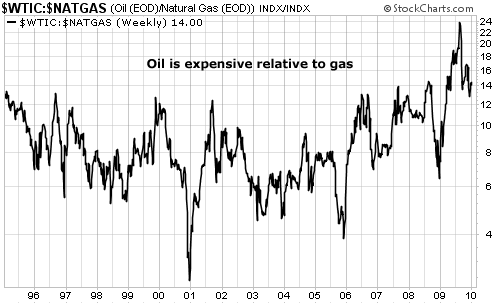
The chart below shows the 15-year historic ratio of oil to natural gas. When the line peaks, gas is cheap relative to oil. When the line bottoms out, gas is expensive compared to oil. When gas prices bottomed in September 2009, the ratio jumped to more than 24. The current ratio is around 14. While we're not catching the exact bottom, we do have the opportunity to buy gas at one of its cheapest points relative to oil in history.


S&P 500: The stock market has gone to sleep

You can see that natural gas is cheap right now. And three main drivers will increase demand...

1. Domestically, power companies are switching a large number of coal-fired power plants to natural gas. As electricity demand rebounds this year, natural gas demand will rebound faster than expected.

2. In China, coal comprises 70% of the primary energy. Natural gas only makes up 3% of its primary energy. Eventually, out of health concerns for its citizens, China will depend more heavily on the much cleaner alternative – natural gas.

3. Finally, my friend Rick Rule, the hugely successful resource investor, points out that many national oil companies, like Venezuela's and Mexico's, have severely underinvested in their domestic oil production for years. As a result, they will suffer drastic production declines. Unless Iraq steps up its oil production in the next five years, Rick says we'll see "a catastrophic shrinkage in crude export availability." Natural gas can solve that problem, as well.

I predict these three macro factors will push natural gas to more than $10 per mcf this year. Natural gas is under $6 per mcf right now. It's time to be bullish on natural gas.

This post has been republished from Steve Sjuggerud's blog, Daily Wealth.