Friday, July 30, 2010

California Attempts To Conserve Cash In Midst Of Crisis

California will return to requiring state workers to take unpaid days off in an attempt to deal with the state's severe budget crisis. The state may also start issuing IOU's as the state's controller estimates that California could run out of cash by October. See the following post from The Mess That Greenspan Made.

The Sacramento Bee reports on the latest developments in the 2010 edition of the California Budget Crisis, what looks to be the worst episode yet unless help arrives from Washington.
Schwarzenegger brings back furloughs for state workers
_
Less than a month after ending unpaid days off for more than 200,000 state workers, Gov. Arnold Schwarzenegger is bringing back a scaled-down version of the policy that will take effect on Sunday.

The governor made the decision this week after Controller John Chiang said that until lawmakers come up with a budget, he’ll start issuing IOUs in August or September to conserve funds as long as possible. The state’s cash could run out by October, the controller estimated.

“We have a fiscal crisis,” Schwarzenegger spokesman Aaron McLear said Wednesday morning as he explained the new furlough order. “We’re doing what we have to do to conserve cash.”
The last furlough program ended on June 30th, so, state workers will likely see just one full-size paycheck before reverting back to a roughly 15 percent pay cut as a result of being forced to take three days off without pay each month.

Complaints are already coming in that the selective nature of these furloughs – exempting groups such as police, fire fighters, and tax collection agencies – isn’t fair.
Schwarzenegger’s latest furloughs pick winners and losers
_
Gov. Arnold Schwarzenegger’s Wednesday furlough order did something different: It picked winners and losers.

True, his earlier furloughs and this one exempt the Department of Forestry and Fire Protection and the California Highway Patrol. Schwarzenegger considers them key public safety organizations and didn’t want to dilute their resources.

But his new order exempts six other departments. That’s significant because the governor has always said that, to be fair, furloughs should be applied across the board.

Let’s list them, and look at why they’re furlough-free.

Tax collectors: The Franchise Tax Board and the Board of Equalization are California’s big money rakers. According to a study by the Senate Office of Oversight and Outcomes, furloughs at FTB cost $7 in lost revenue for every $1 in payroll savings.

Money conduit: The Employment Development Department is a funnel for federal dollars flowing to more than 2 million unemployed Californians. Demand for EDD services has been at a record high, so the department went on a hiring binge while paying overtime to claims processors.

Untouchables: A rationale for prior across-the-board furloughs has been that even departments that get little or no money from the general fund still need to run lean. That way there’s more cash for the general fund, the center of the budget mess, to borrow.
The state legislature comes back from their August recess next week and, like the last few summers, the budget crisis should start heating up shortly thereafter with more IOUs likely to be issued in the fall.

This post has been republished from Tim Iacono's blog, The Mess That Greenspan Made.

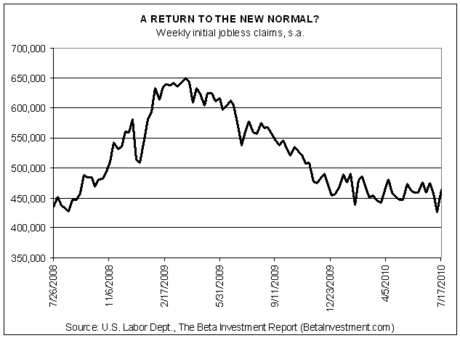
Intial Jobless Claims Flat Over Past 8 Months

Unemployment numbers improved slightly by July 24th but over the past 8 months initial claims have moved sideways. Moses Kim writes that the labor market continues to be very weak, making talk of recovery premature. See the following post from Expected Returns.

From the Department of Labor:
In the week ending July 24, the advance figure for seasonally adjusted initial claims was 457,000, a decrease of 11,000 from the previous week's revised figure of 468,000. The 4-week moving average was 452,500, a decrease of 4,500 from the previous week's revised average of 457,000.

The advance number for seasonally adjusted insured unemployment during the week ending July 17 was 4,565,000, an increase of 81,000 from the preceding week's revised level of 4,484,000. The 4-week moving average was 4,548,250, a decrease of 18,000 from the preceding week's revised average of 4,566,250.


Initial claims fell slightly in the latest week, with the 4-week moving average of claims moving down as well. However, the labor market is still showing tremendous weakness.

Initial claims have been going sideways for about 8 months now. If we were really in an economic recovery, an improvement in unemployment claims should have materialized by now. All recovery talks are premature until we get below 400,000 in initial claims.

This post has been republished from Moses Kim's blog, Expected Returns.

Thursday, July 29, 2010

Goldman Sachs Predicts Higher Oil Prices Due To Global Economic Growth

Following a bad prediction that the euro would bounce back, Goldman Sachs is projecting an oil price increase due to tightening in the balance between supply and demand. They expect further global economic growth to increase demand, although signs point to a slowdown or double dip in US growth. See the following post from The Mess That Greenspan Made.

Everybody’s favorite investment bank, Goldman Sachs, just doesn’t seem to be dispensing the same kind of sure-fire, money-making advice that they used to. After urging bets on a resurgent euro as it continued to plumb new lows in the spring (did they stick with that one long enough to be benefit from the June turnaround?), they’ve consistently called for higher oil prices, the latest recommendation coming yesterday in this story at Bloomberg.
Oil Near 11-Week High; Goldman Says Crude Too Cheap
_
Oil traded near an 11-week high in New York as equities rallied around the world and Goldman Sachs Group Inc. said crude prices are too cheap.

Oil was at about $79 a barrel before a government report due tomorrow that may show U.S. fuel supplies increased last week. Goldman Sachs said futures prices are “significantly” below the level warranted by “fundamentals,” offering buying opportunities for this year and next.

Goldman Sachs said in a report yesterday that the balance between supply and demand will continue to tighten in the second half of this year as global economic growth boosts demand, returning inventories to “more normal” levels.
Crude oil looks to be a one-way bet this week – down – and it’s not clear how that’s going to change in the near-term given all the economic data now piling up that all points to a dramatic slowdown in U.S. growth if not a double-dip recession. Of course, anything could happen in China (and probably will), but, it’s hard to imagine how we’ll see substantively higher oil prices without some signs that growth is increasing, not decreasing.

This article has been reposted from Tim Iacono's blog, The Mess That Greenspan Made.

Reasons To Ignore Mainstream Media And Go Long On Gold

Moses Kim from Expected Returns suggests watching the bond market for signs of capital flowing into the gold market. He sees US bonds as a massive bubble while the government continues to pursue outdated economic thinking, reasons that support his advice to go long on gold. See the following post from Expected Returns.

There are certain periods of time in history when seemingly obscene prognistications are right. I believe we are in one of those times. It is at times like these that "conspiracy theorists" (whatever that means) become what I like to call "reality theorists."

Economic shocks come from nowhere. One day the global economy is humming along; the next day it collapses. Crashes don't occur because the fundamentals suddenly change; they occur because the public at large recognizes the fundamentals and heads for the exit at the same time. What's crashing next is the public's confidence in governments across the Western world. You can guess how that will affect the price of gold.

If you study the bull market of the 1920's and the Great Depression of the 1930's, one of the amusing things you'll discover is how consistently wrong the mainstream was. During the great bull run of the 1920's, the mainstream was forever expecting a stock market crash. Remember, the decade began with a severe Depression (which incidentally came to a swift end without government intervention). The great Jesse Livermore was the only one who recognized the bull market very early on in the 1920's. He was mocked, but he was the only one making money for the longest time.

On the other side of the coin, the mainstream refused to believe that we were in for a prolonged period of economic weakness in the early years of the Great Depression. People were continually calling for a bottom in the economy. Of course the bottom didn't come for a decade.

So what gives? Why causes the mainstream to consistently miss the boat at key turning points? When does the risk/reward dynamic skew towards the seemingly insane- such as $3,000 gold?

Why Do People Miscalculate?


What we must realize is that economic orthodoxy is constantly changing. For example, it used to be common knowledge that interest rates rise in bull markets and vice versa; now the average investor believes the exact opposite. Back then, people feared the slightest rise in inflation; now the Helicopter Bens of the world are scared out of their mind of deflation.

So what causes people to miscalculate? It's pretty simply actually: Economists and investors alike fail to adjust their economic models to account for changing underlying conditions. They try to fit square pegs into round holes- then they scratch their heads and wonder what went wrong.

Our leaders haven't the slightest clue. They are using the same medicine to cure a different disease. Keynesian economics can work in theory if it were used sparingly and only in response to a true underutilization of productive capacity. But what we have on our hands right now is a debt crisis. Our leaders think they are geniuses curing the disease, when in fact, they are making it worse.

What amuses me is the brouhaha over Keynesian economic stimulus as if it arrived yesterday. Excuse me, but what do you call the last 50 years of American economic policy characterized by debt-financed consumption? Is it not Keynesian economics and has it not already failed?

Gold Rocket Launch


I am a big believer that Pareto's law applies to markets. In other words, 20% of inputs will drive 80% of outputs. I honestly couldn't care less about productivity numbers because what's coming is no demand-pull inflation. I am much more focused on the dollar, bond rates, bond/dividend spreads, TIC capital flows, and the stupidity of governments around the world. Of all these variables, I am most confident in my prognostication that politicians will become increasingly foolish as the economic crisis on our hands becomes more complicated.

I have been preparing for the gold rocket launch for many months now. I am probably different from most people in that I focus more on the likely flow of capital than inflation when trying to figure out gold price movements. What I foresee is a flood of capital going from bonds into gold. The bond market is so huge that even a small percentage of capital flowing from bonds to gold will result in a volcanic eruption of epic proportions. So the potential rocket launch in gold depends largely on the bond market.

You all know where I stand. U.S. government bonds are the biggest bubble I've seen in my life. If you are trying to rationalize 10-year yields at 3%, then you are probably the kind of person who rationalized bubble home prices by using the "there's a fixed amount of land but a growing population" argument. In other words, your mind is stuck in the 5th grade. I advise you to think rationally for a second and consider the credit quality of a country that has to monetize its debt in the face of falling tax receipts and a stalling economy. Are you really on the right side of the trade going long bonds?

There will be monumental paradigm shifts in the years ahead. Everyone is asleep, but I think this is going to change fairly soon. The big changes, which will be evidenced by huge moves in gold, are still ahead.

This post has been republished from Moses Kim's blog, Expected Returns.

Wednesday, July 28, 2010

Positive Numbers For Home Prices May Be Short Lived

Despite positive numbers for the S&P/Case Shiller Home Price Indices that show monthly and annual improvement, some analysts think that seasonal effects and tax credits have a lot to do with the price increase. Without these stimuli, home prices may bounce around the bottom in the near term. See the following post from Expected Returns.

From Standard and Poors:
Data through May 2010, released today by Standard & Poor’s for its S&P/Case-Shiller Home Price Indices, the leading measure of U.S. home prices, show that the annual growth rates in 15 of the 20 MSAs and the 10- and 20-City Composites improved in May compared to those reported for April 2010. The 10-City Composite is up 5.4% and the 20-City Composite is up 4.6% from where they were in May 2009. While 19 MSAs and both Composites reported positive monthly changes in May over April, only 12 of the MSAs and the two Composites saw better month-over-month growth rates in May than those reported in April.

“While May’s report on its own looks somewhat positive, a broader look at home price levels over the past year still do not indicate that the housing market is in any form of sustained recovery,” says David M. Blitzer, Chairman of the Index Committee at Standard & Poor’s. “Since reaching its recent trough in April 2009, the housing market has really only stabilized at this lower level. The two Composites have improved between 5 and 6% since then, but this is no better than the improvement they had registered as of October 2009. The last seven months have basically been flat.”
The Case-Shiller 20-City Composite index rose 1.2% in May. From last month, 19 out of the 20 cities saw price increases. Year-over-year, 13 out of the 20 cities are showing improvement. But remember, this is with the assistance of two tax-credits. The hangover effect is just starting to set in.

Seasonal Factors
“The May 2010 data for 15 of the 20 MSAs and the two Composites show an improvement in annual returns compared to April’s report. With the month-over-month data, while 19 of the 20 MSAs and the two Composites were positive, we are in a strong seasonal period for home prices, so that was largely expected. In addition, there may still be some residual impact from the homebuyers’ tax credit, since they affect any purchase that closes through June 30th 2010. We need to watch where the housing markets will go after these temporary stimuli go away. June’s existing and new home sales and housing starts data do not show much real improvement in those statistics either. It still looks possible that the housing market might bounce along the bottom for the foreseeable future, before showing any real improvement that will filter through to the rest of the economy.”
Case-Shiller housing data lags behind other housing data. Recent data for new and existing home sales suggest that future Case-Shiller reports will disappoint. We are simply bottom bouncing at this point, and the risks are all to the downside.

This article has been republished from Moses Kim's blog, Expected Returns.

Is The Treasury Lying About HAMP Numbers?

The extremely low redefault rate for HAMP permanent loan modifications of 1.7 percent is being challenged as inaccurate. Paul Jackson points out that the reason for the misleading number is that HAMP permanent modifications are canceled in the event of non-payment. See the following post from The Mess That Greenspan Made.

Like some of you, perhaps, I looked at the astonishingly low redefault rate for HAMP graduates as reported last week and just kind of scratched my head wondering how people with a median total debt service that consumes a full 64 percent of their gross income could possibly survive more than a few months or so. Well, apparently, the freakishly low 1.7 percent redefault rate for HAMP permanent loan mods is not what it seems – Paul Jackson over at Housing Wire provides all the details in this report.
At HW, we chose not to run with the HAMP redefault numbers except to note that Treasury officials had added them into the latest report card. And this choice was made with purpose: we knew these numbers were fake. Nobody gets a 1.7% redefault rate 6 months after modification –- not even Uncle Sam — and any media outlet reporting that number with a straight face quite simply doesn’t understand the industry it’s covering.

The only way to come up with a 1.7% redefault rate is to change how redefaults are calculated. And that is precisely what our government did.

In the report card, buried in a footnote, is the following disclaimer: “a HAMP permanent modification is canceled for non-payment if it is more than 90 days delinquent.” It’s also apparently removed from redefault calculations, which is a great way to smear a pig in a mountain of lipstick and hope nobody notices.

The researchers at Barclays Capital were among the few paying attention to this footnote, and took the unprecedented step of issuing a separate research alert on the HAMP numbers last week, highlighting what they called “misleading” reporting by Treasury on HAMP mod performance.

I prefer to call it lying…
At least it makes sense now. I was starting to think that I couldn’t do math anymore…

This article has been republished from Tim Iacono's blog, The Mess That Greenspan Made.

Tuesday, July 27, 2010

New Home Market Still Troubled Despite Upswing

Tim Iacono points out that although the new home sales increased in June, it follows record lows and is still the second worst since 1963. When the numbers are put into context they indicate a very troubled market for new homes. See the following post from The Mess That Greenspan Made.

It appears as though the U.S. housing market has finally turned the corner as the Census Bureau reported(.pdf) a short while ago that new home sales surged 24 percent in June, the biggest monthly increase in almost six decades of record keeping.


This stunning increase has caused housing bears across the land to “throw in the towel”, retracting recent predictions of a double-dip decline for home prices, and the mainstream financial media is overflowing with glowing headlines about the resurgence of the nation’s housing market as shown below.

Here’s a sampling:


Not!


To their credit, all of these reports note right up front that the “surge” is simply the not-too-surprising move upward from what can only be described as a virtual collapse in home sales during May, just after the homebuyer tax credit expired. In fact, all but one of the above reports also notes the downwardly revised April-to-May home sales plunge of some 37 percent, even worse than the 32 percent nose-dive previously reported.

But, that doesn’t excuse the headlines…

There’s no reason to provide a title that does not include the words “from record lows” and not doing so is really just irresponsible and, kind of silly.

The plot of new home sales normally seen here looks like this, the most recent activity put into its proper historical context, what is clearly a very troubled market for new homes:


As it turns out, the June annualized rate of 330,000 new homes sales is the second worst total since 1963, up 24 percent from the new record low rate of 267,000 reported in May.

This post has been republished from Tim Iacono's blog, The Mess That Greenspan Made.

Poor Monetary Policy Increases Value Of Gold

Despite gold remaining dormant for a while, Moses Kim thinks it could be building up to another rally, especially if news emerges of another round of quantitative easing by the Federal Reserve. Kim is critical of the Fed's policies and thinks this increases the long term value of gold. See the following post from Expected Returns.

Although it may not seem like it right now, gold is putting in the conditions for a runaway move: months of consolidation, waning volume on the downside, general bearish sentiment, and most importantly, boredom.

The gold market really puts you to the test. I must admit I am bored out of my mind tracking this market on a day-to-day basis. It is only my experience that keeps me sane, since I know that the longer gold lies dormant, the stronger the volcanic eruption will be. I am simply accumulating on weakness and getting ready for the ride.

Helicopter Ben has made it clear in recent testimony that another round of quantitative easing is coming. When the Fed first announced its plan of quantitative easing last March, gold reacted immediately, embarking on a multi-month, $300 dollar rally. Quantitative easing part 2 should result in an even more explosive rally. Be wise and build your position before Helicopter Ben makes QE 2 official.


It is amazing to me how bearish the mainstream continues to be about gold. Do they not realize that being bearish on gold is the equivalent of being bullish on the fiscal and monetary policies coming out of the Fed and our government? I truly believe this is a once-in-a-lifetime opportunity to implicitly short all of our braindead leaders across the board by buying gold. I doubt we will see fiscal stupidity of this magnitude anytime soon.

And at the end of the day, do you really want to fight the money printing prowess of this guy?

So where is gold going tomorrow or next week? I have no clue. All I know is that fundamentals always win in the long run. Follow the advice of Warren Buffett and buy value. There is so much value in gold and silver shares right now that I hope gold consolidates for another year. I am also praying for another $100 dollar shellacking of gold so I can buy at a discount. But most of all, I am praying that Prechter comes out on CNBC and calls the top in gold. I will then back up the truck in gold and silver shares with conviction.

This post has been republished from Moses Kim's blog, Expected Returns.

Monday, July 26, 2010

Has Obama Given Up On Economic Stimulus?

Based on recent statements, the Obama Administration appears to be pulling back efforts for fiscal stimulus and is instead aiming to sell the idea that the US is in recovery. Timothy Geithner says that it is time to transition to "a recovery led by private investment" to the chagrin of many economists who think that the economy is too weak and requires additional help. See the following post from Economist's View.

Instead of a series of op-eds by Christina Romer, Larry Summers, Jared Bernstein and other members of the administration making a strong, strong case for more stimulus -- particularly that devoted to job creation -- along with the president himself making the case to the nation, the appearance of key administration officials on Sunday talk shows to bolster the effort, and so on, the administration has decided to try and sell a recovery that hasn't yet taken hold.

Thus, instead of a much needed and impressive effort to move Congress to action, or at least make clear to voters who is and who isn't trying to help those struggling with the recession, here's Timothy Geithner saying it's time for the government to back off because a solid recovery is underway:
Treasury Secretary Timothy Geithner said the economy has now recovered sufficiently for government to begin to make way for private business investment.... Mr. Geithner’s comments on Sunday, which echo previous sentiments expressed by President Barack Obama, reflect a turning point in the government response to the worst economic downturn since the Great Depression, a period marked by deep federal intervention in the financial, housing, auto and other industries...
The message is that the administration is pulling back, and maybe even starting to balance the budget because good times are just around the corner:
“We need to make that transition now to a recovery led by private investment,” Mr. Geithner said Sunday on NBC’s “Meet the Press.” Mr. Geithner hit two Sunday talk shows, delivering the Obama administration’s message that the economy was recovering...
I don't understand this strategy. The election is not that far way. If unemployment continues to be a problem, and it looks like it will, saying that things are fine and recovery is just around the corner will backfire.

Update: I meant to make this point, but forgot, so I'm glad Calculated Risk noted this (and I likely would have relied on his evidence in any case):
The WSJ is quoting Treasury Secretary Timothy Geithner as saying it is time for private investment to take over from government stimulus:

“We need to make that transition now to a recovery led by private investment,” Mr. Geithner said Sunday on NBC’s “Meet the Press.”
...
“I think the most likely thing is you’ll see an economy that gradually strengthens over the next year or two, you’ll see job growth start to come back, investments expanding ... but we’ve got a long way to go still,” Mr. Geithner said.

I discussed this last week - in most sectors of the economy there is over capacity or too much supply (housing), so there is no reason for significant new private investment.
(Also, in response to comments, maybe I should also add that, despite the poorly chosen title, I wasn't serious about the reverse psychology part.)

Update: Brad DeLong follows up.
I would put it much less politely: have Tim Geithner and Barack Obama lost their minds? The Administration's mid-session review--released last week--projects that the unemployment rate will rise in the next several months and will be at 9.3% in February 2011. It projects that Q4/Q4 real GDP growth will be 2.9% this year--and I don't see how we are going to get there with a 2.7% growth rate in the first quarter, a likely 2.0% growth rate in the second quarter, and with the tracking third-quarter growth aret at 2.9%. We would need 4.0% growth in the fourth quarter of this year. Nor do I understand where the 1.7% decline in unemployment over 2011 is supposed to come from: a simple Okun's Law coefficient of 2 would suggest that we need 2 x 1.7 + 2.6 = 6% real GDP growth to generate such a decline.

According to Mark Zandi, in the fourth quarter of this year the phase-out of the ARRA is likely to shave 0.3% off the real GDP growth rate. in 2011, the contractionary effects of the ARRA phase-out on the quarterly growth rates are likely to be -0.8%, -1.2%, -0.7%, and -0.2%.

It sure ain't morning in America. Maybe I need to go back and read Geithner's transcripts from this morning to see if the MSM is misrepresenting what he said...
This post has been republished from Moses Kim's blog, Economist's View.

Homeowners Using Extra Cast To Repay A Mortgage Early

The Wall Street Journal points out anecdotal evidence of people who are taking advantage of low interest rates and low home prices to upgrade to a larger house or better neighborhood. Some financial advisors are also changing their tune and encouraging individuals to pay down their mortgage faster rather than use extra cash to invest in the stock market. See the following post from The Mess That Greenspan Made.

While I sometimes lament the troubles we’re having in getting our short sale offer moving toward a signed sales agreement, it’s easy to lose sight of the fact that the housing market is dramatically different than it was just a few years ago for long-time homeowners who may have been non-participants in the housing bubble back around 2005 or 2006.

This WSJ story provides more reasons why being long-time renters isn’t all that bad…
Record-low mortgage rates and a new slump in home prices are presenting unusual opportunities in the housing market these days—even for so-called underwater borrowers.

Some intrepid homeowners are intentionally taking a loss on their current house—and writing a big check to retire their old mortgage—in order to buy twice the home for not much more money. Others, eschewing conventional personal-finance advice, are even opting for “cash-in” refinancings, paying thousands of dollars out of pocket to settle old loans—and then taking out new mortgages with lower payments, shorter durations or both.

Katie Everett, a real-estate broker in Denver, says none of her clients kicked in cash when selling their homes last year. This year, “about half are willing to bring money to closing, anywhere from $5,000 to $45,000,” she says.

Are these people crazy to be tying up even more of their cash in their homes, in effect doubling down on what has been a losing bet thus far?
Uh… yes?

No. Apparently the correct answer is no – they’re not crazy.

At least according to some economists.
Yet economists say trading up to new homes or refinancing existing ones can be smart—even if it means plunking down more cash to get out of old mortgages. People living in less-desirable neighborhoods might be able to find better homes in tonier ones that offer better appreciation potential. And with mortgage rates so low, such buyers can keep their monthly payments manageable, even though the new homes are more expensive.

“If you are trading up, what better time than when interest rates are at record lows and the cost of the trade-up is much less than it used to be?” says Christopher J. Mayer, a Columbia Business School economist.
Oh puhlease. Chris Mayer? Housing bubble denier extraordinaire?

Why do these people who gave such bad advice about five years ago still get called on by reporters to give even more advice? Search on “Mayer” here or here to see what Chris was thinking back in 2005 and 2006 – something about “Superstar Cities” where prices have fallen up to 40 percent since that wisdom was offered up.

Now here’s something that seems to make sense in our new de-leveraged world…
In the past, financial planners typically recommended that homeowners devote as little cash to real estate as possible, and to invest it in the financial markets instead. But with stocks essentially where they were 11 years ago and market volatility seemingly on the rise, people are rethinking that wisdom. Devoting extra cash to repay a mortgage early is among the safest ways to produce an investment return.

“At this point,” says Jay Brinkmann, chief economist of the Mortgage Bankers Association in Washington, “if they don’t have anything else that is bringing a tremendous return, then they are buying themselves an annuity by paying their house off sooner than they needed to.”

During the fourth quarter of 2009, 33% of refinancings were of the cash-in variety, the highest percentage since Freddie Mac began tracking the characteristics of refinance transactions in 1985. Figures for the second quarter are due next week.

“Historically high percentages of borrowers are paying down their principal when they refinance their mortgages,” says Brad German, a Freddie Mac spokesman.
Man, that’s gonna kill an economy like ours that is largely based on asset prices forever rising faster than debt.

I guess people are starting to catch on – aspiring to live a debt free and more stress free life.

There’s a bit more in this report including a few examples of growing families trading up to a bigger house that seem to make good sense – just be sure to sell the old one before you commit to the new one!

This post has been republished from Tim Iacono's blog, The Mess That Greenspan Made.

Friday, July 23, 2010

Jobless Claims Have Highest Spike Since February

The highest weekly spike in jobless claims since February is a reminder that the employment market continues to struggle. James Picerno describes the dilemma faced by the Federal Reserve in deciding between additional stimulus to address short-term problems or an exit strategy that will improve the long-term situation. See the following post from The Capital Spectator.

Well, that didn’t last long. Today’s weekly update on new jobless claims dashed hopes for the moment that the previous downturn in this series was the start of something new in the way of positive momentum for the labor market. Indeed, the numbers were sufficiently encouraging a week ago to inspire asking: Is the dip real? We now have the first installment on an answer. It's not necessarily the last word, but so far the response is discouraging.

New filings for unemployment benefits surged by 37,000 last week on a seasonally adjusted basis. That's the biggest weekly rise since February's 40,000 pop. ""It's very disappointing to have this leading indicator of economic conditions jump higher," John Lonski, chief economist at Moody's Economy.com, told CNNMoney.com today. "This is the latest reminder of a weak labor market, and the jump preserves worries regarding the adequacy of economic growth."


Of course, there's always a case for thinking that the latest number for any economic report is less (or more) than it seems. And so it is with today's jobless claims. Tony Crescenzi, a portfolio manager at bond giant PIMCO, offers one possibility for reserving judgment, writing (via Marketwatch.com): "Elevated levels of claims remain consistent with a relatively subdued pace of job growth, but it is important to keep in mind that many individuals are filing for benefits and hoping to capitalize on the many extensions of benefits that have been approved."

But even if today's rise in jobless benefits doesn't mean much, there's still the bigger problem that's plagued this metric all year: it's going nowhere fast. As the weeks and months roll by without a material decline in new filings for unemployment insurance, it's getting tougher to argue that the labor market's salvation is just around the corner.

Meantime, today's numbers only remind that the stakes are that much higher for the next phase of monetary policy. As we discussed in our previous post today, it's not yet obvious that the Fed is prepared to go to the next level with monetary stimulus, even if the case for acting grows with each new number.

Adding to the list of worries is yesterday's mixed news in housing for June: a small annualized rise in new housing permits issued last month (+2.1%) that was tempered by a bigger fall in new housing starts (-5.0%).

Perhaps it's prudent to wait a bit longer for more economic reports to come in before rolling out the big guns of quantitative easing; perhaps not. But the burden of waiting increasingly falls on those who argue for staying the central bank's hand. The Fed's balance sheet has already ballooned dramatically over the past two years, and so the exit strategy challenge is already a big question mark for the future. But not today. If Bernanke and company do nothing at this stage of the game, that's not going to make future policy choices any easier, or the risks any smaller. But doing nothing on the monetary front might bring big problems for the economic cycle in the near term. Choices, choices.

This much is obvious now: the broad trend isn't improving. The real worry is that it may actually be getting worse. Tick tock, tick tock…

This post has been republished from James Picerno's blog, The Capital Spectator.

Will We See More Quantitive Easing From The Fed?

Paul Krugman says that the Federal Reserve deserves an "F" for their failure to increase employment or stabilize prices. Bernanke's comments have fueled speculation that the we will see further quantitative easing by the Fed. See the following post from The Mess That Greenspan Made.

Despite yesterday’s somewhat sanguine view, if Federal Reserve Chief Ben Bernanke really thinks that the U.S. economy is headed for serious trouble due to various traps that have been encountered (said traps having previously been set by the deflation and/or liquidity monsters), he has more company with each passing day. Earlier today in “the land of deflation”, one former Fed head lent his support to this view as reported by Reuters.
Former Federal Reserve board member Lawrence Lindsey said on Thursday it will be “obvious” by the end of this year that the U.S. economy has entered a “deflationary trap.”

“We know from (Fed) Chairman (Ben) Bernanke’s recent comments that it is now at least a concern … By the end of this year I think it will be quite clear,” Lindsey said in an economic forum in Tokyo.

“I would expect by December we will see further quantitative easing” by the Fed, he said.
December seems like such a long time away…

Paul Krugman sketched out the situation for Bernanke creating a new “Fed misery index” that he chose to call a “Fed fail index” since he figures the central bank deserves an “F” for the job it’s been doing in achieving full employment and stable prices.

Like many others in recent years, this discussion again strikes me as something that historians will look back upon in a few decades and wonder, “What were those guys thinking? They run an economy on asset bubbles for twenty years and then they wonder why normal monetary policy doesn’t work any more.”

This post has been republished from Tim Iacono's blog, The Mess That Greenspan Made.

Thursday, July 22, 2010

Major Real Estate Markets Struggling Despite Record Low Mortgage Rates

Moses Kim discusses the poor housing market that is struggling despite the lowest mortgage rates on record. He points out that historically, housing cycles often last decades rather than a few years. See the following post from Expected Returns.

In the midst of all the blind enthusiasm towards housing last year, I steadfastly held to my belief that housing was set for another leg down. It was, to put it simply, presumptuous to believe that a housing bubble would resolve itself in 2 years when real estate down cycles often last decades. As I've expected, 2010 is the year that reality sets in again. From the WSJ, Housing Market Stumbles:
The housing market, whose collapse pulled the economy into recession in late 2007, is stalling again.

In major markets across the country, home sales are deteriorating, inventories of unsold homes are piling up and builders are scaling back construction plans. The expiration of a federal home-buyers tax credit at the end of April is weighing on the market.

Economists aren't singling out one reason for the stalling housing market. A variety of factors have led to flagging confidence, they say, including sluggish labor markets, global economic turmoil and falling stock prices.
People tend to group assets together. So since the stock market bottomed last March, they assume housing will follow. But historically, the stock market bottoms a lot sooner than real estate. The way to think about real estate is totally different from stocks since real estate is, relatively speaking, an illiquid asset. Add in the variable of schizophrenic lending standards from banks, and you can see that real estate is an asset class that stands by itself irrespective of stock market conditions.

It is interesting that the article points to flagging confidence since confidence is indeed collapsing. And confidence won't return until jobs do. I'm talking about real jobs, not the phantom birth/death model jobs created by our government.

Interest Rates and Tax Credits
Even falling interest rates aren't enough to whet consumer appetites for housing. Last week, the average rate on a 30-year fixed-rate mortgage was quoted at 4.57%, according to Freddie Mac, the lowest since its survey began in 1971. But demand for home-purchase mortgages sits near 14-year lows, according to the Mortgage Bankers Association, down 44% over the past two months.

The government last fall extended tax credits worth up to $8,000 to home buyers who signed contracts by April 30, causing sales to surge early this year. Those buyers had until June 30 to close their sales until Congress, concerned that the backlog of sales wouldn't close in time, extended the deadline through September.

Analysts long expected the withdrawal of a federal tax credit, which had juiced sales, to lead to a slower-than-usual summer.

"It's the magnitude that's been the issue,'' says Douglas Duncan, chief economist at Fannie Mae. "The drop-off in activity has surpassed expectations.''
The housing market is on life support even with 4.57% 30-year mortgage rates, which is confounding level 1 thinkers. This goes to show you why interest rates are a useless indicator when uncertainty prevails. The same flawed logic goes for the stock market, where investors are apparently expected to gamble their life savings away because of a percentage point drop in rates. But any cut in interest rates must match the lowered expectations of future returns in times of crisis. So in a time of very low real return expectations, there is nothing monetary policy can do.

The government pushed taxed credits as a way of restoring housing. Now that housing has undeniably stalled, they cannot admit they have failed. They continue to justify their actions by saying things would have been worse. They refuse to listen to people who said all along that their programs would fail, and more importantly, why they would fail.

There is little hope of the housing market turning up from here. I believe that the housing market is, at a minimum, years away from a real bottom.

This article has been republished from Moses Kim's blog, Expected Returns.

Is China's Property Boom Slowing?

After months of fast-paced growth in Chinese real estate markets, government restrictions may be starting to reverse the movement in prices. Shanghai is one of the first markets to show signs of slowing with a double-digit fall in luxury home prices. See the following post from The Mess That Greenspan Made.

There’s been quite a bit of news lately about the Chinese real estate market now that government restrictions on buying property and getting financing for these purchases seems to be having more than a fleeting impact.

The lastest un-China-like report on prices comes from this story in Bloomberg.
Shanghai Average New Luxury Home Prices Fall 13%

Shanghai’s average new luxury home prices dropped 13 percent in July from April following expanded government restrictions on the property market, the Shanghai Securities News reported today, citing China Real Estate Information Corp.

The average price fell to 62,439 yuan ($9,212) per square meter in July from April, according to the newspaper.

In Shenzhen, average luxury home prices declined 6.3 percent to 40,370 yuan per square meter in June from April, the newspaper reported, citing the housing market consultant.
Another Bloomberg report details the effect on local governments where the land sale boom of recent years appears to have no obvious replacement as a source of government funding. Israel’s Financial Expert provided details of what he thinks is behind the boom, replete with videos of angry citizens and a run on one of the banks.

Steven Roach’s recent protestation that China does not have a housing bubble is looking a little shakier with each passing day and each new revelation about what’s been going on.

This article has been republished from Tim Iacono's blog, The Mess That Greenspan Made.

Wednesday, July 21, 2010

Bush Tax Cuts Extention On The Table

Eric Rosenbaum from The Street discusses the possibility of congress extending the Bush tax cuts for the wealthy, with Democrats compromising in order to pass a jobless benefit extension. Republicans are arguing that any tax increase could harm a shaky economy. See the following post from The Street.

The political battle for the hearts and minds of Main Street reached new levels in Washington D.C. this week. The Senate voted on Tuesday to extend unemployment benefits for millions of out-of-work Americans after a contentious battle in which Republicans refused to sign on for the extension without cutting fat from federal spending to keep the deficit from growing larger.

While seemingly contradictory on the surface, the battle over unemployment benefits for struggling Americans has been linked to the battle over extending the Bush tax cuts that benefit upper income tax brackets, commonly referred to as Bush tax cuts for the wealthy, which are set to expire at the end of 2010. How can politics over giving minimal support to the jobless be tied up with making the rich richer? It's not just politics, but economics also, and it actually makes perfect sense, and it's all come to a head in Washington.

The battle over the jobless benefits extension was waged over concerns about levels of federal spending and the ballooning deficit. It might just be election year rhetoric, and Republicans said it wasn't about unemployment support, but how it was funded.

President Obama had made a campaign pledge of allowing the Bush tax cuts to expire. During a Monday morning Rose Garden speech, President Obama again chided Republicans for blocking efforts to pass an extension of jobless benefits while working overtime to extend tax cuts for the rich. Democrats more broadly have tried to make the Republicans look bad by juxtaposing their refusal to extend jobless benefits with their full-throated support for continued upper class tax relief.

Democrats are already expected to see through the extension of middle class tax cuts, which will be a welcome extension of tax relief on Main Street, alongside any extension of jobless benefits. Yet there are rumblings in Washington D.C. that the moves on the political chessboard could, in fact, be leading up to a political compromise allowing the Bush tax cuts to be extended, something that would be a contradiction of the President's campaign promise and may not be received too well on Main Street.

Republicans have said they may use Congressional tactics to "hold the middle class tax cuts hostage" until they get their way on the Bush tax cuts for the richest Americans. Republicans are making the argument that with the economy as shaky as it is, any tax increases are a bad thing.

President Obama spoke harshly on Monday morning, accusing Senate Republicans of a "lack of faith in the American people" for repeatedly blocking passage of the jobless benefits extension bill.

President Obama specifically noted that "after years of championing policies that turned a record surplus into a massive deficit, [Republicans] who didn't have any problems spending hundreds of billions of dollars on tax breaks for the wealthiest Americans are now saying we shouldn't offer relief to middle-class Americans like Jim or Leslie or Denise who really need help." Jim, Leslie and Denise were actual out-of-work Main Street Americans appearing alongside Obama at this Rose Garden speech.

Jim, Leslie and Denise are not among those who will jump for joy alongside their tax advisors if Republicans get their way on a Bush tax cut extension, but might the Bush tax cuts be needed for jobs to "trickle down" to the unemployed? Will you be among those breathing a sigh of tax relief if the Bush tax cuts are extended?

This article by Eric Rosenbaum has been republished from The Street, an investment news and analysis site.

Government Saving Money With Contractors

Government officials may be realizing something that the public sector has known for quite a while - hiring contractors rather than full-time employees can save a lot of money. With local governments being forced to reduce costs in the face of growing deficits, there will likely be a lot more government employees who will be replaced by contractors. See the following post from The Mess That Greenspan Made.

Given what has happened in the world over the last few years – the last few decades, for that matter – it’s hard to imagine that reports like this from the New York Times should come as a surprise to public sector employees, many of whom are working on borrowed time.
A City Outsources Everything. Sky Doesn’t Fall.

Not once, not twice, but three times in the last two weeks, Andrew Quezada says, he was stopped and questioned by the authorities here.

Mr. Quezada, a high school student who does volunteer work for the city, pronounced himself delighted.

“I’m walking along at night carrying an overstuffed bag,” he said, describing two of the incidents. “I look suspicious. This shows the sheriff’s department is doing its job.”

Chalk up another Maywood resident who approves of this city’s unusual experience in municipal governing. City officials last month fired all of Maywood’s employees and outsourced their jobs.

While many communities are fearfully contemplating extensive cuts, Maywood says it is the first city in the nation in the current downturn to take an ax to everyone.
Maywood sounds like a very unusual place. Just south of Los Angeles with as many as 50,000 residents packed into just one square mile and a police force that sounds like it was completely dysfunctional before it was disbanded, bankruptcy was the city’s only alternative to letting all 66 city employees go.

Nonetheless, a growing number of people across the land are realizing that it makes little sense for the city worker mowing the courthouse lawn to be making $50,000 or more in wages and benefits when a contractor could do the same job for a fraction of the cost.

This article has been republished from Tim Iacono's blog, The Mess That Greenspan Made.

Tuesday, July 20, 2010

Inflation Outlook Continues To Fall

Foreign countries are reducing their holdings of US treasuries as demand for US long term debt appears to be weakening. Meanwhile, speculation over deflation is increasing as the 10 year inflation outlook continues to fall. See the following post from The Capital Spectator.

The Treasury market's 10-year inflation forecast slipped last week, and more of the same looks likely for today. The yield spread between the conventional and inflation-indexed 10-year Treasuries dropped to 1.71% on Friday, down 10 basis points from the week before and well below late-April's 2.45%--the previous peak. The debate about deflation—is the risk rising?—is likely to be front and center this week. That's likely to fuel more buying in Treasuries.

“U.S. Treasuries are still attractive,” Sungjin Park in the fixed-income department at Samsung Investment Trust Management in Seoul told Bloomberg News. “A double- dip recession is inevitable” in the U.S.

Inevitable? That's a bit strong. But the risk surely isn't fading. And there's no denying that the public demand for Treasuries is rising. Adding to the momentum to chase government bonds is last week's news that headline consumer price inflation retreated by 0.1% last month—the third straight month of decline. "The latest string of reductions of the CPI is significant and raises questions about the probability of a deflationary situation," advises Asha Bangalore of Northern Trust in a research note.


But before we concluded that even lower rates are fate for an extended period, consider the recent dip in foreign demand for U.S. assets. AP reports:
China reduced its holdings of U.S. Treasury debt in May as total foreign holdings of government debt posted a slight increase.

China's holdings fell by $32.5 billion to $867.7 billion, the Treasury reported Friday.

The report said that total holdings of Treasury securities edged up $5.8 billion to $3.96 trillion in May, a slight increase of 0.1 percent compared to April.

The Treasury said that net purchases of long-term securities, a category that covers not only U.S. government debt but also debt of U.S. companies, increased by $35.4 billion in May. That followed bigger gains of $81.5 billion in April and $141.4 billion in March.
The deflationary pressures may be mounting, but offshore demand for Treasuries is likely weakening, at least at the margins. It's unlikely that China and other large holders of U.S. government debt are going to start selling their massive holdings of Treasuries. But it's also unlikely that there's a growing appetite for buying huge quantities of additional Treasuries going forward. Yes, the dollar's still the world's reserve currency, and that's not going to change anytime soon. More flows in the greenback are destiny for the time being. But...

According to Dow Jones: "China should reduce the amount of U.S. dollar-denominated assets in its foreign exchange reserves in favor of those denominated in other currencies or other types of assets, former People's Bank of China adviser Yu Yongding wrote in an article published in the state-run China Securities Journal on Monday."

Nonetheless, last week was a good one for going long Treasuries. The iShares Barclays 20+ Year Treasury Bond ETF (TLT), for instance, was up about 1.6% on Friday vs. the weak-earlier close. And for the year so far, TLT has climbed more than 12% vs. a 4% loss for the S&P 500 Spider ETF (SPY). Treasuries are hot, and stocks are not. Deciding if that holds will depend on how the deflationary game plays out. As usual, it all looks clear…until it's not.

A few months ago, the notion that deflation was again lurking was widely dismissed. Today, it's on everyone's mind. The only thing for sure is that betting the farm on one outcome is a short cut to big gains…or big losses. For everyone else, a bit of hedging is in order.

There are lots of moving parts for deciding what comes next. That starts with wondering: Will the Fed roll out a new round of monetary stimulus in an effort to slay the D risk? What are the odds that Bernanke & company will sit on their central banking hands and watch the market's 10-year inflation forecast fall even lower in the days and weeks ahead? Will they really do nothing if the inflation outlook drops to 1.6%, 1.5%, or lower?

This article has been republished from James Picerno's blog, The Capital Spectator.

Do Freddie and Fannie Create More Costs Than Benefits?

Economist Mark Thoma weighs the pros and cons of keeping Fannie and Freddie around to subsidize the mortgage market. Thoma suggests that the GSEs help stabilize the macro economy in times of crisis by concentrating risk and also helps to overcome some mortgage market failures, however they also can cause banks to take on excessive risks. See the following post from Economist's View.

The Economist asks:
What should be done with Fannie Mae and Freddie Mac?
Here's my response (additional responses from Laurence Kotlikoff, Phillip Swagel, Tom Gallagher, and John Makin, with others to follow, all responses):

There are two potential justifications for the existence of institutions like Fannie and Freddie. One is to solve a significant market failure in the private sector mortgage market. If there is some reason why the mortgage market does not function properly on its own, perhaps due to lack of information on one side of transactions, inefficient risk management, adverse selection, the presence of moral hazard, etc., then government can step in and fix the problem.

The second justification is the role these institutions can play in stabilizing the macroeconomy. Contrary to what you may have heard from people who want you to believe that government is always the problem and never the solution -- the people who try to blame Fannie and Freddie for the crisis despite evidence they weren't the primary cause -- having such institutions in place may allow a better response to a financial crisis than would otherwise be possible.

With respect to the market failure justification, no market is perfect, and the mortgage market is certainly no exception. Even so, I think it's hard to justify the existence of Fannie and Freddie based upon their ability to solve private sector market failures. To the extent that market failures do exist, there are better ways to overcome them. For example, there may be externalities from home ownership that accrue to the local community, but these benefits are not captured in the price of homes. If this is the case and the external benefits are large, then there may be a role for government to subsidize home ownership. However, simple mechanisms such as tax rebates can be used to solve this problem, we wouldn't need Fannie and Freddie. Since the same is true for most other examples of mortgage market failure I can think of, it's hard to justify the existence of Fannie and Freddie based upon their ability to effectively overcome imperfections in the mortgage market.

I think a better case can be made for Fannie and Freddie based upon the role that they can (and did) play in helping to stabilize a financial system that is in crisis. Fannie and Freddie concentrate risk that is dispersed across many different banks and other financial institutions. If a systemic shock hits, instead of having all the difficult problems that come with the nearly simultaneous failure of such a large number of banks, only one or two institutions get into trouble. This allows regulators to focus their efforts on these institutions as they attempt to stabilize the financial system.

The politics of the recent bailout of Fannie and Freddie are lousy, and the distribution of benefits to large banks through the backdoor bailouts Fannie and Freddie provide could certainly be improved, but mortgage markets may have failed entirely were it not for Fannie and Freddie. In addition, they have helped to keep long-term interest rates low through their purchase and guarantee of mortgage contracts. Things are bad, but a completely dysfunctional mortgage market coupled with much higher long-term interest rates would have been much, much worse.

However, it's important to note that it's not certain that the effect of institutions like Fannie and Freddie will, on net, be positive. The benefit of these institutions is that they allow us to more effectively stabilize mortgage markets -- which are prone to bubbles -- when they get into trouble. However, there is also a cost. The implicit government guarantee that stands behind Fannie and Freddie increases risk taking behavior overall making crises both more likely and more severe.

This means that effective regulation of risk taking behavior will improve the chances that Fannie and Freddie are beneficial on net. As explained at the link given above, regulation of Fannie and Freddie was relatively successful in this regard, but far from perfect. It was the private sector, not Fannie and Freddie, that took the lead in exploiting the short-run profit potential of risky mortgage products. Initially, regulation kept Fannie and Freddie out of these highly risky markets. It wasn't until Fannie and Freddie began losing market share that they began to find ways around the restrictions that prevented them from pursuing the same risky strategies. They were followers, not leaders, into subprime markets.

However, the fact that they could follow at all indicates that regulation was less than perfect. The loss of market share should have been a signal that the private sector markets needed closer scrutiny, and Fannie and Freddie should not have been allowed to follow the private sector down the sinkhole. The fact that Fannie and Freddie were allowed to follow private sector into risky markets when they began losing market share to private sector firms, and the failure to adequately regulate the risk that private sector institutions could take undermines faith in regulators and makes the case for Fannie and Freddie murky.

I still think that, overall, having Fannie and Freddie was beneficial, and I'll give lukewarm support for these institutions. But that support is conditional upon the expectation that regulators will do a better job of monitoring and regulating the amount of risk that is present in financial markets. The presence of institutions like Fannie and Freddie encourages banks to take on additional risk, and the additional risk generates costs that can more than offset the benefits Fannie and Freddie provide in terms of helping to stabilize the financial system when it gets into trouble. We need to do a better job than we have in the recent past of regulating the amount of risk that banks can take in response to the insurance that they get from the implicit government support of Fannie and Freddie. If we can't, then the case for the existence of Fannie and Freddie is much harder to make.

This post has been republished from Mark Thoma's blog, Economist's View.

Monday, July 19, 2010

Governments Losing Support As Economies Continue To Struggle

Faced with the difficult decision of inflation or austerity, many of the world's governments have lost significant support as neither has proven effective. In the US, two years of flooding the system with liquidity has had limited success and poll numbers show voters are growing impatient. See the following post from Dollar Collapse.

For the first time in 250 years, politics has become irrelevant. Not uninteresting or unimportant; obviously the way a society organizes itself matters to its citizens and its place in the world.

But today there are no policies left on the “possible” menu that will save us from what’s coming. So a rational person’s time is better spent preparing rather than debating.* (Later, when we’re trying to decide what to build from the rubble, the argument will get interesting again.)

The most recent batch of election and poll results illustrates this point:
Poll blow raises Japanese economy fears
Naoto Kan has been Japan’s prime minister since only last month, but already he has been dealt a stinging rebuke by the electorate. His Democratic Party of Japan (DPJ) and its tiny coalition ally lost their majority in the upper house of parliament. Japan has already suffered two decades of economic stagnation; now it faces political stagnation too unless Mr Kan can persuade small parties to help him pass laws.

Centre-left rise in German state underlines Merkel woes
The Social Democrats and Greens took over Germany‘s most populous state, North Rhine-Westphalia, on Wednesday in a minority government the centre-left says could one day challenge Chancellor Angela Merkel at federal level.

At a time of weakness for conservative leader Merkel nine months into her second term, the Social Democrats (SPD) speculate that they and the Greens could form a minority German government after the next federal elections due in 2013.

L’Oréality check
Nicolas Sarkozy’s approval ratings have hit a record low in recent weeks

Should Republicans Take Control of Congress?
According to a new ABC News/Washington Post poll, registered voters are increasingly critical of President Obama’s work on the economy, and by an 8-point margin they say they’d prefer to see the Republicans take control of Congress. It’s a clear sign of GOP opportunities and Democratic risks going into the 2010 midterm elections, with 51 percent of poll respondents saying they would rather have Republicans run Congress “to act as a check on Obama’s policies.”
So what’s happening? Just a few years — in some cases just a few months — after sweeping into office with promises of “change” and a quick clean-up of their predecessors’ messes, leaders of major democracies from across the political spectrum are being swept right back out.

Did they turn out to be incompetent, or their policies wrong-headed? There’s hardly been enough time for either verdict. But if not that, what?

The answer, in a word, is debt. When an economy’s borrowing passes an historically identifiable point it loses the ability to navigate from crisis to solution. In the case of Europe, Japan, and the U.S., the range of choices has narrowed to only two, inflation and austerity, and neither is working.

When Europe tried inflation by promising to bail out the PIIGS countries, the euro collapsed, as the global markets correctly saw an oversupply of paper currency on the horizon. When it switched to austerity, workers across the continent saw their livelihoods threatened. Either way, the folks in charge get blamed and have a tough time holding their jobs.

In Japan, public debt keeps soaring no matter who is in charge. The government, believe it or not, will borrow more this year than it raises in taxes. So the newly-elected Prime Minister proposed doubling the national sales tax to 10% and then backed off in face of falling poll numbers, thus becoming a tax raiser and a ditherer, a combination that hardly ever wins popularity contests.

The U.S. government has been flooding the system with liquidity for two years, but unemployment remains in double digits. Three of the five biggest states are functionally bankrupt and will either lay off hundreds of thousands of workers in 2011 or receive a bailout that will dwarf what Goldman and AIG got last year.

The next round of elections will bring either new leaders or old ones who adopt the other side’s ideas in order to hold power. Either way, the death spiral of the military industrial complex/welfare state/fiat currency system will continue, and accelerate.

A really depressing band called Garbage said it pretty well:
It’s All Over But The Crying

Everything you think you know baby
Is wrong
And everything you think you had baby
Is gone

Certain things turn ugly when you think too hard
And nagging little thoughts change into things you can’t turn off
Everything you think you know baby
Is wrong

It’s all over but the crying
Fade to black I’m sick of trying
Took too much and now I’m done
It’s all over but the crying
* But there is a bright side. Make the right decisions now and the coming mess can be profitable (though it still won’t be fun). In 2006, shorting the housing/banking sector made a few prescient people rich (read The Big Short). In 2001 those who saw the Fed easing in response to the tech crash and loaded up on gold now have five times their original capital. In 1999 shorting tech stocks was both obvious and worth a quick fortune. So the question isn’t whether another disaster is coming — it clearly is — but whether we’ll be among the people who look like geniuses when the dust clears.

This article has been republished from John Rubino's blog, Dollar Collapse.

Monetary Policy Stimulus Is Far From Dead

A lack of public support for a second government stimulus package likely decreases the likelihood of additional fiscal stimulus measures before the November elections. Although the door for fiscal stimulus appears to be closing, James Picerno discusses why the Fed may still have some options left on the table with monetary policy. See the following post from The Capital Spectator.

The cover story in Time's current issue summarizes what everyone already knows. The economic rebound has lost strength recently. The story goes on to report that the policy responses at this late date aren't encouraging, largely because political support for more fiscal stimulus is weakening faster than the economy. Strangely, the article makes no reference to the possibilities for additional monetary stimulus. The not-so-subtle suggestion is that if the economy needs additional help, new government spending programs are the only game in town and this door is closing fast because of political considerations.

The chief problem, as the Time article presents it, is one of fading public support for more spending by Washington:
Polls show that voters either don't understand — or don't buy — the long-established economic theory of John Maynard Keynes, which calls for more government spending (even if it means running up deficits) to help the economy through hard times. Instead, the public is in the mood to smack big Washington spenders hard this November...A new Time poll reveals just how hard the task is: Two-thirds of respondents say they oppose a second government stimulus package.
But as many economists have been explaining recently, monetary policy options may not be a dead end at this point--despite the fact that nominal interest rates are at or near zero. Yet the so-called zero-bound problem inspires some economic pundits to conclude that fiscal stimulus is all that's left, or so Time's cover story this week counsels. But this is shortsighted, according to a number of dismal scientists. What's more, the possibilities for additional monetary policy at the zero bound have been circulating for quite some time.

Late last year, the Peterson Institute for International Economics, for example, published a research report that reviewed some of the monetary policy options with very low short-term rates. And a recent working paper by economists at the New York Fed and Princeton University models the possibilities and finds that the impact of "non-standard monetary policy can be large at zero nominal interest rates." Even Paul Krugman, the high priest of Keynesian fiscal stimulus, doesn't ignore the potential of monetary policy at the zero bound (even though he tends to be skeptical of it), as he discusses in his blog post of July 14. And in another post on the same day, Krugman argues that the Fed isn't targeting a sufficiently high level of inflation. In other words, the central bank needs to be more aggressive in its monetary policy now--even at the zero bound!

I'd be remiss if I didn't mention Scott Sumner, an economist who arguably has done more than any one blogger over the past year to remind, reflect and otherwise explain how monetary policy is far from dead during the infamous liquidity traps. Spend some time reading his blog and you'll be hard pressed to ignore monetary policy options at the zero bound. You may find reason to disagree, but Sumner's detailed analysis over the last year or so remind that the topic of monetary policy at the zero bound is (or at least should be) a topic of discussion.

Yes, we can debate how effective the Fed and other central bankers will be when rates are this low. Expectations, for instance, are a key issue at this point. Simply targeting higher inflation might not work if the crowd thinks it's temporary. Of course, some financial commentators (including this one) aren't persuaded at all that printing more money at this stage, regardless of the details, will work.

Perhaps, but given the state of the economy at the moment it's not clear that we still have the luxury of ignoring the case for an additional round of unorthodox monetary stimulus. Or perhaps the better way to put it is that we don't have all that much to lose if the Fed goes the extra mile in the summer of 2010. The stakes are all the higher if, as Time tells us, that the political outlook for more fiscal stimulus is dead.

This post has been republished from James Picerno's blog, The Capital Spectator.

Friday, July 16, 2010

There Is A Good Chance Of An Economic Double Dip

Peter Morici from The Street writes that the government has few tools left to stimulate the economy, which has an outlook for mediocre growth for the rest of the year. Morici thinks that there is a good chance of a double dip, especially if Greece reschedules and sets off a sovereign debt contagion or if there is a jump in the trade deficit. See the following post from The Street.

It's the season for economic forecasts and I have been polled by several published surveys. Like other forecasters, I see growth too weak to create enough jobs to pull down unemployment; private sector jobs could even stagnate. The risk of a double dip is at 50%. If that happens, the economy likely will stay down for many years.

Growth


Generally, the outlook is for mediocre growth -- a tad less than 3% and far less than the 4% to 5% needed to appreciably dent unemployment.

President Obama should not boast progress from the recent decline in the unemployment rate because a good deal of that was accomplished by folks throwing up their arms and quitting the labor force -- unemployed adults that stopped looking for work altogether.

Retail sales are weakening despite a lift from lower gas prices. This indicates second-quarter growth in consumption, which is about 70% of gross domestic product, is slowing from its modest first-quarter pace.

Second-quarter investment will get a lift from a modestly stronger manufacturing sector, especially in autos and technology-related equipment. Bellwether Intel(INTC) reports strong sales for the enterprise applications -- businesses have finally followed consumers in updating essential hardware. Otherwise investment will take a hit from much weaker new-home sales and construction; the nation has a serious overhang of housing units that will take some years to work off. Third-quarter housing construction should improve, and the recent dip in sales is an overreaction to the end of the homebuyer tax credits.

Overall, federal policymakers' policies have few arrows left in their quills. Federal stimulus spending remains controversial and unlikely to expand because voters are wary of more deficits and borrowing (which must come from the Middle East and China), and Christina Romer continues to issue outrageous, ill-founded claims that the stimulus package is generating up to 3.5 million jobs, eroding President Obama's credibility.

Moreover, thanks to Rahm Emanuel and Nancy Pelosi, the $787 billion stimulus was structured to maximize the president's image with environmentalists and pay off constituents. Jobs creation was a secondary consideration. Obama got what he paid for -- love from the left and too few jobs for middle America.

The Federal Reserve cannot lower short-term rates -- those are already at near zero levels -- and it is doubtful that new purchases of mortgage-backed securities would do much. Mortgage rates are already very low. The overhang in the supply of housing requires that any immediate gain in construction and jobs accomplished by further subsidizing housing purchases, through tax credits or Federal Reserve intervention, will only borrow from sales and construction from a quarter or two into the future.

The Treasury has forsaken the third tool of monetary policy -- exchange rates -- by letting Beijing enforce an undervalued yuan.

The trade deficit is a huge drag on the U.S. economy, creating a growing hole in aggregated demand. It is a primary reason, along with the administration's lack of comprehensive action to address the woes of the 8,000 regional banks, that the economy cannot accomplish growth of 4% or 5% as it should when emerging from a recession.

The deficits on imported oil and with China account for nearly the entire imbalance. The president's energy policies don't fully exploit, by some long and considerable measure, the potential to substitute domestic energy for foreign oil. The president's failure to accomplish genuine exchange rate reform in China means that the U.S. will face a long period of mediocre growth that will only further increase the national debt, with too much held in China. Unemployment will stay alarming high.

Double Dip?


The preponderance of risk in my forecasts and those of my colleagues -- the consensus of which are fairly similar to mine -- are to the downside.

China keeps saying it is preparing for slower growth but its exports keep rocketing with the missiles landing in the United States. Much of China's labor strife and consequent higher wages are concentrated in the factories of foreign-invested companies. It seems now that Honda(HMC) has taught Chinese engineers how to make cars, and Chinese automakers through government influence on unions are establishing a two-tiered wages structure --high wages for foreign companies and lower wages for domestics. Not surprisingly, this has drawn comment or attention from the ever apologetic for China U.S. Treasury or broader U.S. administration.

The chances of a double-dip recession are at about 50%. If the European Union patch for Greece and others holds and the U.S. trade deficit does not jump too much, then the economic expansion will continue in the United States, affected but not derailed by troubles in Europe. If Greece reschedules and sets off a sovereign debt contagion, all bets are off, grab a helmet and head for trenches. The same applies if President Obama's ill-conceived drilling bans and excessive emphasis on low-yield alternative energy sources and conservation options, and his continued tolerance of Chinese mercantilism, result in a jump in the trade deficit.

It simply would not take much to knock the U.S. economy off track.

The only thing that is certain is that Obama and his economic team will reference the mess left by President Bush and assume no responsibility for making things worse by a combination of all-too-political economic and energy policies and ill-advised actions on energy and China.

Stock Market


If U.S. growth continues near 3%, the stock market will recover and reach new highs -- the Dow Jones Industrial Average will rocket to 13,000 sometime in 2011. I remain bullish because 3% growth, plus strong growth in China -- even if only 8% -- is enough to boost the balance sheets and enhance the fundamentals under major U.S. stocks.

If growth languishes between 1.5% and 2.5%, equities will recover but that is about all. I don't see growth at less than 1.5% without a wholesale derailing of the recovery.

To some considerable measure the outlook is binary -- the patch in Europe holds or it doesn't.

This article by Peter Morici has been republished from The Street, an investment news and analysis site.