Wednesday, March 31, 2010

Disposable Income Increasing Due To Growth In Government Sector

Personal income and consumer spending have both been increasing in recent months, which ordinary would bode well for an economic recovery. This increase in income and spending, though, has been fueled by government salaries and transfer payments as opposed to being caused by expansion of private payrolls. See the following post from Expected Returns.

Consumer spending, which is directly correlated with personal income, is one of the keys to an economic recovery. At first glance, consistently rising personal income figures suggest an economic recovery, albeit a weak one, is at hand. However, the characteristics of the data leaves me very hesitant to say that the worst is over. From the Bureau of Economic Analysis:

Personal income increased $1.2 billion, or less than 0.1 percent, and disposable personal income (DPI) increased $1.6 billion, or less than 0.1 percent, in February, according to the Bureau of Economic Analysis. Personal consumption expenditures (PCE) increased $34.7 billion, or 0.3 percent. In January, personal income increased $30.4 billion, or 0.3 percent, DPI decreased $26.0 billion, or 0.2 percent,and PCE increased $38.5 billion, or 0.4 percent, based on revised estimates.

Real disposable income increased less than 0.1 percent in February, in contrast to a decrease of 0.4 percent in January. Real PCE increased 0.3 percent, compared with an increase of 0.2 percent.
Personal income is rising along with consumption, so what makes me so suspicious of these figures? In short, government spending is accounting for an outsized portion of personal income growth. We have yet to see job creation in the private sector, and until we do, we will be bottom bouncing for a long, long time.

Government Spending Bull Market

If government spending were a stock, I would have invested all of my life savings into the stock long ago. There is clearly nothing stopping our government from spending money we don't have to thwart an economic Depression caused by...spending money we don't have.

While the private sector continues to shed payroll month after month, those lucky enough to work for the government have bucked the downward trend in salary disbursements. When governments wantonly spend, growth always stagnates, since the private sector is where all real innovations come from. If you think the government knows how to innovate and spur business growth, just think for a second about the failures known as the U.S. Postal Service and Amtrak. The more the government spends, the less money we have to invest in future economic growth.


Government Transfer Payments

The government has opened up the coffers to anyone and everyone in an effort to placate the large portion of the population that realizes there is no economic recovery. Government transfer payments, which include government unemployment benefits, have risen steadily in a clear sign that there is no organic growth in our economy.

If someone can explain to me what is materially different from the U.S. and countries we would characterize as "welfare states," I would like to know. History shows that government handouts are a temporary expedient that do much more long-term harm than good.


Real Personal Income Minus Transfer Payments

The Twilight Zone economic recovery becomes apparent when we adjust real personal income to account for government handouts. After peaking in 2007, real personal income excluding transfer payments has cratered, and we haven't even experienced the obligatory dead cat bounce.


We all need to put our preconceived notions aside and just think logically for a second. If our economy were really recovering, there would be no reason for the government to ratchet up spending, extend unemployment benefits over and over again, provide endless support to housing, and manipulate the bond market. The fact remains that the government is doing all of these things in an unprecedented fashion, and there are still no jobs. It's time to wake up to reality folks.

The crisis of confidence that inevitably follows prolonged periods of economic weakness is coming. The gold and bond markets are telling you everything you need to know.

This post has been republished from Moses Kim's blog, Expected Returns.

Agreement Reached For Greece Emergency Bailout Plan

The problems with the European economy are continuing with Fitch's recent downgrading of Portugal's sovereign debt. At the same time as Portugal's downgrade, the EU and IMF released a plan where they would work together to bailout the Greek economy if they are not able to bail themselves out. This article has been republished from The Mess That Greenspan Made.

It was another tumultuous week in Europe but one that, in my view, increased the odds of the common currency surviving over the long-term and carried valuable lessons about what can and should be done in other Western nations such as the U.S. and the U.K. where similar structural budget problems continue to fester.

Early in the week, Fitch Ratings downgraded Portugal sovereign debt and, in the absence of any news flow in the run-up to a meeting of the EU (European Union) on Thursday, the euro tumbled to an 11-month low. The ratings agency warned that another downgrade for Portugal could follow and it looked rather bleak for the “single unit” until an agreement was struck between German Chancellor Angela Merkel and French President Nicolas Sarkozy on terms of a bailout for Greece, should one be required, that included support from the IMF (International Monetary Fund).

Like Greece, Portugal is struggling with large budget deficits, large trade deficits, and continuing economic contraction that has led to high unemployment, though none of these conditions are as bad as their Aegean neighbor to the East is now seeing. With budget fixes not coming fast enough to bring their deficit below the euro zone limit of 3 percent by 2013, Fitch lowered their sovereign debt rating to AA-minus, just above the BBB-plus for Greece, the lowest in the euro zone. In a statement, Fitch noted, “The planned deficit adjustment is back-loaded and the risk of macroeconomic disappointment … is significant”.

While this came at an unfortunate time, just as EU leaders were dealing with new concerns about Greek debt, it was not a surprise as the Portuguese government has struggled in making necessary spending cuts and, importantly, this will not be the last of the debt downgrades in the region.


In a hopeful development late in the week, Standard & Poor’s reaffirmed Portugal’s A+ long-term and A-1 short-term foreign and local currency sovereign credit rating, citing progress made so far in executing fiscal reforms, but they also said their outlook remained negative.

The week’s most important news came in advance of Thursday’s gathering of the 27-nation EU when a deal was finally struck between Germany and France on how to provide tangible support to Greece, Angela Merkel succeeding in getting the IMF involved, noting that, “Europe in and of itself is not in a position to solve such a problem. The IMF simply has more experience.”

While much of the rest of Europe didn’t share this view, it appeared to be the only way in which a consensus could be reached and the 16-nation euro zone – the core of the European Union – ended up supporting the deal.

The agreement lays the groundwork for a combined EU – IMF bailout that would be offered only as a last resort, should the Greek government not be able to borrow funds that are needed to roll over some $27 billion in debt in April and May. Also, it serves to override the “no bailout” agreement amongst European countries, a major impediment to previous rescue efforts, and all European countries will maintain veto power over providing bailout funds since there must be unanimous support for any decision to provide aid.

This development was seen as a major victory for Germany and Ms. Merkel and a big step toward the EU cobbling together a political structure to deal with the economic and financial crises of recent years, a feature that had been absent from the currency union since its formation in 1999, but one that hasn’t been needed until recently.

On news of the accord, Greek officials expressed relief that a compromise had been reached after they had complained loudly in recent weeks that vague guarantees were not sufficient. Greek Prime Minister George Papandreaou said the agreement was “sending a very positive message to the markets” and Greek bond yields fell modestly.

What, if Anything, Does All This Mean?

It’s hard to say what might happen next in this ongoing saga of a monetary union attempting to develop a political structure during a time of crisis, but, last week’s agreement is certainly a step in the right direction – any agreement at all would have been an improvement over the uncertainty of the last month or two.

Unfortunately, there will be little time for credit markets to contemplate the deeper meaning of the accord that was just reached as Greek debt sales will be coming quickly in the weeks ahead, the first big test coming on April 20th when $11 billion in loans must be refinanced. Problems could arise if the Greek government’s finances deteriorate between now and then and, as a result, borrowing costs again rise.

The agreement’s condition for providing aid is that “market financing is insufficient” and there is some debate as to whether sharply higher rates would be considered a trigger. For weeks, Greece has argued that interest rates above six percent were too high and loans at 3.25 percent from the IMF were understandably very appealing. Clearly, the austere Germans are seeking to provide some “tough love” for their neighbors to the south and there may well be even more twists and turns as we get closer to the next Greek debt auctions.

So, what does this mean for the euro and, for that matter, the rest of the world’s currencies?

First and foremost, it is a reminder of the inadequacy of the euro zone as currently constructed. The euro was launched in 1999 as a way to promote cross-border trade and, in that, it succeeded.

But, from the outset of the financial market crises in 2007, its lack of political structure has always been a glaring deficiency as there were no mechanisms in place to enforce strict rules such as annual budget deficits that are capped at 3 percent of GDP and overall public debt that is limited to 60 percent.

As shown in the graphic to the right from the Economist, the recession has caused budget deficits to spiral out of control.

That Greece lied about their finances certainly didn’t help.

The fact that provisions are now being put in place to deal with these shortcomings is a big first step toward a more durable currency union, however, there remain nagging differences between member nations – spendthrift Greeks and austere Germans being the latest example – and there is no guarantee that a one-size-fits-all monetary policy will ever be successful over the long-term. This broader division may ultimately prove to be the currency’s downfall as resentment over what is perceived as heavy-handedness by the Germans grows.

Secondly and, in my view, perhaps more importantly, it is a reminder to the rest of the world that there is such a thing as honoring commitments about fiscal responsibility. As opposed to the U.S. and the U.K., there is more than just talk behind controlling government spending in the euro zone, a reality that should be clear after looking at areas circled in red in the graphic.

While euro zone members put systems into place to enforce fiscal restraint, possibly plunging those nations into a deeper recession in the process, both the U.S. and the U.K. seem determined to “spend their way out” of the economic downturn and it remains to be seen which approach, over the long-run, will be more successful.

Anyone who advocates sound money would surely agree that the Germans are on the right track and that more money printing and bigger budget deficits in the Anglo-Saxon world are destined to produce an undesirable result.

This article has been republished from Tim Iacono's blog, The Mess That Greenspan Made.

Tuesday, March 30, 2010

How Healthcare Reform Will Affect Taxes

The health insurance overhaul that was recently passed will expand access to medicine, but will also significantly increase the tax burden on a number of Americans. Approximately $438 billion will be levied over the coming ten years, and much of this will come through increased taxes on capital gains, making tax-efficient investing strategies important. See the following post from The Capital Spectator.

The newly enacted health care reform legislation may be a net plus when it comes to expanding access to medical services, but it's not free, or at least not for taxpayers in the upper brackets and certain investors. The new health care reform "will raise taxes for many Americans," according to a report by RSM McGladrey, a consulting firm in Atlanta.

The two new pieces of legislation that comprise the health care reform "significantly increase taxes on individuals with higher incomes and those with more costly health insurance plans," says Mike Metz of RSM's vice president of tax services via the firm's web site.

The overall cost of the reform for the next decade is roughly $940 billion. "To pay for these changes," Metz continues, "the bills impose $438 billion in new taxes and fees on insurers, businesses and individuals. The remainder of the cost is paid for by cuts in Medicare funding. The bills are expected to reduce federal deficits by $143 billion over the next ten years. The bills are also expected to expand health insurance coverage to 32 million individuals."

RSM's web site goes on to report...

The bills significantly increase taxes on individuals with higher incomes and those with more costly health insurance plans. At the same time, the bills provide significant tax credits for some individuals and small businesses, including:

• a credit to qualifying small businesses to reimburse them for the cost of providing health insurance to their employees, and

• a credit for up to 50 percent of investments made in 2009 and 2010 for new therapies to prevent, diagnose and treat acute and chronic diseases.

Considering the investment implications, the Aperio Group, a quantitative money management shop in Sausalito, California, projects the following changes to the federal marginal capital gains rate in terms of today vs. January 2013:


The not-so-subtle implication, according to Aperio, is that returns on tax-inefficient investments, such as bonds, active equity strategies and hedge funds, are set to shrink, all else equal.

Speaking of taxes, the Tax Foundation yesterday published its 2010 Facts & Figures Handbook. Among the taxing tidbits in the booklet is a ranking of tax burdens by state. The top three with the highest combined state and local tax burdens for fiscal year 2008:

Connecticut: $7,007
New Jersey: $6,610
New York: $6,419

And the bottom three:

Mississippi: $2,834
Alaska: $2,871
West Virginia: $3,000

The U.S. overall weighs in at $4,283.

This post has been republished from James Picerno's blog, The Capital Spectator.

Protect Your Assets With An Overseas Bank Account

One excellent hedge against the potential for a dollar crisis due to the extreme level of government debt is to open a foreign bank account. Although there are regulations which can make this a challenging task, it is possible to open such an account without visiting the country in which the account is to be located. See the following post from Daily Wealth.

Joel Nagel must be a busy man...

The U.S. government has built up the largest debt in the history of the world, and there's no possible way it'll ever be able to pay it back. Worse, this debt is now growing faster than ever before... and no one in Washington seems to care.

It's impossible to predict exactly when, but eventually the markets are going to question the solvency of the government... and there's going to be a dollar crisis.

With these insane policies in ascendance in Washington right now, it's never been more important for Americans to get familiar with foreign investments, bank accounts, and tax havens. That's true whether you've got $5 million in the bank or $50,000. This is where Joel comes in...

Joel is one of America's top international asset lawyers. He helps large companies set up entities in foreign countries. He helps billionaires protect their wealth from the taxman. He advises hedge funds on their foreign investments. And he's an expert on immigration and expatriation..

In short, Joel Nagel's expertise is in such high demand, he sits on the board of directors for 15 companies, advising them on their foreign investments and asset protection strategies.

This week, my colleague Brian Hunt asked Joel Nagel the first thing the average American can do to protect his or her assets from a dollar crisis...

"Open a bank account based outside the United States," said Nagel.

Nagel says this is the easiest way to protect your money from a devaluation of the dollar or another failure in the banking system. Most importantly, if capital starts fleeing the U.S. and Washington decides to implement capital controls – inevitable in my opinion – you'll have a nest egg outside the country.

So how do you open a foreign bank account?

The obvious step is to go to a foreign country and find a bank branch. Almost any bank will open an account for you, regardless of where you come from. When I was in China, for example, I opened up a bank account at the Industrial and Commercial Bank of China using just my passport. The whole process took about 20 minutes.

For Americans, I recommend Canada. It's close, it's convenient, and the banks are strong. The Royal Bank of Canada will open a non-resident account for you with two pieces of ID.

If you're not willing to take a vacation to Canada, you'll have to jump through a few more hoops. Bureaucracy is the problem. To hinder money laundering and terrorism, governments encourage banks to only accept new account applications in person. They're called the "Know Your Customer" rules.

Here's one idea...

The Royal Bank of Canada operates a bank in America called RBC Bank. TD Canada Trust also operates banks in America.

Contact customer service at a Canada-based institution and ask them to send you an application for a new account. Then contact your closest branch in America and ask them to help you process the application without you having to fly to Canada.

It won't be easy. The American branch will tell you they are a totally different operating entity from the Canadian bank. You'll probably have to spend a few hours on the phone... But a lady from RBC's customer service assured me it's possible.

One more thing, it's not illegal for banks to open accounts by mail. They just can't advertise this service. So to find a foreign bank that's willing to open an account for you "over the wire," you'll have to search for it yourself... or contact an international asset specialist like Joel Nagel.

This article has been republished from Dr. Steve Sjuggerud's blog, Daily Wealth.

Monday, March 29, 2010

Is Government Intervention Delaying A Housing Recovery?

Even after the stimulus of low interest and homebuyer tax credits, the government is launching another program to help homeowners and support home prices. However, these ongoing programs are preventing the market from reaching a bottom. See the following post from The Mess That Greenspan Made.

Well, it looks like many more billions of dollars will be spent to aid the nation's housing market in what is, in large part, an ultimately futile attempt to keep home prices above where the market would like to take them.

Freakishly low interest rates and $8,000 or more in tax credits for homebuyers apparently hasn't done the trick, so the White House today is launching a new program to help homeowners who can't afford to stay in their house by lowering payments through government subsidized financing and, in some cases, reducing mortgage balances.

Not long ago, a commenter here noted the following:
I feel that another leg down is inevitable. I also think the government will try to intervene which may keep us in limbo for longer than necessary. The end could come and we could get back to business in a more stable, albeit lower price level, market if the government would just get out of the way. It is much harder to sell or rent in a market that is still trending downward or where there is a lot of lingering doubt. If we could reach a bottom and have prices stabilize on their own for a few months without any government action, it would become obvious to all that the worst truly is behind us and then all the pent up buying could come back. But as long as the market is being propped up superficially, the skeptics will continue to wait on the sidelines making recovery impossible. We need to bottom and start over so we can develop business models that will work. With the government involved and more bad news waiting in the wings, it is impossible to make long-term plans. The economy will just have to wait until the government gets out of the way, IMHO.
Unfortunately, that doesn't appear to be one of the options now being considered...

While I'm as sympathetic as anyone about a family down on their luck after job losses and a collapsing real estate market, this misplaced notion of the sanctity of homeownership and how people losing their houses to foreclosure is somehow such a terrible tragedy is ultimately doomed to make things much worse than they would otherwise be.

The vital lesson that, apparently, has not yet been learned through previous efforts at bailing out homeowners is that most of these people had no business buying the place in the first place and, while the feeling that "Banks got their bailout so I want mine too" is both understandable and pervasive, it is no reason to make a bad situation even worse.

Caroline Baum has some similar thoughts in today's column at Bloomberg:
Between them, the federal government and central bank can lower mortgage rates, modify mortgages, use their power to get private lenders to modify mortgages, and create incentives to move inventory, such as the first-time homebuyer’s tax credit.

What they can’t do is manufacture enough artificial demand for an asset that was artificially inflated to begin with. Prices will have to fall, which is how supply is allocated in a market economy. (An occasional reminder is in order given the current spend-money-to-save-money mindset.)
...
I’m all for charity and doing what makes sense. If a lender decides it’s in his self-interest to reduce the loan balance on underwater or delinquent mortgages -- if modification is cheaper than foreclosure -- that’s between management and shareholders.

With government programs, those who lived within their means, who bought a home they could afford, are being asked to pay for the mistakes of others. Bankers and insurance companies weren’t the only ones who were greedy.
Barry Ritholtz also had some thoughts on this, arguing we need more foreclosures, not less:
I have been dismayed about the latest actions out of Washington and Wall Street. The banks are now pushing all manner of mortgage mods and foreclosure abatements. These are little more than “extend & pretend” measures, designed to put off the day of reckoning. They are not only ineffective, they are counter-productive. They reward the reckless and punish the responsible, and create a moral hazard. Worse yet, they penalize middle America for the sake of giant Wall Street banks.

It may sound counter-intuitive, but the best thing for the nation (but not necessarily the banks) is to allow the foreclosure process to proceed unimpeded. We need more, not less foreclosures.
...
We should allow the real estate market to experience a healthy price normalization process. Even though home prices have fallen dramatically, they have yet to reach their historical means relative to income or the cost of renting. This is to say nothing of the usual careening past the median towards under-valuation that typically follows a massive mis-allocation of capital.
Yes folks, this is how you get a "lost decade", by again and again trying to: a) prop up assets that desperately want to return to levels supported by market fundamentals; b) keep insolvent banks solvent; and c) sustaining the misguided belief that a 70 percent homeownership rate is or ever was a desirable goal.

This post has been republished from Tim Iacono's blog, The Mess That Greenspan Made.

Housing Recovery May Be In Jeopardy

As the Obama administration executes its latest plan to rescue troubled homeowners who are underwater on their mortgages, the housing market is stumbling along in a weak state and a recovery appears to be in jeopardy. Home sales are falling as signs suggest that a growing number of homeowners are having trouble paying their mortgage . See the following post from The Capital Spectator.

The Fed is talking about an exit strategy these days, including selling its existing stockpile of mortgage securities, which it purchased in large quantities over the past 18 months to boost the sagging fortunes of the housing industry. It may be coincidence, but the Obama administration is reportedly rolling out a new program to address the still-high rate of foreclosure in the residential housing market.

"We would like to get back to an all-Treasury portfolio within a reasonable amount of time," Fed chairman Bernanke said yesterday in testimony in a session of the House Financial Services Committee. But not any time soon. We're unlikely to see an imminent unwinding of the central bank's massive portfolio of mortgage-backed and debt securities issued by Fannie Mae and Freddie Mac. The reason is hardly a secret. The real estate market is still weak, as suggested by the latest updates on new home sales and existing home sales.

But new purchases are reportedly set to end. "The Fed is on track to shut down a $1.25 trillion mortgage-securities-buying program at the end of this month," the AP reports.

Meantime, the housing market remains a drag on the economic recovery. Echoing the troubles in the labor market, the housing industry, while no longer contracting across the board at a steep rate, isn't yet showing clear signs of health. Recognizing the challenge, the White House is moving ahead with a fresh effort to stem the tide of foreclosure and the related financial turmoil it brings to homeowners.

The Obama administration has "recognized that the complexion of the mortgage crisis has changed," Howard Glaser, a mortgage industry analyst, writes in a note to clients, according to Reuters. "This is no longer about risky subprime loans -- its about home value declines that have made default a rational economic choice for homeowners."

It's not hard to find supporting evidence for Glaser's concern. In Massachusetts, for instance, the pace of foreclosure rose last month vs. January. Today's Boston Globe explains:

More than 2,000 Massachusetts homes went into foreclosure in February, a sign the state’s housing problems are not going away soon.

The number of foreclosure petitions, the first step in the process, increased 13.2 percent to 2,122 from January, according to data released yesterday by the Warren Group, which tracks real estate. Though the number of petitions was down 7.5 percent from the same month in 2009, the figures still point to a steady flow of homeowners who are struggling to pay their mortgages, said Timothy Warren Jr., the firm’s chief executive.

"The petitions are a leading indicator of people getting into trouble," he said. "It remains at a fairly high level."

The data for foreclosure deeds, the last step in the process when a lender takes back a property, were mixed last month. The number of deeds dropped 19.6 percent to 917 in February, compared with the January figures, but increased 10.4 percent from the same month a year before.

The number of foreclosure auctions tracked by the Warren Group more than tripled in February to 2,771, compared with the same month last year.
Recognizing that foreclosure remains a challenge, Bank of America earlier this week announced it would start forgiving a portion of mortgage loans. This isn't necessarily an act of charity—The Wall Street Journal reports that BoA is "under pressure by Massachusetts prosecutors."

In any case, no one doubts that the housing market is struggling. In fact, some economists say that the real estate recovery, such as it is, may be at risk, according to an Associated Press story published this week:
Only a few months ago, the housing market had been showing signs of strength as it recovered from the most painful downturn in decades. Much of the improvement, though, came from government programs that held down mortgage rates and provided tax breaks for buyers. Since the fall, sales have sunk. And the government support is running out.

The latest sour news came Wednesday, when the Commerce Department said sales of new homes fell last month to their lowest point on record. It was the fourth straight drop.

"While bad weather could well have suppressed the February result, it was dismal no matter how one tries to slice and dice it," wrote Joshua Shapiro, chief U.S. economist at MFR Inc.

That news followed a report a day earlier that sales of existing homes fell for the third straight month in February, to their lowest level since July.

This post has been republished from James Picerno's blog, The Capital Spectator.

Friday, March 26, 2010

Investors View Berkshire Hathaway As Less Risky Than US Government

For the first time in over 20 years, US government debt traded at a higher interest rate than debt from a private company - Berkshire Hathaway. This is an indication that the financial markets are concerned about the healthcare bill's effect on the US deficit and economy. See the following post from Daily Wealth.

It should go down as a historic moment...

But hardly anyone noticed.

The same day the health care bill passed, U.S. government debt lost its "risk-free" status.

That day, for the first time in over a generation, the U.S. government was a worse credit risk than a U.S. company.

Specifically, investors were willing to accept a lower interest rate to lend money to billionaire Warren Buffett's company, Berkshire Hathaway, for two years than to lend to the U.S. Treasury for the same period of time.

It shouldn't be possible... after all, the government prints the money... how can it be less likely to pay off its debts? But it makes sense on the other side, too. You can easily see how billionaire Buffett's company is less of an actual credit risk than our government, which is on the hook for tens of trillions of dollars of promises.

It's not even just the world's richest man who's grabbing lower interest rates than Uncle Sam... Heck, even home-improvement store Lowe's can borrow money at a cheaper rate than the U.S. government.

Here's how my good friend Porter Stansberry explained it earlier this week:

Congress says by spending an extra $1 trillion on health care over the next 10 years and raising taxes substantially (but only on the wealthy, of course), our annual deficits can be reduced... This has to be one of the most outlandish claims we've ever seen politicians make. It will so surely end up being a financial disaster that the bond market has actually begun to price government obligations at higher interest rates than highly rated private companies...

We believe the debt of nearly every government in the world will soon trade at a significant premium to the best-run private companies.

The reason is quite simple: As long as they don't have to pay for it, people will always vote for more government spending. That leads politicians to implement strategies that shield the true costs of government spending from the majority of voters – using debt and steeply progressive taxes. Today, roughly half of all Americans pay zero federal income taxes. As a result, it's not hard to win an election promising more things, like "free" health care.

This isn't really a political problem. It's actually an economic problem. There's a structural asymmetry between the people who approve the budgets (through elections) and the people who have to finance the budgets. Eventually, this will lead to a complete fiscal collapse. And it's going to happen a lot sooner than people think because the bondholders aren't stupid. They can see where the trend is heading. And that's why, as of today, it costs OBAMA! more to borrow money than Warren Buffett.

The problem is, once creditors begin to fear more and more paper will simply be printed to pay these debts (and, of course, that's what will happen), interest rates will rise. And they could rise suddenly. That would force governments to spend vastly more money on interest payments than they expect. That's the big problem right now in Greece, for example. I believe the U.S. will be spending close to 25% of its income tax receipts on interest by 2015. That's simply not sustainable.
The Obama administration believes the health care bill is "historic." Obama meant historic in a good way. The bond market recognizes it's historic in a bad way...

The passing of the legislation marked the first day in decades the bond market thought highly rated corporate bonds are a safer bet than the people who print the money.

The market decided a bet on bonds from our government is no longer risk free... It was a historic day.

The way to play it is simple, and you've heard it before... but it's right. Sell government bonds and buy gold (the currency that can't be printed).

This article has been republished from Dr. Steve Sjuggerud's blog, Daily Wealth.

Long-Term Return On Currencies Is Often Zero

Due to Greece and Portugal's significant debt problems, the Euro has recently begun to fall relative to the dollar. This downward adjustment of the Euro could serve as evidence of the thinking that the long-term return of foreign currency investments is close to zero. See the following post from The Capital Spectator for more on this.

The debt problems of Greece and Portugal are punishing the euro, The Wall Street Journal reports. That's another way of saying that the U.S. dollar is rising sharply against the euro. ""Sovereign credit worries in Europe and Japan are leading to some general risk aversion," Michael Malpede, a market analyst at Easy Forex in Chicago, tells Reuters.

What's interesting about the euro's current troubles is that the currency was the darling of forex not that long ago. As the chart below shows, back in early 2008, the world couldn't get enough of the euro, or so it seemed from a dollar-based perspective.


But currencies are a volatile beast, and so today's accepted wisdom is tomorrow's radical idea. So it goes in forex. The euro started out at parity with the dollar more than a decade ago; it reached roughly $1.60 about two years ago. Is it headed back toward a buck? Probably, or at least if that's the future, it shouldn't come as a great shock.

It's long been standard in financial economics for thinking that the expected return on currencies in the long run is zero. But that "consensus," which is far from universal, ends the agreement over how to treat currencies. Even for those who agree that the expected return is zero, there's debate about whether that implies that hedge forex risk is prudent ("The Free Lunch in Currency Hedging: Implications for Investment Policy and Performance Standards") vs. avoiding the expense of hedging ("Currency Hedging over Long Horizons").

If that's not sufficiently complicated for assessing forex in a strategic-minded portfolio setting, there's the overlay issue of whether we should treat currencies as a separate and distinct asset class or not. And if we should see currencies as a equal to stocks, bonds, commodities, and real estate, should the currency beta be actively or passively managed?

Well, for now, let's recognize that it's devilishly hard to make money in a randomly chosen currency over the long haul by simply buying and holding it. The empirical record suggests that the long run return really is zero, as a general proposition. That doesn't mean you can't make money in trading currencies, or that forex-related strategies like the carry trade aren't productive, particularly in a multi-asset class portfolio.

Meantime, no one should be shocked, shocked to find that the euro isn't set to climb indefinitely, or that the dollar weakness of recent years, must run to zero. There's a lot of light and heat in forex, but when the dust clears, we're often right back where we started. Not always, but enough of the time to raise questions about the latest forecast du jour.

This article has been republished from James Picerno's blog, The Capital Spectator.

Thursday, March 25, 2010

New Home Purchases Sink To Historic Lows

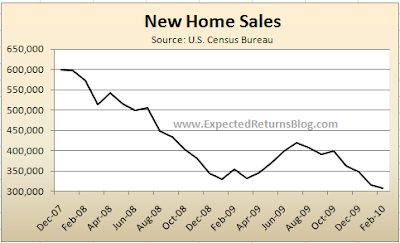
Commerce Department figures showed that new home sales in February fell to an all time low while inventory of homes-on-market posted its fourth straight month of increases. Although some sources placed the blame for this decline on severe winter weather, a more plausible explanation is that it was caused by 2009's severe job losses. See the following post by Moses Kim from Expected Returns.

"Green shoots" continue to bypass the housing sector, and the rest of the economy for that matter, as new home sales in America fall to a record low. From Bloomberg, Sales of New U.S. Homes Dropped to Lowest on Record:

Sales of new homes in the U.S. unexpectedly fell in February to a record low as blizzards, unemployment and foreclosures depressed the market.

Purchases decreased 2.2 percent to an annual pace of 308.000, figures from the Commerce Department showed today in Washington. The median sales price climbed by the most in more than two years.


The fall in new home sales was unexpected to only those who view the economy with rose-colored glasses. It is correct to blame the fall in new home sales on unemployment, but to blame it on blizzards is laughable. We lost over 4.1 million jobs in 2009, and it's a couple of blizzards that are putting pressure on housing? What a joke.

For your information, the 4.1 million jobs lost represents the largest number of job losses since the BLS started taking records in 1940. But with the combination of a dose of sophistry and some good old government spin, we have apparently pulled ourself out of this recession against all odds.

Supply Continues to Rise
The supply of homes at the current sales rate increased to 9.2 months’ worth, the highest since May, from 8.9 months in January.

Housing, the industry that triggered the worst recession in seven decades as the subprime mortgage market collapsed, showed signs of recovering in 2009 as an $8,000 first-time buyer tax credit boosted sales ahead of its originally scheduled expiration in November.

Extension of the credit for contracts signed by April and its expansion to include some current homeowners has failed to boost sales in recent months.

New-home purchases are considered a leading indicator because they are based on contract signings. Sales of previously owned homes, which make up the remainder, are compiled from closings and reflect contracts signed weeks or months earlier.

The weakness in new home sales will be reflected in weak existing home sale figures in the months ahead. Buyers aren't stepping in front of this train anymore. We need to see some inventory clearing, but inventories are now rising to levels from a year ago.

2010 will clearly be a year when housing comes under pressure once again. Let's not forget that the government is withdrawing from the direct purchase of MBS in a week. We should know very soon how mortgage rates react. In all probability, rates will rise significantly, which will deal a huge blow to the housing recovery that never was.

This article has been republished from Moses Kim's blog, Expected Returns.

Manufacturing Numbers Show Positive Signs For Economic Growth

Although not as strong as January, February was the third consecutive month of increasing orders for durable goods, indicating that the industrial sector of the economy is truly moving into recovery. Although durable goods orders tend to signal increasing optimism about the economy moving forward, it still remains to be seen when it will begin to positively affect the labor market. See the following post from The Capital Spectator for more on this.

This morning’s update on new orders for durable goods reminds that the cyclical forces of recovery are bubbling. It’s still unclear how deeply and how soon the recovery will spill over into the labor market. As long as that uncertainty persists, there's some doubt about strength of the economic rebound overall. Meantime, it’s clear for the moment that the trend in the manufacturing sector continues to claw its way back from the steep losses of 2008.

New durable goods orders on a seasonally adjusted basis rose 0.5% in February, the government reports. That's well below January's 3.9% surge, but for the last three months this series has posted gains. Excluding the volatile transportation sector, new orders increased 0.9 percent in February; and if we ignore defense, the jump was even higher last month at 1.6%.

Three straight months of gain, along with substantially higher levels of new orders vs. a year ago, is an encouraging sign for the industrial corner of the economy. "Orders are generally believed to be a front runner for activity in the manufacturing sector because a manufacturer must have an order before contemplating an increase in production," explains Brian Kettell in Economics for Financial Markets .

Although the monthly reports for this series are notoriously volatile, the broad trend offers convincing clues for what lies ahead. By that standard, the ongoing rise over the past year suggests the rebound in manufacturing is more than a quirk. As our chart below shows, new orders for durable goods last month were nearly 11% higher compared with the level in February 2009. That's the biggest year-over-year gain in nearly four years (based on monthly data).


"Persistent strength in durable goods orders should be taken as a sign that both consumers and businesses are confident enough in the economy to engage in spending on big-ticket items," writes Pimco's Tony Crescenzi in The Strategic Bond Investor.

It's still debatable if durable goods orders are truly on a "persistent" uptrend, although the case for thinking optimistically is a bit stronger in light of today's report. "The business sector has been the strongest piece of the U.S. economic backdrop, an encouraging indication that the seeds of an organic growth dynamic are taking root and the recovery will continue," according to Julia Coronado, senior economist for BNP Paribas, via MarketWatch.com.

And Bloomberg News reports today:

Business spending on new equipment, inventory restocking and a pickup in global demand mean companies from Boeing Co. to Owens-Illinois Inc. can look forward to sustained sales gains. A pickup in employment is needed to broaden the expansion as the economy heals from the worst recession since the 1930s.

"Businesses are ready to invest not just in inventories, but in equipment as well,” said Lindsey Piegza, an economist at FTN Financial in New York, who accurately anticipated the gain in orders. “These will be some of the key drivers of growth going forward."
But while the industrial sector continues to improve, it's still unclear how soon the recuperating process will spill over into the labor market. Either the recovery in manufacturing helps nurture an expansion in job creation, or the weak labor market puts a lid on the incipient mending in the industrial sector. Today's news on durable goods, along with other positive signs, indicate there's reason to stay optimistic in spite of the rough period of late in the labor market, as we discussed here and here, for instance.

The next installment of confirmation (or not) that the long-awaited rebound in the labor market is here arrives with tomorrow's news on initial jobless claims, followed by next week's update on nonfarm payrolls for March.

This article has been republished from James Picerno's blog, The Capital Spectator.

Wednesday, March 24, 2010

Will The Financial Crisis Affect Long-Term Economic Growth?

Economist Mark Thoma responds to Bill Easterly's argument that long-term growth of the economy will not be significantly hurt by the recent financial crisis. Thoma agrees that long-term growth will be okay if the US can exit stimulus measures gracefully and pay down the debt during the good times. See the following post from Economist's View.

Bill Easterly emails to ask what I think of this:
Stop panicking: Capitalism repeatedly recovers from financial crises, by William Easterly: I am just beginning to dive into the awesome book by Carmen Reinhart and Ken Rogoff, This Time is Different: Eight Centuries of Financial Folly. Along with great analysis, they have some wonderful pictures, evidence, and data. What I say here is my own take on it.

First, financial crises are remarkably common. Their Figure 5.1 shows the number of countries that have defaulted on their external debt (one possible dimension of a financial crisis) over the last two centuries. The numbers come in episodic waves of defaults and involve a remarkably high number of countries in each wave:


Second, the global capitalist system does well in the long run anyway. Average per capita income in the world (a shaky estimate, but probably right order of magnitude) increased by a multiple of 12 over 1800-2008, despite repeated epidemics of financial crises.

The US is arguably the country with democratic capitalism the longest, and it also shows a steady upward trend from 1870 to the present, despite repeated banking crises (using those identified by Reinhart and Rogoff), with usually little effect of each crisis on output relative to trend (except for the Great Depression).

Reinhart and Rogoff calculate directly the growth pattern before and after crises in advanced capitalist economies, and growth does indeed recover quickly to the trend growth rate of around 2 percent per capita per annum. 2 percent per capita is roughly the same growth rate that increased US per capita income so much from 1870 to the present.


y-axis reads "Real GDP Growth (Percent)"

I don’t mean to minimize the short run pain that the current financial crisis has caused. It’s horrible. But there is no reason to panic about the long run growth potential looking forward.

The obvious rejoinder is Keynes’ “in the long run, we are all dead.” But we can’t ignore that Capitalism already survived repeated financial crises and has made us all vastly better off despite them. So here’s a counter-quote: “In the long run, we are all better off because our dead ancestors stuck with capitalism.”

My take is a bit different. The graph of per capita income from 1870 - 2008 seems to say we shouldn't worry that aggressive intervention to stimulate the economy will cause long-run problems. It may help substantially in the short-run, but the graph above indicates it's unlikely to have long-run consequences. So, I agree, let's not panic. Let's not panic and start reducing stimulus measures too soon, or be too timid with stimulative policies, out of fear it might harm long-run growth. As the Great Depression shows us -- a time when there were legitimate fears about capitalism ending -- the more attention we pay to the short-run problems that undermine support for capitalism, the better chance there is that it will survive in the long-run.

I should acknowledge the Reinhart and Rogoff finding that debt levels higher than 90% of GDP are associated with lower economic growth:

...[D]ebt burdens are racing to thresholds of (roughly) 90 per cent of gross domestic product and above. That level has historically been associated with notably lower growth.

While the exact mechanism is not certain, we presume that at some point, interest rate premia react to unchecked deficits, forcing governments to tighten fiscal policy. Higher taxes have an especially deleterious effect on growth. ...

Given these risks of higher government debt, how quickly should governments exit from fiscal stimulus? This is not an easy task, especially given weak employment, which is again quite characteristic of the post-second world war financial crises... Given the likelihood of continued weak consumption growth in the US..., rapid withdrawal of stimulus could easily tilt the economy back into recession. Yet, the sooner politicians reconcile themselves to accepting adjustment, the lower the risks of truly paralysing debt problems down the road. ...
But as Rogoff notes elsewhere,
Monetary policy has done what it can to limit damage. Fiscal policy I would also give high marks to. We moved in the right direction in as timely a manner as possible.
I am not as willing to give fiscal policy high marks. We could have, and should have, done more to help the economy, and it certainly could have been more timely. As for fears more aggressive intervention will lower long-run growth, so long as we have the discipline to exit from these policies gracefully -- to pay the bill for the stimulus package in the good times -- long-run growth should not be affected by aggressive intervention in the short-run.

I believe that when the time comes to pay for the stimulus package, we'll do the right thing, just as we've always done in the past (yes, I know I'm being Pollyannish). And, in any case, the long-run debt problem has little to do with the stabilization measures used to counter the effects of the recession. The growth in health care costs is the problem in the long-run, nothing else matters much in comparison. If we fix the health cost escalation problem, a much more aggressive intervention to help the economy could have easily been absorbed into the budget without creating problems. And if we don't fix the health cost problem, the size of the stimulus package is of little consequence by comparison.

Finally, on the general "stop panicking" message, when people are hurting -- and they are -- we ought to panic. Legislators have given little indication that the understand the urgency of the employment problem we face. We need more panic, not less, about the employment situation.

This article has been republished from
Mark Thoma's blog, Economist's View.

Housing Recovery Will Not Begin Until Distressed Inventory Is Resolved

Despite recent news that the rate of delinquencies appears to be slowing and predictions of a surge in existing home sales in the second quarter of 2010, some analysts believe that true recovery in the housing market will not be realized until the issue of bloated distressed inventory levels is resolved. Examining the market from a supply side perspective, it is clear that the number of loans in default is growing faster than lenders can fix. See the following article by Paul Jackson from HousingWire.

Last week, I wrote about REO volumes and showed how bank-owned real estate was back on the upswing after two quarters of limited inventory—and by the end of last week, so too had most of the financial press. Which is flattering.

This week, I’m going to build from last week’s column to take a more in-depth look at delinquency trending to help you get a feel for where the real estate market is headed next. (I can only hope the message is as widely followed by my journalistic colleagues this week, as well.)

Last week, using data from Lender Processing Services (LPS: 41.31 +0.41%), I highlighted the fact that there are some 7.5 million loans in some stage of delinquency, and noted that problem residential mortgage loans are growing—not shrinking. Take a peek at the below chart, which clearly shows that delinquency and foreclosure inventory is currently double the levels seen in the 1995-2005 decade.


While the pace of delinquencies seems to be slowing somewhat as of late—good news, indeed!—we still face a situation where loans are going bad faster than we can offer a “fix.”

Consider that 2.5 million loans, current at the start of 2009, had become 60+ days delinquent or in foreclosure by the end of January 2010, according to LPS. Compare that to the roughly 2 million loan modifications in process or processed in generally the same time frame—116,000 permanent HAMP mods + 830,000 trial HAMP mods + 1.0 million completed non-HAMP mods.

It’s simple math: 2.5 million is greater than 2.0 million.

And keep in mind that many of the loans modified now will inevitably re-default later, as most modifications bring with them substantial re-default rates—roughly 60% or so, according to most of the data I’ve seen (the Treasury does not report on HAMP re-default rates, by the way).

JP Morgan Chase & Co. (JPM: 44.58 +1.92%), for example, recently suggested to investors that it expects re-default rates on completed modifications to run 35 to 50 percent one year out, reaching as high as 65 percent 3 years out.

So let’s assume the redefault rate over time is untenably optimistic and stays at 35 percent (JPM’s lowest bound, just for the first year). Even in such a scenario, we’ve got a “fix” shortfall of 1.2 million loans on new defaults recorded during 2009 alone. Short sales will help cover some of this gap, absolutely—but as I’ve written before, I do not expect them to be the panacea that many are currently predicting.

Regardless, the point here is that there remains significant distressed housing inventory yet to be cleared off the books—and cleared off the books it must be, one way or another. Which means whether REO or short sale, these properties must eventually come on the market and be sold to somebody in order for there to be recovery.

With that as background, take in recent remarks by the National Association of Realtors’ chief economist Lawrence Yun, discussing January’s 7.6 percent monthly drop in pending home sales: “We will see weak near-term sales followed by a likely surge of existing-home sales in April, May and June,” Yun said in a recent press statement.

“The real question is what happens in the second half of the year. If there is sufficient job creation, housing can become self-sustaining with stable to modestly rising home prices because inventory has been trending downward.”

Because inventory has been trending downward. Read Yun’s quote again, and focus on that very last phrase. Given the numbers I threw out earlier in this column, we’d all better think about what millions of distressed sales will do to inventory, and prices too. We’d better start doing something that the NAR is famously horrible at: considering the supply side of the housing economics equation, rather than simply looking at ways to juice housing demand (read: generate commissions for dues paying NAR members).

And speaking of housing demand, I’m not sure how higher mortgage rates tied to the Fed’s exit from mortgage purchases coupled with a pending expiration of the homebuyer tax credit will translate into an expected “surge of existing-home sales in April, May and June,” as Yun asserts. Both changes to the mortgage market’s inner workings are scheduled to hit in April.

More impartial economists than Yun are watching April as a critical month for U.S. housing. Mark Fleming, chief economist at First American CoreLogic has said that “[t]he big unknown for the 2010 spring selling season continues to be the future of the federal homebuyer tax credit.”

I agree insofar as demand for homes goes, but my concern sits more squarely with the supply side of the housing equation—what, exactly, becomes of millions of units of already distressed residential housing?

To understand the depth of the problem here: we’ve already got 4.7 million loans either 90+ days delinquent or in foreclosure, according to LPS data. I could legitimately argue that at least 25% of that figure should already have been listed on the market as inventory to be sold via REO or short sale (after all, the average age of a loan in foreclosure is well over one year).

The NAR estimates that there are 2.8 million single-family existing homes available for sale, representing a 7.6 month supply at the annualized, seasonally-adjusted sales rate recorded in January 2010; add the 25% figure I describe to that, and we might in reality be closer to an single-family inventory figure of 4.0 million and 11 months supply.

Here’s the bottom line: any so-called recovery in housing right now is a faux recovery until we work through bloated distressed inventory levels. The sooner we get to work on this, the sooner we get ourselves a long-term and sustainable recovery in U.S. housing.

This article has been republished from HousingWire. You can also view this article at
HousingWire, a mortgage and real estate news site.

Tuesday, March 23, 2010

Health Care Savings Projections May Not Materialize

When the healthcare bill passed the House of Representatives, it was touted as providing significant long-term deficit reduction. Many parties, however, feel that the bill will instead increase deficits, due to both Congress' traditional track record of higher-than-expected spending as well as the bill's dependence on new revenue streams that may not materialize. See the following post from The Capital Spectator.

The health care reform bill has passed the House and the only thing standing in its way from becoming law is the Senate. Although Republicans are expected to put up a fight, it’s unlikely that they’ll succeed in keeping the bill from the President’s desk, where Obama will sign it and proclaim victory.

Among the many questions that surround the health care legislation is cost. At a time when the U.S. budget is already saddled with hefty doses of red ink, there’s a growing debate about how the new health care bill will help, or hinder, the cause of fiscal probity.

Advocates of the legislation argue that the deficit will fall under with the arrival of health care reform as currently packaged. The bill is set to spend some $950 billion over the next decade, but it would also raise revenue. If you buy into the embedded assumptions in the legislation, the deficit outlook via the Congressional Budget Office will be lower, thanks to the various revenue-raising efforts.

"Could this really be true?" asks Douglas Holtz-Eakin, a former director of the Congressional Budget Office and currently the president of the American Action Forum, in a New York Times op-ed over the weekend. No, he warns. "The health care legislation would only increase this crushing debt," he predicts, offering several examples of why he thinks this is the future that awaits.

The Everyday Economist raises some doubts about whether the revenue raising assumptions in the bill will pan out. As one example, he considers the excise tax on “Cadillac” health care plans. But expecting this will generate revenue is premature because...
The tax is not implemented until 2013. This suggests that, in the near-term, firms that offer top-of-the-line insurance have an incentive to reduce the coverage extended to their employees to avoid the tax. This shift could potentially reduce health care spending as these individuals would then have to spend more in out-of-pocket costs – effectively raising the price and reducing the quantity demanded. Such a shift, however, would also imply lower tax revenue as these plans are eliminated.

Of course, even the analysis of the excise tax above makes important assumptions. For example, it was assumed that the tax was actually implemented and not repealed by subsequent legislation. In addition, the most vehement detractors of this provision have been labor unions as they tend to offer their members better benefits that could potentially be subject to the new tax. As a result, there has been discussion about creating an exemption to the excise tax for members of labor unions. Such an exemption, however, would result in lower tax revenue and a lesser reduction in health care spending.
But as a broad brush piece of legislation, supporters of the bill assert that net effect will be one of deficit reduction. "Americans think the bill is too expensive because they don't understand its cost controls," complains Ezra Klein of Newsweek. "The fact that the cost controls are complicated and numerous doesn't mean they're absent, or that they won't work." With that, he proceeds to offer a list of the bill's "best ideas" for controlling costs, including these two items:
Outlawing the bad kind of competition while enabling the good kind, which the bill does, is more than just a humanitarian measure. It's a cost control. The insurance "exchanges" imitate the market in which federal employees (including congressmen) purchase their health care insurance. Participating insurers can't discriminate based on pre-existing conditions, they have to answer to regulators if they attempt to jack up premiums, and consumers will be able to rate their insurers, a rating that everyone else will see when shopping for their insurance.

…The next cost control worth mentioning is an effort by Congress to solve the problem of, well, Congress. Medicare's cost problem is, in many ways, a political problem: Saving money means cutting someone's profits or someone's benefits, and politicians are afraid to do either.

Enter the Independent Medicare Advisory Board. Modeled off of the highly-respected (but totally toothless) Medicare Payment and Advisory Commission, IMAC is a 15-person board of independent experts chosen by the president, confirmed by the Senate, and empowered to cut through congressional gridlock. IMAC will write reforms that bring Medicare into like with certain spending targets. Congress can't modify these proposals, it can't filibuster these proposals, and if it wants to reject them, it needs to find another way to save the same amount of money. Making the process of passing tough reforms easier is the single most important thing you can do to make sure tough reforms actually happen.
None of this is swaying critics, including the Cato Institute's Michael Cannon, who argues that the new health care bill will boost the budget deficit by $59 billion.

In fact, no one really knows how the future will play out with the true cost of the health care. The legislation is so complicated, with so many moving parts, that it's virtually impossible to foresee how all its facets will interact and how this will change current estimates of revenues and costs.

Meanwhile, even if you don't fully understand the bill (and who does at this point?), one can maintain a healthy skepticism solely by recognizing that Congress has a poor record on matters of cost control. That's the nature of the beast. The optimistic view is that it's different this time.

This article has been republished from James Picerno's blog,
The Capital Spectator.

City Governments Losing Millions In Risky Derivative Bets

City governments who participated in risky derivative trades are now scrambling to get out of bad deals, costing tax payers millions. While some are pointing fingers at the financial firms which sold the investments, the responsibility for the losses belongs to officials who made the bets. See the following post from Expected Returns for more on this.

In line with the trend of government idiocy and irresponsibility, the Wall Street Journal reports that states and cities are losing money on derivative bets gone bad. The derivative of choice? Interest rate swaps. The effect of government stupidity? Higher taxes. From the WSJ:
Buyer's remorse has hit some cities and states that did deals with Wall Street in different times.

Hundreds of U.S. municipalities are losing money on interest-rate bets they made during the bull market in hopes of protecting themselves from higher rates. The deals backfired when rates fell, shriveling the sums paid to municipalities. Now some are criticizing Wall Street and trying to exit the contracts.

The Los Angeles city council approved a measure this month instructing city officials to try to renegotiate an interest-rate deal with Bank of New York Mellon Corp. and Belgian-French bank Dexia SA. The pact, reached in 2006 to help fund the city's wastewater system, currently is costing the city about $20 million a year. The banks declined to say how they would respond to a request to renegotiate.

In Pennsylvania, 107 school districts entered into interest-rate swap agreements from October 2003 to last June. At least three have terminated them. Under one deal, the Bethlehem, Pa., school district had to pay $12.3 million to terminate a swap with J.P Morgan Chase & amp; Co., according to state auditor general Jack Wagner. J.P. Morgan declined to comment.

State lawmakers have proposed restrictions on municipalities' ability to use swaps. "It's gambling with the public's money," Mr. Wagner said. "Elected officials are simply no match for the investment banker that's selling the deal."
Did municipalities seriously expect to make money by purchasing esoteric derivative contracts they didn't understand at the casino known as Wall Street?

Interest rate swaps are OTC (over the counter) instruments, which means there is no official exchange where these products are traded. Counterparties agree to exchange streams of cash flow to "hedge" against interest rate movements. Basically, they're gambling against each other. This arrangement gives Wall Street firms free rein to rob unsuspecting municipalities out of millions of dollars.

Derivatives are interesting instruments- they always find a way to provide steady and "risk-free" streams of income before absolutely imploding and leaving contract holders shellshocked. Don't think for a second that we have seen the last of government bailouts. There are still hundreds of trillions of dollars of OTC derivatives floating around. As counterparties begin to renege on their obligations, we should see some real damage to the real economy. Warren Buffet called derivatives "weapons of financial mass destruction" for a reason.

Taxpayer Bailout

Government budgets are stretched thin, prompting officials to look for dollars wherever they can. The clashes over the swaps come amid growing scrutiny of the municipal-bond market, where the U.S. government is investigating whether there was bid rigging in certain cases.

Some securities-industry officials say they are open to renegotiating with municipalities so long as doing do doesn't cause a tidal wave of demands.

"If they can't come to an agreement on how to modify, the contract should stand," said Michael Decker, a managing director at the Securities Industry and Financial Markets Association, a trade group.

Escaping isn't cheap or easy. Under a transaction between Oakland, Calif., and a Goldman Sachs Group-backed venture, Goldman paid the city $15 million in 1997 and $6 million in 2003, according to Oakland financial reports. But now, the city stands to lose about $5 million this year.

That money "is coming out of taxpayers' pockets and could be used for other things," said Rebecca Kaplan, a city council member. She wants the city to renegotiate. But the city faces a $19 million termination payment. Oakland officials didn't respond to requests for comment.
It's ironic that municipalities are scrambling to get out of swap arrangements at the exact time their bets on higher interest rates will likely net them a profit. But I suppose I shouldn't be surprised that municipalities that have so thoroughly mismanaged their finances will sell investments at the absolute bottom and buy at the absolute top.

Government officials are pointing their fingers at Wall Street for taking them for a ride, but honestly, the blame rests squarely on the shoulders of governments that bought derivatives they didn't understand. Instead of trying to bolster returns by taking on tremendous risk, municipalities should have focused on cutting spending and bureaucratic waste.

The bottom line is derivative bets gone bad will further constrain budgets and force tax rates higher. Municipalities are going to face tough choices for years to come, and layoffs in the public sector are far from over.

This post has been republished from Moses Kim's blog, Expected Returns.

Monday, March 22, 2010

Ben Bernake's Wishlist For Financial Reform

Ben Bernanke says that the existence of very large financial firms are necessary in the global economy although government must be allowed to unwind failing firms without causing disruption to the system and costing taxpayers. He also calls for limits on excessive risk taking and a level playing field that allows for smaller banks to compete. See the following post from Economist's View.

In a speech today, Ben Bernanke says the financial system is far from the "competitive ideal," and that the too-big-to-fail problem is the primary cause of the "insidious barriers to competition" and "competitive inequities" that currently exist in these markets.

One thing I'd add is that there is reason to be concerned about the size of these firms over and above the too-big-to-fail problem, i.e. for traditional reasons involving the exercise of market power. Bernanke says that:
our technologically sophisticated and globalized economy will still need large, complex, and internationally active financial firms to meet the needs of multinational firms, to facilitate international flows of goods and capital, and to take advantage of economies of scale and scope
But I'd like to have more precise information about how large these firms need to be until the economies of scope and scale begin bottoming out. If it's so large that firms can gain a substantial market share by moving down the cost curve, then regulators need to ensure that firms do not exploit their market power:

...Toward a More Competitive, Efficient, and Innovative Financial System The United States has a financial system that is remarkably multifaceted and diverse. Some countries rely heavily on a few large banks to provide credit and financial services; our system, in contrast, includes financial institutions of all sizes, with a wide range of charters and missions. We also rely more than any other country on an array of specialized financial markets to allocate credit and help diversify risks. Our system is complex, but I think that for the most part its variety is an important strength. We have many, many ways to connect borrowers and savers in the United States, and directing saving to the most productive channels is an essential prerequisite to a successful economy.

That said, for the financial system to do its job well, it must be an impartial and efficient arbiter of credit flows. In a market economy, that result is best achieved through open competition on a level playing field, a framework that provides choices to consumers and borrowers and gives the most innovative and efficient firms the chance to succeed and grow. Unfortunately, our financial system today falls substantially short of that competitive ideal.

Among the most serious and most insidious barriers to competition in financial services is the too-big-to-fail problem. Like all of you, I remember well the frightening weeks in the fall of 2008, when the failure or near-failure of several large, complex, and interconnected firms shook the financial markets and our economy to their foundations. ... It is unconscionable that the fate of the world economy should be so closely tied to the fortunes of a relatively small number of giant financial firms. If we achieve nothing else in the wake of the crisis, we must ensure that we never again face such a situation.

The costs to all of us of having firms deemed too big to fail were stunningly evident during the days in which the financial system teetered near collapse. But the existence of too-big-to-fail firms also imposes heavy costs on our financial system even in more placid times. Perhaps most important, if a firm is publicly perceived as too big, or interconnected, or systemically critical for the authorities to permit its failure, its creditors and counterparties have less incentive to evaluate the quality of the firm's business model, its management, and its risk-taking behavior. As a result, such firms face limited market discipline, allowing them to obtain funding on better terms than the quality or riskiness of their business would merit and giving them incentives to take on excessive risks.

Having institutions that are too big to fail also creates competitive inequities that may prevent our most productive and innovative firms from prospering. In an environment of fair competition, smaller firms should have a chance to outperform larger companies. By the same token, firms that do not make the grade should exit, freeing up resources for other uses. Our economy is not static, and our banking system should not be static either.

In short, to have a competitive, vital, and innovative financial system in which market discipline encourages efficiency and controls risk, including risks to the system as a whole, we have to end the too-big-to-fail problem once and for all. But how can that be done? Some proposals have been made to limit the scope and activities of financial institutions, and I think a number of those ideas are worth careful consideration. Certainly, supervisors should be empowered to limit the involvement of firms in inappropriately risky activities. But even if such proposals are implemented, our technologically sophisticated and globalized economy will still need large, complex, and internationally active financial firms to meet the needs of multinational firms, to facilitate international flows of goods and capital, and to take advantage of economies of scale and scope. The unavoidable challenge is to make sure that size, complexity, and interconnectedness do not insulate such firms from market discipline, potentially making them ticking time bombs inside our financial system.

To address the too-big-to-fail problem, the Federal Reserve favors a three-part approach.

First, we and our colleagues at other supervisory agencies must continue to develop and implement significantly tougher rules and oversight that serve to reduce the risks that large, complex firms present to the financial system. Events of the past several years clearly demonstrate that all large, complex financial institutions, not just bank holding companies, must be subject to strong regulation and consolidated supervision. Moreover, the crisis has shown that supervisors must take account of potential risks to the financial system as a whole, and not just those to individual firms in isolation. Implementing supervision in a way that seeks to identify systemic risks as well as risks to individual institutions is a difficult challenge, but the fact is that the traditional approach of focusing narrowly on individual firms did not succeed in preventing this crisis and likely would not succeed in the future. ...

The second component of the strategy to end too-big-to-fail is to increase the resilience of the financial system itself, to reduce the potential damage from a systemic event like the failure of a major firm. ... Limiting the fallout from the failure of a major firm is not only directly beneficial in a crisis, it also helps to reduce the too-big-to-fail problem, because the government has much less reason to intervene if it believes that the financial system is resilient enough to handle a significant failure without excessive disruption.

Third, because government oversight alone will never be sufficient to anticipate all risks, increasing market discipline is an essential piece of any strategy for combating too-big-to-fail. To create real market discipline for the largest firms, market participants must be convinced that if one of these firms is unable to meet its obligations, its shareholders, creditors, and counterparties will not be protected from losses by government action. To make such a threat credible, we need a new legal framework that will allow the government to wind down a failing, systemically critical firm without doing serious damage to the broader financial system. In other words, we need an alternative for resolving failing firms that is neither a disorderly bankruptcy nor a bailout. ... If, in the end, funds must be injected to resolve a systemically critical institution safely, the ultimate cost must not fall on taxpayers or small financial institutions, but on those institutions that are the source of the too-big-to-fail problem.

I don't want to understate the difficulties of creating an effective resolution framework for large, interconnected firms. Such firms can be extraordinarily complex, both in terms of their legal structure and in the range and sophistication of their activities. The resolution of large institutions whose operations span many countries poses particular challenges, as legal frameworks vary across countries, and the authorities in each country naturally seek to protect the interests of depositors and creditors in their own jurisdictions. We must also recognize that such resolutions might well take place in the context of a broader crisis, in which the government might be forced to address problems at multiple firms simultaneously. Careful planning is therefore essential. An idea worth exploring is to require firms to develop and maintain a so-called living will, which will help firms and regulators identify ways to simplify and untangle the firm before a crisis occurs. ...
This article has been republished from Mark Thoma's blog, Economist's View.

Greenspan Defends His Legacy

Alan Greenspan recently released a paper defending his legacy, claiming that the Fed policy of low interest rates were not to blame for the economic crash. Although he did concede that regulation was inadequate and that the Fed, under his leadership, did not see the mounting level of risk in the system, he asserted that the low short-term interest rates had no net effect on the housing bubble. See the following post from The Mess That Greenspan Made.

The defense of monetary policy during the gestation years of the housing bubble was reiterated (yet again) yesterday by former Fed chief Alan Greenspan in a paper(.pdf) titled "The Crisis" that is being presented today at the Brookings Institution.

While the 48 pages of text and the 18 page appendix await attention that they are unlikely to receive from me on this Friday, the contents are quite clear based on reports in the mainstream financial media and the two central points appear to be:

1. Low rates are not to blame
2. See number 1

The Wall Street Journal carries a story in the public area of their website today where Jon Hilsenrath restores some order to the recent reporting on the former Fed chairman, inserting the once-mandatory caveats that all post-2008 Greenspan stories used to carry before an image re-building campaign apparently met with some success over the last year or so:
Mr. Greenspan's reputation has been tarnished by the crisis. Widely hailed when he left office in January 2006 as one of the greatest central bankers ever, he is now blamed by many for advocating deregulation and low interest rates during the 1990s and 2000s.
That's more like it - the third paragraph in - short and sweet.

In his paper, Greenspan concedes that regulation failed and that the central bank didn't see the mounting risks in the financial system, but he goes on to defend monetary policy back in 2002-2004 and blames the "savings glut" as the primary interest rate culprit, that is, the theory that short-term rates played little role in inflating the housing bubble and that the Fed was powerless over the long-term rates that did.

Does anyone still believe this?

Teaser rate ARMs didn't play an important role as the housing bubble neared its peak?

This excerpt from the New York Times piece by Sewell Chan sheds some light on this question, one that, on its face, seems to be just nonsensical, but one that has nevertheless been repeated countless times over the last few years.
While conceding that the low fed funds rate, the benchmark interest rate the Fed controls, made it easier for borrowers to use adjustable-rate mortgages, he said he suspected — “but cannot definitively prove” — most home purchasers would have taken out 30-year fixed-rate mortgages had the adjustable-rate ones not been available.

“The global house price bubble was a consequence of lower interest rates, but it was long-term interest rates that galvanized home asset prices, not the overnight rates of central banks, as has become the seemingly conventional wisdom,” Mr. Greenspan wrote.
Now, remember that the guy turned 84 not long ago, so, he's not getting any sharper as the years go by, but, this is just pitiful.

Interestingly, the New York Times piece also has a similar third paragraph disclaimer:

Mr. Greenspan, once celebrated as the “maestro” of economic policy, has seen his reputation dim after failing to avert the credit bubble that nearly brought down the financial system.
Nicely done.

Ultimately, the conclusion that the former Maestro reaches is that regulation must be improved and that banks should hold more capital, however, the issue of monetary policy is really the "elephant in the room" for both this paper and Ben Bernanke's similar defense of the Fed funds rate during the first week of the year as discussed here.

On this subject, it strikes me that the approach taken by both the current and former Fed chairmen in their recent writing is both dishonest and naive.

If, for example, back in 2001 and 2002 as interest rates were being slashed, Fed board members would have sat around their conference room table and said, "We've really got to beef up regulation because housing prices really have room to run and we don't want to just create another bubble", then there might be some merit to this defense.

But, obviously, they did nothing of the sort.

In fact, not only did Greenspan poo-poo warnings from the likes of the late Ed Gramlich about subprime lending, but he encouraged borrowers to take out adjustable rate loans as late as 2004 and praised the financial innovation of both subprime lending and credit default swaps at the very period of time that the credit market and housing bubble excesses were accelerating out of control.

It's as if both Greenspan and Bernanke are hopelessly naive about the world in which we live where people are clearly motivated by short-term gains and end up doing stupid things, behaving quite irrationally at times.

In order to even consider taking interest rates to one percent or zero over the last ten years, the first step should have been to beef up regulation, but it wasn't back then and isn't today.

This sort of defense of monetary policy - including today's freakishly low rates - is only applicable to a world of perfect actors, perfect regulation, or some combination of the two and the most disturbing aspect of the combined Greenspan/Bernanke defenses is how they both continue to demonstrate how detached they are from this reality.

Of course, none of this bodes well for the future since short-term rates have already been at zero percent for over a year as Wall Street firms continue to dream up new ways to destroy the world while, at the same time, finding time to thwart meaningful financial market reform.

This post has been republished from Tim Iacono's blog, The Mess That Greenspan Made.