Thursday, December 31, 2009

Obama's Senior Economic Adviser Outlines Plan For Jobs

Christina Romer, senior economic adviser to President Obama, describes some of the measures the Obama Administration is planning to take to improve jobs. This includes additional infrastructure projects, support for the clean-energy industry, and help for small businesses in the form of tax breaks and increased loan guarantees. See the following post from Economist's View for more on this.

It's looking as though the recovery of labor markets will follow the pattern of the last two recessions and lag significantly behind the recovery of output. Additional fiscal policy measures could be used to help employment markets recover faster, so this statement from Christina Romer about the administration's plans to create jobs is good to see. But how much of a priority will job creation be for the administration given that it has other things it would like to accomplish? The amount of political capital that the administration is willing to use to push an expanded version of this legislation forward will say a lot about its true commitment to job creation:
Making job creation a priority, by Christina Romer, Commentary, sfgate.com: President Obama has laid out a series of steps that should be at the heart of our continuing efforts to accelerate job growth, rebuild our economy for the long term, and bring American families relief during these difficult times. ...

Our nation faces double-digit unemployment. Far too many Americans still are struggling to make ends meet. But to understand where we need to go, it's important to look back at where we started. On the first days after the president was elected, our economy was rolling toward the edge of a cliff with ever-increasing momentum. President Obama instructed his economic team to take swift action to stem the tide of crisis. And we did..., we took unprecedented - and often unpopular - action to stave off a total economic collapse.

We worked with Congress to pass the American Recovery and Reinvestment Act, which has already provided tax relief to millions of small businesses and families, saved more than a million jobs and begun to lay the foundation for lasting recovery. ... Today, our economy is growing for the first time in more than a year. Last month, employment was nearly stable and the unemployment rate dropped slightly.

But we understand that talking about what we've accomplished may mean little to someone who is still out of a job. That's why President Obama outlined plans earlier this month to accelerate private-sector job creation in three key areas.

First, because small businesses are the No. 1 driver of job growth in America, the president's plan encourages investment by ... proposing a one-year elimination of the tax on capital gains from new investments in small businesses.

We're also calling for the extension of Recovery Act provisions to give small businesses tax incentives to invest in new equipment and other types of capital goods. We will work with Congress to create a tax cut for small businesses that hire new workers. And we will eliminate fees and increase loan guarantees for small businesses that borrow through the Small Business Administration.

Second, because smart, targeted investments in energy efficiency can help create jobs, we will create new incentives for consumers who invest in energy-efficient retrofits to their homes. And we will expand Recovery Act programs to leverage private investment in energy efficiency and create clean-energy manufacturing jobs.

Finally, the president is calling for investments in a wide range of infrastructure, designed to get out the door as quickly as possible while continuing a sustained effort at creating jobs and improving America's long-run productivity. The infrastructure projects include highway, transit, rail aviation and water projects. ...

These are important steps, but there is still so much work that remains. President Obama ... will not rest until every American who wants a job has one.
State and local governments also need more help, and this could do a lot to save existing jobs, so I'd like to see that on the list as well.

This post has been republished from Mark Thoma's blog, Economist's View.

Labels:


Falling Tax Revenues: A Bad Sign For Economic Recovery

As federal and local governments increase spending to stimulate the economy, their revenues through taxes continue to fall. According to the Wall Street Journal state and local tax revenues are falling due to lower consumer spending while property taxes are sure to decline as property assessments catch up to the depressed home values. See the following discussion from Moses Kim at Expected Returns.

I'm becoming increasingly wary of news of a nascent economic recovery, especially with news from the WSJ that state and local tax revenues declined 7%. Declining tax receipts evidence the weakness in both the labor market and consumer demand. All signs point to this weakness to persist as credit continues to contract for consumers who are deemed by banks to be less and less creditworthy.
State and local tax revenues fell 7% in the third quarter of 2009 from a year ago, the Census Bureau said in a report underscoring how the economic downturn is stressing government collections.

Sales taxes declined 9% to $70 billion in the third quarter compared with the year-ago period, the Census Bureau said. Income taxes plunged 12% to about $58 billion. Together, sales and income taxes make up roughly half of state and local tax revenue.

"We expect continued weakness well into 2010 if not further," said Lucy Dadayan, an analyst at the Rockefeller Institute of Government at the State University of New York.
What more objective indicator is there of economic conditions than sales tax receipts? The consumer is conspicuously not participating in this "economic recovery". There is hardly room to spin this glaring hole in the recovery thesis, but that probably won't stop permabulls from trying.

Property Tax Receipts Rise...For Now

Property taxes increased 3.6% in the third quarter compared with a year ago. But as property assessments catch up with falling residential and commercial real-estate values, property-tax revenues are expected to be weak. That will have a particularly severe impact on local governments, which fund much of their operations from property taxes.
Property taxes were the only bright spot in this report, but don't expect that trend to last. Housing assessments, which determine property tax receipts, haven't fully accounted for the decline in housing prices yet.

Keep an eye on the real estate market. The latest Case-Shiller report shows that housing is flatlining, and suggests further downside risks. The government, through its homebuyer tax credits, has effectively crushed future demand, which should weigh on housing in the months ahead. Of course the government has the option of repeatedly extending tax credits to artificially inflate prices and cause the next major housing crisis, but they can't be that stupid, can they?

States in Crisis Mode

State and local tax revenues tend to lag behind the downturns as well as the upturns in the economy because of the time it takes for collections to catch up with depressed store sales and diminished incomes. The third quarter was the fourth consecutive quarter in which tax collections were below year-ago levels.

Through the first three quarters of 2009 state and local tax revenues totaled $875 billion, nearly 8% below the $951 billion collected in the first three quarters of 2008. In the same period, federal receipts were down nearly 19%.

While the recession appears to have ended during the summer, government revenues are expected to continue to be weak. State and local governments employ 15% of American workers outside of agriculture.
States are about to face some tough choices. Declining tax revenues, which are at depression levels, will force states to cut services and layoff more employees. We are facing a huge fiscal crisis at the state and federal level that is being patently ignored. 2010 should bring these key issues to the fore as deteriorating balance sheets of governments become too much to ignore.

This post has been republished from Moses Kim's blog, Expected Returns.

Labels: , ,


Wednesday, December 30, 2009

Could Property Prices Tumble Again?

David M. Blitzer, Chairman of the Index Committee at Standard & Poor's doesn't think that the double dip housing decline in the 1980's will be repeated next year. However, when the banks unload their millions of foreclosures onto the market and the government stimuli end, prices could tumble again. See the following post from The Mess That Greenspan Made.

The latest report for the S&P Case-Shiller Home Price Indexes showed another small monthly gain in October for the 20-city index, up 0.37 percent on a seasonally adjusted basis or a gain of 0.05 percent when seasonal factors are not taken into account. On a year-over-year basis, prices are now down 7.3 percent and indexes for all 20 cities are shown below.


Note that the top-to-bottom end-positions of the curves on the right of the chart correspond to the order in the legend in the upper left to aid in viewing the data - this represents how well areas have clung to housing market gains since the 20-city index began in 2000.

Naturally, Washington and New York continue to hold their gains better than any other areas in what seems most unfair since the housing bubble was spawned in these two cities.

Meanwhile, at the other end of the price appreciation spectrum, Phoenix moved back ahead of Atlanta for the 17th spot and Las Vegas held onto 19th position, fending off Cleveland again while Detroit maintains its lock on last place and, at 73.07 and rising, may soon re-enter the colorful graphic above.

Monthly data (NSA) for all 20 cities along with the two indexes are shown below.


David M. Blitzer, Chairman of the Index Committee at Standard & Poor's noted:
Coming after a series of solid gains, these data are likely to spark worries that home prices are about to take a second dip. Before jumping to conclusions, recognize that the one time that happened at the beginning of the 1980s, Fed policy saw dramatic reversals, which is very different from the stable and consistent Fed policy we have today. Further, sales of existing homes – those included in the S&P/Case-Shiller Home Price Indices – have been very strong in recent months, working off the inventories of houses for sale. At the same time, housing starts remain weak, fears that the market will be swamped by a wave of foreclosures are heard and government programs aimed at the housing market will expire in the first half of 2010.
Maybe Mr. Blitzer should re-read his Federal Reserve history a bit to learn more about how different the early-1980s are from today and of the long-term impacts of Fed policy. For one thing, back then mortgage rates were three or four times the current level.

While it shouldn't be surprising that efforts by the central bank in pushing mortgage rates to freakishly low levels when combined with a Washington D.C. give-away of $8,000 for each new home purchased would provide a boost to home prices, it also shouldn't be surprising (if not likely) that prices may again tumble when these supports are removed.

As for the period immediately ahead, seasonal factors are now working decidedly against home prices and the "second derivative" is now clearly signaling the return of more minus signs in the monthly data as indicated in the non-seasonally adjusted data.


Seasonally adjusted data tells a similar story of the pattern taking shape, but, it's difficult to lend too much credence to seasonally adjusted data that looks very seasonal.


The direction and magnitude of home price changes over the next few months will be quite interesting indeed as traditional sellers await the spring selling season, whereas, banks itching to unload foreclosed properties may not.

But, more than anything else, it is likely that there will be a much bigger increase in sellers than buyers in the year ahead as the recent price stability will encourage the former while we see just how much the latter are affected by rising mortgage rates and how much demand has been "pulled forward" due to government incentives.

If there is one thing that is clear after the events of the last six months it is that an $8,000 check from Uncle Sam and 30-year fixed rate loans at below five percent were an irresistible combination for many homebuyers who are likely unaware of any second derivative in the Case-Shiller data that may portend future price declines.

This post has been republished from Tim Iacono's blog,
The Mess That Greenspan Made.

Labels:


How to Profit From Property Taxes

Steve Sjuggerud shares a smart way to profit from property taxes by buying a tax certificate from the county. By paying another homeowner's property taxes, you can receive your money back plus all the late fees once they pay their taxes with virtually no risk. See the following post from Daily Wealth.

I got a nice Christmas surprise... a check in the mail for about $2,250.

It is the easiest 18% interest I've ever earned. And – as I will explain – I feel like I had no risk in the deal... at all.

You can easily do the same thing I did. Here's the story...

Here in Florida, if you don't pay your property tax, you're hit with late fees. As you might expect, the later you are in paying your taxes, the more the late fees rack up.

Of course, it's foolish not to pay your property taxes... because ultimately your property can be sold out from under you, literally on the county courthouse steps, just to recoup the back taxes due to the government.

In plain English, YES, you can lose your $100,000 property – over a couple thousand dollars of late property taxes. Ouch!

I took advantage of this situation. I invested in a no-risk way... My possible outcomes were to either get:

1) 18% interest over up to two years, or (in a much less likely case)
2) the property.

Now how does that work?

In short, the county can't wait for you to pay your property taxes if you're late. It needs your property tax money RIGHT NOW. And it's going to get that money from someone else, if not from you.

As soon as you're late on your property taxes, the county sells a "tax certificate." That's what I bought. Basically, the county strikes a deal with the buyer of the tax certificate (in this case, me). It goes like this:

"If you pay Mr. Jones' property taxes today through buying this tax certificate, then we (the county) will pay you back all your money PLUS all Mr. Jones' late fees, once Mr. Jones pays his taxes."

Well, Mr. Jones just paid his taxes. And I just got a nice Christmas check.

The key to turning tax certificates into a "no risk" 18% is knowing the property... This is actually pretty easy, too.

I know the property I just got paid on pretty well... as well as you need to. Let me tell you about it.

The property is about two miles from both my home and my office. It's about a mile from the beach. It is an empty lot (0.38 acres) in a neighborhood. The owners paid six figures for it.

It was simple. No issues... a six-figure empty lot not far from the beach that the owners didn't pay taxes on.

Now they're caught up on their taxes. And I received 18% interest for my troubles... which were hardly more than driving by the lot, looking at it on the property appraiser's website, and then clicking to buy the tax certificate just like I was buying a book on Amazon.

Seriously, what's my risk in this deal? The main risk is if the property is not worth what you pay for the back taxes. But this is a problem that's easy to avoid as long as you know the property you're buying. A $2,000 certificate on a six-figure empty lot is perfect.

I'm telling you this story so you start saving to buy tax certificates when "the season" kicks in again.

This time of year is not the time to buy tax certificates. The time to buy them is in the summer... when counties start to sell them again.

Taxes are usually officially late by April 1. And the tax sales usually start in late May. I bought in July, when I could get a guaranteed 18% interest.

You can actually do much better than Florida, by the way... Iowa, for example, has a guaranteed 24% interest. And don't even get me started on Texas... the penalty STARTS at 25%.

But my experience is in Florida. I live here. All the properties I have 18% tax certificates on are empty lots within a couple miles of my home – most of which are just a few hundred feet from either the ocean or the intercoastal waterway. I am confident I'll either end up with 18% interest or the property – and I am quite happy to get either.

It sure is nice to get random checks from the government for a few thousand dollars at a time...

Start learning now about tax certificates and tax deeds (skip the Internet and instead buy the first few books you can find on Amazon related to this topic). And when the "season" kicks in again, get yourself in line for your own no-risk 18% interest checks.

This post has been republished from Steve Sjuggerud's blog, Daily Wealth.

Labels: ,


Tuesday, December 29, 2009

The Decade Of Zero Economic Gains

How bad was the first decade of the millennium for the American economy? Stocks are almost at the same levels as in 1999 and inflation-adjusted housing values are roughly the same as well. Median household income has fallen while the government has buried itself in massive debt. Paul Krugman discusses the decade of zero economic gains below.

Will the beginning of a new decade bring an end to the Great Stagnation?:
The Big Zero, by Paul Krugman, Commentary, NY Times: Maybe we knew, at some unconscious, instinctive level, that it would be an era best forgotten. Whatever the reason, we got through the first decade of the new millennium without ever agreeing on what to call it. The aughts? The naughties? Whatever. ...

But from an economic point of view, I’d suggest that we call the decade past the Big Zero. It was a decade in which nothing good happened, and none of the optimistic things we were supposed to believe turned out to be true.

It was a decade with basically zero job creation..., private-sector employment has actually declined — the first decade on record in which that happened.

It was a decade with zero economic gains for the typical family. Actually, even at the height of the alleged “Bush boom,” in 2007, median household income adjusted for inflation was lower than it had been in 1999. And you know what happened next.

It was a decade of zero gains for homeowners...: right now housing prices, adjusted for inflation, are roughly back to where they were at the beginning of the decade. ... Almost a quarter of all mortgages ... are underwater, with owners owing more than their houses are worth.

Last and least for most Americans — but a big deal for retirement accounts, not to mention the talking heads on financial TV — it was a decade of zero gains for stocks, even without taking inflation into account. Remember the excitement when the Dow first topped 10,000...? Well, that was back in 1999. Last week the market closed at 10,520.

So there was a whole lot of nothing going on in measures of economic progress or success. Funny how that happened.

For as the decade began, there was an overwhelming sense of economic triumphalism in America’s business and political establishments, a belief that we — more than anyone else in the world — knew what we were doing. ...

Let me quote from a speech that Lawrence Summers, then deputy Treasury secretary..., gave in 1999. ... [quote] ... Mr. Summers — and ... just about everyone in a policy-making position at the time — believed ... America has honest corporate accounting; this lets investors make good decisions, and also forces management to behave responsibly; and the result is a stable, well-functioning financial system.

What percentage of all this turned out to be true? Zero.

What was truly impressive about the decade past, however, was our unwillingness, as a nation, to learn from our mistakes.

Even as the dot-com bubble deflated, credulous bankers and investors began inflating a new bubble in housing. Even after famous, admired companies like Enron and WorldCom were revealed to have been Potemkin corporations with facades built out of creative accounting, analysts and investors believed banks’ claims about their own financial strength and bought into the hype about investments they didn’t understand. Even after triggering a global economic collapse, and having to be rescued at taxpayers’ expense, bankers wasted no time going right back to the culture of giant bonuses and excessive leverage.

Then there are the politicians. Even now, it’s hard to get Democrats, President Obama included, to deliver a full-throated critique of the practices that got us into the mess we’re in. And as for the Republicans: now that their policies of tax cuts and deregulation have led us into an economic quagmire, their prescription for recovery is — tax cuts and deregulation.

So let’s bid a not at all fond farewell to the Big Zero — the decade in which we achieved nothing and learned nothing. Will the next decade be better? Stay tuned. Oh, and happy New Year.
This post has been republished from Mark Thoma's blog, Economist View.

Labels:


Rising Treasury Note Yields Could Threaten Economic Recovery

Rising interest rates could quickly derail chances of an economic rebound in 2010 and would cancel out the efforts of government to stimulate the housing market. However, with an alarming report from Morgan Stanley that projects a 40% increase in the yield of benchmark 10-year notes, the economy could face a major obstacle in 2010. See the following from Expected Returns.

The artificially low interest rate environment manufactured by the government is about to come to an end, at least according to Morgan Stanley, which sees a 5.5% note in 2010. The implications of such a rise in interest rates are profound and will be felt at all levels of the economy. From Bloomberg:
Yields on benchmark 10-year notes will climb about 40 percent to 5.5 percent, the biggest annual increase since 1999, according to David Greenlaw, chief fixed-income economist at Morgan Stanley in New York. The surge will push interest rates on 30-year fixed mortgages to 7.5 percent to 8 percent, almost the highest in a decade, Greenlaw said.

Investors are demanding higher returns on government debt, boosting rates this month by the most since January, on concern President Barack Obama’s attempt to revive economic growth with record spending will keep the deficit at $1 trillion. Rising borrowing costs risk jeopardizing a recovery from a plunge in the residential mortgage market that led to the worst global recession in six decades.

The Treasury will sell a record $2.55 trillion of notes and bonds in 2010, an increase of about $700 billion, or 38 percent, from this year, Morgan Stanley estimates. Caron says total dollar-denominated debt issuance will rise by $2.2 trillion in the next 12 months as corporate and municipal debt sales climb.
The primary concern in a rising yield environment will be its effect on housing prices. If tax credits and direct MBS purchases couldn't lift housing out of the abyss, imagine what mortgage rates at 50% above current levels will do to housing. The Option ARMageddon that is already set to drag housing down in 2010 will pick up even more steam as resets occur at much higher rates. Keeping this in mind, do you really think the Fed will raise interest rates in 2010 as so many people expect?

Debt Servicing Costs Set to Rise
“There’s no free lunch, and when you take these kinds of aggressive policy actions to prevent a depression, you have to clean up after yourself,” Greenlaw said. “Foreign central banks are just not going to be able to finance these kinds of budget deficits for very long.”

Monetary officials in China, Japan and other countries helped Geithner lower U.S. borrowing costs by 15 percent in the government’s 2009 fiscal year. Indirect bidders, a group of investors that includes foreign central banks, purchased 45 percent of the $1.917 trillion in U.S. notes and bonds sold this year through Nov. 25, compared with 29 percent a year ago, according to Fed auction data compiled by Bloomberg News.

The decline in interest expense was the biggest decrease since before 1989 and came even as the nation’s debt increased by $1.38 trillion this year to $7.17 trillion in November, the data show.
Our debt burden is so great that even a slight increase in yields will cause serious strains to our budget. Interest obligations were relatively small in 2009 due to record low debt servicing costs. Interest rates were, of course, suppressed through the Fed's program of quantitative easing. Unfortunately, the party is about to come to an end because when about 40% of Treasury purchases are carried out directly by the Federal Reserve, you have a recipe for disaster. We can easily see interest payments on our debt rise 100-200% in 2010, which should put a lid on any economic recovery.

This post has been republished from Moses Kim's blog, Expected Returns.

Labels:


Monday, December 28, 2009

What If America Had An IPO To Raise Funds?

Taking a cue from public corporations, Robert J. Shiller suggests that governments should sell "trill" securities, allowing investors to own shares in a country's gross domestic product. Each trill would represent the equivalent of a trillionth of a nation's quarterly nominal GDP and could serve as a means for countries to create a cheap source of funding for future growth. See the following article from Economist's View.

Robert Shiller wants people to be able to take stock in America:
A Way to Share in a Nation’s Growth, by Robert J. Shiller, Commentary, NY Times: Corporations raise money by issuing both debt and equity, the latter giving investors an implicit share in future profits. Governments should do something like this, too, and not just rely on debt.

Borrowing a concept from corporate finance, governments could sell a new type of security that commits them to paying shares in national “profit,” as measured by gross domestic product. ... Such securities might help assuage doubts that governments can sustain the deficit spending required to keep sagging economies stimulated... In a recent pair of papers, my Canadian colleague Mark Kamstra ... and I have proposed a solution. We’d like our countries to issue securities that we call “trills,” short for trillionths. ...

Each trill would ... pay in perpetuity, and in domestic currency, a quarterly dividend equal to a trillionth of the nation’s quarterly nominal G.D.P. If substantial markets could be established..., trills would be a major new source of government funding. Trills would be issued with the full faith and credit of the respective governments. ... The market price of trills would fluctuate, reflecting the changing prospects for future G.D.P. growth, just as the market price of stocks reflects the changing prospects for future earnings growth. There is no complexity here. It is all plain-vanilla financing, though unconventional by today’s standards.

There are indications that officials in China are starting to worry about threats to their huge investment in United States debt from a possible outbreak of high inflation. The trills, tied to nominal G.D.P., would protect them. Right now TIPS, or Treasury Inflation-Protected Securities, are offering disappointingly low yields... Trills, even at an ultralow dividend yield, would seem more exciting as an inflation-protected prospect, because they represent a share in future economic growth.

The United States government is highly unlikely to default on its debt, but even this remote possibility would be virtually eliminated by trills, because the government’s dividend burden would automatically decline in tough times, when G.D.P. declined. ...

In fact, issuing shares in G.D.P. might even be viewed as a policy that systematically rectifies a wide array of imbalances in capital flows. People who expect strong economic growth in a country would bid up the price of a claim on its G.D.P., creating a cheap source of funding for the issuing government. So a country with good investment prospects gets the resources at a low current cost. There would be no need for central bank machinations to try to correct global imbalances. ...

Someday, China might issue shares in its G.D.P..., and international investors who would love to participate in its economic miracle might put a very high price on them. That could help secure international financing of future growth without relying on the enormous government and enterprise saving that is now suppressing China’s standard of living.

Proposals for securities like trills have been aired many times over the years. ... So far, these proposals have gone unheeded. But the current environment may be more suitable for them.
This shifts risk around a bit, etc., but I can't say I'm convinced this is some sort of magic means of financing government activities.

This post has been republished from Mark Thoma's blog, Economist's View.


Gold Outperforms Every Other Currency

Gold has stood its ground as a solid investment, outperforming paper while global markets compete in a never-ending cycle of devaluing national currencies in order to stay competitive in trade. Despite a recent price correction, gold investment has delivered strong returns since 2000, beating out every other monetary asset including the gold standard of currency, the Swiss franc. For more on this, see the following post from Daily Wealth by Chris Weber.

Even though gold has been in a correction during these last few months, it is important to step back and see how it has out-performed every other currency since this decade, century, and millennium began.

I first recommended gold and gold stocks back in February 2002 because the trend I saw of currencies cheapening themselves against their trading partners. You can call this "competitive devaluation." This had not been seen since the Great Depression, and to me, even back then, was a signal that the world economy was heading into tough times.

Since about 2001, whenever any currency rises too much, the local manufacturers or farmers – or anyone who lives by exporting – start to scream about it. Their local governments respond by doing all they can to lower the value of that currency, having it fall in value and thus making exports cheaper, all this in the hope that the domestic economy will become better.

Pick any period so far this young century and you'll see how this is true. For instance, right now you see it in those countries whose currencies have soared the most in the last few months. Let's focus on a recent highflying currency...

The New Zealand dollar has soared 23.6% against the U.S. dollar from mid-March through mid-June. That's the best three-month performance for the Kiwi dollar since way back in 1971, when currencies began floating against each other. New Zealand depends on exports, especially agricultural exports. Total export prices have plunged 8.2% from last quarter 2008 to first quarter 2009. This is not an annualized rate, either, but a quarter-to-quarter drop. If it continued at that rate, it would mean a 33% fall in export income over the year.

Now, the New Zealand monetary authorities are doing all they can do cheapen their dollar. That includes slashing interest rates to just 2.5%, which is a shock to those of us who remember Kiwi interest rates as being the highest in the world. They are printing money and talking about actively intervening in the currency markets to sell their dollar short. New Zealand's Finance Minister, Bill English, just came right out and said that his government would prefer a weaker currency.

The same thing is happening in Switzerland, Australia, Canada, and Norway, which have all seen their currencies strengthen recently.

At any given time in the last few years, whichever currencies have been strongest have screamed about it. A year ago, with the euro at $1.60, Germany – a huge exporting country – basically said it wanted a cheaper euro. It got it: The euro fell to $1.23 within months. The UK wanted its highflying pound, then $2.10, to fall to boost domestic and foreign demand for its goods. It got its wish: Within months, the pound had plunged to $1.45. And on it has gone for a few years now.

As all the countries with unwanted strong currencies move to cheapen them by printing more money, slashing interest rates, or just "talking" it down, the question remains, just what are those high currencies declining against?

If you answer, "against the currencies of their main trading partners," well, yes, this is true. But it is only temporary. If they are successful in this, then the trading partners don't want their own currencies to go too high, so at some point they try to cheapen them.

It has become an endless round-robin game, except to call it a "game" is a little perverse. All holders of currencies suffer in the decline of the purchasing power of their money. You go lower, but then your partners go even lower, and then you have to cheapen your money yet more... It's an endless cycle that really doesn't help the world economy in the long run.

But there has been one money that has benefited from this huge trend. Moreover, it has benefited by giving profits of hundreds of percent –minimum – to anyone on Earth who has owned it since 2000. It is the oldest money of all, a money that has been used long before any of the other currencies were even dreamed about and will be used long after all of them are memories in history books. It is a money that cannot be printed at will and artificially cheapened. And even though all central banks own it, it is the creature of none of them.

I'm speaking, in case you haven't guessed, about gold. Sure, you can play the currency market. I've done it for over 35 years now, and have done nicely. You can buy a currency that is way too cheap and wait, getting paid nice interest while you wait. (At least you could have done that until recently. Now no matter what currency you hold you get paid nearly zero.)

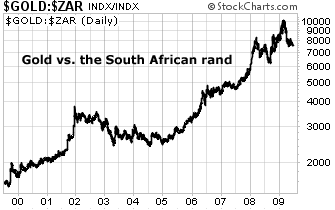
But shall we now see what gold has done in terms of the major currencies of the world?

The South African rand has been the strongest currency so far this year. It is a big gold producer. Yet look the price of an ounce of gold since 2000 in terms of the rand.


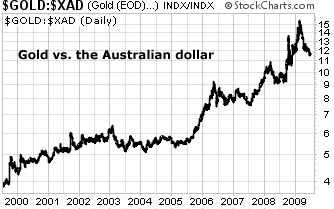
Now let's go to another currency which has risen sharply this year, the Aussie dollar.


You see the pattern. Now, gold has not gone up in value against the Chinese yuan (+200%) as much as it has against the U.S. dollar (+260%). Still as great as the Chinese economy has been over the past decade, as powerful as it has become, gold has still soared in terms of the yuan.

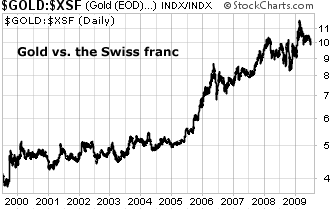
It has soared against the Canadian dollar (+178%), the Russian ruble (+360%), the Mexican peso (+417%), and even the Swiss franc (+155%), a currency that has long been regarded as the strongest on Earth.


You can talk about or trade the merits of one paper currency against the other, but they've all been falling against gold.

Put another way, every person on Earth over the past decade, regardless of where they live, would have made hundreds of percent in terms of their own currency had they just owned gold.

Most people do not hold mostly gold and silver in their portfolios. With this fact, I believe that both have much more to rise before their bull markets are finished. Well into the future we'll see the phenomena of the average person piling in, as happens towards the end of every bull market... We'll see the same action in gold; it's just a matter of time.

This post has been republished from Steve Sjuggerud's blog, Daily Wealth.

Labels:


Thursday, December 24, 2009

Consumer Spending Making A Comeback

Recent personal consumption numbers show that American's propensity for spending has not evaporated although the savings rate has increased slightly. While the economy appears wobbly, the rebound in consumer spending could be a sign that the recovery has legs. See the following post from The Capital Spectator.

Is there no way, said I, of escaping Charybdis, and at the same time keeping Scylla off when she is trying to harm my men?
Homer's Odyssey

We can argue if today’s encouraging numbers on consumer spending and personal income for November are skewed because it’s the holiday season (a.k.a. an excuse-to-spend season). We can also debate if yesterday’s downward revision in third-quarter GDP implies that the recovery will be unusually sluggish. And we can go back and forth over yesterday’s sharp rise in November sales of existing homes on whether that’s due a first-time buyer’s tax credit that expired last month. Of course, we can also throw around some ideas about how much if any of the government's stimulus deserves credit for keeping the country out of the black hole of economics. But for now, the recovery trend in post-apocalyptic America is intact.

Deciding if it’ll remain intact is the great unknown. More than likely this will be a debate over the degree of the recovery’s magnitude and duration. Never say never, but short of a new and unexpected negative of some consequence arriving on the economic scene in the weeks and months ahead, the U.S. recovery has legs. Exactly how wobbly those legs prove to be is the question. But if we step back and look at the broader trend in the statistical front line for economic fate—spending and income—there’s no denying the upward bias, as our chart below shows.


There’s still plenty to worry about, but most of the anxiety is related to how the growth in 2010 plays out. Yes, there's an expansion building, but it's not yet clear it'll suffice for the challenge ahead.

"I think we'll be 'driving sideways' in both the California economy and the U.S. economy," UC Berkeley economist Barry Eichengreen opines today. Meanwhile, Brian Bethune, an economist with IHS Global Insight, predicts the U.S. economy will expand by a modest 2.0% to 2.5% next year. "It's a half-speed recovery."

In other words, there’s some debate about how quickly the labor market will recover. The jobless rate remains at a lofty 10%, the highest in 30 years. In past cycles, the peak in the jobless rate was followed by a sharp and swift decline. Will history repeat? There’s some skepticism this time.

"I'm cautiously optimistic that the unemployment rate won't get a lot worse," Charles Ballard, an economist with Michigan State University, told the Detroit Free Press last week. "That's not the same as saying it'll get dramatically better in coming months. The economy remains pretty weak."

One reason it may stay weak is the growing propensity to save. We should be cautious in assuming too much when it comes to Joe Sixpack’s inclination to renounce his spendthrift ways. Indeed, today’s income and spending report for November is hardly compelling evidence for thinking that the urge to consume has evaporated. But spending habits can and do change, although there’s no reason to think that change will come quickly. Consider the second chart below. Consumers are clearly saving more these days than they were when the Great Recession was just building a head of steam. Last month, personal saving as a percent of income was 4.7%, up sharply from the previous nadir of 0.8% in April 2008.


Saving is neither inherently bad nor good, although it does have economic ramifications depending on the time and context. The paradox of the moment is that America needs more saving to fund its mounting liabilities. Yet the same economy, which is overwhelmingly dependent on consumption, needs spending to bounce back and stay high to keep the rebound rolling and unemployment falling. There are no easy solutions for navigating the tight space between the economic Scylla and Charybdis that awaits. Even worse, evidence of success or failure will come slowly. It’s going to be a long 2010.

But, heck, Christmas is just two days away and it’s already been a long year. For the moment, we’re going to focus on Chart 1 and dream of sugar plums. There’ll be plenty of time to sober up in January.

This post has been republished from James Picerno's blog, The Capital Spectator.

Labels:


Many States Running Out Of Unemployment Funds

25 states have already run out of money for unemployment benefits and many more states are expected to follow in the next couple of years. With a growing number of Americans staying unemployed for more than 26 weeks, the costs to the government will continue to rise. See the following article from Expected Returns.

The ongoing recession has resulted in elevated levels of unemployment, and a dramatic increase in the extension of unemployment benefits- which is proving to be a drain on the budgets of states. There will eventually come a point where states can no longer function without draconian cuts to services. From the Washington Post, Unemployment funds going 'absolutely broke':
The recession's jobless toll is draining unemployment-compensation funds so fast that according to federal projections, 40 state programs will go broke within two years and need $90 billion in loans to keep issuing the benefit checks.

The shortfalls are putting pressure on governments to either raise taxes or shrink the aid payments.

Currently, 25 states have run out of unemployment money and have borrowed $24 billion from the federal government to cover the gaps. By 2011, according to Department of Labor estimates, 40 state funds will have been emptied by the jobless tsunami.
Undoubtedly these projections are overly optimistic. Lets just take California as an example. In the 5 months of this budget year, California is already running $1 billion dollars behind already dire budget projections. Furthermore, tax revenues in November were 12% below estimates. Our economy simply will not recover unless California recovers as well.

Below I have included a chart showing the Employment to Population ratio over the past 10 years. This chart helps to explain why economic conditions are deteriorating at the same time that the unemployment rate is falling. The Employment to Population ratio captures unemployed persons that may not be calculated in the "official" unemployment rate for whatever reason, and therefore, gives a more objective and fuller view of the unemployment picture. The chart below makes it plain that people are relying on the local and federal government to hand them checks.


Unemployment benefits are funded by the payroll tax on employers that is collected at a rate that is supposed to keep the funds solvent. Firms that fire lots of people are supposed to pay higher rates. The federal government pays for administrative costs, and in a recession, it pays for the extension of unemployment benefits beyond 26 weeks. But over the years, the drive to minimize state taxes on employers has reduced the funds to unsustainable levels.
Can the federal government expect a reprieve in the near future from paying extended unemployment benefits to Americans? From the graph below, which shows the number of Americans unemployed for 27 weeks or longer, you can see that the federal government is going to be distributing many more checks to Americans.


States are following our federal government on the road to bankruptcy. Exactly how long can the government continue to hand out checks to people when they facing solvency issues themself? We will soon find out.

This post has been republished from Moses Kim's blog, Expected Returns.

Labels:


Wednesday, December 23, 2009

The Lost Decade For US Stocks

US Stocks were the worst asset class over the past decade with an abysmal 0.1% 10-year annualized total return, the worst performance in 200 years. US Stocks provided lower returns than cash while emerging market stocks returned over 10% and commodities over 7%. See the following post from The Capital Spectator.

The 2000s have been the worst decade for U.S. stocks in 200 years, reports yesterday's Wall Street Journal. Meanwhile, it’s been a somewhat better decade for the Global Market Index, a passively weighted mix of all the major asset classes that's the benchmark for our sister publication, The Beta Investment Report.

There are still two weeks left to 2009 and the decade and so it's not over until it’s over. But barring a massive change in prices in the days ahead, the mystery is fading quickly for year- and decade-end numbers. Using performance through the end of last month, the 10-year annualized total returns for the major asset classes and GMI stack up as follows:


U.S stocks were dead last, returning a trifling 0.1% on an annualized basis for the past 10 years. By contrast, the best performer among the major asset classes has been emerging market bonds, which soared by an 11.5% annualized total return. As for our Global Market Index, it returned 4.2% over the past decade.

GMI’s more or less middling performance isn’t surprising. As a market-weighted asset allocation of all the major asset classes, our index embraces the world’s assets as they are. It is a naïve benchmark of everything, presuming nothing other than the idea that there’s some degree of embedded wisdom in the valuation of assets as collectively assigned by investors.

Did some of us do better? Yes, although some of us did worse. Although this is just a guess, it wouldn’t surprise this observer to learn that more than half of the planet’s efforts to "beat the market" trailed GMI. So it goes. A robust definition of "the market" is a competitive beast over the medium and long term.

Should we give up hope of engineering a better outcome than GMI over time? No, not necessarily. As GMO’s Jeremy Grantham notes in today’s Journal article, "We came into this decade horribly overpriced" in terms of stocks. The message: prospective equity returns a decade ago looked unattractive if not horrible, a point that Grantham and a few other contrarians made at the time.

We can argue if various market clues (dividend yield, volatility trends, yield curves, etc.) about future performance are a sign of market inefficiency or evidence of time-varying expected returns in a reasonably efficient marketplace. The better question: Should we act on this information? If so, when? And under what conditions? Sometimes—sometimes—these clues provide compelling reasons to adjust Mr. Market’s asset allocation.

Unfortunately, the clues aren’t always as clear and potent as they were at the end of the 1990s for stocks, when expected return for equities--U.S. equities in particular--looked unusually low. Peering into the future isn't always so investor friendly. Sometimes, arguably most of the time, the outlook is murky. That's one reason why besting an expansive definition of the market (i.e., GMI) is so difficult for so many of the world's investors over time. Yes, some beat the odds, although not so many as conventional wisdom suggests after adjusting for risk.

The good news is that different asset classes dispense different messages at different times. In other words, a relatively potent signal about future risk and return may be reflected in one or more asset classes at any point in time, which provides a basis for adjusting the passive asset allocation. That was certainly true at the end of 2008 and early this year. The problem is that the outlook for most asset classes is usually a gray area, as it is now. That suggests holding something approximating the passive allocation for that asset class until better information comes along.

Knowing when to hold ‘em, fold ‘em or overweight ‘em is the central challenge in strategic-minded investing. The academic and empirical record in support of managing money along these lines is compelling, as we detail in our upcoming book Dynamic Asset Allocation: Modern Portfolio Theory Updated for the Smart Investor.

Meanwhile, forecasting risk premiums for the major asset classes, GMI and our trio of model portfolios on a monthly basis is the raison d’etre of our monthly subscriber-based newsletter, The Beta Investment Report. Our current forecast for GMI’s risk premium is roughly 2.5%, well above the 0.4% delivered over the past 10 years. (Risk premiums are returns in excess of the risk-free rate, such as the return on a 3-month Treasury bill.) Not surprisingly, our modeling tells us that the component asset classes offer an array of prospective returns above and below our expectation for GMI. Par for the course.

Figuring out which asset class looks compelling, or not, keeps the midnight oil burning in the offices of The Beta Investment Report. Coming up with robust forecasts isn’t easy, nor is it foolproof. Suffering all the usual caveats that bedevil mortal efforts at divining the future, we assume a fair degree of error in our predictions. That said, the road to strategic insight is smoother if we routinely assess the outlook for risk and return cautiously, do so for all the major asset classes through a variety of techniques, and generally remain humble in deviating from GMI's mix until the numbers strongly suggest otherwise.

Accordingly, the fact that U.S. stocks dispensed an dreadful 10-year run is but one piece of a larger strategic puzzle. The more valuable perspective begins by recognizing that a passive allocation to everything is likely to continue dispensing middling levels of return and risk in the years ahead. That’s hardly a silver bullet, but it’s a solid foundation for analyzing markets, developing some intuition about future risk premiums and deciding what looks compelling, and not so compelling, for second-guessing Mr. Market’s asset allocation.

This post has been republished from James Picerno's blog, The Capital Spectator.


Gold Bubble Or Typical Bull Market?

The recent price correction in gold has created some to warn of a gold bubble that is ready to collapse. However a look at historical data makes the latest gold run look rather mild in comparison. Moses Kim makes a case for why the potential of gold greatly outweighs the risks. See the following post from Expected Returns for more on this.

As expected, gold bears led by the likes of Bob Prechter are calling for the imminent collapse of gold. Lets forget for a moment that the deflationists have been wrong about gold for the better part of this decade, and try to assess whether gold is indeed overstretched at these levels.

Below is a chart courtesy of golddrivers.com that shows the inflation-adjusted price of gold as per the CPI figures from shadowstats.com. John Williams at shadowstats.com calculates CPI figures using the old methodology, which is before the government started using statistical gimmicks like hedonics and substitution. As you can see, relative to the price of real goods, gold is still historically cheap. This looks nothing like a bubble to me.


Below is a 3-year chart of gold, which will give you an idea of the volatility this market often brings. While this correction may seem abrupt and brutal in the short run, it is mere noise in the context of this bull market. When all is said and done, this correction will look mighty trivial. I can tell you this much: many people will be kicking themselves for not buying into this correction and expecting a "collapse" in gold prices.


Anyone who looks at the chart above and tells me this looks like a blow-off top should not be investing lest they lose all their money. Since when do bubbles not bring record high prices in the underlying equities? If you ask me, this is the strangest "bubble" I've ever seen. Never before have I seen a bubble without public participation. Never before have I seen a bubble when the mainstream was screaming from the rooftops that it was a bubble. Believe me, those who are accumulating physical gold and gold shares love it every time someone publicly proclaims gold to be a bubble.

Gold is going to $2,000 an ounce as long as we have clowns like Helicopter Ben Bernanke dictating monetary policy. There is so much disbelief in the gold story only because people do not know their history. There have always been times in history, all the way back to when fiat money was first created in China, when people were supremely confident in the merits of paper money. Every single time that misguided confidence was shattered in a heartbeat. If you think this time will be different and that paper money will retain its value, then you are playing a dangerous game based on a premise that goes against all of human history.

Let me put it this way for rational-minded folks. My argument is structured along the lines of Pascal's wager and has nothing to do with supply, demand, or monetary policy. Basically, the downside risks to owning some gold in the event that fiat currencies don't collapse are far outweighed by the downside risks of owning no gold in the case of a fiat currency collapse. Why would any rational-minded individual accept such assymetric risks with what amounts to their livelihood? I don't know about you, but I'm proactively protecting myself from the foolishness of government officials who have thrown all prudence out the window and are leading us into the abyss.

This post has been republished from Moses Kim's blog, Expected Returns.

Labels:


Tuesday, December 22, 2009

Could Surge In Temp Workers Lead To Jobs Improvement?

Moses Kim discusses the possibility that the surge in temp workers might be a precursor to growth in the market for desperately needed permanent jobs. It could also be a false prophet as temp workers are often cheaper alternatives for employers and are the easiest to eliminate from their payroll. See the following post from Expected Returns.

From the New York Times, Labor Data Shows Surge in Hiring of Temp Workers:
The hiring of temporary workers has surged, suggesting that the nation’s employers might soon take the next step, bringing on permanent workers, if they can just convince themselves that the upturn in the economy will be sustained.

As demand rose after the last two recessions, in the early 1990s and in 2001, employers moved more quickly. They added temps for only two or three months before stepping up the hiring of permanent workers. Now temp hiring has risen for four months, the economy is growing, and still corporate managers have been reluctant to shift to hiring permanent workers, relying instead on temps and other casual labor easily shed if demand slows again.
Temp hiring has risen the last 4 months, which is a positive sign. However, companies do add to their work force during the holiday season due to seasonal factors. If labor conditions were truly strong, we would see a rise in the hiring of permanent workers, which we just aren't seeing yet.

Here's a visual representation of the increase in temporary work. As you can see, the increase in temp work isn't that considerable in the grand scheme of things. Quite simply, the increase in temp work has been a long-term trend as companies do anything to increase their bottom-line

Government Statistical Games

The rising employment of temp workers is not all bad. However uncertain their status, they do count in government statistics as wage-earning workers, adding to the employment rolls and helping to bring down the monthly job loss to just 11,000 in November. Indeed, the unemployment rate fell in 36 states in November, the Bureau of Labor Statistics reported last week, partly because of the growing use of temps.

The bureau, which issues the monthly employment reports, does not distinguish between permanent and casual employment, with one exception: it has a special category for temp workers, the men and women supplied by Manpower, Kelly Services, Adecco and other agencies.

Last month 52,000 temps were added, greater than the number of new workers in any other category. Not even health care and government, stalwarts through the long recession, did better.

The example above is telling in the way our government can manipulate government statistics. There is an obvious qualitative difference between temp work and permanent employment, but that distinction is not made by our government. Temporary workers do not enjoy benefits such as defined benefit plans, which is a huge issue moving forward.

The move away from defined benefit plans (pensions) to defined contribution plans (401k's), along with the shortfall in Social Security, will result in a mass of Baby Boomers working into old age. Considering the fact that we have just come out of the worst decade for stocks in quite some time, Baby Boomers who have relied on their 401k's to retire are in for a world of pain.

From Temp to Out-of-Work

“An actual employee with benefits costs more than a temp or a contract worker,” Ms. Baker said, “and as long as I can still get highly skilled temps, I’ll go that route. It gives me more room to reverse course if the economy weakens again and sales do finally sink.”

Given the nature of the upturn, that could happen. After 18 months of contraction, the economy expanded from July through September at a 2.8 percent annual rate, and many economists expect the expansion to be even stronger in the fourth quarter, approaching 4 percent. The rebound is robust mainly because of a “turnaround in inventory policies from breakneck liquidation to slow accumulation,” Mr. Wojnilower said.

If this restocking of shelves and warehouses were to stop or slow next year, a possibility that concerns Mr. Littlefield and Ms. Baker, then the temps, freelancers and contract workers they and many other employers now use would have a harder time moving from casual to regular employment.
The increase in temp hirings can easily backfire and cause another spike in unemployment, since temporary workers are the most vulnerable to layoffs. I believe we will experience another dip down in the economy in 2010, which will be reflected by an increase in unemployment. Expectations of a V-shaped economic recovery are overly optimistic since we have yet to address the fundamental problem, which is debt. 2010 will be a very interesting year since it coincides with an election, which means our government officials will do anything to forestall an economic collapse, including massive stimulus measures that will drive the dollar to new lows.

This post has been republished from
Moses Kim's blog, Expected Returns.

Labels:


Banks Impeding Growth By Limiting Loans

Despite the Fed creating vast amounts of liquidity, the banks are impeding the flow of the money to consumers and businesses by holding onto their money to rebuild their balance sheets. Starved of cash, businesses will unable to hire new workers and expand production. See the following post from The Capital Spectator for more on this.

There are many things to worry about for the economy in 2010, but perhaps the leading cause of anxiety is bank lending, or the diminishing state thereof.

Commercial and industrial loans made by U.S. commercial banks fell in November to the $1.36 trillion, the lowest since September 2007, reports the Federal Reserve. This isn't surprising after the large negative economic shock over the past two years, but it's troubling nonetheless.


The Federal Reserve can print all the money it wants, but if the liquidity isn't finding its way into the coffers of businesses, the recovery will suffer. Financial institutions, of course, are only too happy to accept the central bank's monetary gifts of late. Nothing makes a banker smile more than a world where he can borrow short and lend long. But while there's a whole lot of borrowing short going on, there's a dearth of lending. What are they doing with the money? For reasons that need no explanation at this point, banks have been focused on rebuilding their balance sheets.

The four largest banks in the U.S., for instance, reduced loans by 15%, or $100 billion since April, according to analysis of government data released earlier this week, reports The Huffington Post.

Bank lending is a lagging indicator and so we should expect to see lending levels decline at this point in the business cycle, or so history suggests. Richard Yamarone's The Trader's Guide to Key Economic Indicators notes that C&I loans tend to "bottom out more than a year after the end of a recession."

If we're optimistic and assume that the recession ended sometime in the summer, that implies that bank lending will continue to fall through the first half of 2010. That's a long time to wait for an economy that's struggling to mount a recovery in the wake of the deepest economic retreat since the Great Depression. Bank loans are critical for juicing business growth, which in turn helps the labor market expand. The latter is essential for an economy that's lost more than 7 million jobs over the last two years and continues to shed workers (of last month).

The good news is that there appear to be signs that the descent of C&I loans is slowing. As our second chart below illustrates, last month's 1.2% drop in lending was roughly half as deep as the 2%-plus pace that prevailed in each of the previous three months.


It's too early to say if C&I loans have hit bottom, but for the moment there's at least reason to hope. That's doesn't mean that lending will quickly soar. The ranks of qualified corporate borrowers have thinned. Meanwhile, banks continue to look for any excuse to hold on to their cash. Lending has remained frozen to the point that the President earlier this week asked bankers to consider "every responsible way" to boost loans.

Talk is cheap, of course, and so are loans. But for the moment, talk is all we have, and some hope that the trend has finally turned.

This post has been republished from James Picerno's blog, The Capital Spectator.

Labels:


Monday, December 21, 2009

Gold Versus Chocolate: Which Is A Better Investment?

With the Federal Reserve dramatically increasing their balance sheet Porter Stansberry suggests that investors prepare for the coming inflation. Commodities like gold and chocolate are good ways to protect against inflation as the following post from Daily Wealth explains.

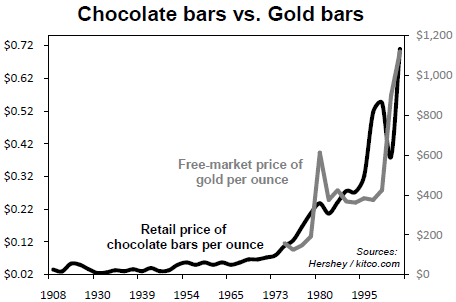
Which asset do you think is a better hedge against inflation – gold or chocolate bars?

Since I'm asking, you can probably guess it must be chocolate bars. But how sure are you? Would you be willing to bet $1,000 on your answer?

I would. I did the math.

Franklin Delano Roosevelt signed Executive Order 6102 into law on April 5, 1933. The order forbade the private ownership of gold (which was labeled "hoarding") by all U.S. citizens. Americans had until midnight on May 1, 1933 (the Communist's "May Day"), to turn in their gold bullion to the Federal Reserve. They were paid $20.67 per ounce for their gold. Ignoring the order was punishable by a fine of up to $10,000 and 10 years in prison.

Interestingly, the president derived his authority for the order from the 1917 Trading with the Enemy Act, which Congress passed to give the government the power to sanction citizens who were supporting Germany in World War I. (Keep that in mind the next time you consider supporting any effort to expand the government's authority during a war. You never know what it will do with the power when the war is over... but you know it won't give it up.)

The Gold Reserve Act of 1934 amended Executive Order 6102 to make gold clauses in contracts unenforceable and fix the value of gold to $35 per ounce. What the government had seized the year before – offering only $20.67 in compensation – was now worth $35. Law-abiding citizens turned in a little more than 500 metric tonnes of gold (16,075,373.18 troy ounces). These people were robbed of at least $14.33 per ounce of gold, a theft of more than $230 million.

Congress repealed the limitation on private gold ownership in 1974, and Gerald Ford signed the bill into law on December 31. Beginning in January 1975, Americans could buy and own gold bullion again.

This history is important to know because the market for gold was so tightly regulated during these 42 years that the market prices of gold aren't reliable. If you're studying the free-market price action of gold, you have to wait until 1975 for a true free market in gold bullion to return to the United States.

In January 1975, gold traded for $175 per ounce. The price of a one-ounce chocolate bar was $0.15. Today, the price of gold is roughly $1,100 per ounce, an increase of 603%. A one-ounce chocolate bar goes for about $1.15, an increase of 633%. Either asset would have protected you against the Federal Reserve. However, chocolate bars – at least their retail price – have slightly outperformed gold for the period.


Now consider this... The world's top chocolate-bar maker has vastly outperformed gold – and nearly every other possible investment. Buying shares of Hershey would have earned you more than 7,000% on your money from 1980 until today – better than 15% per year, assuming you reinvested the dividends.

Hershey is the sort of company I think every investor should own over the coming years. If you've read any of my commentary over the past year, you know I expect the huge expansion in the Federal Reserve's balance sheet to cause inflation soon. This inflation will wipe out the unprepared.

To get prepared, I recommend you buy gold and silver. These two will soar as the dollar crumbles under the U.S. government's crushing debt load. I also recommend you own companies that make for quintessential Warren Buffett investments, like Hershey, Coke, Kraft, and Nestle. These companies possess what Buffett calls "economic goodwill." It's one of the great secrets of rich investors... one that will protect you from inflation (read Buffett's 1983 letter to shareholders for a full expiation).

Businesses with lots of economic goodwill have strong consumer franchises. They use their brand loyalty to continually raise prices as input costs rise (folks think of "Coke" when they hear soda, they think "Hershey" when they hear chocolate).

This brand loyalty allows them to generate high returns on capital with little additional ongoing investment. They can raise prices as needed. Higher prices translate into more money returned to shareholders... for years and years.

In a recent New York Times op-ed, Buffett warned about inflation. He, like me, noted the government is going to have to finance its debts with printed money. He's preparing for this inflation with stocks like Hershey. You should, too.

This post has been republished from Steve Sjuggerud's blog, Daily Wealth.

Labels:


Gold Correction May Signal Golden Opportunity

Moses Kim discusses why he is confident that gold is a good investment right now after a price correction has wiped out a lot of the bullishness in the precious metal. While gold may stay at the $1,100 level for a while, Kim considers a spike to the $1,500 level as a feasible outcome. See the following post from Expected Returns.

The last 2 weeks have shown just how violent corrections in gold can be. Most of the momentum driven investors and weak hands have already been liquidated. Most, but not all, of the bullishness in gold has been wiped out. While the correction may still have some more legs, I believe it is time for long-term investors to buy into this correction.

Gold is very close to violating the multi-month trendline that has served as solid support. The confluence of 3 technical indicators: the multi-month trendline, 50 day moving average, and fibonacci retracement level, make $1,100 a very important level. If $1,100 is broken, I would look to $1,070 as near-term support, which corresponds with the 50% retracement level.


Ideally I would like to see gold hover above the $1,100 level while the dollar works off some of its oversold conditions. The longer the period of consolidation, the better, as it will allow me to continue to accumulate before the next blast off to higher prices.

This bull market has been characterized by prolonged periods of consolidation, followed by huge spikes up. The last consolidation was at the $900 level, bringing gold prices all the way up to $1,226. If gold can maintain the $1,100 level for the next couple of weeks or so, a spike to $1,500 is not out of the question. At $1,500, euphoria from the mainstream is likely to return, which means it will be time to lighten up again.

Now that Helicopter Ben Bernanke has been reappointed as Fed Chairman, the conditions for much higher inflation are in place. Even without inflationary pressures, a bond default would be sufficient to send gold prices flying. When treasuries collapse, what do you think the "safe haven" will be? In my opinion, the $1,100 level is one you have to buy at if you believe in the gold thesis.

Trading Plan

I plan to continue buying at key support levels and using the volatilty in gold prices to lock in profits. I will likely stop trading on a shorter-term time frame and start adding positions with more long-term conviction above the $1,140-$1,150 level. Core positions will be left untouched.

This post has been republished from Moses Kim's blog, Expected Returns.

Labels:


Friday, December 18, 2009

Should Homeowners Honor Underwater Mortgage Obligations?

A study from the University of Arizona examines the forces that are causing homeowners to act against their own self interest by continuing to make mortgage payments on homes that have lost a large percentage of value. Tim Iacono discusses how the government has encouraged homeowners to fulfill their obligations while bankers routinely walk away from theirs. See the following post from The Mess That Greenspan Made.

The question of what motivates underwater homeowners to either stay put and continue to make their mortgage payments (if they can) or "walk away" from their home (and their financial obligations) has been receiving an increasing amount of attention in recent weeks.

In looking at this matter, a good place to begin is with the abstract below from the recent study Underwater and Not Walking Away(.pdf) by Brent White at the University of Arizona:
Contrary to reports that homeowners are increasingly “walking away” from their mortgages, most homeowners continue to make their payments even when they are significantly underwater. This article suggests that most homeowners do not strategically default as a result of two emotional forces: 1) the desire to avoid the shame and guilt of foreclosure; and 2) exaggerated anxiety over foreclosure’s perceived consequences. Moreover, these emotional constraints are actively cultivated by the government and other social control agents in order to induce homeowners to ignore market and legal norms under which strategic default might not only be a viable option, but also the wisest financial decision. Unlike lenders, individual homeowners have thus generally not acted to minimize their losses and have born a disproportionate share of the burden from the housing collapse.
Brent probably has more than enough sample data in Arizona from which to draw and his conclusions are no doubt valid in many other parts of the country as well where the magnitude of the current "underwater homeowner" problem is highly correlated to the size of the mid-decade housing bubble.

But, what is most fascinating about this report is the aspect of "emotional constraints" that are "actively cultivated by the government and other social control agents". Apparently, this has played a major role in getting underwater homeowners to act (or, in this case, not act) in ways that work against their own financial interests.

In the report, White noted comments by the former Treasury Secretary on one of the hottest housing market topics of the day - strategic defaults:
The worst criticism has been reserved, however, for those who would walk away from mortgages that they can afford. Typical of such criticism is that of Secretary of the Treasury Henry Paulson, who declared in a televised speech: “And let me emphasize, any homeowner who can afford his mortgage payment but chooses to walk away from an underwater property is simply a speculator – and one who is not honoring his obligations.”
It seems there is a national movement afoot to divert homeowners' attention away from the degree to which they are underwater on their mortgage and focus on monthly payments, that being the thrust of the recent Making Home Affordable government program to slash interest rates while leaving the outstanding debt intact.

To this point, we have lived in a country where the "What's my monthly payment?" culture has thrived, but that seems to be changing and the question that more and more underwater homeowners are now asking is, "If banks can walk away from their obligations, why can't I?"

This is occurring with increasing frequency, Bloomberg reporting just this morning that Morgan Stanley will "relinquish" five San Francisco office buildings after having purchased them more than two years ago near the top of the market. It's probably no coincidence that the phrase "walking away" is noticeably absent from their account when, in fact, that is exactly what the investment bank is doing.

Maybe the rules are different for big banks than for homeowners.

You'd surely think that this is the case after reading part of this story in today's Wall Street Journal, one in a series of excellent reports in the Journal in recent weeks about "strategic defaults" where the morality issue is neatly captured:
A standard mortgage-loan document reads, "I promise to pay" the amount borrowed plus interest, and some people say that promise should remain good even if it is no longer convenient.

George Brenkert, a professor of business ethics at Georgetown University, says borrowers who can pay -- and weren't deceived by the lender about the nature of the loan -- have a moral responsibility to keep paying. It would be disastrous for the economy if Americans concluded they were free to walk away from such commitments, he says.
What banks have done in recent years has not been a disaster?

And Wall Street firms can walk away from their "obligations" but ordinary Americans can't?

That sort of thinking should be about as popular as Wall Street bonuses right about now.

While simple laziness is surely a big reason why most homeowners will continue to pay $3,500 a month (if they can) for a house that is worth $200,000 less than what they owe instead of sending the keys back to the bank and renting a house down the street for about half the monthly payment, there is clearly a very big moral issue here, one that continues to surprise me every time I run across it.

No stranger to the idea of acting in one's own self interest when it comes to real estate (as detailed here, my wife and I did a short sale back in 1995 when the previous California housing bubble went bust), it does continue to amaze me that, in light of some of the most wretched financial market excesses in history, many homeowners continue to think that we live in a world full of Jimmy Stewart-like bankers instead of those populated with the likes of Hank Paulson and Lloyd Blankfein.

It seems that one homeowner's morality is another homeowner's naïveté, that is, unless the latter truly believe that "the meek shall inherit the earth".

We are, by far, the most religious of all western nations, but the idea of somehow being rewarded in the afterlife for continuing to make mortgage payments to Bank of America is beyond my ability to comprehend.

In a place like California, the terms of the deal are quite clear - the bank either gets the monthly mortgage payments until the loan is paid in full or it gets the house back with very few strings attached. And while the word "promise" appearing in the loan documents may prove too much for some borrowers to surmount, it is clearly not a legal impediment.

Without question, many underwater homeowners are acting against their own self interest by continuing to pay their mortgage if other dramatically less expensive housing arrangements can be made.

One could wait for home values to recoup a $200,000 decline, betting on an even bigger housing bubble materializing someday, all the while making good on the monthly mortgage obligations, but that may take much longer than you think and, in the end, it is sure to be much more costly than you could imagine.

Now, there's a big distinction to be drawn here between, say, the just-married couple who bought a house at the top of the market because that's what people do (that's what we did 20 years ago) and your run-of-the-mill wild-eyed housing speculator circa 2005 who managed to amass a large real estate portfolio without ever having earned a high school diploma.

It's not clear if there is any sympathy anywhere for the latter, but too few seem to see any distinction between the two to the detriment of the non-speculator who seems to go on believing that, today, "if you can continue to pay, you shouldn't walk away".

So, where does this all bring us?

A shocking decline in naïveté or, if you prefer, more immoral behavior on the part of the American public regarding their underwater mortgages may be one of the more important developments for the housing market over the next year or two.

This post has been republished from Tim Iacono's blog, The Mess That Greenspan Made.

Labels:


Learning From The Mistakes Of The Dubai Bust

Ronan McMahon discusses the rampant speculation of the Dubai housing bubble that ignored the fundamentals of real estate. Some investors were so caught up in the irrational exuberance that they didn't stop to think about whether people would actually want to rent their properties. See the following post from Pathfinder International for more on this.

I never quite got Dubai. I haven’t been…but I never understood how it could make sense for us real estate investors. I’ve been pitched real estate opportunities in Dubai more times than I care to remember. I never took real estate in Dubai seriously, viewing it as a curiosity. I always sought out the Dubai booths at real estate exhibitions. They were usually entertaining and completely surreal.

Dubai was full of “cool” things…like golf in 120- degree heat, or skiing in a shopping mall. How could we resist? It made sense that Dubai would be Las Vegas, Wall Street and your dream beach resort rolled into one. Didn’t it?

Not once during these pitches did I get a rational case for why I should part with my money. The argument (delivered by a cartoonish used-car salesman character) was always the same. Prices rose by 25% in the last six months, and prices in one project or another were increasing by 15% the next day. Oh…and David Beckham and half the English soccer team have houses here. Of course, this was all made up, and the celebrity names associated with Dubai were paid ambassadors.

There never was a real market…speculators just bought pieces of paper (pre-construction contracts) in the expectation that they could find a bigger fool down the track. 100,000 people from the UK and Ireland alone bought real estate here. Where were all the people who would live in these shiny new condos going to come from? The frenzied crowds of buyers, however, never stopped to ask. They were blinded by greed.

Now, according to The London Times, close on 400 building projects with an expected development value of more than $300bn have stalled. They report that property prices have tumbled by around 60%. A price fall of 60% understates what I hear from contacts. I’ve heard anecdotes of people selling for as little as 20% of the original price of their property. There is no market, so to sell a property you almost have to give it away.

Expats are driving to the airport, abandoning their cars, and getting on the first plane out of the country. Many have lost their jobs…selling shiny new condos, or selling cocktails and champagne to the condo salesmen. In Dubai, if your rent check bounces, you will be locked up in jail. Missing a rent, mortgage or other payment is serious business here. So many are simply leaving Dubai.

Dubai is now in default. Despite repeated assurances that everything was ok, Dubai has now said that they need more time to pay back the folks who have lent then money. Truth is this doesn’t matter a hoot for the real estate market there. It’s been dead and gone for the past 18 months. This will just be the final nail in the coffin.

The lesson we need to take from all this is a timely reminder that we always need to understand who the end user for a piece of real estate will be. If you are buying pre-construction, who will rent or buy your unit from you on completion? How much competition will you have with other vendors or landlords? How will demand measure up with supply?

In the case of Dubai, the question was whether they could build a major financial and tourism/second home destination from the sands of this tiny emirate. I never understood why someone would want to spend time there. There are much nicer places to golf, ski, lie on the beach or go shopping. Dubai just never made sense to me.

Those who applied these most basic of rules could see that there never was a market for all these shiny new condos…that there was never a true real estate market. There was only the hope of finding a bigger fool. Now even that is gone.

This post has been republished from Pathfinder International, an international real estate analysis site.

Labels:


Home

© 2011 NuWire Investor and NuWire, Inc. All Rights Reserved.