Friday, October 30, 2009

Famous Investor Says Gold Could Reach $5,000

John Paulson, who is known as one of the greatest hedge-fund managers of all time and has been called "The Man Who Made Too Much" after making billions betting against mortgage-backed securities is bullish on gold. Paulson said that gold could rise to $5,000 due to the devaluation of paper currencies. Chris Mayer from Daily Wealth discusses this in the following article.

The U.S. dollar is a sort of monetary brand.

And like any other brand, it can fall out of favor. Even iconic brands can rapidly lose their "must-have" cachet. Sometimes, a brand can disappear entirely, as did Pan American Airways or "Members Only" jackets. But there is always something else waiting to take its place. So it is with the U.S. dollar, a brand making lows in the financial markets.

The dollar has been the "Coca-Cola of monetary brands," says James Grant, editor of Grant's Interest Rate Observer. But even the best of brands can be lousy investments. Grant uses the analogy of the New York Times. It was the greatest name in newspapers. In 2002, the stock sold for $53 per share – an all-time high, as it turned out. Today, the "Gray Lady" fetches only $8 per share.

"What happened?" Grant asked. The World Wide Web happened, he says. "The Times has hundreds of reporters, but this is a story they seem to have missed." As if the lowly stock price was not evidence enough of its decline, the NY Times got another reminder when it borrowed $225 million against its headquarters building.

The cost of such borrowing, Grant reports, was 14%. The august Times today borrows at rates no better than a working-class stiff at a pawnshop. The U.S. Treasury should take note. The government seems as intent on creating dollars as prolifically as bunnies create other bunnies.

Here we get to John Paulson, a presenter at the Grant's Fall Investment Conference and undoubtedly the richest man in the room. Portfolio magazine dubbed him "The Man Who Made Too Much" after he made $3.7 billion by betting against mortgage-backed securities (MBS). He is one of the greatest hedge-fund managers ever.

Gold is his favorite today. As to why, Paulson presented a simple, but compelling case. First, the monetary base has exploded in a way we've never seen before. The monetary base is essentially the Federal Reserve Bank's currency and reserves. The Fed, by buying up securities in this crisis, has pumped a lot of money into the economy.
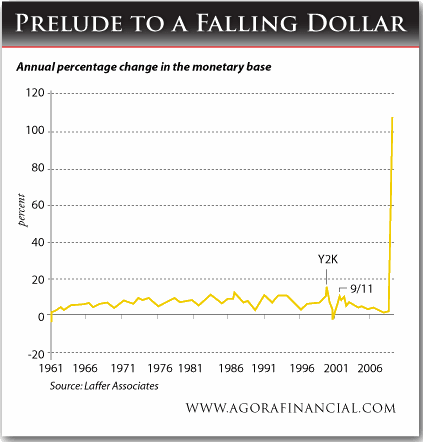


You've probably seen this chart, or some variation of it. Still, there haven't been noticeable signs of inflation as a result of that big spike – not yet.

As Paulson explained, that's because this base money has not yet been lent out and multiplied throughout the economy. Yet the monetary base and money supply are highly correlated, "almost 1-to-1 between the two," Paulson said.

That means that as the monetary base expands, the money supply surely follows, though there is a lag. (Money supply is a broader measure of money than just the monetary base, as it includes personal deposits and more. The monetary base is like a kind of monetary yeast. It makes money supply rise.)

If money supply grows faster than the economy, that will create inflation, says Paulson. As it is impossible for the economy to grow anywhere near that vertical spike in the monetary base, Paulson contends inflation is coming.

The U.S. is not alone in its money-printing exercise. The supply of most currencies is expanding rapidly – even the normally tame Swiss franc. In the race of paper currencies, they are all dogs. Hence Paulson's interest in gold, which no government can make on a whim.

Therefore, in the content of the exploding monetary base, gold seems relatively cheap. In other words, as the money supply rises, so does the price of gold, eventually. As a result, says Paulson, "gold has been a perfect hedge against inflation."

There is some slippage over time. The gold price can change faster or slower than the money supply. But when the market gets worried about inflation, the gold price usually changes much faster – as happened in the 1970s. In 1973 – to pick a typical year – inflation was 9% and gold rose 67%. That was a pattern common in the 1970s.

The potential for inflation this time around is greater than it was in the 1970s, given that the growth in the monetary base is so much greater than it was in the 1970s. Gold could do much better this time around, reaching "$3,000 or $4,000, or $5,000 per ounce" as Paulson said.

Future historians will look back at the present day and see clearly how this unfolded. They will see the litany of news items that pointed to the dollar losing its top perch: China and Brazil are settling up trade in their own currencies. The Russians and others are openly calling for a new monetary standard. Even mainstream outlets are discussing alternatives to a dollar-based standard, a province once solely occupied by cranks and gold bugs. Not a week goes by without these kinds of stories.

As for a replacement waiting in the wings, Grant offers up gold. Indeed, a kind of "de facto gold standard" seems to be taking shape. The SPDR Gold Trust, the largest gold-backed security in the world, is now the sixth largest holder of the metal in the world. Anybody with a brokerage account can easily buy gold today through the trust, which trades on the NYSE under the ticker GLD.

It's still early. Most people still own no or very little gold. As it becomes clearer what's happening, they will buy more gold, especially as it is now easy to do so.

The gold supply, too, is limited against the vast pool of dollars. As Paulson points out, global money supply is 72 times the value of gold. I'm betting that gap will narrow. It only has to narrow a smidgen and the gold price flies.

As Grant eloquently put it: "Gold is a speculation. But it is a speculation on a certainty: the debasement of the currency." Gold stocks, too, are a speculation. But they are a speculation on an inevitably higher gold price.

This post has been republished from Daily Wealth.

How The Economy Grew By 3.5% In The Third Quarter

There is reason to think that everything might be okay after all, as third quarter GDP numbers revealed the first time the economy has expanded in a year. All areas of consumer spending showed healthy growth, and although there are a number of caveats, this news is no small feat. James Picerno discusses how it unfolded in the following post from The Capital Spectator.

It's official: the U.S. economy expanded by 3.5% in the third quarter, the Bureau of Economic Analysis reports today. Encouraging as that is, it's neither a surprise nor anything near to closure for the financial and economic hurricane of the last year or so. But it is a step in the right direction, albeit a tentative and not-yet fully confirming step that the walk ahead will be equally brisk.

Nonetheless, good news is worthy of celebration at this point, if only for a moment. After four straight quarters of retreat, a gain in GDP is no trivial change. All the more so when we dive into the numbers and learn that the expansion was broad based. All the major categories that factor into the final GDP calculation posted healthy gains in Q3. That is, personal consumption expenditures, gross private domestic investment, exports and government spending were higher during the three months through September. That compares with red ink on those ledgers in past quarters, save for government spending and a mild rise in consumer spending in Q1 2009.

Otherwise, this is the first time in more than a year (or two, depending on your perspective) since the GDP report showed unambiguous growth across the board. If there's a single report that confirms that the economy has dodged a bullet—i.e., avoided a deeper, prolonged contraction—today's update is it. Thanks largely to Bernanke's Fed, the central bank's great mistake in the 1930s—keeping monetary policy too tight after the economic slump—has been avoided this time. GDP's Q3 report tells us so in no uncertain terms.

Indeed, it's no small trick to elevate consumer spending in the wake of the deepest economic recession since the Great Depression. And yet the numbers in our table below show that Joe Sixpack has been pulling out his wallet and spending across the board. This is no free lunch, of course, and so there'll be a price to pay for juicing consumer spending at a time of mounting debts and default. But the bigger risk, albeit temporary risk, was allowing spending generally to seize up. We've avoided that trap, at least for the moment, although we fear that we've traded an large acute problem for a modest chronic one that lingers.


In short, there are caveats lurking behind today's sunny GDP report. Many caveats. For now, we'll simply note one. The jump in durable goods, for instance, was assisted in no small way by the government's cash-for-clunkers stimulus program that boosted (or seemed to boost) auto purchases in recent months. That was a one-shot deal, of course, and it's not clear that the additional spending generated by the plan didn't simply transfer future spending activity into the present. Indeed, a report by Edmunds.com, via The Christian Science Monitor, charges that the cash-for-clunkers program gave money to consumers who would have bought a car regardless of the government's efforts.

The fact that the Fed has been effectively giving money away for much of the past year, combined with various fiscal stimulus efforts, insured that liquidity would be spilling over into every nook and cranny of the economy. Some of this liquidity was destined to show up as new consumption. If you print it, they'll spend it, at least some of it.

Helping the process along has been the snapback effect. Early in 2009, the economy was going to do one of two things: collapse or bounce back. The Fed's efforts helped tip the scale by more than a little to the latter, and we continue to see the effects. Indeed, the clues leading up to today's news of GDP's Q3 rise have been bubbling for some time, as we've been noting for months, including here.

But the snapback effect has limited reach, as do the government's various stimulus efforts. The true judge of the post-apocalyptic world of last autumn can't be judged—shouldn't be judged—by the Q3 GDP report alone. Yes, we've learned the lesson of how to manage monetary affairs in the immediate aftermath of a severe financial crises/recessions. But the lessons, and the solutions, for the period beyond that early post-crash period remain much more of a gray area with less-obvious policy responses, if any.

We're now moving into uncharted territory. Yes, we've arguably laid a foundation to provide the economy with a fighting chance of maintaining stability. Fostering growth, on the other hand, remains a challenge of some magnitude, with no easy answers, as the ongoing slump in the labor market reminds. Part of the problem is that there are so few periods to study in recent history. Japan in the 1990s and the U.S. in the 1930s are the main precedents, and neither offers compelling insights beyond the immediate snapback period.

Regardless, the U.S. economy faces a number of challenges, few of which are of the garden variety, starting with debt. Another is the labor market, which was showing signs of strain well before last year's debacle. As we pointed out earlier this month, the labor market rebound following recessions over the past 25 years has been increasingly mild. Given the context this time around, there's little reason to think the trend will abate. If anything, it seems likely to accelerate.

So, yes, let's cheer today's GDP report. But let's reserve judgment on whether we won the war or merely survived the first battle.

This post has been republished from James Picerno's blog, The Capital Spectator.

Thursday, October 29, 2009

New Real Estate Sales Flatline

Sales of new homes hit a wall in September and now sit at an annual rate of 402,000, a record low when adjusted for population. This is hard to swallow for home builders who can't move inventory and see a massive wave of bank-owned homes on the horizon. See the following post from The Mess That Greenspan Made.

"Flatline" appears to be the operative word for the homebuilding industry these days as sales levels remain near historic lows amid fierce competition from banks where the supply of distressed sales coming onto the market continues unabated.


The Census Bureau reported(.pdf) that new home sales unexpectedly declined last month, from a downwardly revised annual rate of 417,000 in August to 402,000 in September.

On a year-over-year basis, sales were down 7.8 percent and, from the peak of the residential construction boom back in mid-2005, sales are down 71.1 percent.

More importantly, current levels of home construction and sales remain near historically low levels, first reached in January of this year, and this bodes ill for a sustainable economic recovery where residential construction normally plays a major role.

Last week's report on housing starts showed a similar trend in recent months.

As noted here many months ago when all-time record lows were first being made, in population-adjusted terms, the current housing downturn is without precedent. The pre-2009 all-time low of 338,000 in September of 1981 works out to a population-adjusted rate of about 460,000 today, meaning that, even after the improvement of recent months, new home sales would have to rise another 15 percent just to get back to the previous record low!

While there has clearly been improvement in new home sales in recent months, recent increases are akin to your favorite 2000 technology stock rising 8 or 10 percent during a few months in 2001 after plunging 80 percent in 2000.

Inventory remained at a 7.5 months supply in September, down significantly from earlier this year but still about 50 percent higher than normal, and the total of 251,000 unsold new homes is the lowest in 27 years, a confirmation of just how low current sales levels are.

It looks to be a long and difficult road to recovery for the homebuilders, particularly in light of the expected waves of foreclosures that are expected to come in the next year.

This post has been republished from Tim Iacono's blog, The Mess That Greenspan Made.

Can Housing Be Fixed Without Jobs?

An end to the first time home-buyer tax credit could result in a decline in the housing market, experts warn. However, can we expect a sustainable recovery in housing by using temporary measures rather than creating more jobs? See the following post from Expected Returns.

From Bloomberg, U.S. Economy: New home sales drop as end of tax credit looms:

Sales of new U.S. homes unexpectedly fell in September as the end of a tax credit for first-time homebuyers approached, highlighting the importance of government aid to the emerging economic recovery.

Purchases dropped 3.6 percent to a 402,000 annual pace that was lower than the most pessimistic economist’s, according to Commerce Department figures issued today in Washington. Other data showed orders fo climbed 1 percent in September, the fourth gain in the last six months.

The drop in sales “does raise some questions about where the housing market is going to be in six months, arguably without any more support,” said Michael Feroli, an economist at JPMorgan Chase & Co. in New York. “Whatever you think about the economy, it’s not going to be a straight line” toward recovery.

Are people still calling a bottom to this market? This is a sneak peek of what is going to happen once the government removes props from housing. Housing sales are still down year over year, and we're supposed to be in recovery mode. The ultimate driver of housing will be jobs, which we're still shedding, and lower housing prices, which the government won't allow to happen.

Tax Credits + MBS Purchases

“Much of the strength in the economy is due to temporary factors such as fiscal stimulus initiatives like the home- buyers credit,” said Dana Saporta, an economist at Stone & McCarthy Research in Skillman, New Jersey.

Fed policy makers meeting next week are likely to repeat their commitment to keeping interest rates low for an “extended period.” The Fed last month decided to slow purchases of $1.25 trillion in mortgage-backed securities while extending the end-date of the program by three months, to March 31.
Fed policy makers are obviously pushing on a string here when it comes to housing. Low interest rates are immaterial when banks refuse to refinance and people are unemployed. It won't be pretty for housing when there are no more buyers of mortgage-related debt, and foreclosures and distressed sales really start to hit the market.

This post has been republished from Moses Kim's blog, Expected Returns.

Wednesday, October 28, 2009

Another Round Of Stimulus Anyone?

Although most economists proclaim the recession to be at an end, the expected surge in foreclosure and unemployment rates could precipitate the recurrence of a recession which has some economists calling for more government stimulus. The argument is that another round of effective stimulus could prevent the slowest recovery in modern memory. See the following from Economist's View.

As many of us have been saying for some time now, more stimulus would speed the recovery -- the jobs outlook is particularly worrisome -- but unfortunately, it doesn't appear that more stimulus is politically feasible:

The Case for More Stimulus, Editorial, NY Times: The consensus among economists is that the recession is over, and, technically, the herd is probably right. ... Immense federal stimulus has jolted the economy.

But... The economy is going to need more government support, or it is bound to be very weak for a very long time — and vulnerable to a relapse into recession. Unemployment is expected to worsen well into next year, exceeding 10 percent. Foreclosures are expected to rise, which will push home values down further. Hundreds of small and midsize banks are likely to fail in coming years. State and local governments face budget shortfalls in 2010 that are as bad or worse than this year’s.

Yet Washington is not providing a coherent plan for effective stimulus. The Senate has been hamstrung for nearly a month over the most basic relief-and-recovery boost: an extension of unemployment benefits. ... Lawmakers in both parties fret that large budget deficits preclude more stimulus, lest the burden of debt outweigh the benefit of deficit spending. ... Deficits are a serious issue, but the immediate need for stimulus trumps the longer-term need for deficit reduction. A self-reinforcing stretch of economic weakness would be far costlier than additional stimulus.

The Senate could take a step in the right direction by extending unemployment benefits without further delay. ... Next, Congress and the administration should agree on ways to ease the dire financial condition of the states. Most important is continued aid for state Medicaid programs... As long as the states are suffering, any economic recovery efforts by the federal government are undermined. ...

Without another round of effective stimulus, the worst recession in modern memory will likely become — at best — the weakest recovery in modern memory. Another boost to federal spending that is targeted and timely should not be too much for politicians to deliver.

Recall this recent graph from the San Francisco Fed:


Output is not expected to return to potential until well into 2012.

Now recall the long delay between the end of the last two recessions and the peak in the unemployment rate (or just about any other labor market indicator):


And the recovery for the labor market could be even slower this time.

To be fully effective, plans for additional stimulus should have been in place long ago. However, given how long the recovery is expected to take, it's not too late to do more if we get started right away. But the political climate makes it highly unlikely that labor markets and the economy will get the help that they need.

This post has been republished from Mark Thoma's blog, Economist's View.

Is Gold Overrated?

Is Gold Overrated? Economics Professor Nouriel Roubini says yes, arguing that gold is unlikely to go much higher due to deflationary pressures. However, there are many counterarguments to this such as the falling dollar and the higher demand by the world's central banks. See the following from The Mess That Greenspan Made.

Nouriel Roubini shares some thoughts about gold in this interview with IndexUniverse, drawing the same conclusion that millions of investors have drawn - gold can't go significantly higher without high inflation or Armageddon, neither of which are imminent.

I don’t believe in gold. Gold can go up for only two reasons. [One is] inflation, and we are in a world where there are massive amounts of deflation because of a glut of capacity, and demand is weak, and there’s slack in the labor markets with unemployment peeking above 10 percent in all the advanced economies. So there’s no inflation, and there’s not going to be for the time being.

The only other case in which gold can go higher with deflation is if you have Armageddon, if you have another depression. But we’ve avoided that tail risk as well. So all the gold bugs who say gold is going to go to $1,500, $2,000, they’re just speaking nonsense. Without inflation, or without a depression, there’s nowhere for gold to go. Yeah, it can go above $1,000, but it can’t move up 20-30 percent unless we end up in a world of inflation or another depression. I don’t see either of those being likely for the time being. Maybe three or four years from now, yes. But not anytime soon.
To his personal list of reasons that gold can go up, Nouriel may want to add the one that David Einhorn noted last week - people are increasingly realizing that all paper money is bad.

After what we've seen over the last couple years, $1,200-$1,300 an ounce gold sometime in the next year without either high inflation or a financial catastrophe probably isn't going to shock too many people (aside from those like Roubini).

In fact, if the dollar continues to weaken, that could occur very quickly - just look at the move from $950 to $1,050 over the last couple months and then look at a multi-year chart.

You'll see that the gold price has spent a lot of time in the $800-$1,000 range and is due for another big move up.

Regarding the "lack of inflation" argument, the folks at GATA had a few comments:

If GATA had been part of the interview, we might have asked Roubini to elaborate with a few follow-up questions. For example:

1) What if the monetary inflation already has occurred over decades and has been masked, in regard to gold, by Western central bank gold sales, leasing, and underwriting of bullion bank derivatives, activities meant to mask that inflation and support government currencies and bonds and suppress interest rates?

2) Since it is generally acknowledged that in recent years gold demand has greatly exceeded supply and that the gap has been filled by massive dishoarding of gold by Western central banks, what if, inflation or deflation aside, the day comes when central bank reserves available for dishoarding are simply exhausted? What happens to gold then?

3) Is Roubini aware of the Federal Reserve's recent admission that it has gold swap agreements with foreign banks that the Fed insists on concealing? (For that admission, see http://www.gata.org/files/GATAFedResponse-09-17-2009.pdf.) What does Roubini imagine the purposes of those swap agreements might be? Could those swap agreements indicate the continuation of a long and often surreptitious U.S. government policy of suppressing the gold price, a policy documented extensively by GATA and others? (See http://www.gata.org/node/7894 and http://www.gata.org/node/6242.)

Roubini is a brilliant guy who has identified much that is wrong with the world financial system and who lately has fascinated the financial news media. Imagine the possibilities if someone in his position was to go beyond the financial news media's superficiality in regard to gold, or if the financial news media were to question his own superficiality -- or, for that matter, any other supposed expert's.
The more you think about it, the less meaning there really is in any "gold-inflation" relationship given how central bankers and economists have changed the meaning of the word "inflation" over the years.

We'll probably never have high "consumer price" inflation the way it's currently measured.

As for the GATA arguments about gold price suppression, a few years ago I was starting to worry that I'd never know in my lifetime whether there was anything substantive behind this.

That's much less of a worry these days...

For years, Jim Rogers has poo pooed gold as an under-performing commodity saying that central banks simply have too much of the stuff that they can sell for too long and that this will keep a lid on the price. The sales are ostensibly not because they're suppressing the price, mind you, but because they have no use for the stuff any more.

That seems to have changed rather dramatically in just the last year or so as central banks around the world have been doing more buying than selling.

The gold story is not going to go away anytime soon, though it's not clear whether any economist will ever really understand it.

This post has been republished from Tim Iacono's blog, The Mess That Greenspan Made.

Tuesday, October 27, 2009

Costs Of Stimulus Far Outweigh The Benefits

Moses Kim argues that by subsidizing deeply underwater mortgages, the government is unfairly bailing out those who made unwise investments and undermining the free market system. Moreover, the costs of the bailout seem to heavily outweigh any benefits. See the following post from Expected Returns.

The government continues to recklessly waste taxpayer money without any measurable effect to our economy. The post cash-for-clunkers hangover effect on auto sales has now made it clear to most observers that the program was a failure. Housing is also receiving tremendous support from the government with similar dubious results. From the Washington Post, refinancing lifeline fails to reach most 'underwater' homeowners.
A seven-month-old government program to help homeowners with little or no equity refinance their mortgages has so far reached fewer than 3 percent of those targeted, with many struggling borrowers deciding that the benefits of a new loan aren't worth the closing costs.

This lackluster performance reflects the difficulty of helping the growing segment of "underwater" homeowners -- those who owe more than their home is worth.

The program is a key component of the Obama administration's efforts to stabilize the housing market and arrest the nation's growing foreclosure rate. But the initiative has received far less public attention than its companion, a loan modification program that pays lenders to lower the payments of delinquent borrowers who are in imminent danger of losing their homes.

The skewed logic behind subsidizing deeply underwater homeowners is similar to the screwed up logic behind bailing out "too big to fail" companies. A functioning free-market system demands accountability for failed investments- otherwise, the resulting moral hazard guarantees the perpetuation of crises in the future.

Level 1 Economic Thinking Masks Inefficiencies

During a recent conference call with reporters, Treasury Secretary Timothy F. Geithner noted that, with mortgage rates near historic lows, 3 million homeowners had already refinanced this year. That refinancing boom pumped $10 billion in purchasing power into the economy, chimed in Shaun Donovan, secretary of the Department of Housing and Urban Development.

But those benefits have yet to trickle down.

"The government is spending a trillion dollars to drive mortgage rates down, and it's been successful. But who is taking advantage of that? The people with the best credit and best equity. Not the people on the fringes," said Bob Walters, chief economist of online mortgage company Quicken Loans.

You can be sure that the government will focus only on the billions of dollars that have been pumped into the economy and not the costs. However, someone needs to bring up the asymmetric relationship between inputs and outputs here. Even a 2nd grader understands that spending trillions of dollars to bring about billions of dollars in benefits is not good economics.

Frederic Bastiat's parable of the broken window beautifully illustrates the faulty logic behind statists' arguments for government intervention. In short, statists argue that broken windows have a net positive effect on the economy since so many jobs are created to fix the broken window. This is level 1 economic thinking at its finest- just focus on benefits and not costs.

The modern day equivalent of the statists in Bastiat's day are the Keynesian economists that litter the Obama Administration and college campuses across the country. The government, primarily through the manipulation of interest rates, creates malinvestments and imbalances in the economy that always get addressed through shocks to our system. Government intervention has gone a step further through the monetization of debt, which is a move that will bring shocks to the system that will be far greater than anything we've experienced thus far. Someone needs to ask: what are the costs to government intervention? The costs are quite clearly being reflected in the dollar.

The example of the Great Depression makes one thing clear: the more the government intervenes in the economy, the longer recovery will take. As the masses start to realize that "green shoots" are utter nonsense, expect the government to blame it on not enough stimulus. Ironically, the same government and banking clowns that got us in this mess in the first place are going to garner more power.

This post has been republished from Moses Kim's blog, Expected Returns.

Uruguay Real Estate: Why Its The Perfect Location For Expatriates

The picturesque, sleepy Uruguay town of Punta del Este represents a unique opportunity for savvy investors. Boasting affordable real estate, a remarkably high standard of living, and a party season each summer that transforms the town into a prime spot for South America's rich and famous, Punta del Este is primed for a real estate boom. See the following post from Daily Wealth for more on this.

I'm writing to you from a farm in South America...

There are three horses outside my bedroom window. My host, Fitzroy, lets horses roam his property. In the morning, we find them munching grass on the front lawn. And when we're having afternoon tea on the back patio, they'll come wandering slowly past...

In a moment, my wife and I will walk across the garden, past the horses, to the main house, where we'll join Fitzroy's family for breakfast. The housekeeper, Alexandra, is there. She's already set the table, pressed the oranges, and prepared a large plate of organic sausage, ham, and eggs.

After breakfast, we'll saddle the horses and Fitzroy will take us for a trot around his property...

We're in Uruguay, in a town called Punta del Este.

They call Uruguay the "Switzerland" of South America because of its powerful banking secrecy laws. It's also one of the last countries in the world where you can own property anonymously. Finally, there's no tax on foreign earnings. So Europeans and South Americans move here to avoid income taxes.

These laws attract money to Uruguay. Uruguay is the second-richest country in South America, after Chile.

For six weeks every summer, Punta del Este is the most important party town in South America. If you're a celebrity here, this is where you come for your summer vacation. If you're a wealthy aristocrat from Brazil, Argentina, or Columbia, you come here to party with the celebrities.

During this "party month," tables at nightclubs sell for $10,000 a night, rents jump 4,000%, and it takes two hours to move across town because of the traffic.

Luckily, high season doesn't start until January. For now, we're the only tourists in town...

For full-time residents, Punta del Este is a sleepy seaside town. Three-quarters of the houses and apartments are empty. Most of the restaurants are closed. And they disconnect the traffic lights. The standard of living for these folks is extraordinarily high...

Fitzroy, for example, lives in a large country house with wooden floors and big windows. He has a lake, a forest, and a horse paddock on the grounds. On the other side of the lawn, there's a cottage for the housekeepers and another cottage for guests.

He told me his country estate would sell for around $750,000 if it were on the market today. The same property in England or America would cost 10 times as much...

We went on a tour of Punta del Este's real estate market with Fitzroy. We found dozens of seaside cottages and small homes for under $200,000. They come with neat lawns, brightly painted walls, and fruit trees. Most of them even have separate quarters for housekeepers. A full-time housekeeper costs $400 a month. The country club charges $150 a month for offseason membership. And the top private school charges $200 a month per pupil.

The weather is wonderful. It never freezes. In the summer, you rarely need air conditioning. Travel connections are great, too. The international airport is two hours away and offers direct flights to the United States and Europe.

In short, Punta del Este is the perfect location for expatriates. It's cheap, easy to reach, and the quality of life is unbeatable, even in America. Best of all, there's going to be a property boom here as money flees from the bankrupt governments in America and Europe.

If you ever get the chance to visit Punta del Este, I highly recommend it. Just make sure you avoid the party season... unless you like that sort of thing.

This post has been republished from Daily Wealth, Steve Sjuggerud's contrarian investment site.

Monday, October 26, 2009

There's No Magic Formula To Investing

Despite what some self-proclaimed experts might tell you, seeking quick and easy profits with magic formulas or limited information is a recipe for a losing investment strategy. James Picerno argues that successful investment requires constant vigilance, effort, and intuition. See the following post from Capital Spectator.

Twenty-first-century investing is all about predicting. But developing intuition about markets, asset classes and how they interact is too often overlooked if not ignored outright. That's a mistake for strategic-minded investing, albeit a mistake that's understandable in the crowd's rush for quick and easy profits.

It's hard to miss all the self-proclaimed seers running around espousing magic formulas and the three most-important investment gauges that insure big gains. Rarely do you hear of the dark side of these easy rules, such as the possibility that maybe, just possibly they're byproducts of data snooping, survivorship bias and other gremlins that harass seemingly flawless assumptions.

It's no surprise that limitations, blemishes and in some cases blatant fallacies are minimized/ignored in the three-minute talking-head interview or the personal finance column at your favorite financial publication. To be fair, some of this is simply an issue of time. Journalists and investment strategists can't deliver a full accounting of prudent investing practices and concepts every time they opine on the subject du jour. As such, it's easy to get a distorted view of investing by looking at any one post from, say, the CapitalSpectator.com and embracing it in isolation to my broader asset allocation analysis as outlined in my book and in my monthly newsletter.

The point is that investing requires (demands) constant vigilance on the critical issue of maintaining strategic perspective. It's tempting to cherry pick a few tidbits of the analytical pie in the belief that a few simple rules and/or market metrics will dispense triumph. Too often they lead to something less.

Investing, after all, is complicated. Financial economics has uncovered many insights into the inner workings of the black box known as asset pricing, but we're still a long way from fully understanding the process. There are some tantalizing clues, however. But in order to take full advantage of the lessons distilled by way of studying economic cycles, asset class relationships and asset pricing, we need to develop some intuition and context about the capital and commodity markets and how they compare with one another and the larger economy through time.

As a quick example, investors need to develop informed expectations about return and risk for each of the major asset classes, or at the very least domestic stocks, domestic bonds, and the aggregate equivalents for foreign markets. That begins by studying history and incorporating what we know about the behavior of prices relative to risk.

Take a simple dynamic like stock market return relative to stock market volatility. How should we think about this relationship? It's temping to extrapolate a raw reading of history and call this a forecast, but that's naïve. The relationship isn't stable. By looking at, say, three-year snapshots of this relationship, however, we can develop a deeper understanding of risk and return. In turn, this can help us formulate an enlightened view of the future.

But we can't stop there. We should also apply an overlay of current valuation, for instance. Another variable is integrating these signals with the business cycle. And if we're strategically oriented in our investing decisions, we'll apply a similar analysis of other asset classes and combine the insights for designing asset allocation. Even so, this only scratches the surface of the necessary work.

If you're looking for rules of thumb, here's one: Forecasting returns directly is short sighted. A more durable approach is inferring equilibrium-based risk premiums via studying volatility, correlation and other risk parameters and then comparing that with our tactical expectations. This takes time and effort, of course, which is why such topics aren't popular fodder for the three-minute interview.

The bottom line: be wary of easy solutions that purport to offer investment success for little or no effort. If it was really that easy, middling investment results (and worse) wouldn't be so common.

This post has been republished from James Picerno's blog, Capital Spectator.

Sunday, October 25, 2009

Government Money Should Not Go To Bondholders

While government bailouts of banks often protect depositors, the argument can be made that it is wasteful to protect bondholders as well. Harvard Professor Lucian Bebchuk discusses why the costs outweigh the benefits of a government safety net for bondholders. See the following post from Economist's View.

Lucian Bebchuk says there's no need for the government to protect bondholders in a financial crisis:

Governments must not bail out bondholders, by Lucian Bebchuk, Commentary, Project Syndicate: A year after the United States government allowed ... Lehman Brothers to fail but then bailed out AIG,... a key question remains: when and how should authorities rescue financial institutions?
It is now widely expected that, when a financial institution is deemed “too big to fail”, governments will intervene if it gets into trouble. But how far should such interventions go? In contrast to the recent rash of bailouts,... the government’s safety net should never be extended to include the bondholders of such institutions.
In the past, government bailouts have typically protected all contributors of capital of a rescued bank other than shareholders. Shareholders were often required to suffer losses or were even wiped out, but bondholders were generally saved by the government’s infusion of cash. ... Bondholders were saved because governments generally chose to infuse cash in exchange for common or preferred shares – which are subordinate to bondholders’ claims – or to improve balance sheets by buying or guaranteeing the value of assets.
A government may wish to bail out a financial institution and provide protection to its creditors for two reasons. First,... a protective government umbrella might be necessary to prevent inefficient “runs” on the institution’s assets that could trigger similar runs at other institutions.
Second, most small creditors are ... unable to monitor and study the financial institution’s situation when agreeing to do business with it. To enable small creditors to use the financial system, it might be efficient for the government to guarantee (explicitly or implicitly) their claims.
But, while these considerations provide a basis for providing full protection to depositors and other depositor-like creditors..., they do not justify extending such protection to bondholders.
Unlike depositors, bondholders generally are not free to withdraw their capital on short notice. They are paid at a contractually specified time, which may be years away. Thus, if a financial firm appears to have difficulties, its bondholders cannot stage a run on its assets and how these bondholders fare cannot be expected to trigger runs by bondholders in other companies.
Moreover, when providing their capital to a financial firm, bondholders can generally be expected to obtain contractual terms that reflect the risks they face. Indeed, the need to compensate bondholders for risks could provide market discipline: when financial firms operate in ways that can be expected to produce increased risks down the road, they should expect to “pay” with, say, higher interest rates or tighter conditions.
But this source of market discipline would cease to work if the government’s protective umbrella were perceived to extend to bondholders... Thus, when a large financial firm runs into problems that require a government bailout, the government should be prepared to provide a safety net to depositors and depositor-like creditors, but ... the government should not provide funds (directly or indirectly) to increase the cushion available to bondholders.
Rather, bonds should be at least partly converted into equity capital, and any infusion of new capital by the government should be in exchange for securities that are senior to those of existing bondholders.
Governments should ... make their commitment to this approach clear in advance. ... This would not only eliminate some of the unnecessary costs of government bailouts, but would also reduce their incidence.

Anything that imposes the costs of the bailout on the people participating in the markets rather than on taxpayers without compromising the ability to protect the financial system (or, as claimed above, even enhancing the protective shield) is ok with me.

This post has been republished from Mark Thoma's blog, Economist's View.

Friday, October 23, 2009

The Case For A Jobless Recovery

Even as some indicators point to an economic upturn, the employment sector has faltered. Without job opportunities to accompany the positive forecasts, intervention may be needed to prevent a long and painful recovery. The following post from Economist's View discusses the mounting evidence that a jobless recovery will take place.
Each year, Tim Duy organizes the Oregon Economic Forum, and this year he invited David Altig of the Atlanta Fed to talk about monetary policy. I'll be discussing fiscal policy, and one of the questions I'll address is whether more stimulus is needed. The poor condition of job markets will be a key part of that discussion, and this post of David's at macroblog provides additional evidence that the odds of a jobless recovery are increasing:

The growing case for a jobless recovery, by David Altig: The Wall Street Journal repeats the unhappy news:

"Companies across the economy are holding off on hiring even as the profit outlook improves, amid economic uncertainty and their own success at raising productivity in rough waters.

"Hiring always lags behind in economic recoveries, but the outlook this time is worse, many economists say. Most forecasters now expect a prolonged period of high unemployment, even though the government is expected to report next week that the economy grew in the third quarter, after four quarters of contraction."

I'd like to be able to contradict what most forecasters expect, but we at the Atlanta Fed have been building the case for a similar outcome on macroblog. Here are few salient points from previous posts.

Job opportunities are scarce. (Oct. 14, 2009)

"At the end of August there were estimated to be fewer than 2.4 million job openings, equal to only 1.8 percent of the total filled and unfilled positions—a new record low."

This development could, of course, turn around as business activity picks up, but there is more than a little evidence that some structural impediments are afoot.

Job losses have been disproportionately concentrated in small businesses. (Oct. 6, 2009)

As Melinda Pitts pointed out a few weeks back, businesses with fewer than 50 employees account for about one third of net employment gains in expansions. They have accounted for about 45 percent of job losses since the beginning of this recession. Given that these are the types of businesses most likely to be dependent on bank lending—and given that bank lending does not appear poised for a rapid return to being robust—the prognosis for an employment recovery in these businesses is a question mark.

The share of workers reporting that they have been involuntarily cut back to part-time is at a recorded high. (Aug. 14, 2009)

"… the increase in people reporting that they are involuntarily working part-time rather than full-time is considerably higher in this recession than in past recessions. Although the increase in these workers has moderated some since the spring of this year, the number of people in the category of working part-time for economic reasons remains at 8.8 million, well above the level of past contractions in both absolute and relative terms."

One potential implication of this fact is that firms probably have the capacity to expand production without hiring new workers (or increasing worker productivity). All these firms have to do is give more hours to existing workers, who have indicated they would be plenty eager to have them. Good for them—and good for GDP growth—but not much help on the employment front.

Here is one additional concern that we have not previously emphasized.

The percentage of employee separations labeled permanent is at a recorded high.

Underneath the usual total unemployment numbers are the reasons an individual is unemployed: You are on temporary layoff; you quit your job; you have reentered the labor market and have yet to find a job; or you are entering the job market for the first time and have yet to find a job. Or, finally, you have been permanently separated from your previous employer, who has no expectation of hiring you back.

The last category is the dominant reason for unemployment at this time. That might not seem surprising, but it actually is. Never, in the six recessions preceding the latest one, did permanent separations account for more than 45 percent of the unemployed. The current percentage stands at 56 percent as of September and appears to be still climbing:


Of course, none of this is proof positive that we are in for a "jobless recovery," but, to me, the odds appear to be increasing.

I wish I would have had the last graph when I made up the slides (pdf) for the presentation.
This post has been republished from Mark Thoma's blog, Economist's View.

Investment Opportunities In Emerging Countries

The potholes, frequent power outages, and various non-connected dots within emerging markets are dismaying and off-putting at first glance to unaccustomed visitors from fully industrialized countries. However, a smart investor can look at that same scenario as a golden investment opportunity. See the following post from Daily Wealth for more on this.

Two weeks ago, I returned from my second visit to the financial capital of India, the city of Mumbai (formerly Bombay).

On the first go-round, I was mainly in tourist mode and visited several other cities, too. This time, I spent a week here just working, meeting businessmen, and talking with investors.

I got a different perspective simply living there on a day-to-day basis. I got a sense for more mundane things like the harrowing daily commute. I got a better feel for how the city works. Mumbai looks and feels chaotic and messy, but for millions, it gets the job done.

Some parts of Mumbai are tough to stomach, such as the widespread and seemingly hopeless poverty. While at a stoplight, little kids came up to our car window begging. One was carrying a little baby, barely clothed, dirty. It was sad to see.

One of the things about India that I always find striking is the contrasts. There is great poverty in this city, but also great wealth. Often, they are side by side. For instance, we visited the oldest gold market in the city. It's part of a larger market that also houses a temple to the goddess Mumbadevi, from whom some think the city got its name. This market was packed with people. Cars, including ours, rolled slowly down the narrow streets, honking their horns at indifferent pedestrians.

Old, dilapidated buildings lined the streets with shops selling everything from linens to pineapples. In the gold market, we saw several blocks of gold merchants selling gold in all its forms. We stopped to visit the largest market maker for gold in the city.

We entered a decrepit building with towering slums around it. We got in a creaky elevator little bigger than a phone booth, with an attendant who opens and shuts the door. The elevator looked about a hundred years old. We got to our floor and went down a filthy hallway so narrow that you had to turn your shoulders to get by other people in the hall. Finally, we got to this gold merchant's office.

When we got inside, we entered a modern looking office – clean, wooden floors; air conditioned; a wall-mounted TV playing the Indian version of CNBC. You'd never know the squalor and chaos that exists just outside the door.

When it comes to India, I also always think of the infrastructure opportunity here. Our other daily trips throughout the city brought home how rough the basic infrastructure is. The roads are often clogged with cars and people and the occasional cart drawn by man or beast. The effects of this poor infrastructure are wide and deep.

India, for instance, actually wastes more fruit and veggies than it consumes, according to The Economic Times, India's largest financial daily. India is the second largest producer of fruits and vegetables in the world, but 30%-40% never make it to their destination.

As the Times reports: "Gaps such as poor infrastructure, insufficient cold storage capacity, unavailability of cold storage in close proximity to farms and poor transportation infrastructure all are contributing factors."

There are also routine brownouts and blackouts throughout India, often lasting for seven hours or more, which lead to food spoilage. It may seem hard to believe, but after being here for a week, I believe it.

Somehow, so far, India has managed to overcome many of these obstacles. The economy is still growing more than 6% annually. We saw more evidence of this, too, when we spent some time going over a cross section of midcap and small-cap Indian stocks. Many are growing 30%-40% per year, and have done so for 15 or 20 years.

One of the people we met on this trip was Jayesh "Jimmy" Seth, who runs KC Securities, a large brokerage firm in Mumbai. We also met his son, Harsh, a 22-year-old Northwestern graduate who returned home to make it in Mumbai.

Over lunch one day, Jimmy told us the advice he gave Harsh: "When you are in America, take note of all the daily conveniences you enjoy. Write them all down. Then, when you come back to Mumbai, check that list again. Whatever's missing, start a business around that."

It's a good piece of advice, as India has lots of gaps to fill, such as those basics of infrastructure. I think it's a brilliant strategy for all emerging markets. Look for the gaps in these emerging markets. Find what they don't have but want or need. Invest in the companies that fill those gaps.

For U.S. investors, you can play this idea with shares of water, agriculture, and energy producers. The huge and growing countries of India and China simply don't have enough of these resources to grow. They must buy them.

For instance, my readers have made good money on Nalco Industries (NLC), one of the world leaders in water filtration equipment and services. We've also made great returns in Potash, the world's largest agricultural fertilizer company.

I'm also bullish on smaller, local India plays. More will become available to U.S. investors as India grows. These ideas – and the resource investments I just mentioned – are the road map to making a fortune in emerging markets.

This post has been republished from Daily Wealth.

Thursday, October 22, 2009

How Can We Encourage Reduction Of Global Trade Imbalances?

Ben Bernanke voiced concerns over the global macroeconomic imbalances creating conditions for another global crisis, but reducing the imbalances could require a herculean effort. The challenge is creating an incentive for countries to cooperate in lowering imbalances. In the following post from Economist's View, Eswar Prasad explains a creative idea to encourage this cooperation.

Ben Bernanke recently expressed worries that continued large global imbalances could create the conditions for another crisis. Eswar Prasad has a proposal to reduce the danger. The idea is to have individual countries commit to particular objectives with regard to policies that could contribute to global imbalances, and then pay a price if they fail to meet those commitments. The argument is that this would "shift the discussion from contentious arguments about current policies to a focus on outcomes":

Global macroeconomic imbalances: G20 leaders must back up their rhetoric with deeds, by Eswar Prasad, Commentary, Financial Times: The financial crisis has taught us a painful lesson that global macroeconomic imbalances can wreak enormous damage on the world economy. Indeed, the centerpiece of the recent G20 Summit in Pittsburgh was agreement on a framework for balanced and sustainable growth to forestall a resurgence of imbalances as the economic recovery gets underway. ...G20 leaders gave the IMF a mandate to manage this framework by providing hard-nosed evaluations of their countries’ macroeconomic policies.

Experience suggests that grand promises to implement policies that are in the collective global interest can’t be taken seriously without an effective enforcement mechanism. ... The IMF has no real levers when it comes to the leading G20 economies, especially since they are the major shareholders in the institution. Moral suasion and name-to-shame approaches don’t work well as the large economies tend to simply brush off external criticism of their policies.

There is a simple approach that has real consequences, would be straightforward to implement and allows G20 countries to make enforceable policy commitments. It involves Special Drawing Rights, essentially an artificial currency created at the IMF and distributed to countries in rough proportion to their economic size. The total stock of SDRs is now close to $300bn, a sizable chunk of money.

The scheme would work as follows. The G20, in consultation with the IMF, develops a simple and transparent set of rules for governments on policies that could contribute to global imbalances - for instance, that government budget deficits and current account balances (deficits or surpluses) should be kept below 3 per cent of national GDP. Each country posts a commitment bond amounting to a minimum of 25 per cent of its SDR holdings to back up its commitments to those objectives.

Since it is not easy, even with the best of policies, to turn around the factors underlying imbalances within a short period, commitments to policy objectives would be made over a five year horizon. ... Failure to meet the targets would mean a forfeiture of the bond... The actual cost would not be large. China, for instance, now has an allocation of 7bn SDRs and 25 per cent of that would amount to less than $3bn. Still, the symbolic effect of being levied an SDR penalty for running bad economic policies would be huge. ...

This approach would shift the discussion from contentious arguments about current policies to a focus on outcomes. For instance, China has consistently maintained that its current account surplus reflects structural problems in its economy and has nothing to do with its exchange rate policy. Who could quibble with methods so long as China commits to reducing its current account surplus and succeeds in putting its economy on a trajectory to get it below 3 per cent of GDP in the next 5 years...?

What happens to SDRs that get docked if countries don’t hit their targets? These SDRs would be distributed among low income countries. To get incentives right, only those low-income countries that meet minimum standards in terms of their macro policies would be eligible for this redistribution. This way, the IMF could finally offer carrots to poor countries for good policies rather than just sticks for bad policies. Any SDR redistributions to small poor economies ... would be morally justified - instability caused by bad policies in the larger and richer economies tends to hurt these vulnerable and innocent bystanders disproportionately.

The G20 commitment to tackling global macroeconomic imbalances is laudable. G20 leaders must now be ... ready to pay the price for breaking their commitments.

Five years seems too short of a time period given the large adjustment some countries would have to make to get to a 3% target, but I can't imagine this being implemented in any case. They'd never get past the contentious, endless discussions over what the targets should be, how they should be defined, the acceptable range in each case, and so on.

I suppose we could think of this as a tax on excessive contributions to global imbalances (solving an externality problem that is present when individual countries do not consider the effect of their policies might have on other countries except to the extent that it feeds back on them). Maybe we could try a cap-and-trade system instead. Cap global imbalances at some level, and then have countries buy and sell permits in order to deviate from their allotment of the total (the initial permits could be distributed by auction with the proceeds distributed among countries in some way, or simply given away). Yeah, that'll work.

This post has been republished from Mark Thoma's blog, Economist's View.

The Relationship Between Gold and Interest Rates

Former economics professor John Doody argues that $1,000 is the new floor for gold based on a simple historical relationship between gold and interest rates. As interest rates remain low and inflation rises, this information can help you profit from gold. See the explanation in the following post from Daily Wealth.

Using basic economic principles (the gold to interest rate ratio), a former economics professor explains why gold is not a safe investment but rather the only safe investment.

"$1,000 an ounce is thought by some to be gold's ceiling..." John Doody wrote last week to his subscribers. "We see it as now the FLOOR."

When John Doody talks about gold, I listen...

This year, his Top Ten List of gold stocks is up over 100%. John says his Top Ten list has averaged a 30% annual return since the start of his newsletter, Gold Stock Analyst. John has been writing Gold Stock Analyst for about 15 years.

One thing I like about this former economics professor is that it's all about the numbers to him... It's not about conspiracy theories like it is with so many gold bugs. For example, John will actually tell you when gold stocks are overpriced according to his model – imagine that with dyed-in-the-wool gold bugs!

So why does John think gold will keep going up now, when many others say it's bumping up against its ceiling? I asked John that yesterday...

It's simple, he said, if you just compare the price of gold to interest rates.

In short, when interest rates are high, then gold (which pays no interest) falls. And when interest rates are low (like they are now), gold rises. To keep it apples to apples over time, John subtracts inflation from interest rates.

In the 1980s and 1990s, you earned high rates of interest on your cash. So gold was flat for those two decades. Plain as day.

But for much of this decade and the decade of the 1970s, you typically earned NEGATIVE interest on your cash (after you subtracted inflation). So gold has soared.

John sees those negative real interest rates continuing. So gold will keep rising. Simple as that.

For the specifics, currently, the consensus inflation rate forecast for the first half of 2010 is around 2%. But banks basically pay you no interest. So you have a choice: Own gold, which pays no interest. Or hold cash, which pays you NEGATIVE interest, when you take inflation into account.

Yesterday, John explained that since the Federal Reserve will likely keep interest rates very low for a very long period of time, gold can keep going higher.

I asked John if gold had become too popular these days. He said absolutely not...

"Look, hedge funds are just starting to get into gold. Retail investors haven't bought. CNBC calls gold a bad inflation hedge. Central banks haven't bought. If gold was popular, I'd have a hundred thousand subscribers, not a couple thousand. We've got a long way to go. $1,000 isn't the ceiling... it's the new floor."

John ran the numbers, and in a sneak preview of his upcoming issue, he proves how the price of gold has "beaten" inflation fivefold since it first started freely trading 40 years ago.

"CNBC says that gold has only gone from a peak of $850 in 1980 to $1,050 today – for a $200 gain," he said. "So CNBC's conclusion is that gold is not a good inflation hedge... That's just plain wrong, but the people believe it."

To be brutally honest, if you plan to be a serious investor in gold stocks – and you're willing to do your homework – you're foolish if you don't read John's newsletter. John updates his unique valuation numbers every month for the 75 precious metals companies he follows. Plus, he writes up a detailed analysis about once a quarter on each company.

It is the best starting point in the business. It's the first place I go to find out how much gold each company has in the ground and what its cash flows are.

If you agree with John – that $1,000 gold is the new floor, not the ceiling – chances are, you're buying gold stocks. And if you're buying gold stocks in size, you ought to do it with John's help.

This post has been republished from Daily Wealth.

Wednesday, October 21, 2009

Homebuilders Show No Confidence In Housing Market

The lack of growth in new construction by homebuilders is not a good sign for the struggling real estate market. The cautious behavior may be attributed to the excess inventory and uncertainty over the possible extension of the homebuyers tax credit. See the following post from The Mess That Greenspan Made.

It appears there was good reason for yesterday's dimming confidence by homebuilders - according to today's report(.pdf) from the Commerce Department, housing starts and permits for new construction have flattened out at severely depressed levels.


Housing starts increased modestly, from an annual rate of 587,000 in August to 590,000 in September, however, the gain would not have occurred if not for a downward revision to the August data from 598,000.

In a way, this is reminiscent of a few years ago when there were huge downward revisions to prior data and, each month, gains would be reported when comparing new unrevised data to previous data that had been revised, all part of a clear and persistent downward trend.

The good news today is that, as shown clearly in the chart above, there's not much room to move down from current levels of home building that are still about 75 percent below the 2005-2006 peak, remaining near all-time lows. From year-ago levels, housing starts are down 28.2 percent.

Permits for new construction fell 1.2 percent in September, from an annual rate of 580,000 to 573,000 and as is the case for housing starts, have clearly flatlined over the last five months, a point that should be quite clear to see in the enhanced image to the right from the larger graphic above.

While this is not necessarily bad news for the housing market in general since, if there's one thing that we don't need right now it's more housing inventory coming onto the market, it is certainly not an indication of a resumption to more normal levels of residential construction that would create a few jobs and boost economic growth.

The downward revisions to previous data and the fact that permits - a leading indicator for new home construction - appear to be weaker than housing starts do not bode well for a sustainable rebound in this sector.

It's no wonder that home builders are clamoring for an extension and expansion of the home buyers' tax credit that, according to news this morning, has had more than its share of fraud.

Somehow, just throwing money at the bursting housing bubble doesn't seem to be fixing it...

This post has been republished from Tim Iacono's blog, The Mess That Greenspan Made.

Gold Still Far Below 1980 Inflation Adjusted Peak

If adjusted for inflation, then gold is not near the 1980 peak, which would be over $2000 in today's dollars. With the Federal Reserve still unable to raise interest rates to fight the risk of inflation, gold's current upward cycle could continue. See the following post from Expected Returns for more on this.

From Bloomberg, Gold at $2,000 becomes inflation-adjusted bullseye for '80 high:
Gold’s rally to a record means prices are still 53 percent below the 1980 inflation adjusted peak.

While gold rose 19 percent this year to $1,072 an ounce on Oct. 14, consumer prices almost tripled in the past three decades, eroding the metal’s value. Bullion hasn’t kept pace with the cost of bread, fuel or medical care. In 1980, gold hit a then-record $873 an ounce. In today’s dollars, that would be $2,287, according to the U.S. Labor Department’s inflation calculator.

When speaking in terms of real, inflation-adjusted dollars, it's easier to understand the argument that gold is still cheap. Note that these inflation adjustments are based on government statistics of inflation, which are understated.

Gold Bears

“If you bought gold in the 1980s, you’re still losing money today,” said Zeman, a metals trader.

Gold prices in New York languished for two decades after declining from the 1980 record, dropping to a 20-year low of $253.20 on July 20, 1999. While bulls say gold is cheap, the inflation-adjusted price is 15 percent above its 30-year average, Bloomberg data show.

The Federal Reserve may limit gains by raising interest rates before inflation balloons, analysts said. Fed Chairman Ben S. Bernanke said on Oct. 8 that policy makers will need to raise interest rates “at some point” to control inflation

This is the argument you hear most often from gold bears. Of course if you bought gold at its absolute bubble peak in 1980, you wouldn't be doing well. Most people assume that "gold bugs" are always bullish on the yellow metal. In fact, the smart money in gold knows that gold, like any other asset, moves in cycles. We just happen to be in a powerful upward cycle for gold.

Concerning interest rates, the Fed has its back against the wall. Our economy has become so dependent on artificially low interest rates and government stimulus that raising interest rates anytime soon would be disastrous for our economy. Any talks of raising rates to contain inflation must be viewed as mere jawboning. Historically, inflation has always been the means by which governments attempt to escape the burdens of debt.

This article was republished from Moses Kim's blog, Expected Returns.

Tuesday, October 20, 2009

Bernanke Blames Asia For Financial Crisis

Federal Reserve chairman Ben Bernanke places much of the blame for the global economic crisis on global trade imbalances and warns that without changes in the saving and consumption habits for US and other countries that the global economy is in danger of future crises. While economist Paul Krugman agrees with Bernanke to some extent, he adds that it is important to consider strengthening US financial regulatory defenses to protect the US economy from future shocks. Economist Mark Thoma discusses this in the post below from Economist's View.

Ben Bernanke:

Fed Chief Cites Trade Imbalances’ Role in Crisis, by Edmund Andrews, NY Times: Ben S. Bernanke, the chairman of the Federal Reserve, said on Monday that global trade imbalances played a central role in the global economic crisis and warned that the both the United States and fast-growing Asian nations needed to do more to prevent them from recurring.

“We were smug,” Mr. Bernanke said of the United States, saying the American financial regulatory system was “inadequate” at managing the immense inflows of cheap money from China and other countries that had huge trade surpluses.

Though the Fed chairman acknowledged that trade imbalances have declined sharply as a result of the crisis, mainly because trade itself plunged, he warned that American foreign indebtedness will aggravate the imbalances once again unless the United States reduces its soaring federal budget deficit.

“The United States must increase its national saving rate,” he said. “The most effective way to accomplish this goal is by establishing a sustainable fiscal trajectory, anchored by a clear commitment to substantially reduce federal deficits over time.” ...

By the same token, he said, Asian countries needed to rely less on exports and more on their consumption at home for their economic growth. One way to increase Asian household consumption, he said, would be for countries like China to increase social insurance programs and reduced the uncertainty that currently hangs over many consumers. ...

With the Asian economy expanding at an annualized rate of 9 percent in the second quarter of this year, and China’s economy expanding at rates of more than 10 percent, Mr. Bernanke said, “Asia appears to be leading the global recovery.”

But the Fed chairman warned that the United States-led crisis was fueled in large part by huge inflows of cheap money to the United States from countries like China that were trying to recycle dollars from their huge trade surpluses.

The Fed chairman noted that global trade and financial imbalances have narrowed considerably since the crisis began... But he cautioned that the imbalances could widen out again as economic growth revives. While the United States has to tighten its belt by saving more and consuming less, China and other Asian countries need to increase their consumer spending in order to promote faster domestic economic growth.

Mr. Bernanke avoided what was in many ways the elephant in the room: the value of the United States dollar. The dollar has dropped sharply in recent weeks against the euro and the Japanese yen, which has helped increase American exports by making them cheaper in some foreign markets. But the dollar has not budged in more than a year against China’s renmimbi...


There were three important factors in the crisis, global imbalances (Bernanke's savings glut), low interest rate policy by the Fed, and the failure of markets and regulators to provide the checks and balances necessary to prevent the crisis from occurring. The global imbalances combined with the Fed's low interest rate policy led to the massive build up of global liquidity looking for a safe, high return home, and the market and regulatory failures allowed the extra liquidity and the false promise of high, safe returns to concentrate risk in the mortgage markets.

Bernanke focuses on two of these causes of the crisis, global imbalances and regulatory problems (market failures get less attention), but he does not focus on the Fed's role in the crisis at all. So let me say that I hope the Fed is more willing to consider popping bubbles as they inflate than it has been in the past. But that is not the main point I want to make.

The crisis, according to Bernanke, occurred when the excess global liquidity overwhelmed financial markets -- it was too much for either regulators and markets to handle. Think of a hurricane hitting a city that is so strong and powerful that it overwhelms levees and other flood/damage control mechanisms. That's essentially Bernanke's explanation, the shock was too big for the mechanisms we had in place to control the damage. One solution to the hurricane problem is to hope that such large shocks don't happen again and simply rebuild the same defenses as before, and another response is to recognize that such shocks will occur every so often and to build the stronger defensive measures needed to get ready.

Bernanke acknowledges that the defenses, i.e. the regulation of financial markets, need to be strengthened, but he seems to place a lot of emphasis on reducing the size of future shocks (reduce the budget deficit, have Asian countries consume more to reduce imbalances, etc.). I think that is fine, we should reduce the danger as much as we can, but we need to accept that global imbalances are possible, that a shock of this magnitude could and probably will happen again at some point in the future, and we need to make sure that markets don't fail like they did this time (i.e. we need to fix the bad incentives in these markets). But more importantly, we need to strengthen our regulatory defenses in anticipation of the next big shock. If it's fair to blame the government for not having levees, etc. ready for Katrina, if we insist that the defenses need to be strengthened going forward, then the same argument can be made in financial markets. Despite our best efforts to reduce the chances that a large shock will occur through deficit reduction and higher domestic saving rates, we should expect that global imbalances will rear their head again at some point, and the system cannot be overwhelmed again like it was this time.

For that reason, I'm a bit disappointed in Bernanke's willingness to point fingers at external causes and say other countries must change their consumption habits, or to blame budget deficits, at a time when financial regulation is coming onto the legislative agenda (though he didn't say anything about the exchange rate). Those are important problems and I don't mean to dismiss them, but right now financial regulation is being considered by congress, and it's essential that we get the regulations in place that can withstand the next big shock. Blaming external forces for the crisis will make it easier for opponents of regulation to blame China and other countries, and that gives legislators an excuse to give in to pressure (e.g. campaign contributions) from the financial industry to go soft on regulatory changes.

Update: Paul Krugman comments on Bernanke's remarks: America’s Chinese disease (not quite what you think).

This post has been republished from Mark Thoma's blog, Economist's View.

America's Desire To Save Money Getting Stronger

As Americans continue to reduce their consumer debt by billions of dollars and with personal savings rates rising to the highest levels since 1998, Tom Dyson says that cash may be the best investment opportunity in the U.S. right now. By the end of 2010, it is estimated that Americans will have paid off approximately 13% of their outstanding credit card debt. See the following article from Daily Wealth for more on this.

"We've never seen this aggressive paying down of debt before," said a banker in the Financial Times last week. "Once you slap households in the face... it sticks."

Each month, the Federal Reserve calculates and reports the total amount of consumer credit outstanding in America. This is the money Americans have borrowed to pay for cars, vacations, education, and refrigerator-freezers at Wal-Mart.

When this number rises, it means credit is easy and Americans are in consumption mode. They're buying SUVs, houses, flat-screen TVs, granite countertops, and stainless-steel appliances. And they're borrowing money to make these purchases – often using credit cards – so they're not worried about finances.

When this number falls, Americans are in thrift mode. They prefer saving money and paying off debt to shopping at the mall and going on vacation.

Despite the improvement in the economy and the bounce in the stock market, the American desire to save money seems to be getting stronger...

In the last year, American consumers have reduced their outstanding debt by more than $100 billion, according to the Federal Reserve's data.

In July, Americans reduced their consumer debt by $21 billion... the sixth monthly decline in a row and the largest monthly drop in borrowing ever recorded.

The report for August came out earlier this month. It showed American consumers paid back another $12 billion of their outstanding credit, the seventh monthly decline in a row. At this rate, Americans will have paid off 13% of their outstanding credit-card balances by this time next year.

Not only are Americans paying off debt, but they're saving more money...

Each month, the St. Louis Fed publishes America's savings rate. This is the percentage of disposable income Americans choose not to spend.

In 2005, the personal savings rate fell to less than 1%. This year, it has averaged 4.1%. The last time it averaged more than 4% for the year was in 1998.

Here's the thing: While demand for cash in America soars, investors have been dumping it from their portfolios as if it were venom...

This year, cash has fallen...

60% in terms of Russian stocks
55% in terms of lead
53% in terms of coal
50% in terms of copper
40% in terms of Internet stocks
33% in terms of sugar
17% in terms of gold
16% in terms of the S&P
13% in terms of cotton

The terrible sentiment and Americans' new attitude toward saving make cash the most contrarian investment opportunity in America right now.

In tomorrow's essay, I'll show you one of my favorite ways to invest in cash...

This post has been republished from Daily Wealth, an investment analysis site.

Monday, October 19, 2009

Obama's Report Card On The Economy

After only nine months in office, some may question whether President Obama’s administration has achieved much in changing the lives of Americans. NY Times commentator Alan Blinder believes that while any substantial achievements have yet to be seen, President Obama has been instrumental in pushing forward several macroeconomic and banking policies that may well create positive long-term changes in the future. See the following post from Economist's View.

Alan Blinder grades the administration's accomplishments on macroeconomic and banking issues:

Comedy Aside, an Obama Report Card, by Alan Blinder, Commentary, NY Times: First, “Saturday Night Live” parodies President Obama’s “achievements.” Then Mr. Obama wins the Nobel Peace Prize, bringing yet more head-scratching. Clearly, the nation’s attention is focused squarely on a question few presidents want to answer just nine months into their term: What has your administration accomplished?

I’ll leave foreign and military affairs to the Oslo Five and concentrate on domestic economics. ...

Stopping the Slide Let’s remember that the new president was dealt a dreadful hand on Inauguration Day — including a shattered financial system and a national economy teetering on the brink of disaster. The administration’s chief accomplishment to date surely is devising and executing — with huge assists from the Federal Reserve — a comprehensive program to pull us back from the abyss. ... Thus Job No. 1 — stopping the train wreck — appears to have been done rather well.

Enacting the Stimulus Package The much-maligned fiscal stimulus has been criticized from both the left (as too small) and from the right (as too big, especially the spending parts). My own judgment is that both its magnitude and composition were reasonable, though not perfect. But ... speed of enactment merits substantial weight in the overall grade. By that standard, the stimulus package scores well — especially considering that Republican obstructionism... Give it a B or B+.

Rescuing Banks ...[T]he Treasury secretary ... wisely resisted the siren songs coming from both the left (“nationalize the banks”) and the right (“let ’em fail”), opting instead for the high-risk “stress tests” of 19 big financial institutions. Today, all 19 are alive and breathing. None have been nationalized. ... Most are not just showing a pulse but also actually have pink in their cheeks. ... (In fairness, the Fed and other regulators deserve great credit for executing this delicate task so skillfully.)

So give the bank rescue plan an A–. The minus comes from being too soft on many banks and bankers, who failed us and then benefited from public largess.

Reducing Foreclosures Mr. Obama’s efforts to mitigate foreclosures have been more modest — and less successful. ... Give them a C.

Trying for Regulatory Reform While it is still only a set of proposals,... the Treasury worked at breakneck speed ... to produce an intelligent and comprehensive set of financial regulatory reforms after just five months in office. The ... proposals ... are not perfect. ... And I continue to be distressed that the president, having overloaded his plate, has been unable to devote enough time and effort to pushing the proposals through Congress — leaving the lobbyists far too much running room.

At this point, we can’t even guess what may pass. So give this policy an “incomplete,” noting, however, that the first draft shows promise.

Etc. In addition to these efforts on the macroeconomic and financial fronts, the president appears to be making some headway on health care reform... By contrast, the betting is against getting through Congress a cap-and-trade system for reducing carbon emissions.

On balance, then, this assessment leads to a Nobel-like verdict in the areas of financial regulation, health care and energy: the ideas have great merit, but any real achievements are hopes for the future. They don’t award prizes for that in Washington, even if they do so in Oslo.

Yet on the crucial macroeconomic and banking issues,... Mr. Obama’s accomplishments in just nine months are palpable and were very much needed. ...

Let me add one more category, how the benefits from the stimulus package and the bank bailout package have been distributed. With so many of the benefits of the financial bailout accruing to the same people and institutions that helped to cause the problems, with employment still lagging, and with social insurance programs to help those who cannot find employment coming under increased budgetary pressures, particularly at the state and local levels, it seems evident that the distribution could have been much better without compromising (and perhaps even enhancing) the speed of recovery.

This post has been republished from Mark Thoma's blog, Economist's View. Photo courtesy of Wikipedia Commons.