Monday, November 30, 2009

Would A War Tax End The War?

The current wars in Iraq and Afghanistan are unlike previous wars fought by the US in that the president traditionally has asked for public sacrifice, usually through increased taxes. However, Bush and Obama have not asked for Americans to pitch in, instead putting the billions per month onto the nation's "credit card". In the following post from Economist's View, Mark Thoma discusses congressman David Obey's Share the Sacrifice Act of 2010 that would add a 1% tax increase to a majority of American's federal income tax.

If people had to pay for the cost of the war with an explicit, dedicated tax for that purpose, would they still support it? I think it's a good idea to make clear what the war costs - e.g. the $11 billion per month the war effort costs would pay for a lot of health care and other domestic needs - but I'm not sure that raising taxes during a recession (or during the inklings of a recovery) is a good idea.

The economic effects of a tax increase are one of the worries, though the size of those effects depends upon where the burden falls. If the Bush tax cuts didn't do much to help middle and lower class income and employment -- and I don't see any strong evidence that they did -- it's hard to see how reversing such taxes would have much of an effect either. But the tax surcharge proposal is broad-based, everyone would face higher taxes not just the wealthy, and the effects of a broad-based tax change might be larger. Why take a chance when the job market doing so poorly?

The main worry for me is not the size of the debt or the economic consequences (though the latter is of concern), it's the political message that raising taxes right now would send. Raising taxes to pay for the war would send the message that the federal debt is such a large problem we have to implement a tax surcharge even while the economy is struggling to recover from a recession. That is the opposite of the message I think we should be sending -- the economy and labor markets still need more help -- and it's hard to imagine how to get that help after sending a message that the debt is so worrisome.

We do have debt problems down the road, and rising health care costs are the driving force behind the budget trajectory. We will need to address this problem. In addition, we should pay for the wars and the stimulus package when the economy is on better footing. Thus, I would support legislation that raises taxes (or cuts "wasteful" spending, though good luck with that) to pay for these items at some point in the future. That would highlight the cost of the war without simultaneously sending a message that the budget problem is urgent, so urgent that it ties our hands from doing anything more. It would also blunt the inevitable "tax increases will kill jobs" objection that is sure to come.

So yes, let's raise taxes now to pay for these things, but the tax changes shouldn't take effect until the economy surpasses some metric for health -- unemployment falling below a particular number could be one trigger -- or it could come at some date certain in the future, e.g. two years from now, (assuming that gives the economy enough time to regain more solid footing).

If I thought that the Obey tax surcharge plan would actually end the war, or stop it sooner, I might see this differently. But it seems to me that highlighting budget problems now would be more likely to affect funding for needed social programs such as food stamps and unemployment compensation than it would be to affect the war effort.

I'm curious to hear your thoughts on this:

Will the Obey Plan End the War?, by Bruce Bartlett, Commentary, Forbes: In recent years, Republicans have been characterized by two principal positions: They like starting wars and don't like paying for them. George W. Bush initiated two major wars in Iraq and Afghanistan, but adamantly refused to pay for either of them by cutting non-military spending or raising taxes. Indeed, at his behest, Congress actually cut taxes and established a massive new entitlement program, Medicare Part D.

Bush's actions were unprecedented. During every previous major war in American history, presidents demanded sacrifices from rich and poor alike. As Robert Hormats explains in his 2007 book, The Price of Liberty: Paying for America's Wars, "During most of America's wars, parochial desires--such as tax breaks for favored groups or generous spending for influential constituencies--have been sacrificed to the greater good. The president and both parties in Congress have come together … to cut nonessential spending and increase taxes."

During World War II, federal revenues roughly tripled as a share of the gross domestic product (GDP) and the number of people paying income taxes expanded tenfold, from 3% of the population in 1939 to 30% by 1943. In 1940, a family of four needed close to $80,000 of income in today's dollars before it paid any federal income taxes at all. By the war's end, it saw its effective tax rate rise from 1.5% to 15.1%. (Today such a family only pays a federal income tax rate of about 6%.) But taxes weren't the only way the war was paid for. Spending on nondefense programs was cut almost in half, from 8.1% of GDP in 1940 to 4.4% in 1945.

See the rest of the article "Will the Obey Plan End the War?".

This post has been republished from
Mark Thoma's blog, Economist's View.

US Short Term Debt Could Lead To Dollar Decline

Porter Stansberry offers an interesting argument of why the dollar could see significant declines in the near future. He argues that the US will have difficulty paying its short term debt, 44% which is owed to foreigners. If foreigners stop buying US debt, while the US prints more dollars to cover the shortfall, it could cause significant downward pressure on the value of the dollar. See the following post from Daily Wealth.

It's one of those numbers that's so unbelievable you have to actually think about it for a while...

Within the next 12 months, the U.S. Treasury will have to refinance $2 trillion in short-term debt. And that's not counting any additional deficit spending, which is estimated to be around $1.5 trillion.

Put the two numbers together. Then ask yourself, how in the world can the Treasury borrow $3.5 trillion in only one year? That's an amount equal to nearly 30% of our entire GDP. And we're the world's biggest economy. Where will the money come from?

How did we end up with so much short-term debt? Like most entities that have far too much debt – whether subprime borrowers, GM, Fannie, or GE – the U.S. Treasury has tried to minimize its interest burden by borrowing for short durations and then "rolling over" the loans when they come due. As they say on Wall Street, "a rolling debt collects no moss."

What they mean is, as long as you can extend the debt, you have no problem. Unfortunately, that leads folks to take on ever greater amounts of debt... at ever shorter durations... at ever lower interest rates. Sooner or later, the creditors wake up and ask themselves: What are the chances I will ever actually be repaid? And that's when the trouble starts. Interest rates go up dramatically. Funding costs soar. The party is over. Bankruptcy is next.

When governments go bankrupt, it's called a "default." Currency speculators figured out how to accurately predict when a country would default. Two well-known economists – Alan Greenspan and Pablo Guidotti – published the secret formula in a 1999 academic paper. The formula is called the Greenspan-Guidotti rule.

The rule states: To avoid a default, countries should maintain hard currency reserves equal to at least 100% of their short-term foreign debt maturities. The world's largest money-management firm, PIMCO, explains the rule this way: "The minimum benchmark of reserves equal to at least 100% of short-term external debt is known as the Greenspan-Guidotti rule. Greenspan-Guidotti is perhaps the single concept of reserve adequacy that has the most adherents and empirical support."

The principle behind the rule is simple. If you can't pay off all of your foreign debts in the next 12 months, you're a terrible credit risk. Speculators are going to target your bonds and your currency, making it impossible to refinance your debts. A default is assured.

So how does America rank on the Greenspan-Guidotti scale? It's a guaranteed default.

The U.S. holds gold, oil, and foreign currency in reserve. It has 8,133.5 metric tonnes of gold (it is the world's largest holder). At current dollar values, it's worth around $300 billion. The U.S. strategic petroleum reserve shows a current total position of 725 million barrels. At current dollar prices, that's roughly $58 billion worth of oil. And according to the IMF, the U.S. has $136 billion in foreign currency reserves. So altogether... that's around $500 billion of reserves. Our short-term foreign debts are far bigger.

According to the U.S. Treasury, $2 trillion worth of debt will mature in the next 12 months. So looking only at short-term debt, we know the Treasury will have to finance at least $2 trillion worth of maturing debt in the next 12 months. That might not cause a crisis if we were still funding our national debt internally. But since 1985, we've been a net debtor to the world. Today, foreigners own 44% of all our debts, which means we owe foreign creditors at least $880 billion in the next 12 months – an amount far larger than our reserves.

Keep in mind, this only covers our existing debts. The Office of Management and Budget is predicting a $1.5 trillion budget deficit over the next year. That puts our total funding requirements on the order of $3.5 trillion over the next 12 months.

So... where will the money come from? Total domestic savings in the U.S. are only around $600 billion annually. Even if we all put every penny of our savings into U.S. Treasury debt, we're still going to come up nearly $3 trillion short. That's an annual funding requirement equal to roughly 40% of GDP.

Where is the money going to come from? From our foreign creditors? Not according to Greenspan-Guidotti. And not according to the Indian or Russian central banks, which have stopped buying Treasury bills and begun to buy enormous amounts of gold. The Indians bought 200 metric tonnes this month. Sources in Russia say the central bank there will double its gold reserves.

So where will the money come from? The printing press. The Federal Reserve has already monetized nearly $2 trillion worth of Treasury debt and mortgage debt. This weakens the value of the dollar and devalues our existing Treasury bonds. Sooner or later, our creditors will face a stark choice: Hold our bonds and continue to see the value diminish slowly, or try to escape to gold and see the value of their U.S. bonds plummet.

One thing they're not going to do is buy more of our debt. Which central banks will abandon the dollar next? Brazil, Korea, and Chile. These are the three largest central banks that own the least amount of gold. None owns even 1% of its total reserves in gold.

All of this is going to lead to a severe devaluation of the U.S. dollar... Which I expect to happen within 18 months. I examined these issues in much greater detail in the most recent issue of my newsletter, Porter Stansberry's Investment Advisory, which was published last week. Coincidentally, America's paper of record – the New York Times – repeated our warnings (nearly word for word) last weekend. Word is getting out.

If you haven't taken steps to protect yourself from the coming devaluation – like owning gold and silver bullion, foreign real estate, and farmland – make sure you do it soon. The dollar rout is coming.

This post has been republished from Steve Sjuggerud's blog, Daily Wealth.

Friday, November 27, 2009

No End In Sight For Fed's Massive Monetary Interventions

The Federal Reserve is walking a fine line on when to start retreating from its massive monetary interventions. If history is any indication, central banks tend to err on the side of inflation, suggesting a rate increase will be delayed even as the dollar falls rapidly in relation to gold. See the following post from The Capital Spectator.

“We have to be sure that the recovery is final, that domestic demand is self-sustaining and the peak in unemployment is on the foreseeable horizon,” Dominique Strauss-Kahn, managing director of the IMF, said yesterday in London yesterday in connection with a speech he gave at a British industry conference.

The topic of discussion was the exit strategy, and the ever-topical question of when to begin retreating from the massive liquidity injections that remain the status quo in the global economy, particularly in the U.S. Straus-Kahn emphasized that “a premature exit is the main danger,” and that’s probably true. But the risk associated with keeping the stimulus running too hot for too long isn’t exactly chopped liver either.

Waiting for absolute certainty is waiting for the impossible in central banking. As we discussed last week, prescience is the stuff of dreams in a world where mortals manage monetary policy. Mistakes are inevitable, which implies that central bankers should hedge their bets if only slightly.

Should the Fed start hiking rates immediately by a large degree? No, but it’s time to begin the inexact science of sending a message to the crowd that the price of money will climb in the months and years ahead. A 25-basis-point increase in Fed funds wouldn't derail the stimulus efforts but it would send a timely reminder of things to come.

The soaring price of gold suggests it’s time for a nudge upward in the price of money. A similar message arises from the internal discussions at the Fed these days. As discussed in the FOMC earlier this month, “members [of the Fed] noted the possibility that some negative side effects might result from the maintenance of very low short-term interest rates for an extended period, including the possibility that such a policy stance could lead to excessive risk-taking in financial markets or an unanchoring of inflation expectations.”

But while the Fed is on record as worrying about irrational exuberance and the possibility that the central bank might be promoting the next bubble, the official position is that such a risk is at present “relatively low.” And the Fed funds futures market is inclined to agree. Futures are priced in anticipation that the current 0-0.25% target rate will endure at least through next year's first half.

That's no surprise, of course. Central banks prefer to err on the side of inflation, modestly so if possible. It's what they know and monetary policy works better with a little pricing juice. That implies that even a small 25-basis-point hike is probably far off in the future. Ultimately we won’t know for sure if the Fed made a timely decision to keep inflationary pressures at bay until several years down the road. Of course, by that time it’ll difficult to retroactively correct any mistakes. Waiting for absolute clarity is a nice idea, but only if it works.

This post has been republished from James Picerno's blog, The Capital Spectator.

Planning An Exit Strategy For Gold Investment

The skyrocketing price of gold has some investors nervous about a repeat of past bubbles like the dot com bubble or the housing bubble. Steve Sjuggerud lays out how to plan an exit strategy when your investment is booming. See the following from Daily Wealth.

"We made three thousand dollars just yesterday in gold," a family member told me this week.

"I know your friend Porter says buy. And I haven't heard you tell anyone to sell. But it's starting to feel like the dot-com days... I'm getting worried."

This family member should have reason to be concerned... Yes, he scored big in the dot-com boom – at first. But he later gave back much of the gains.

What did he do wrong? He had no plan. He didn't know when to sell.

So... when do you sell once you're in a dot-com-style bubble?

First off, while it may feel like a bubble to you in gold, I think we're just getting warmed up. The dot-com bubble peaked in March 2003. Remember, at that point, stock trading was the talk of dinner parties. We're not quite there yet.

Also, you don't need to believe Armageddon is near... that deficits and debt will destroy America... to believe gold will go up. Beyond the Chicken Little scenarios, we have plenty of reasons to own gold that have proven to make you money in the past. I've shared a few of those with you in recent issues of DailyWealth:

· You'd have made 17% a year in gold using a modified version of my friend Meb's system.

· You'd have made 15% a year in gold using the "gold versus currencies" strategy.

· You'd have made 18% a year in gold using real interest rates as an indicator.

If you own gold when at least one of these systems says "buy," chances are, you'll do very well. All three of those are in "buy" mode right now.

OK, so when is the exact, optimal moment to sell your gold? The first two systems will get you out in plenty of time before it busts. Another idea is to use a trailing stop.

Yesterday, I asked my friend and math Ph.D. Richard Smith, who founded the excellent TradeStops website, to run the numbers. I wanted him to find the optimal percentage trailing stop for gold.

Of course, I realize all the disclaimers apply: "past performance doesn't mean future results" and so on. But testing trailing stops on gold going back to 1972 should give us an indication of what's "about right."

For his test, Richard set up a simple system: You buy when gold crosses 1% above its 200-day moving average and you sell either when gold crosses 1% back below the 200-day moving average... or when it hits the trailing stop, whichever comes first. By Richard's math, the "optimal" trailing stop for gold is 16%.

My traditional "catch-all" trailing stop has been 25%. That's when I cry uncle... when I say I'm wrong. You can use that wider stop on gold to make sure you don't get kicked out by corrections and can stay in for the full gold move. Or you can use Richard's stop.

One of my own secrets for managing risk and reward is I try to always have my potential reward be at least three times what I'm willing to risk. In simple terms, if our potential upside in gold is 75% from here, then a 25% trailing stop will make sure you're only risking one third as much as your potential reward.

If you always keep the odds in your favor like that, you never end up with a dot-com style bust. You get all the gains on the way up... and only give back a bit on the way down.

Again, the first two of the three systems I mentioned earlier will get you out in plenty of time before a bust. Between those systems and using a trailing stop, you really can't get hurt. You won't be a part of the carnage in a gold bust... You'll take your profits and move to the sidelines.

So don't worry about a bust in gold. Have an exit strategy and stick to it. Then you won't be stuck if gold ends up in a bubble that pops.

This article has been republished from Daily Wealth, a contrarian investment site.

Wednesday, November 25, 2009

5 Reasons The Dollar Could Collapse

Moses Kim gives several reasons why the dollar could collapse leading to a depression in the United States. He discusses the dangerous consequences of a $100 trillion in unfunded liabilities (including social security), a trend of countries bypassing the dollar in international trade, and a massive oversupply of dollars. See the following from Expected Returns.

The history of the dollar is one marked by a dominance unrivaled in history. Following the Bretton Woods Agreement of 1944, which established the dollar as the global reserve currency, Americans have enjoyed an era of unprecedented wealth and prominence.

The impressive growth in America could not have occurred without a stable dollar. Stable currencies are the unheralded but undeniable foundation of any vibrant economy. Stable currencies allow for longer term transactions and help instill confidence in the public, which is critical, since the value of any fiat currency is ultimately a function of public confidence.

That being said, there are several factors that lead me to believe the dollar is headed for a precipitous decline, and that this decline will exacerbate what I perceive currently as a Depression in our country.

The value of a currency is determined by a number of variables. In this article, I will focus on the dynamics of demand, supply, current account deficits, and aggregate government debt.

Demand for Dollars


The dollar has enjoyed a boost in demand and an exchange rate premium due to its privileged role as the world's reserve currency. As a function of this status, world trade is, for the most part, transacted in dollars. However, recent developments on the periphery have slowly undermined the dollar's dominant position in global trade.

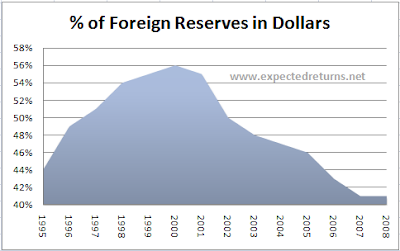
World trade in dollars has been declining since the start of the decade. Recent currency swap agreements between countries, mostly involving China, have been used to bypass the dollar in global trade. Arrangements such as these threaten the dollar's role as global reserve currency, removing any support to the dollar's value such an arrangement provided. This decreased demand is clearly reflected by a falling percentage of foreign reserves held in dollars.


Further, in a low interest rate environment, the dollar has become the carry trade currency of choice. Investors have long been waiting for a powerful countertrend rally in the dollar, but as the example in the yen shows, prolonged weakness in carry trade currencies can and do occur. Also keep in mind that alternative assets, such as gold, become much more attractive in an environment where yields are essentially 0%.

Massive Supply

It's been well-documented that the Fed has embarked on a campaign of massive monetary stimulus. Unfortunately, it's hard to quantify the extent of money supply growth, since the government has stopped reporting M3 money supply figures.

The real problem brewing under the surface are accumulating bank reserves, which can be thought of as a proxy for risk aversion. Once these reserves are deployed, expect inflation to increase significantly. Sooner or later, banks will have to focus on their core business, which is lending to consumers. Here is a chart of the quickly accumulating bank reserves. Is there any question there will eventually be a flood of dollars hitting the system?


Current Account Deficits

Current account deficits are the quantifiable measure of a country's profligacy and overconsumption. Current account deficits are historically a short-term solution to a nation's underproductivity, which must eventually be settled through the balancing of capital and current accounts. As a nation continually funds consumption via debt, its currency naturally becomes less and less valuable as a medium of exchange.

Current account deficits as a percent of GDP in the U.S. have exploded to troubling levels, especially since President Nixon removed the last vestiges of our link to gold in 1971. Over the long run, the value of a currency is inversely correlated to the level of current account deficits. Persistent imbalances in current account deficits will weaken a currency without exception. The downward trend over the last decade in the dollar evidences the detrimental effect of long-term current account deficits. Notice how gold, as an alternative to the dollar, has risen in response to rising current account deficits.


U.S. Government Debt and the Treasury Market

Moving forward, the Treasury market will inordinately dictate major moves in the dollar. But before I explain why, I want to briefly overview the relationship between treasury debt, inflation, and the value of the dollar under the Maestro, Alan Greenspan.

The "great moderation" in the Greenspan years was facilitated by the recycling of dollars into our capital accounts- such as stocks, treasury debt, and agency debt. This meant that inflation was temporarily stifled as dollars were sterilized in debt instruments, while asset prices received a jolt from the attendant low interest rates. Furthermore, the tremendous demand for U.S. capital products proved to be supportive of the dollar. If there ever were a period of getting "something for nothing" in America, it was during this era of massively inflated asset prices, and moderate consumer price inflation.

Now what happens when our debt grows to a level that forces the government to become a major player in the bond market? Foreign actors will start unloading their treasury debt, especially on the long end of the yield curve, to an increasingly overburdened government. As demand for Treasuries falls, yields will rise, which makes the burdens of servicing debt greater.


Due to collapsing tax receipts and excessive stimulus measures to stave off the effects of this crisis, our budget deficit has exploded in 2009. This phenomenon is what forces our government to "monetize" debt.

The monumental and ever-increasing level of debt the government has directly taken on through its program of quantitative easing is troubling. The reason is simple: in an inflationary environment, the Fed will be inhibited from containing inflation by selling bonds in the open market, and thereby, soaking liquidity from the system. Due to the sheer size of our program of monetization, any move to sell treasury instruments will likely be met with panic from foreign investors. This is something to keep in mind moving forward.

Total Debt Including Unfunded Liabilities


And now we come to the elephant in the room: aggregate government debt, including unfunded liabilities. Decades of kicking the debt can down the road in Ponzi scheme entitlement programs, like Social Security, has created a behemoth of debt that is quite literally unpayable. Absent a growth miracle, and a bigger miracle of fiscal austerity by our government, there is no way we can fund these accruing liabilities through our dwindling tax base.

According to the Dallas Fed, current unfunded liabilities are about $100 trillion dollars. While a restructuring of entitlement programs is absolutely necessary, it is not politically viable. If recent government actions are any indication, our government will attempt to mask insolvency through the printing press.

Conclusion: Implications of a Weaker Dollar


A weaker dollar poses tremendous complications for Americans. For one, it makes imports more expensive, which is effectively inflation. Ultimately, this means a standard of living lower than what we have come to expect. If confidence in the dollar totally erodes, then things will really get ugly.

While we could possibly stave off an inflationary spiral if we enacted the correct policy right now, the reappointment of "Helicopter" Ben Bernanke all but destroyed any hopes of a stable currency. The inflationary spiral of the late 70's and early 80's was brought to a halt through the politically unpopular actions of Paul Volcker. It's counterintuitive, but central bankers that are denigrated politically are doing their job correctly. Celebrated central bankers like Ben Bernanke are succumbing to political pressure, making decisions based on expedience rather than prudence. The inherent deficiencies in our system virtually guarantee that long-term implications of massive debt will be ignored. Unfortunately, the "long-term" may finally be upon us, and a dollar collapse of shocking proportions is increasingly likely. This Depression is just getting started.

This post has been republished from Moses Kim's blog, Expected Returns.

Think Tank Calls For More Government Spending

A paper by a think tank at the Levy Economics Institute calls for a temporary bank closure and increased government spending in order to help the economy recovery. However, at some point government spending can become counterproductive and the burden of proof should be on those who call for more spending. James Picerno from The Capital Spectator discusses this in the following blog post.

Is it time to consider more radical strategies for repairing the U.S. economy? Perhaps, although as a recent essay from the Levy Economics Institute argues, it’s also clear that the old game of trying to reflate bubbles isn’t going to work this time.

“Like the Bush administration before it, the Obama team appears to be trying to re-create the bubbly financial conditions that led to disaster,” a research paper from LEI asserts. “This tack is not likely to succeed, and it is displacing policies that might actually prevent a recurrence of the Great Depression.”

The paper continues,

In our view, most administration proposals are fundamentally misguided, since they are based on the twin presumptions that Big Banks face only a liquidity problem and that, if this problem is resolved, the economy will recover. We believe these presumptions are entirely mistaken. The Big Bank problem is insolvency, and these banks should not be saved because they form a barrier to a sustainable recovery. Given a chance, they will resurrect the bubble conditions that led to the current crisis.

What’s the solution? LEI argues that a banking “holiday” is needed. The biggest institutions are temporarily closed and the books are closely analyzed, including a careful look at cross-bank liabilities. The immediate goal is “consolidating the balance sheets” in order to “downsize the financial sector and reduce monopoly power.”

The basic motivation for these changes, according to LEI, is that borrowers can’t service their debt. But the think tank’s solution isn’t exactly novel. “A major increase in government spending is the only way to smooth the deleveraging process.”

The reasoning, the paper concludes: “It is better to spend on a much bigger scale now in order to create jobs and rekindle private sector growth. If we do that, the budget deficit will shrink and GDP will grow, while government debt- and deficit-to-GDP rates will fall.”

Even assuming that huge amounts of new spending are the intelligent choice (a debatable proposition, to say the least), the conceit here is that Congress will make intelligent decisions when it comes to directing the new monies.

Ultimately, there’s a question of whether the government, any government, can create jobs worthy of the name on a grand scale over long periods of time. One problem: the funding of such a massive public enterprise has to come from somewhere, which raises questions of whether we're simply borrowing from Paul to pay Peter. There are three basic methods for such programs: raise taxes, borrow more, or quietly devalue the currency. Perhaps a mix of all three is coming.

Yet the burden should be on those who call for a colossal increase in government’s role at this juncture in the economic cycle. Does history suggest this is a logical path that will bear fruit? We think not, although the devil's in the details. But as a general proposition, economic growth doesn’t flow from government mandates. Governments have some capacity for keeping disaster at bay, but that's quite a different state of affairs than promoting growth.

We can make a case for intervention to stave off some immediate threat. But let’s not fool ourselves into thinking that economic expansion can be engineered as one more state program. The limited response (so far) of the so-called stimulus program from earlier this year suggests as much. Clearly, many disagree, although the "solution" in some corners is always: spend more. If $800 billion wasn't enough, $1.6 trillion would have been. Ah, if it was only that easy.

And so we ask a simple question: What does history say? To be precise, what does history say about government spending on promoting growth beyond some immediate crisis?

By all means, we need to encourage economic expansion by all reasonable methods and use government levers in a prudent fashion. But there are limits to everything, just as public spending at some point becomes counterproductive. And so let’s not kid ourselves: we’re looking at a period of subpar growth on a number of levels, and the brilliant ideas cooked up in, say, the U.S. Senate or the Department of Energy probably can't save us from this fate.

The only thing worse than an unsatisfactory recovery is one that's also laden with an even higher level of excess debt and questionable expansions of the public sector.

This post has been republished from James Picerno's blog, The Capital Spectator.

Tuesday, November 24, 2009

Is This Just The Beginning For Gold?

It is said that when an investment becomes too mainstream it may be time to sell. Despite the plethora of headlines touting gold investment, gold is still not quite mainstream yet and the fundamentals suggest continued growth. See the following post from Expected Returns.

Even for the staunchest of bears, it's getting harder and harder to deny the power of the most recent move in gold. All corrections are shallow, buying pressure is intense, and the dollar is clearly on life support. The shaky fundamentals of our monetary system made such a move in gold inevitable. The truly amazing thing is that this move in gold is just beginning.

We are starting to see more headlines touting gold as an investment, which is usually a good short-term sell signal. Nonetheless, here's an interesting article from Marketwatch, which looks into the recent phenomenon of hedge fund gurus buying into gold.

Gold has long been favored by a fringe of the investment world, but this year some of the world's leading hedge-fund managers have loaded up on the precious metal amid concern government efforts to avoid another Great Depression that could undermine major currencies and fuel rampant inflation.

"I have never been a gold bug," Paul Tudor Jones, chairman of hedge-fund giant Tudor Investment Corp., wrote in an Oct. 15 letter to investors. "It is just an asset that, like everything else in life, has its time and place. And now is that time."

Tudor has been building positions in gold and other precious metals in recent months and they now represent the firm's largest commodities exposure, he noted.
I would disagree with Marketwatch that gold is going mainstream now that elite hedge fund managers have hopped on board. In order to be truly successful in investing, you have to by definition shy away from mainstream thought. For example, John Paulson made his billions by shorting subprime securites, essentially betting that the market that "always goes up" would come crashing down. As we all know, he was dead right.

Paul Tudor Jones made a name for himself by predicting the 1987 crash in the midst of a powerful bull market. His views definitely were not mainstream, and he was rewarded when the market crashed in October.

Gold Bugs: Lunatics or Rational Investors?

"I can't remember in 20 years so many respected investors focused on a single strategy," said Bradley Alford of Alpha Capital Management, which invests in hedge funds. "Some of these people are icons of the industry with at least 15-year track records. It's a losing proposition to bet against guys like that. They aren't billionaires because they make bad bets."

It's not only hedge funds. Managers of mutual funds and insurance company portfolios are often limited in how much gold they can buy, but these investors have been purchasing the metal for their personal accounts, according to Ed Yardeni, president of Yardeni Research.

"A surprising number of level-headed folks, who I have known over the years, are confessing to me that they've become gold bugs," he said. "They're starting to give more respect to what was for a long time considered the lunatic fringe."
The worst trait you can have as an investor is stubbornness. I can guarantee you will miss bull market after bull market if you are not open to new ideas. Lets just look at how one of the best in the business, David Einhorn, has changed his mind about gold in recent years:
Since Einhorn launched Greenlight in 1996, he's shunned gold and other broad economy-based trades in favor of tracking down under-valued and over-priced stocks.

"We never thought we would ever buy gold or gold stocks," Einhorn wrote in January, recounting the lesson he learnt from his grandfather's obsession with the precious metal.

"The lesson that I have learned is that it isn't reasonable to be agnostic about the big picture," he said during an Oct. 19 speech at the Value Investing Congress in New York.

At the same conference four years earlier, Einhorn advocated his Grandma Cookie's approach of investing in stocks like Nike, IBM , McDonald's, over his Grandpa's holdings of bullion and gold stocks.

"I explained how Grandma Cookie had been right for the last 30 years and would probably be right for the next thirty," Einhorn said. "However, the recent crisis has changed my view."

Gold should do "fine" until policymakers and politicians show more monetary and fiscal restraint. The metal will likely do "very well" if there's a sovereign debt default or currency crisis, he added
The key lesson here is to always be open-minded, and to not be afraid to change long-held personal views.
It's Supply and Demand, Stupid
Tudor also expects central banks, which have been net sellers of gold for many years, to become net buyers during the second half of 2009, a "remarkable" turnaround for a market that's used to absorbing big sales from this official sector.

The large, developed countries of the G-7 already have roughly 35% of their reserves in gold, but the remaining members of the G-20 only have 3.5% of reserves in the precious metal, Tudor estimated.

These 13 countries, which include China and India, have seen a $2.2 trillion surge in reserves in the past five years, making up well over half of the increase in global reserves during that period, Tudor said.

If non-G-7 countries in the G-20 lifted gold holdings to 10% of their reserves, they would need to buy 370 million troy ounces, or 20% of current above-ground supplies. If they lifted holdings to 35% of reserves, they could need to buy 1.3 billion troy ounces, or 35% of above-ground supplies, Tudor estimated.

"There is huge potential for more buy-side interest to emerge from central banks," Jones wrote in his Oct. 15 letter to investors.

"The scope for increased investment demand over the coming years is much stronger than the potential from new supply," Jones wrote. "As a result, incremental new demand must buy gold from current holders... We doubt the transfer of gold from current holders to its new owners will occur at, or near, current prices."
All I can say is that continued skepticism over the viability of gold as an investment just adds fuel to the fire. Most people buying gold right now aren't looking for 5-10% gains, but 100-200% gains. So we are talking about strong hands here. As net buyers, Central Banks will put a floor in this market; think of it as the "Central Bank put".

This post has been republished from Moses Kim's blog, Expected Returns.

Signs Of Trouble From The Credit Market

The highest deficit to GDP ratio since 1945 is encouraging traders to buy insurance against government bonds in the form of credit default swaps. Another troubling sign is the short-term US Treasury yields moving into negative territory. Jon D. Markman from Money Morning discusses why this could mean trouble for the financial system.

There is some interesting action unfolding in the dark corners of the credit market.

Although this exploratory sojourn takes us fairly far afield from our regular stomping grounds in the equity markets, it could have important implications for our investments. So grab a thinking cap, and let’s go exploring.

First, let’s have some context. As you know, governments around the world have unleashed tons of stimulus spending over the last year. Against a recessionary backdrop, it’s no surprise that tax revenue has plummeted while fiscal deficits have soared.

Here in the United States, the deficit for fiscal 2009 came in at $1.4 trillion, or 9.9% of gross domestic product (GDP) – the highest since 1945.

It was always a race against time: Borrow and spend to get the economy growing again before the vigilantes in the bond market revolt and force a cut in spending and an increase in taxes.

It seemed to work for a while. Interest rates fell. Government funds bolstered the economy via “Cash-for-Clunkers” and the $8,000 tax rebate for first-time homebuyers.

Now, unfortunately, trouble is brewing. The first early warning comes from the credit derivatives market. This is the Wild West of financial markets – fast-growing, unregulated, and not tied to organized exchange like the Big Board (NYSE). It is here that credit default swaps (CDS) trade. These are basically insurance contracts that protect against the failure of bond issuers to pay up.

One segment of this market protects sovereign or government debt. And according to David Klein at Credit Derivatives Research, traders in this market are buying up protection at a rate not seen since July, ending four month of relative tranquility. His Government Risk Index, based on the CDS of seven different countries, has increased 32% since October.

The main cause was a jump in the cost of protection against Japanese, British, and American debt. Japanese CDS doubled from Sept. 11 to Nov. 9. These are the laggards, and the bond rebels are starting to punish them. All three countries are projected to maintain deficit-to-GDP levels in excess of 8% through 2011 according to the Organization of Economic Cooperation and Development (OECD).

This could set the stage for another panic not unlike last fall’s credit crisis. Then, financial CDS spiked and pulled the fixed-income and equity markets down with it. If the rising trend in sovereign CDS continues, Klein believes we should interpret this as the market preparing for a rise in the general risk level.

The second problem was the decline in short-term U.S. Treasury yields this week: Demand for T-bills maturing in early 2010 moved into negative territory for the first time since the depths of last fall’s financial crisis. This is an extraordinary event. Someone is betting with large sums of money that it makes sense to pay the U.S. government to hold their money for 90 days. Anytime people are willing to accept negative returns for the comfort of getting their money back in three months time, risk aversion is obviously on the rise.

Now don’t get me wrong. The context for this outlook is few clouds forming on the horizon. Sure, it could be a big tropical storm coming in. Or it could just be some innocent clouds that block the sun for a few minutes before passing on.

Just because someone is making these bets does not mean they are right – far from, in fact. For now, the sun is still shining and it’s not raining. I’ll continue to monitor these developments and let you know if and when it’s time to take action.

Another interpretation of the sovereign CDS issue comes courtesy of WJB Capital Group Inc. Chief Market Strategist Brian F. Reynolds, who has a great record of calling these things and has been much more bullish than CDR’s Klein in the past eight months.

Reynolds believes the credit bears who targeted the CDS of companies in the spring have moved to U.S. CDS to try to get a rout rolling. Credit products are a relatively inexpensive market to try and manipulate, so this is certainly possible. But he thinks that they will fail, and their short-covering will provide the fuel for the next leg up in the credit and equity markets.

Reynolds was very emphatic last year in insisting that credit bears were right, and he helped keep us out trouble by providing a guidebook to the twisted and dark world of debt. He is now equally emphatic this year in insisting that the credit bears are now only mounting a rear-guard action as prior profits have slipped away, and do not have history or the odds in their favor.

Here’s the bottom line: Credit is where the big boys play, and that’s why we need to keep an eye on this realm. The bad guys are trying to make mischief, but for now they are being held off.

If that changes, I’ll let you know.

This post has been republished from Money Morning, an investment news and analysis site.

Monday, November 23, 2009

Could The Bush Tax Cuts Be Ended Early?

Yes, the government can pass tax increases that are retroactive, as demonstrated by the Omnibus Budget Reconciliation Act of 1993, signed into law by Bill Clinton. David Galland from Casey Research thinks it could happen again as the democratic majority is in desperate need of raising revenue without expending political capital. See the following post from Daily Wealth.

The administration knows its massive deficits will be poison come the November 2010 midterm elections. At the same time, it also knows if it cuts stimulus spending, it risks kicking the props out from under the recovery just ahead of those same elections.

There's only one way out. That's to boost revenues... and soon. It would be political suicide for Obama to break his pledge not to raise taxes on the middle class. So all that's left is to mug the "wealthy."

It's already a given that taxes are going up for higher income earners and investors. Most importantly, the administration and its Congressional allies have announced they'll allow the Bush tax cuts to expire in 2011. Those cuts, passed in 2001 and 2003, reduced personal income taxes and capital gains taxes, as well as eliminated the estate tax.

Once the Bush tax cuts expire, high earners will see their personal income taxes rise from 35% to 39.6%. (And probably go up from there. The House health care bill includes an additional 5.4% surtax on gross income for high-income individuals.) In addition, the estate tax will return.

And long-term capital gains tax rates, now at 15%, will be boosted to as much as 28%.

But here's the rub: Ahead of the 2011 tax changes, investors will begin dumping appreciated stocks in order to lock in capital gains and avoid paying the additional taxes. That will create an unwelcome stock market selloff ahead of the November 2010 elections.

The Democrats knows this, which is why – behind the scenes – they are now setting a bulletproof tax trap to spring soon after the New Year begins. The trap is simplicity itself: a repeal of the Bush tax cuts in 2010, a year ahead of schedule.

Further, when passed, the legislation will be retroactive to January 1, 2010.

It's the perfect trap, because once the higher taxes are in place, there will be no tax incentive for anyone to divest their shares. In fact, many people will decide to hang on to their stocks until a more investor-friendly regime returns to power.

By increasing taxes across the board on the wealthy a year ahead of schedule, the government gets a big lift in revenue. Simultaneously, it avoids a rush for the exits that would otherwise occur ahead of the capital gains tax increases. For the government, it's a win-win. Very much not the case for investors.

Could the government really pull this off – implementing a retroactive tax increase?

In a word, yes. Back in August 1993, President Clinton passed the largest tax increase in history – the Omnibus Budget Reconciliation Act of 1993 (OBRA) – and made it retroactive to January of that year.

It was challenged in court, and the court held that retroactive tax increases were legal. This was not the first time this sort of chicanery had been pulled. (You can read more on the topic of retroactive taxes by clicking here.)

Why am I so confident this trap is being set? Nancy Pelosi herself tipped her hand on the retroactive tax plan when she said last January she wanted Congress to repeal Bush's tax cuts well before their scheduled expiration date. An early repeal of the Bush tax cuts was also one of President Obama's campaign promises.

The administration and its allies have since gone quiet on its intentions. But that's only because they want to avoid triggering a stock selloff before the end of 2009. That all changes once the ball drops in Times Square this coming New Year's Eve. At that point, it will be too late to escape.

The good news is that avoiding this trap is as easy as selling your most profitable stock positions on or before December 31, 2009. This way, you'll only pay 15% on your long-term capital gains... instead of the 28% the government is planning to sting you with once its tax trap is sprung in 2010.

You've been warned.

This post has been republished from Daily Wealth, a contrarian investment site.

Psychology's Role In Economic Recovery

Robert Shiller proposed an interesting argument in the NY Times in which he suggests that economic recovery can be attributed to the collective psychology of the crowd who expect the recession to end. However this goes against traditional economic thinking that puts little weight into consumer sentiment as a primary mover of the economy. See the following post from Economist's View.

Robert Shiller wonders if the recovery is based upon a self-fulfilling prophecy:

What if a Recovery Is All in Your Head?, by Robert J. Shiller, Commentary, NY Times: Beyond fiscal stimulus and government bailouts, the economic recovery that appears under way may be based on little more than self-fulfilling prophecy.

Consider this possibility: after all these months, people start to think it’s time for the recession to end. The very thought begins to renew confidence, and some people start spending again — in turn, generating visible signs of recovery. This may seem absurd, and is rarely mentioned... but economic theorists have long been fascinated by such a possibility.

The notion isn’t as farfetched as it may appear. As we all know, recessions generally last no more than a couple of years. The current recession ... is almost two years old. According to the standard schedule, we’re due for recovery. Given this knowledge, the mere passage of time may spur our confidence, though no formal statistical analysis can prove it.

Certainly, people did not always believe that there is a regular “business cycle” that starts and stops in a definite pattern. The idea began to spread in the popular consciousness in the 1920s and reached full bloom in the ’30s — with one major complication, the Great Depression... “Recession,” a kinder, gentler term, began to be used around the time of the 1937-38 contraction to refer to a normal downturn in the business cycle. ...

Recessions, as the term came to be used, implied timetables that mark their expected end. Uttering the word does not risk damaging confidence, at least not fundamentally. A diagnosis of a recession can be shrugged off as something from which you will recover... A depression came to be another matter entirely.

It wasn’t until 1948 that the Columbia University sociologist Robert K. Merton wrote an article ... titled “The Self-Fulfilling Prophecy,” using the Great Depression as his first example. He is often credited with having invented the “self-fulfilling prophesy” phrase...

In important ways, we are still using that 1930s pattern of thinking. We are instinctively fearful of reckless talk about depressions, and we try to support one another’s confidence. We like the idea that modern scientific economics seems to show that all recessions end in due course.

For now, our common efforts at building confidence appear to be working somewhat. But the economy has still not recovered, by any means. ...

The problem might be put this way: There is still a nagging doubt afloat that the current event is really just another example in that long sequence of recessions. In which mental category does the current contraction belong: recession or depression? We may still be at a tipping point. To the extent that the theory of the self-fulfilling prophecy is correct, there is a case for continued vigilance, to ensure that adverse events don’t encourage widespread talk of the second category.
Barry Ritholtz responds [Note: Updated version posted at Barry's request]:

How Overrated is Sentiment in Economics?, by Barry Ritholtz: There is a small cadre of Economists — original thinkers, contrarians, out of the box theorists — whom I respect a great deal. It is a modest list ranging from Richard Thaler to David Rosenberg to Robert Shiller, with lots of smart econ wonks in between.

This morning, however, I find myself somewhat disagreeing with one of the smarter of the economists, Professor Bob Shiller... Hence, it is with trepidation that I point out the flaws in Shiller’s discussion about the recovery, (titled “What if a Recovery Is All in Your Head?“). It is a thought provoking but unpersuasive argument... To be fair, he uses the column to incite a debate, rather than defend the position that the recovery is “mostly mental.”

I find numerous things worth challenging in the column... Let me offer 10 items..:


To read the rest of Barry's response, click here.

I find that I have a knee-jerk, negative reaction to explanations based upon mass psychology, sentiment, story-telling, and the like. I have to consciously force myself not to dismiss them. I'm not sure why that is, though it probably has something to do with a feeling that such explanations aren't scientific, and hence have no place in serious academic investigations. That is, prior to the crisis I thought that the real economy drove sentiment, and not the other way around. Sentiment could definitely provide a feedback loop that strengthens negative or positive economic shocks, but psychology was not the prime mover. Thus, sentiment changes that did not have evidence to support them would quickly die out before having much, if any effect.

But this crisis has caused me to reevaluate. I still find the Shiller-type animal spirits, psychology based explanations hard to swallow, but when the foundation supporting your beliefs is called into question (in this case modern macroeconomic models), it's important to open your mind and at least give alternative explanations a chance. That's particularly true when the person pushing the stories has a pretty darn good record of using them to warn of bubbles, as Shiller does. So I'm trying.

This post has been republished from Mark Thoma's blog, Economist's View.

Friday, November 20, 2009

Job Growth Missing In Action

Jobless claims staying over 500,000 may cause more worry about economic recovery turning into a double-dip recession. While the crowd has been conditioned to expect extreme outcomes due to recent events, we should be careful not to be overly pessimistic or optimistic says James Picerno. See the following article from The Capital Spectator.

The danger is not the past, but the future.

Today’s update on weekly jobless claims may be the warning sign. New filings for jobless benefits were unchanged last week, hovering at 505,000, matching the previous week’s tally. Although this number is down sharply from it’s recessionary peak of 674,000, set back in late-March, 500k reflects distress in the labor market. In other words, job growth is largely MIA.

It’s too soon to tell if the drop in claims is stalling. But there’s a case to be made that the big, easy reductions are behind us. As we discussed many times this year, there was always a strong case that a snapback on multiple economic and financial levels was in the offing for 2009. Unless the system was truly headed for a collapse, the natural order of the business cycle was righting itself after such a sharp deviation from equilibrium. In short, much of the events in 2009, particularly since the spring, aren’t a huge surprise to students of economic history. But the world is likely to become increasingly nuanced and complicated, and not necessarily for the better.


We’ve commented often in 2009 that the main threat was a stalled rebound in the job market. The risk was less about a double dip recession and another cataclysm and more of meager growth in the all-important labor market. Today’s data point in jobless claims isn’t proof that our forecast is turning into reality, but neither does the latest number do anything to dispel our worry of what may be looming.

The crowd’s been taught to expect that extreme outcomes are the new norm, courtesy of the drama of the past year or so. But we think the hazards will come quietly, softly, sneaking up on us like burglars in the night. Rising inflation, weak job growth, a tepid recovery, and the increasing pain that comes with servicing the debt boom of the past generation all conspire to make the foreseeable future challenging.

None of these problems will change very much over any given period. Nor will the associated fallout appear materially worse from month to month or even quarter to quarter. That raises the possibility that the dangers will be ignored or underestimated, which in turn suggests that the crowd may adopt a degree of optimism that’s unwarranted.

But the chickens are coming home to roost, one seemingly inconspicuous and unthreatening data point at a time. Still, there's a danger in becoming too pessimistic as well. The excess will be worked off and progress will come. But it won't be quick or easy this time. And for some with limited patience, it'll be far too slow. Regardless, the future can't be rushed. That's always true, of course, although in the months and quarters ahead this truism will resonate on a deeper level than we've witnessed in many a moon.

This post has been republished from James Picerno's blog, The Capital Spectator.

Mortgage Delinquencies Reach Frightening New Record

One area of the economy that isn't improving is foreclosures which are not expected to peak until 2011 by some estimates. More bad news is that delinquencies have reached a new record with nearly 10% of home mortgages behind by at least one payment. See the following post from Expected Returns.

As I've expected for months now, 'green shoots' are wilting before our very eyes. I've never heard of a recovery characterized by rising unemployment, record foreclosures, collapsing consumer credit, and falling consumer confidence, but hey, maybe we're in a new paradigm. From the New York Times, U.S. mortgage delinquencies reach a record high:

Nearly one in 10 homeowners with mortgages were at least one payment behind in the third quarter, the Mortgage Bankers Association said Thursday.

That is the highest figure since the association began keeping records in 1972. It is up from about one in 14 mortgage holders in the third quarter of 2008.

“Clearly the results are being driven by changes in employment,” Jay Brinkmann, the association’s chief economist, said on a conference call with reporters. Five million more unemployed people over the last year has turned into about two million more overdue loans, he added.
This is what I mean when I say unemployment is a leading indicator for this particular downturn. You just can't compare this recession with previous recessions when this crisis was preceded by parabolic rises in housing prices and household debt levels. This is a debt crisis pure and simple. Debt crises, especially one of our magnitude, do not disappear after 2 years.

The association’s delinquency numbers do not include those who are actually in foreclosure, a figure that also rose sharply, to 4.47 percent of all loans. A year ago, it was 2.97 percent.

It also indicates that foreclosures, instead of peaking with the unemployment rate next year, will be a lagging indicator. The association expects foreclosures to peak in 2011.

The data indicate that borrowers in trouble are no longer just those who took out subprime loans. High-quality prime fixed-rate mortgages now represent the largest share of new foreclosures.
If everyone agrees that the sky was falling last year, and that we were on the brink of another "Great Depression", what do you call it when foreclosures are up 50% from those "depression" levels? In the lexicon of our leaders, it is called economic recovery.

I've mentioned previously that the next threat to residential housing is in the higher-end markets. There is another wave of delinquencies set to hit the market in 2010, and if the Fed loses control over interest rates, look out below. Here is a chart of the coming Option ARM and Prime resets in 2010 and beyond. Get ready for fireworks.


This post has been republished from Moses Kim's blog, Expected Returns.

Thursday, November 19, 2009

Obama Changes His Tune On Deficit

After campaigning for and signing into effect more than $800 billion in federal stimulus, President Obama now is worried that too much debt could create a double-dip recession and recently spoke out against deficit spending. Although the federal stimulus package delivered limited and underwhelming job growth results, Democrats in Congress are already at work on a second package targeted at spurring job growth – one that will likely result in more deficit spending. See the following from The Street.

President Obama, the champion of stimulus spending, is suddenly worried about an overload of government debt.

After pressing Congress to approve an $800 billion package of infrastructure projects, unemployment benefits and tax cuts during his first month in office, Obama is now warning that too much debt could cause a double-dip recession.

Even more intriguing about this shift in rhetoric is that he chose to deliver the new message to Fox News, News Corp. (NWS Quote) network with which Obama has been feuding over a perceived conservative bias.

One can only assume that the detente with Fox and the decision to talk about debt issues is a politically calculated move to assuage Republicans who have been making deficit spending a centerpiece of their resistance to Obama's many initiatives, in particular health care reform.

Obama also acknowledged that he's in a precarious position in terms of boosting job creation to keep the recovery going while reinstating some fiscal discipline.

In the same interview with Fox, Obama talked about the need for new measures to spur companies to create jobs. Obama's Democratic Party chiefs in Congress are in fact working on new legislation they hope will bring down the unemployment rate from the staggering 10.2% level. Any government-sponsored initiatives along those lines will add to the deficit one way or another.

It's essentially an admission of failure that Democrats are now working on a second job-creation package.

So far, the stimulus spending isn't showing great results. At the end of October, the Obama administration released a report showing that about 650,000 jobs had been saved or created at a cost of $150 billion. That's about $230,000 per job.

I'm not knocking Obama or the Democrats for trying to stoke the economic recovery, for the trillions of dollars spent to bailout the financial industry or for realizing that they may need to do more to help the 15 million unemployed Americans find new jobs.

It's just the idea that Obama is now critical of deficit spending that I find so ironic.

This post has been republished from The Street, an investment news and analysis site.

Obama Wrong About Deficits Causing A Double-Dip Recession

Mark Thoma discusses why Obama is wrong about the deficit causing a double-dip recession. While he may be trying to reassure China about their US dollar concerns, a premature attempt to balance the budget before the economy is fully recovered is more likely to lead to a second recession. See the following post from Economist's View.

Edward Harrison catches this quote from Obama:

The president is in Beijing as part of his tour through several Asian countries to address economic challenges. He spoke candidly about the precarious balancing act his administration is trying to perform. He wants to spend money to kick-start the economy, but at the same time is in danger of creating too much red ink.

Obama warned the United States' climbing national debt could drag the country into a "double-dip recession," though he said he's still considering additional tax incentives for businesses to reverse the rising unemployment rate.

"There may be some tax provisions that can encourage businesses to hire sooner rather than sitting on the sidelines. So we're taking a look at those," Obama told Fox News' Major Garrett.

"I think it is important, though, to recognize if we keep on adding to the debt, even in the midst of this recovery, that at some point, people could lose confidence in the U.S. economy in a way that could actually lead to a double-dip recession."


I hope his economic advisers set him straight, though I suppose there's a chance that this nonsense is coming from them. We needed a larger stimulus package to begin with, and the economy could still use more help, labor markets in particular.

Let's hope that this doesn't turn into a call to actually start balancing the budget before the economy has fully recovered as that would increase the chances of the double dip recession that he is so worried about (something we should have learned from the 1937-38 experience where an attempt to balance the budget prematurely plunged the economy back into recession).

These comments also make it sound like any jobs program, if we get one at all, will be limited to (right-wing approved) tax cuts which is, in my opinion, inferior to direct job creation strategies. Tax cuts can be part of the mix, but by themselves are unlikely to do enough to solve the employment problem.

This post has been republished from Mark Thoma's blog, Economist's View.

Wednesday, November 18, 2009

Why Gold Bubble Advocates Could Be Wrong

Gold has risen to an unprecedented $1140, causing some to conclude the market is a bubble about to burst. Moses Kim makes a case for resisting the urge to short gold as political tensions, particularly class conflict and concerns over taxation, will cause instability, volatility, and an increased demand for the security offered by gold. See the following post from Expected Returns.

That is, if you want to survive as a trader. Anyone who has been trading actively for a reasonable period of time knows that gold and silver move to their own unique rhythm, and that shorting gold over the past decade has been a losing proposition. I know there are many investors "dollar cost averaging" their short positions in gold, praying for a correction that never comes. The formula for making money in this bull market is simple: buy the dips and sell the rips.

I am amazed at the total change in sentiment from investors towards the gold market. Just watch how investors react to any pullback in gold; my guess is that all dips will be bought aggressively. The pattern over the course of this bull market has been clear: a multi-month consolidation followed by a huge breakout. We haven't come close to going parabolic yet, and until we do, this bull market is well intact and is not at bubble levels. Keep your television tuned in to CNBC so you can do exactly the opposite of what they are recommending. Currently CNBC is telling you to sell gold because it is a clear bubble- this means you should be buying.

Anyway, what is $1140 gold telling us? I'll try to give you an idea of my thought process when I invest, which is heavily dependent on politics.

Political and Economic Dislocations Ahead


If you study history, you realize that the majority of truly seminal events happen in the shortest span of time. While most people are stuck in the mindset that events move in a predictable, steady, linear manner, what's actually happening right now politically, economically, and socially are huge changes that will affect the lives of everyone globally. Political tensions will likely escalate in the coming years, and there will be a sudden change in global dynamics. The catalysts for major events will only be obvious to most people in hindsight. The job of the successful investor, however, is to understand how current actions dynamically influence future events. This allows you to foresee events and to adjust investment decisions accordingly.

Class Warfare, Increased Taxation= Recipe for Disaster


It's not surprising, but class warfare is already beginning in America, as politicians try to enforce equality on the population. If your company can't compete globally, don't worry, Uncle Sam will be there to take capital away from productive individuals and funnel it to unproductive companies. State taxes are already rising for the "rich", and as a result, capital will flow out of the U.S. More than people realize, capital flows have an enormous effect on the growth of economies. Further, as unemployment benefits get extended once again, jobs remain scarce, and "too big to fail" becomes the official mantra of government, we are developing an economic model that is more socialist than capitalist. We will learn once again that enforced equality is contrary to the idea of freedom, both economic and political, and that economic growth will suffer as a result. Why is this important as an investor?

Likely Government Responses to Insolvency


Lets look at the range of possible actions the U.S. government will undertake to stay solvent and delay the inevitable path to bankruptcy. If I were a greedy politician, where would I look to confiscate wealth? Besides gold, which acts as a check against government ineptitude, I would be looking at 401k's. Just look at what the government has done with the Social Security "Trust Fund"? It has replaced money taxed from the population and replaced it with worthless government IOU's. I wouldn't be surprised in the least if 401k's were replaced with U.S. Treasuries, all in the name of stabilizing portfolios. Of course this will be a smokescreen for criminal confiscation of the hard-earned wealth of Americans, but what about the handling of this crisis hasn't been criminal under the surface? The point of my little rant is this: eliminate counterparty risk, especially if you are approaching retirement. If you own a 401k, you are a sitting duck in my opinion.

What's the other option? Inflation. This form of confiscation is obviously much harder to escape. Most lower and middle class Americans will understand the curious feeling that standards of living are going down even in the midst of supposed growth in our economy. The idea that our government would purposely manipulate economic statistics to further their agenda is, surprisingly, repugnant to some people. The truth is, government statistics misrepresent the true state of our economy, which should be obvious to anyone who actually thinks. Why do we need such tremendous stimulus if our economy is recovering? Use your common sense and don't buy into flawed Keynesian propaganda.

My point is that in a time of total disregard for the rule of law and an ad hoc approach to administering justice, the free market just can not operate. This is incredibly bearish for our economy. Why do you think so much money is flowing to gold? You never know when the government will do something truly nutty like ban short-selling or impose ridiculous taxes on capital gains. People are buying equities in the short term, but I don't think anyone in their right mind believes equities are undervalued. Everyone has two hands on the exit.

What is Gold Telling Us?


A move to $1500-$2000 gold, especially in the next year, is a frightening possibility. Don't expect business as usual with gold at those valuations. I have repeatedly stated that gold is a purveyor of truth in a time of lies. You have heard our government officials talk about a "strong dollar policy" for years and years, yet the dollar has lost about 50% of its value in the past decade against a basket of global currencies. The dollar's performance against gold is even worse. At what point does this relatively controlled decline in the dollar become chaotic? I can assure you that smart money is stealthily moving out of the dollar and into gold. When there is mass recognition that the dollar is going way down, good luck trying to head for the exit.

Like it or not, we are approaching a time of volatility both economically and socially. Gold is the only true hedge against instability. The coming volatility is already embedded in the system, whether it is in the form of complex derivatives, insane debt levels, unprecedented unemployment statistics, or a fundamentally flawed global currency arrangement. Be sensitive to the message gold is relaying right now- the worst is definitely not behind us.

This post has been republished from Moses Kim's blog, Expected Returns.

Rebalancing The US China Economic Relationship

According to Robert Reich, Barack Obama's plan to rebalance the economic relationship between China and the US is destined to fail due to China's economic policies designed to maintain order. While the productive capacity of China continues to grow, just 35% of the economy is attributed to personal consumption, down from 50% a decade ago. See the following post from Economist's View.

Robert Reich says China won't be abandoning its currency policy anytime soon:

China and the American Jobs Machine, by Robert Reich, Commentary, WSJ: President Barack Obama says he wants to "rebalance" the economic relationship between China and the U.S. as part of his plan to restart the American jobs machine. "We cannot go back," he said in September, "to an era where the Chinese . . . just are selling everything to us, we're taking out a bunch of credit-card debt or home equity loans, but we're not selling anything to them." He hopes that hundreds of millions of Chinese consumers will make up for the inability of American consumers to return to debt-binge spending.

This is wishful thinking. True, the Chinese market is huge and growing fast. ... But in fact China is heading in the opposite direction of "rebalancing." Its productive capacity keeps soaring, but Chinese consumers are taking home a shrinking proportion of the total economy. Last year, personal consumption in China amounted to only 35% of the Chinese economy; 10 years ago consumption was almost 50%. Capital investment, by contrast, rose to 44% from 35% over the decade. ...

Chinese companies are plowing their rising profits back into more productive capacity—additional factories, more equipment, new technologies. China's massive $600 billion stimulus package has been directed at further enlarging China's productive capacity... So where will this productive capacity go if not to Chinese consumers? Net exports to other nations, especially the U.S. and Europe. ...

The Chinese government also wants to create more jobs in China, and it will continue to rely on exports. Each year, tens of millions of poor Chinese pour into large cities from the countryside in pursuit of better-paying work. If they don't find it, China risks riots and other upheaval. Massive disorder is one of the greatest risks facing China's governing elite. That elite would much rather create export jobs, even at the cost of subsidizing foreign buyers, than allow the yuan to rise and thereby risk job shortages at home.

To this extent, China's export policy is really a social policy, designed to maintain order. Despite the Obama administration's entreaties, China will continue to peg the yuan to the dollar... This is costly to China, of course, but for the purposes of industrial and social policy, China figures the cost is worth it. ...
While China's currency policy is certainly a worthy topic for discussion, lately we are spending a lot of time pointing our fingers at others and blaming them for our problems rather than engaging in the more difficult task of getting our own house in order. I'm not saying that we should ignore things that unfairly disadvantage us, whatever those might be, just that a continued focus on external factors provides a convenient excuse to avoid going through the difficult changes needed to reform our own economy, an excuse that can be exploited by powerful interest groups opposed to needed change (though Reich at least touches on the US side of the equation in a part I left out).

Yes, China needs to change its currency policy, and the fact that it won't or can't change will probably lead to further economic imbalances, perhaps to dangerous levels, and cause increased political tension in the future. But I hope we don't allow the financial industry and others wishing to deflect blame for the crisis and avoid stricter regulation to use the controversy over China's currency policy to divert our attention elsewhere and alter the narrative about how we got into this mess.

This post has been republished from Mark Thoma's blog, Economist's View.

Tuesday, November 17, 2009

When The Federal Reserve Gets It Wrong

While often criticized as ignorant and misguided, central bankers make decisions that they deem as the best for their country using the facts and information that they have available to them at the time. Setting monetary policy is a high-stakes, high-skill game played by fallible humans, and flawed decisions have led to major consequences throughout history. See the following post from The Capital Spectator.

Central bankers are a powerful lot and so it’s an easy to assume that they’re also prescient. When you’re making decisions that affect the livelihoods of millions of people—billions on a global scale—confusing people with their institutional authority can become habit forming. But central bankers are mortal, and therefore prone to mortal decisions, a.k.a. flawed decisions. Heck, it happens to the best of us at times. The only difference is that most people’s day jobs don’t cast a long shadow over a nation’s money supply.

No less an expert on central banking than Paul Volcker, the patron saint of inflation slayers everywhere, advises that “central bankers suffer from hubris like everybody else.” That’s not surprising, but it does have consequences.

The monetary policy du jour, as a result, may not be exactly what the macroeconomic gods ordered. A mismatch between the optimal monetary policy and current events is in some sense fate. Working with limited information makes it hard to know if today’s actions will suffice for the uncertainty that arrives tomorrow. As a result, we can talk of monetary policy in terms of its degree of inaccuracy or accuracy.

Intelligently dispensed or not, monetary policy steers economic activity, ranging from decisions in asset pricing to lending preferences to choices that affect the labor market. Alas, poor decisions have a habit of delivering less-than-satisfying results.

Remember all the talk of the Great Moderation? “One of the most striking features of the economic landscape over the past twenty years or so has been a substantial decline in macroeconomic volatility,” Ben Bernanke pronounced in early 2004 in his then-current position as a Fed governor. “Reduced macroeconomic volatility,” he went on to explain, “has numerous benefits. Lower volatility of inflation improves market functioning, makes economic planning easier, and reduces the resources devoted to hedging inflation risks. Lower volatility of output tends to imply more stable employment and a reduction in the extent of economic uncertainty confronting households and firms. The reduction in the volatility of output is also closely associated with the fact that recessions have become less frequent and less severe.”

It’s debatable how much the Fed was influenced by the past for setting monetary policy in 2004 and beyond, but some observers of central banking suggest that the calm history in those halcyon days led policymakers astray. Anna Schwartz of the National Bureau of Economic Research speaks for many dismal scientists when she charges in a recent essay that the Fed kept interest rates too low for too long earlier in this decade. In turn, the inappropriate interest rates distorted markets, she says, and the fallout wasn't trivial. “In the case of the housing price boom, the government played a role in stimulating demand for houses by proselytizing the benefits of home ownership for the well-being of individuals and families.” The net result, to state the obvious, was less than optimal.

Volcker has commented that the preference for low interest rates earlier in this decade was based on a “misreading of the Japan situation.” The worry that deflation threatened in 2001-2005 was simply wrong, as was the resulting prescription: low interest rates.

Economist Scott Sumner opines that another Fed mistake of some consequence was the decision in September 2008 to leave interest rates as is. “On September 16, 2008, the Fed made one of its most costly errors ever,” he recently wrote. “Immediately after the failure of Lehman Brothers, the FOMC decided to leave the target rate unchanged at 2.0 percent.” Monetary policy, in other words, should have been far more supportive given current events. It wouldn’t have prevented the financial crisis, but it might have minimized the fallout, perhaps by more than a trivial amount.

The idea that central banks have power of the ebb and flow of economies isn’t new. In 1963, Milton Friedman and Anna Schwartz reordered perceptions of the Great Depression with their the monumental A Monetary History of the United States, 1867-1960, which indicts the central bank’s monetary policy for the events of the 1930s. Friedman and Schwartz argued that the central bank’s errors in managing the money supply were the primary catalyst that turned recession into something far worse. “Prevention or moderation of the decline in the stock of money, let alone the substitution of monetary expansion, would have reduced the [economic] contraction’s severity and almost as certainly its duration,” they wrote.

Today, central bankers the world over are faced with another decision of above-average consequence. The exit strategy, as it’s called, requires that the Fed and its counterparts choose when to begin drawing back the enormous liquidity that’s been injected into the global economy.

“It is clear…that our exceptional support cannot last for too long a period of time since there are negative side effects,” Jürgen Stark, a member of the European Central Bank’s executive board, said last week. Jan F Qvigstad, deputy governor of the Central Bank of Norway, also remarked last week that the country’s current target policy rate of 1.5% “will be 2.75 per cent around the end of next year.”

Some central banks have already begun raising rates, as we noted a month ago. The Fed too must return monetary policy in the U.S. to something approaching a normal state. As always, the possibility of raising rates too early, too late or insufficiently keeps everyone guessing. Accordingly, inflation may or may not be a problem in the years ahead.

“At some point, the economic trends will shift and waiting too long to raise interest rates will be the primary hazard,” we wrote in March. “We don't know if the turning point will come in a few months or a few years, but we shouldn't delude ourselves that it's never coming.”

The risk tied to the timing and magnitude of the exit strategy isn’t necessary limited to inflation, as the tumultuous history of this decade reminds. We might add that we also shouldn’t kid ourselves that the Fed will make exactly the right decisions at exactly the right time.

There are many advantages to fiat money. But the main advantage is also the primary risk: flexibility. As with democracy and investing, choices matter. Rarely are those choices perfect. Sometimes they’re egregiously wrong, sometimes they’re more or less productive. The great question is what outcome will the decisions give us this time?

This post has been republished from James Picerno's blog, The Capital Spectator.