Friday, May 29, 2009

Top 5 Restaurant Franchises Of The Recession

Restaurant franchises can face tremendous difficulty during a downturn as consumers cut back on eating out. However some franchises are not only surviving, but thriving during the recession. Here are the top five restaurant franchises of the recession according to Blue Mau Mau.

Twenty franchise brands have shown skilled leadership in standing tall against all other restaurant chains during these tough times. Nation’s Restaurant News says in their May 18 edition that these twenty “are using numerous moves in an effort to declare checkmate on the economy.”

Here are five of twenty. Each of the brands have experts and analysts discussing why it stands out compared to the rest of the sector.

1. McDonald’s
A franchisee says the secret to McDonald’s success is its ability to collaborate with franchisees and to align them with disparate parts of the business through its Plan to Win program.

2. Papa Murphy’s
Franchisees attribute the chain’s successful growth to the supportive relationship the franchisor has with them and its focus on operations, food and customer satisfaction. Franchisee Jon Willie says that Papa Murphy’s does not sell food to franchisees, a practice that makes franchisees in other brands feel vulnerable to high costs from price gouging of its franchisor.

3. Buffalo Wild Wings
During tough times, people like to socialize more. Franchisees say the secret to Buffalo Wild Wings is that the system and the franchisees focus on building a socializing business structure around sports. “We try to find employees that, No. 1, genuinely love sports and love to be around people,” says Franchisee Kevin O’Laughlin. “That sort of sets the tone for the restaurant.”

4. Panera Bread
Nothing about franchisees in this piece. But what drives Panera Bread’s success is incredible financial control and its differentiation when its competitors continue to conform with each other.

5. Five Guys
With 400 units, Five Guys is riding on the gourmet burger category that has seen a major revival in the last two to three years. The brand focuses on pushing the quality of their gourmet burger. “We stress that our franchisees, managers and hourly employees are really fanatical about quality,” says Doug McKinney, the chain’s director of training.

This article was reposted from Blue Mau Mau.
Photo by theyearofcoffee

Why No Respect For Gold?

The growing national debts of countries like the US and Britain and concerns of credit downgrades should get people thinking about gold. Could this be the perfect storm to propel gold over the $1,000 mark? According to Tim Iacono from The Mess That Greenspan Made gold is not getting enough respect, despite the economic conditions.

Uber-blogger Joe Weisenthal over at Clusterstock points out the relatively poor performance of gold in recent weeks, offering one more contrary indicator that we're still quite early in the precious metals bull market, now in its tenth year.

Hey Look! Gold's Still Going Nowhere

You would think with all these rising bond yields, talk of a government ratings downgrade and the Fed printing money as fast as possible that gold would really start to break out. But basically it's been a snoozer.

Maybe it's because more people are thinking of gold as something you sell to raise cash in hard times, rather than something you buy with cash to prepare for harder times. Certainly all the Cash4Gold ads on TV suggest there's a lot of demand for green cash. And those other ads, where the guy keeps saying "Real Government Gold" over and over again, complete with images of nuclear terrorism, mainly makes the seller look desperate.

Yesterday, on one of those ground-moving-underneath-your-feet kind of days, the shiny metal didn't do anything.


There's the typical half-hearted caveat at the end, but the title pretty much tells you everything you need to know. Gold continues to get little respect from a lot of people and, like the career of the late Rodney Dangerfield, that's a good thing.

This post can also be viewed on themessthatgreenspanmade.blogspot.com.

US Bonds: Not Worth The Risk

Despite the yield of the 10-year US Treasury bond rising to 3.76%, bonds are not worth the risk that the return will be canceled out by inflation. Martin Hutchinson argues that bonds are not a safe investment, and it's not because he thinks the US will default. To learn more see the following article from Money Morning.

With budget deficits on the rise and inflation almost certain to follow, it’s getting easier to see why British or U.S. government bonds are no longer a truly safe investment.

Standard and Poor’s Inc. (NYSE: MHP) last week put Britain’s credit rating under review for a possible downgrade, a precursor to a potential reduction in the country’s AAA credit rating. Since that indignity was avoided even in 1976, when Britain had to be bailed out by the International Monetary Fund (IMF), this raises questions about the safety of an investment in Britain’s government debt.

Needless to say, Britain and the United States have pursued similar policies in response to the ongoing global financial crisis, and are currently running similar budget deficits: Britain’s budget deficit this year will be 12.3% of gross domestic product (GDP), compared with 13.2% for the United States, according to The Economist.

Given those parallels, Britain’s credit review has to raise questions about whether a similar fate might await U.S. Treasuries. Indeed, the 10-year U.S. Treasury yield has already risen to 3.45% from its low of 2.07% in December, and it appears likely to rise even more.

That brings us back to my opening question: Should individual investors who are subject to inflation even consider U.S. Treasury bonds as a safe and secure investment?

Let me give you an extreme example - one that has jaundiced my entire view of government bonds since childhood. My Great Aunt Nan, a favorite relative in my childhood who had operated a small business, retired at 65 in 1947, having been born in 1882, one year too early for a self-employed person to qualify for a government pension in Britain. That was no problem, however - she had pretty substantial savings, which if invested prudently would give her enough income for a comfortable retirement. So she invested those savings prudently - and, indeed, patriotically - in a British government “War Loan” then yielding 2.5%, a “consol” paying income perpetually, with no maturity date. It gave her a retirement income of about 400 pounds a year, equivalent to about $30,000 today.

Actuarially, she was lucky - she lived in quite good physical and mental health to 91, which meant many happy visits to her during my childhood in the 1950s and 1960s.

Financially, she was rather less lucky, and suffered from an investment one-two punch:

  • First, the War Loan in 1973 - the year of her death - yielded 10.8%, so the nominal value of her savings had declined by 77% (since the market value of a bond moves opposite the direction of interest rates).
  • Second, consumer prices increased by 227% between 1947 and 1973, so the real value of her income had declined by 69%, and the real value of her savings had declined by 93%.

Government bonds - a safe investment. Yeah, right …

Obviously, there are examples that make the opposite case. For instance, if you had invested in long-term U.S. Treasuries in 1981, when they yielded around 15% (the U.S. prime rate actually reached 21.5% during that period), you would have done very well, indeed: The U.S. Federal Reserve, having finally vanquished inflation, embarked upon a rate-reduction campaign that brought American interest rates down at a steady rate for much of the rest of that decade.

But since governments control both monetary and fiscal policy - and since politicians are politicians - they combine to engineer things so that there are far more bad years than good years to be an investor in government bonds. Central banks and insurance companies buy government debt because they have to, but there’s no reason for you and I to get involved in these unattractive one-way bets. Even at 3.5%, 10-year U.S. Treasuries are a positively bad investment, since the U.S. budget deficit is so large that supply of them will never be limited, while inflation looks likely to reappear in force, draining the value of these bonds as inflation did to the savings of my great-aunt.

As daunting as all this all sounds, it’s not the worst that could happen: We still haven’t considered the possibility that the government could actually default on its debt.

Economists will tell you that governments can’t default on bonds in their own currency, because they can always print more money. In extreme cases, printing more money will lead to high inflation or even hyperinflation, leading to an effective repudiation like that perpetrated on my great aunt, or even like that carried out by the German Weimar Republic in 1923, when German prices were measured in the trillions of marks.

Economically, to avoid Weimar 1923, it would be better for a government to default outright, because at least non-government bonds and shares would still be worth something, and values would not be altogether destroyed.

After all, think about it - which would you expect to provide better investments: private companies, which create value, or the government, which merely spends money?

There are no sure things in life, but there are better investments and worse ones. Today, Brazilian government bonds, currently yielding 11.86% in Brazilian reals for an eight-year maturity, are a sounder investment than U.S. Treasuries; Brazilian inflation is expected to run 4.4% in 2009, so that’s a real yield of 7.46%, and the Brazilian budget deficit is only 2% of GDP.

Gold is always attractive while you think inflation is imminent - even at its current price, which is close to $1,000 an ounce. The gold market at $100 billion a year of production is far too small for the potential demand from central banks and speculators, so if inflation gets a real grip, the price of gold could easily go to $5,000.

Then there are stocks. Not cyclical stocks, which will suffer badly if the government finance chaos causes an even deeper recession than we already have. But shares in modestly leveraged companies producing low-priced consumer staples, which will continue to be purchased in even the deepest recession. In this area, think about such companies as The Procter & Gamble Co. (NYSE: PG), The Coca-Cola Co. (NYSE: KO), The Hershey Co. (NYSE: HSY) or, for lowish-priced entertainment, why not Nintendo Co. Ltd. (OTC ADR: NTDOY)?

In one way or another, Procter & Gamble, Coca-Cola, Hershey and Nintendo add value to our lives.

And to my way of thinking, that makes each of these a much better investment than a debt-ridden government. Don’t you agree?

This article has been reposted from Money Morning. You can view the article on Money Morning's investment news website here.

Thursday, May 28, 2009

Why The Yuan Will Become The New Global Currency

Should we be worried that China's yuan will overtake the dollar as the new default global currency? Investment Director of Money Morning, Keith Fitz-Gerald thinks it's not a matter of if but when. In the following article, Fitz-Gerald, makes the argument on why he thinks that the yuan will eventually become the dominant global currency.

China has taken yet another step to transform the yuan into the dominant global currency, a long-term initiative that could ultimately dethrone the dollar as the world’s top unit of exchange.

In the last four months alone, China has signed currency swap agreements worth more than $95 billion (650 billion yuan) with an array of nations - including: Argentina, Brazil, South Korea, Indonesia, Malaysia, Belarus and Hong Kong - that are only too glad to move away from the increasingly shaky U.S. dollar.

For Westerners who are struggling to come to terms with the notion of a disarrayed dollar, the thought of oil, gold or other commodities being priced in yuan instead of dollars has to seem about as likely as having another country put a man on the moon.

But the Chinese yuan is already well on its way to becoming that globally accepted standard unit of exchange and the proverbial genie, as they say, is out of the bottle. In fact, I’d even go so far as to say the dollar’s days of dominance are numbered and with each new round of bailout chicanery, the clock is winding down ever faster.

Asia’s Long-Term View

In such Asian markets as Japan, Hong Kong and Mainland China, the long-term planning that’s an anathema to Corporate America is actually standard fare. During the height of Japan’s dominance in the 1980s, the Western business press - with a touch of derision - wrote about how some Japanese companies routinely formulated business plans with durations of 100 years or more (while working in Asia early in my career, I actually even contributed to several such plans … but that’s another story for another time).

That’s neither here nor there to most people who note smugly that Japan is getting its comeuppance. But what they don’t understand is that Japan is not alone. In fact, many people I talk with are shocked to learn that at a time when the West is still busy handing out Band-Aids in an attempt to deal with the greatest financial crisis on record, China has been quietly and shrewdly reinventing itself with the same kind of long-term vision.

Take commodities, for example. While companies in the United States, Great Britain and Europe are being forced to shed promising assets in order to compensate for massive losses or to pay down debt, cash-rich China has been able to operate as a buyer in a buyer’s market. While the rest of the world has interpreted this as a sign that China’s interested in buying the things it needs to grow, what they have not understood is that China’s also interested in using physical assets as a source of “currency” that offsets an increasingly eviscerated U.S. dollar.

This is actually a double-whammy of sorts, for while the rest of the world has been grappling with the global slowdown, China has been locking up supplies of commodities that are only going to become more scarce (and more valuable) as global demand escalates.

In fact, as I’ve suggested for months, now, China isn’t just going to consume those assets; it’s going to use them as part of the same long-term vision it’s been staking out with regard to its own currency, the yuan, which it fully intends to boost in status to the point where it becomes an internationally accepted currency.

The Once-Dominant Dollar


That’s quite a turn of events.

Even now, despite the travails of the U.S. economy, the dollar remains the world’s most widely held reserve currency and, as such, is the standard unit of exchange in most international transactions. In fact, many non-U.S. firms (such as Airbus SAS) actually price their manufactured products in dollars. And the dollar is the de facto unit of pricing for such commodities as oil (hence the term “petrodollar“). Several countries even use it as their “official” currency.
But the global financial crisis is threatening that dominance.

The United States has already “injected” into the world economy trillions of dollars that are collectively worth more than 60% of this country’s entire gross domestic product (GDP). And the prospect of still more injections for California, GMAC LLC and other “national” interests is extremely worrisome - and not just to millions of Americans, either. If Washington stays on this path, the result will be a currency crisis the likes of which few are capable of imagining and a near-complete devaluation of the once-almighty U.S. dollar.

Ironically, both events will only further embolden China, speeding up its efforts to boost the yuan’s international acceptance.

The “New” Yuan


While some experts may question Beijing’s motives, it’s hard to question China’s long-term strategic vision, since the country is actually being forced to take these steps that ensure its own survival. Unfortunately, our leaders in Washington don’t seem to understand this, so they’re only making matters worse - when they instead could be actively working with China and the world community on this instead of summarily ignoring the fact that the yuan may well be the world’s next reserve currency.

At the very least, China’s currency is likely to be granted a global status on par with the current major currency trading pairs for purposes of settling international transactions, whether the West wants that to happen or not.

I’ve outlined this scenario many times in recent years and, quite frankly, too often received blank stares in return. Most folks here in the West just aren’t prepared to deal with the idea that the U.S. dollar could be finished and that another currency could replace it after more than 60 years of global dominance. But they better get used to the idea - and in a hurry.

China is acutely aware that not having international currency convertibility hampers both its development and - thanks to the ongoing financial crisis - its potential survival. Not only has China been forced to accept huge reserves built upon previous trade growth (its $2 trillion in reserves is an all-time record), but its own policies have contributed to its relative inability to flex its capital-market muscles. That’s especially true in transactions involving U.S. dollar/yuan exchange rates.

What for us sounds quite theoretical in nature represents a very real problem for businessmen such as Dong Xianbin, the chairman of the Guangxi Sanhuan Enterprise Group Holding Co. Ltd. He estimates that he’s lost more than 150 million yuan (about $22 million at current exchange rates) on international trade in the past three years alone because of exchange rate changes between the dollar and the yuan. So he’s keen to see yuan-based transactions that will reduce exchange-rate risks, or eliminate them entirely. And he’s not alone. Thousands of Chinese companies are chomping at the bit for the same reasons.

As a nation, not having a universally accepted currency is a huge issue. China’s record reserves are now at risk thanks to the U.S. government’s bailout boondoggle, because each new greenback printed debases the value of every other dollar out there, including the ones China holds.

Historically, Beijing sought to mitigate that risk by diversifying its holdings into other currencies most notably the European euro and the Swiss franc, for instance. But now China’s facing the kinds of problems that massive mutual funds closer to home must deal with when they hold a disproportionately large amount of money: China’s reserve fund is so massive that there’s literally no other single currency that can absorb all that liquidity. So even if China wanted to diversify more aggressively, it’s going to be hard pressed to do so.

Incidentally, this is precisely why China’s so-called “nuclear option” will never become more than a theory bandied about by conspiracy buffs. Under such a scenario, China will either “dump” its dollars, and/or stop buying them, causing the value of the greenback to plummet. China might start selling, but there literally is not another currency on the planet that could absorb a wholesale liquidation.

Therefore, the reality is that China needs to have the U.S. boost the value of the dollar - even as the United States needs to have China do all it can to maintain the dollar’s value.

Shopping for Commodities

At this point in time, China essentially has two alternatives:
  • It can seek out other stores of value, such as natural resources, which are highly liquid and reasonably “deep” in global markets, but which can also be very volatile from a pricing standpoint.
  • Or it can elevate the credibility of its own currency in the international financial markets and effectively remove the exchange rate risks associated with its own partially blocked yuan.
Never one to leave anything to chance, China is pursuing both strategies. For instance, China’s been buying gold like there’s no tomorrow - and is looking to add to its holdings. Since 2003, China has boosted its holdings of gold by 73% to an estimated 1,054 metric tons, with an approximate value of $31.3 billion. This makes China the fifth-largest holder of gold on the planet, followed by the United States, Greater Europe, and Switzerland.

China’s also gone global in its hunt for oil - which, of course, is the only other global “currency” truly in international demand.

While there’s a real benefit to having locked up supplies of commodities, they aren’t an ideal store of value. And that suggests that what China really needs to do is elevate the global prominence of its own currency at the same time, whether U.S. leaders aid the process or not.

History shows that strong economies tend to have strong currencies. And the actions that I’ve reported on recently from China - the cross-Straits agreements reached between China and Taiwan, the Hong Kong yuan-trade agreements and the “yuan carry trade,” to name a few - only reinforce the effort China is putting forth to achieve this goal.

Speaking of goals … there are obviously plenty of Doubting Thomases on this issue - but they were around years ago before China announced that it wants to put a man on the moon by 2020.

This article has been reposted from Money Morning. You can view the article on Money Morning's investment news website here.

Increase In Sales Outpaced By Growing Housing Inventory

Tim Iacono, from The Mess That Greenspan Made, points out that although we have had good news recently with sales starting to increase and depreciation slowing, this could actually add fuel to the fire if more sellers enter the market on news of improving conditions. A recent report from The National Association of Realtors showed that supply increased to a 5 month high, which could continue to drive prices lower. See the following post to learn why growing inventory could continue for years into the future.

The National Association of Realtors reported a slight increase in home sales last month, but the growing (if misplaced) optimism about the nation's housing market drew even more sellers, pushing the inventory of unsold homes to a five month high.


Sales of existing single family homes, townhomes, condominiums, and co-ops rose 2.9 percent in April to an annual rate of 4.68 million units, following a downwardly revised rate of 4.55 million units in March. On a year-over-year basis, sales were 3.5 percent lower.

The median home price for all housing types, still heavily influenced by the predominance of sales at the low end, fell from $175,200 in March to $170,200 in April, representing a decline of 15.4 percent from a year ago.

Foreclosures and short-sales accounted for some 45 percent of all sales, down from more than half of all sales in March.

In an early sign that stabilization in the housing market will be much easier to accomplish than an actual rebound, housing inventory rose almost nine percent during April to 3.97 million, representing 10.2 months of supply, an indication that more sellers are listing their homes for sale as they see anticipate a rebound.

This is likely to continue for perhaps several years as waves of sellers enter the market after having held their properties back, awaiting better market conditions and, importantly, this includes bank owned properties where the new owners have been in no particular hurry to list repossessed homes for sale.

Lawrence Yun, NAR chief economist, commented on the rise:
The gain in inventory is largely seasonal from sellers entering the spring market. Even with the rise, inventory over the past few months has remained consistently lower in comparison with a year earlier.

You can never go wrong when making comparisons to conditions when the housing market was at its steepest rate of deterioration, just prior to precipitating the late-2008 implosion of global financial markets and life as we knew it.

Mr. Yun also made another plea for the government to start buying jumbo loans:
Most of the sales are taking place in lower price ranges and activity is beginning to pick up in the midprice ranges, but high-end home sales remain sluggish. The Federal Reserve needs to help restore liquidity for the jumbo mortgage market by buying these loans under the TALF program.

Why not? The Fed seems to be buying just about everything else these days.

This post can also be viewed on themessthatgreenspanmade.blogspot.com.

First-Time Buyers Not The Reason For Improved Sales

Despite the generous government incentives for first-time buyers to enter the market, they are not driving the increase in home sales that was seen in April. Sales of distressed properties still account for a large percentage of sales and which drives down values. To learn more on this see the following article by Kelly Curran from HousingWire.

Existing-home sales rose in April with strong activity in lower price ranges, particularly from repeat buyers, according to data released today from the National Association of Realtors.

First-timers, on the other hand, declined to 40% of market sales from 53% in March.

Existing-home sales — including single-family, townhomes, condominiums and co-ops – increased 2.9% to a seasonally adjusted annual rate of 4.68m units in April from a pace of 4.55m units in March, but sat 3.5% below the 4.85m units sold in April 2008.

Single-family home sales climbed 2.5% to a seasonally adjusted 4.18m in April from 4.08m in March, but are 2.8% below the 4.30m-unit pace last year at this time.

Existing condominium and co-op sales jumped 6.4% to 500,000 units in April from 470,000 in March. Condo and co-op sales are 9.4% lower than than the year-ago pace.

A NAR practitioner survey in April shows first-time buyers declined to 40% of transactions, implying more repeat buyers are entering the traditional spring home-buying season, NAR said in a press statement. The survey also shows the number of buyers looking at homes has increased 14% from a year ago.

Regionally, existing-home sales in the West rose 3.5% to an annual rate of 1.17m in April — a significant 19.4% higher than a year ago. Sales in the Northeast jumped 11.6% to 770,000, while sales in the South increased 1.8% and sales in the Midwest slipped 2%.

The national median existing-home price for all housing types came in at $170,200 for the month, which is 15.4% below 2008. NAR says distressed properties, which accounted for 45% of all sales in April, continue to downwardly distort the median price.

But because foreclosed properties will likely be released into the market over the course of 2009, it’s critical that distressed homes are quickly cleared from the market, says Lawrence Yunn, NAR chief economist. “Fortunately, home buyers are being attracted to deeply discounted prices and are bidding up many foreclosed listings…”

This article has been reposted from HousingWire. View the article on HousingWire's mortgage finance news website here.

Wednesday, May 27, 2009

Public Private Investment Plan: Is The Government Helping Investors Get Rich?

With the US government desperate to get "toxic assets" off the books of US banks, they are planning to entice investors with very generous terms to help banks get rid of these problematic investments. There is even resistance to the government's Public Private Investment Plan, not because it won't help revive the nation's banks, but because of fear that investors will profit too much with the help of tax payers. Tom Dyson from Daily Wealth discusses why this situation is similar to the S&L crisis of the 1980's when investors made huge profits by investing in failing banks.

It's the late 1980s. The savings and loan industry has collapsed, and the government has a big mess of failed banks on its books...

The Federal Savings and Loan Insurance Corporation (FSLIC) insures S&L deposits. Whenever an S&L collapses, the FSLIC seizes and then auctions its assets... just like the FDIC does for banks today.

By 1988, the FSLIC has more than 100 failed S&Ls on its books and is close to insolvency. It is so desperate to get these busted S&Ls off its books, it's offering huge tax breaks and federal assistance to anyone who buys them.

So Gerald Ford buys more than 30 of these failed S&Ls...

Ford then restored the S&Ls he bought from the government back to profitability. He built these banks into two large retail banking chains in Texas and New Mexico. He sold one chain to Norwest – or Wells Fargo today – and the other chain to BankAmerica.

According to American Banker, Ford's $300 million investment generated $1 billion in profits in five years.

Today, with a fortune of $1.3 billion, Gerald Ford is No. 559 on the Forbes list of the world's richest people. He has a football stadium named after him, the Gerald J. Ford stadium in Highland Park, Texas. And he races thoroughbred horses. He won the Breeders' Cup in 2003 and the Dubai World Cup in 2004.

Buying distressed banking assets from the government is one of the fastest ways to make a fortune. The government's political agenda is often stronger than its desire to get a good deal for the taxpayer. So it gives tax breaks, low-interest loans, and below-market prices to investors who buy these "toxic assets."

The S&L crisis is one of the best examples of this phenomenon. The government rescued the entire industry, eating $125 billion in losses to get the industry back to solvency and profitability. I can name half a dozen investors like Gerald Ford who made fortunes from the S&L collapse.

In 2008, we experienced a true "credit crunch" and "banking panic." At the height of the crisis, it looked like there might be a run on the entire banking system. The situation was so bad, the Fed created the world's single-largest government intervention in the free market.

These actions simultaneously prevented a run on the entire banking system... while making the perfect situation for profiting at the government's expense.

Remember the FSLIC I mentioned above? Well, now the FDIC insures bank deposits. When a bank fails, the FDIC auctions off the remaining assets to other banks.

In the S&L crisis, some 745 institutions went bankrupt. So far in this crisis, Obama's band-aids have held the system together. Only 60 banks have folded since January 1, 2008. So the big opportunity in buying busted banks is probably still in the future...

The FDIC is also administering the Treasury's toxic asset disposal program. The official name of this program is the "legacy loan program." The government has designed this program to clean bank balance sheets of toxic assets, like distressed loans and junk mortgage securities.

So far, the details of this plan are pretty sketchy... The FDIC isn't sure how the plan will work out. It's set up a section on its website where members of the public can offer suggestions for issues the FDIC still hasn't resolved...

But one thing's for certain... some investors will soon make a fortune from this program.

I'm keeping my eye open for ways we can profit off the banking boondoggle... Even the FDIC wants individual investors to participate in the auctions. It just haven't figured out how to do it yet.

You should keep an eye on the FDIC's website for this announcement. Also, the FDIC publishes a list of all the failed banks since January 2000... When you see more banks failing, you'll know there'll be more FDIC-insured profit opportunities coming.

Dailywealth.com offers a free daily investment newsletter which focuses on contrarian investment opportunities.

California Real Estate Depreciation Slowing

The bad news is that real estate values fell a record 19.1% since Q1 of 2008 according to S&P/Case-Shiller US National Home Price Index. The good news is that data suggests that the decline in housing values is starting to slow in some states such as California and Nevada. The following article by Kelly Curran from HousingWire takes a look at the data that shows which states are starting to show improvement in the housing sector.

As home prices continue to fall across much of the nation, those states that experienced the highest rates of home depreciation over the past three years are finally experiencing a slow down in devaluation, according to data released today by First American CoreLogic.

Nevada and California remain the top ranked states for annual prices drops in March, down 25.9% and 24.9%, respectively; however, California’s decline is the smallest since March 2008 and Nevada’s drop is the smallest in six months.

Rhode Island sits in third place, with a 21.2% depreciation rate, and is currently the only state among the top five — also including Florida and Arizona – that continues to experience a consistent acceleration in price declines.

But as the typically hard-hit states are graced with some relief, price declines are now accelerating in what were once stable markets. 33 states are now showing an acceleration in price declines and 14 are experiencing double digit declines – twice as many as a year ago.

“The problems are no longer confined to a handful of Sand States,” says Mark Fleming, chief economist for First American CoreLogic in reference to Arizona, California, Florida and Nevada.

“Homeowners in many parts of the country are coming under stress from a loss in equity, rising delinquencies and foreclosures, and economic uncertainty,” he adds.

Fleming explains this distress is particularly pronounced in more expensive neighborhoods where the median value of all properties is over $1m.

“In these neighborhoods mortgage delinquency performance is worsening at a faster pace than the overall national delinquency rate, although the rate of delinquencies in these high-end neighborhoods is still much lower than the U.S. overall,” Fleming says.

This article has been reposted from HousingWire. View the article on
HousingWire's mortgage finance news website here.

Consumer Confidence Shows Drastic Improvement

In past recessions consumers may have already started to rush back to the malls, but this time might be different. Instead of going back to the shopping centers, consumers may instead be sending their money to credit card companies to pay back their high levels of debt. So what should we make of consumer confidence increasing the most in six years? Tim Iacono from The Mess That Greenspan Made explains why a sudden improvement in consumer confidence may not be as significant as it first appears.

Reuters reports on the sharpest increase in U.S. consumer confidence in more than six years. But, don't get overly excited (like the stock market currently is), the American shopper is still quite depressed by historical measure.

The Conference Board, an industry group, said on Tuesday its index of consumer attitudes jumped to 54.9 in May from a revised 40.8 in April, the biggest one-month jump since April 2003. Economists had been looking for a much smaller rise to 42.0.

Fewer Americans said jobs were "hard to get," the survey found, with that measure slipping to 44.7 percent from 46.6 percent. Those saying jobs were plentiful climbed to a still meager 5.7 percent, but that was still higher than April's 4.9 percent.

"Consumers are considerably less pessimistic than they were earlier this year," said Lynn Franco, director of The Conference Board's Consumer Research Center.

Once again, less bad is the new good, the "considerably less pessimistic" assessment being cause for some to get out the bubbly and celebrate, at least for a little while.

More details...

The survey offered mixed messages regarding Americans' propensity to spend money. The proportion of those who said they planned on buying a car over the next six months rose to 5.5 percent, its highest in at least a year.

But fewer intended to buy homes -- only 2.3 percent, a tough break for one of the hardest hit sectors in the country's economic crisis. A separate report on Tuesday revealed U.S. home prices dropped 18.7 percent in March compared to a year earlier.


Here's a graphic from the Wall Street Journal showing how the expectations index has surged past the present conditions index in a manner similar to the 2003 bottom. Since confidence had sunk to such historic lows in recent months, like many other economic indicators, comparing recent developments to patterns seen in previous recessions may not provide all that much relevant insight.

This post can also be viewed on themessthatgreenspanmade.blogspot.com.

Tuesday, May 26, 2009

Element 42: A Metal That The Entire Energy Industry Relies On

If you knew of a metal so crucial to energy creation that China restricts the amount that can leave the country, such an investment opportunity might pique your interest. Element 42, or molybdenum, has a very high melting point and improves the strength of steel at high temperatures which gives it useful applications in nuclear energy, oil refining, and aircraft production according to the Los Alamos National Labratory. To learn more about this precious metal and the potential returns from investing in it, see the following article by Chris Mayer from Daily Wealth.

When Carl Wilhelm Scheele discovered element 42 back in 1778, he could scarcely have imagined just how important this silvery-white metal would become one day.

Today, the entire energy complex relies on this metal – for everything from oil pipelines to nuclear reactors. Without this metal, the energy business would grind to a halt. Plus, as society gets all worked up over carbon emissions, element 42 is having a greater role to play here, too. Refineries, for instance, use it to remove the sulfur from gasoline and diesel fuels. It's also used in desalination plants, which turn saltwater into drinkable water.

Element 42's main gig is to strengthen steel. It makes steel more resistant to corrosion and extreme heat. As a result, it is incredibly important to just about every infrastructure project you can name and rides the coattails of the great infrastructure build in China, India, and other emerging markets. Globally, the steel industry uses about 85% of element 42 taken out of the ground.

Element 42 is also known as molybdenum, or moly for short. I've been a "moly bull" for several years, but a recent development has me even more bullish on this metal: For the first time in years, the Chinese have become net importers of moly.

China recently became a net importer of moly because its mines are too costly to run profitably at current low moly prices. Various estimates put about half of China's moly production at costs north of $13 a pound. The current moly price is only $8 and change – down from $30-plus last year, mainly as energy markets softened. So there have been a lot of shutdowns in China, as Chinese producers can't make any money.

China also has export quotas that restrict the amount of moly that can leave the country. China knows how important moly is to its growth. It wants to keep moly cheaper and readily available in China.

But you can sell all you want to China. That's the key. And China will need lots of moly. China is the world's largest producer of steel, by far. No one's even close. China produces nearly 40% of the world's steel. It makes twice as much steel as the No. 2 guy, the European Union. Much of that steel will need moly.

I think you can boil down the moly thesis as a sidecar on steel. As steel production rises, moly demand will also rise. In that, there is a long-term story worth hanging onto. China is only just entering its most metal-intensive phase of economic development. As China gets richer, its use of steel will rise at a much faster pace.

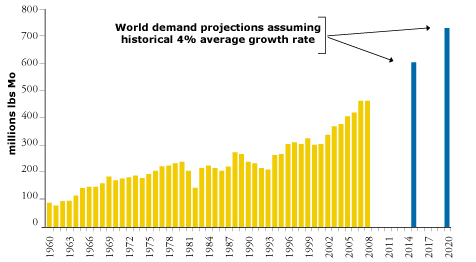
So any rebound in moly is bound up in the China growth story. In fact, over the past five years, Chinese demand for moly has grown 27% annually, compared with only 4% globally. China alone now makes up 25% of the global demand for moly – about 110 million pounds.

The beauty of moly as a long-term investment lies in this portrait of long-term demand against a seemingly limited batch of high-grade moly deposits. The long-term demand has, so far, been a reliable upward march.

Molybdenum World Demand
Small resource stocks have explosive potential... and they're rising along with the big ones...

Also, when we think about supply, the ongoing credit crisis has basically quashed whatever new moly projects were on the board. The big New Hope project, owned by General Moly, is at least 20 months away after it gets financing. In this climate, I don't see it getting financing anytime soon. And other big projects by Freeport and Moly Mines have been pushed out to 2011 or canceled altogether.

To sum up: Molybdenum is a winner, albeit one that is temporarily resting, like a basketball player taking a breather before he steps back on the court. All the elements that pushed moly to $30-plus per pound in the first place are still in place for yet another run at three sawbucks or better. Molybdenum is cheap at $8 per pound.

Although the global economic crisis will sidetrack China for a while, the country is just entering its commodity-intensive growth phase. This phase will create terrific investment opportunities in energy, agriculture, and mining for us. "Moly" is just a chapter in a long story... one we'd all be wise to follow.

Dailywealth.com offers a free daily investment newsletter which focuses on contrarian investment opportunities.

UK Real Estate Sales Reach 18 Month High

There is more positive news coming out of Britain that may suggest that the mood may be starting to improve in the UK real estate market. According to the National Association of Estate Agents' latest numbers, sales are up as people with access to financing are interested in buying at today's low prices. The following post from Property Wire takes a look at the latest data and explores whether the market has reached a significant milestone that could lead to a turnaround.

Confidence is beginning to return to the UK property market with estate agents reporting sales reaching an 18 month high.

The latest figures from the National Association of Estate Agents show that the average estate agency in the UK sold ten properties in April, compared to just eight in the previous month.

'What we are beginning to see now are consistent positive indicators that have held firm or improved since the beginning of the year,' said Chief executive of the NAEA, Peter Bolton King.

The organization's Housing Market Survey also shows that estate agents in the UK had an average of 265 people registered with them in April, slightly down on March's figure but high in comparison to the previous 12 months.

The number of first-time buyers held firm at 23%, the same level seen in March. The average number of properties available for sale increased from an average of 67 in March to 76 in April.

And the success of estate agents last month represents a move away from the low point of around five houses sold per property professional in August.

The NAEA said it is evidence that attitudes toward the UK property market are not likely to change for good because of the credit crunch.

'The NAEA always said that this was nonsense and that demand for property remained strong, but confidence in the market had gone. These figures show that this confidence is returning,' said Bolton King.

He also believes that there are other indicators such as an increase in interest from first time buyers that confidence is returning to the market. 'First time buyers believe that there are bargains to be had in property at the moment. Every measure by every organization has shown that the fall in house prices is slowing and it is understandable that those people who have access to finance want to take advantage of that and reap the rewards when the market begins to bounce back,' he added.

This article has been reposted from Property Wire. View the article on Property Wire's international real estate news website here.

Monday, May 25, 2009

Gold Investment: Is There Still Room For Growth?

With national debts growing all over the world, a strong case can be made for the future of gold prices. Even though gold values have risen from under $300 in 2002 to nearly $1000 in 2009, some gold experts believe there is still a lot of room for growth. For more on this, read the following article from Dr. Steve Sjuggerud at Daily Wealth.

Yesterday, I spent an hour and a half with two of the most experienced gold investors on the planet...

It was a bit by accident... I was at a private two-day meeting on the Eastern Shore of Maryland, and I needed to leave early to get to the Baltimore airport. Both Van Simmons (my good friend and a legend in the coin world) and ace gold-stock analyst John Doody needed to be at the airport too, so they hitched a ride with me.

At the meeting, John had told us gold stocks will "surprise on the upside" this year. In short, if you don't own gold stocks now, you need to buy. Let me share John's reasons why...

The cost of producing gold is down. According to John, oil makes up 25% of the cash cost of producing an ounce of gold. The price of oil has fallen by over half since last summer.

Also, the value of the currencies in gold-producing countries has fallen. John showed a table including the currencies of Australia, South Africa, and Canada (among others). The currencies had lost between 15% and 40% of their value versus the dollar.

Don't underestimate the importance of this... Much of the cost of production of gold (like local labor costs) is in those local currencies, but the gold is priced in U.S. dollars. In short, a fall in the currency is an instant boost for most gold producers.

So the price of gold is up while the cost of production is down. This directly increases profit margins. Gold-mining companies should report excellent earnings in the next few quarters... surprising on the upside.

John tracks three solid indicators to figure whether gold mining companies, as a group, are cheap or expensive. He looks at 1) market value versus ounces in the ground, 2) market value versus production, and 3) market value versus operating earnings. He tracks these in his excellent, data-heavy monthly newsletter, Gold Stock Analyst.

In his most recent newsletter, John said gold stocks were undervalued by 19% based on the first two of these metrics above.

Lastly, John explained sentiment toward gold stocks is still pretty bad. He had just spoken at the New York Gold Show, which he said was relatively poorly attended.

So gold stocks are cheap based on history... People are not clamoring for them, yet... And with cheaper oil and currencies, earnings of gold miners will surprise on the upside. In other words, if you think you've missed the move in gold stocks, you haven't.

If you haven't bought gold stocks yet, you should. And if you want to get the complete picture on gold stocks, then you should get to know John Doody.

Dailywealth.com offers a free daily investment newsletter which focuses on contrarian investment opportunities.

Two Opposing Views Of The Future Of The US Credit Rating

Concern of Standard and Poor's reducing Britain's credit rating leads to the question on everyone's mind — will the US be next? On one side is co-chief investment officer of Pimco, Bill Gross who says it will likely happen, and on the other side is Treasury Secretary Tim Geithner who says no. Continue reading to learn their arguments in this post by Tim Iacono from The Mess That Greenspan Made.

Pimco co-chief investment officer Bill Gross and Treasury Secretary Timothy Geithner are at odds regarding the prospect of the U.S. losing its triple-A credit rating.

Not that it really matters.

In a world crowded with nations whose budget deficits are rising sharply and whose central banks are furiously printing money in an attempt to soften the economic pain, it seems that the general shift downward will just redefine what it means to be a good credit risk.

Kind of like, "less bad" is the new "good".

According to this report at Bloomberg, after Standard & Poor's raised the possibility of the British government getting taken down a notch or two, Gross figures it's only a matter of time until we lose our AAA credit rating in the USofA, but it won't happen anytime soon - this sort of thing should be expected when government debt is growing at near-exponential rates and the printing presses are running 24 hours a day.

Gross commented on the prospects for future budget deficits on both sides of the Atlantic:

“Both the U.K. and the U.S. have prospective deficits of 10 percent annually as far as the eye can see,” Gross said. “At some point over the next several years” the debt of each “may approach 100 percent of GDP, which is a level at which country downgrades tend to occur,” he said.
...
The U.S. will issue a record $3.25 trillion of debt in the fiscal year ending Sept. 30, according to Goldman Sachs Group Inc., one of the 16 primary dealers that trade directly with the Fed and are required to participate in Treasury auctions.

“The market knows and believes that both the U.S. and the U.K. are quite similar in terms of their debt levels and debt trends,” Gross said.

He went on to note that the Fed's balance sheet will probably increase to $5 or $6 trillion by the time they're done printing money, all the newly created dollars aimed at restoring the proper functioning of a financial system that more and more people are realizing is patently unsustainable in its current form.

Meanwhile, Tim Geithner over at the Treasury Department thinks that tumbling prices for U.S. debt are a sign of a resurgent U.S. economy, rather than an inexorable march toward the status of deadbeat borrower.

Admittedly, the term "deadbeat borrower" isn't quite correct here because any government that operates a printing press can always find a way to pay its bills - just look at Zimbabwe.

It simply becomes a question of the value of the money that is used to pay those bills.

Cutting the budget deficit will be a top priority for the U.S. government, as soon as things return to "normal" according to this report also appearing at Bloomberg:

“It’s very important that this Congress and this president put in place policies that will bring those deficits down to a sustainable level over the medium term,” Geithner said in an interview with Bloomberg Television yesterday. He added that the target is reducing the gap to about 3 percent of gross domestic product, from a projected 12.9 percent this year.
...
It’s “critically important” to bring down the American deficit, Geithner said.
In its latest budget request, the administration said it expects the deficit to drop to 8.5 percent of GDP next year, then to 6 percent in 2011. Ultimately, it forecasts deficits that fluctuate between 2.7 percent and 3.4 percent between 2012 and 2019.

Absent another asset bubble of some kind - preferably the kind that both Wall Street and the government can get behind, rather than, say, surging commodity prices that hurt as much as they help - it's hard to imagine how the U.S. is going to generate enough economic growth and tax revenue to bring these deficits down anywhere close to what the White House projects in the years ahead.

This post can also be viewed on themessthatgreenspanmade.blogspot.com.

Friday, May 22, 2009

Greenspan Says Financial Crisis Not Over

It appears as if Alan Greenspan still has some power despite being retired for several months. His warning that the banks need to raise large amounts of capital and that the financial crisis is not over, contributed to stocks falling yesterday. Tim Iacono from The Mess That Greenspan Made discusses Mr.Greenspan's reappearance and how he was dead wrong about a previous financial crisis.

Former Fed chairman Alan Greenspan probably got a little warm and fuzzy feeling inside sometime over the last few hours if he happened to catch this headline at Bloomberg.


He probably thought to himself, "I've still got it", before proceeding with his daily bubble bath, ruminating in a manner only he knows how about the state of global economic affairs, now more than three years into a retirement that is anything but private.

Yesterday's headline read Greenspan Says Banks Still Have a ‘Large’ Capital Requirement and the report contained warnings uttered by the former Maestro about the U.S. banking system. That is, the same U.S. banking system that the U.S. government recently declared healthy after the successful conclusion of the bank stress tests.

Former Federal Reserve Chairman Alan Greenspan signaled that the financial crisis has yet to end even as borrowing costs tumble, warning that U.S. banks must raise “large” amounts of money.

“There is still a very large unfunded capital requirement in the commercial banking system in the United States and that’s got to be funded,” Greenspan said in an interview yesterday in Washington. He also said that “until the price of homes flattens out we still have a very serious potential mortgage crisis.”

Greenspan’s comments suggest he sees a bigger capital shortfall in the banking system than reflected in regulators’ stress tests on the 19 biggest U.S. lenders.

“We’re on the edge and if this thing doesn’t get resolved quickly I’m worried,” he said before a meeting with House of Representatives members on financial regulation that was organized by the Washington-based Bipartisan Policy Center.
He went on to note the "extraordinary improvement" in the global economy from the near-death experience of the last six months, predicted that the second quarter of 2009 would prove to be the bottom of the U.S. recession, and voiced opposition to the idea of a "systemic regulator".

Earlier in the week, in a telephone interview with Bloomberg's Scott Lanman, Greenspan commented on the career of the outgoing Hong Kong central bank chief.
Former Federal Reserve Chairman Alan Greenspan, who in 1998 criticized Hong Kong’s central bank for purchasing $15 billion in stocks during the Asian financial crisis, now calls it a savvy move.

“It turned out that his timing was exquisite,” Greenspan said, referring to Joseph Yam, who plans to retire Oct. 1 after 16 years as chief executive of the Hong Kong Monetary Authority.

“It was a risky action, but he pulled it off,” as share prices rose for several years, the former Fed chief said in a telephone interview today. “I wouldn’t recommend that as a general rule for central banks.”
The year 2006 will probably be looked back upon as the Greenspan "quiet-period", immediately after his term at the Fed came to an end, during which time he gave successor Ben Bernanke about nine months of breathing room before popping up nearly everywhere, inking deals with investment firms that profited handsomely during and immediately after his tenure as Fed chief.

The "quiet period" will someday resume ... after all, he is 83 years old.

This post can also be viewed on themessthatgreenspanmade.blogspot.com.

British Real Estate: Weak Pound Making Investment More Attractive

The falling value of the pound is making British real estate look more appealing to overseas investors. The pound just fell sharply in response to news that Standard and Poor may lower the UK's AAA credit rating. The depreciation of the pound means that overseas investors can get more for their money, as the following article from Overseas Property Mall describes.

Overseas buyers are increasingly attracted to UK real estate due to the gradually collapsing value of the pound. According to DTZ’s European quarterly report:

"Overseas investors in particular are circling the UK market, where the depreciation of sterling has reinforced the perceived improvement in value brought about by relatively rapid yield correction."

When the Investment Property Databank published its 2008 index for the European markets,an increased focus on overseas investors. The index reported a -4% total return over the year across the continent, measured in local currencies.

Returning a plus of 6.7% in the year of 2007 this indicated a rather sharp drop. The analysis clearly showed that currency movements had indeed a huge impact on investor returns.

Investors in the Sterling currency were able to enjoy a positive return of 16.7% over the year. On the contrary, those who placed their funds into the Japanese Yen pot suffered a 31.5% drop in the value of their holdings. This was seen thanks to the weakening of the Sterling, and the appreciation of the Yen respectively. Investors in the EURO suffered a loss of -11.4%.

Head of direct investment at DTZ, John Slade said the correction in UK yields was the main reason for the return of foreign interest. He also added the weakening pound meant that if a dollar or Euro investor bought a five-story building, the top floor would come free.

John said: "It is certainly encouraging people to invest in the UK."

Head of the cross-border team at property advisers King Sturge, Penny Hacking, said US, German and Middle Eastern investors were being attracted by the weak pound. They also favored the drop in prices, and the trend would shift to Europe.

Penny Hacking said: "I think the euro will weaken a lot by the end of the year, so US investors who are focusing now on the UK will focus more on Europe, where capital values are also about a year behind the UK."

Another market thought to look attractive according to the DTZ report was the Swedish market. Thanks to the 15% depreciation of the Krona against the Euro over the past 12 months it offered many opportunities for overseas investors. Hacking had advised a client on a large Norwegian portfolio last year and this enabled that client to make a nice profit on the currency hedge on the investment. She also stated that a lack of ready finance in the Scandinavian markets and the cost of hedging local currencies, was bad for foreign investors.

This post can also be viewed on overseaspropertymall.com.

Thursday, May 21, 2009

Florida Single-Family Home Sales Up 25 Percent In First Quarter

Real Estate prices may have hit an inflection point in Florida, where demand has increased for existing single-family homes. Whenever prices fall as significantly as they have, there will eventually be a point where risk changes into opportunity. This article from Property Wire describes signs that such a shift may be taking place in states like Florida and Arizona.

Two states in the US that have been badly hit by the property foreclosure crisis are showing signs of recovery with some buyers even entering into bidding wars for bargain priced real estate.

Figures from the Florida Association of Realtors show a surprise rise in sales for the first quarter of 2009. There was a 25% increase in sales of existing single-family homes in the first three months of the year.

It is the ninth straight month that Florida has reported higher existing home sales. Sales levels in the third and fourth quarters of 2008 were higher than the corresponding three-month period of the previous year, according to FAR.

Sales of existing condominiums in Florida also increased, up 19% in the first quarter compared to the same time the previous year.

There are signs that it is foreign property investors who are leading the charge. 'Demand for Florida property from the British market is at an all time high for our company. Since the beginning of 2009 we have received over 2000 inquiries for auction, distressed or foreclosed property as prices have tumbled and sellers and banks are motivated to move inventory,' said Lee Weaver of The British Homes Group Florida based in Orlando.

Meanwhile in Phoenix, Arizona more properties are selling than at any time since 2006. Locals are saying that the bust has turned to a boom for the lower end of the real estate market. Buyers are once again finding themselves in frantic bidding wars over foreclosed houses selling at large discounts.

According to John Burns Real Estate Consulting affordability in Phoenix is better than at any time since 1981 and buying a house is once again cheaper than renting.

The fall in prices in the area slowed in March for the first time in two years. Arizona State University business professor Karl Gunterman said at the time that it was a sign of the market bottoming out.

Mike Orr, a Phoenix real estate analyst, said that has now happened. 'It's a dramatic change in just three months. I never imagined it'd get this crazy this quickly,' he said. But he added that it was only lower priced property are present and he thinks mid and high priced properties still will lose value in the coming months.

'I wouldn't be investing in luxury right now. But if you're looking for inexpensive homes, you're going to have a fight on your hands,' he explained.

This article has been reposted from Property Wire. View the article on Property Wire's international real estate news website here.

Geithner's TALF Could Help Banks Sell $1 Trillion in Troubled Assets

As the TARP funds are running out, the Federal Government is preparing for a second round of funds to attempt to resuscitate the US financial system. The TALF is intended to take troubled assets off bank's balance sheets restart consumer lending. In this article Mike Caggeso from Money Morning, describes the details emerging of Timothy Geithner's plan to use the TALF to jump start the economy.

The U.S. Treasury Department is pressing the go button on its Public-Private Investment Program and re-expanding the $1 trillion Term Asset-Backed Securities Loan Facility (TALF).

Treasury Secretary Timothy Geithner said to the Senate Banking Committee that he expects the programs to start by early July, Bloomberg reported.

“Working with the Federal Reserve and the FDIC, we expect these programs to begin operating over the next six weeks,” Geithner said in prepared testimony.

The Public-Private Investment Program is a coordinated effort with the Federal Reserve and Federal Deposit Insurance Corp. (FDIC) to help banks sell as much as $1 trillion in distressed mortgages and other assets.

Announced in March, the Public-Private Investment Program will be funded with $75 billion to $100 billion of U.S. Federal Reserve and Federal Deposit Insurance Corp. (FDIC) debt guarantees, as well as the funds remaining in the U.S. Treasury Department’s Troubled Asset Relief Program (TARP).

Geithner is betting this plan will finally establish market values for the toxic debt left over from the U.S. housing bust, and that getting the private market involved will minimize the risk that taxpayers will overpay for assets.

“Leverage has declined, the most vulnerable parts of the non-bank financial system no longer pose the same risk, and banks are funding themselves more conservatively,” he said.

TALF Expanded, TARP Reserves Revised


Earlier this week, the Federal Reserve announced it would add older real estate to TALF. And Geither reiterated that the Treasury and Fed intend to expand programs to help asset-backed securities markets, such as TALF, Bloomberg reported.

“The Treasury and the Federal Reserve will continue to monitor and enhance the ABS programs to bring in new, more niche asset classes and make sure that the number of eligible borrowers and issuers continues to increase,” Geithner said.

In late March, the Federal Reserve kicked up TALF’s capacity from $200 billion to $1 trillion and began accepting mortgage-related securities as loan collateral.

Geithner also said the Treasury has about $124 billion of the $700 billion Troubled Asset Relief Program (TARP) left, $11 billion less than his previous estimate in March. He also said he expects about $25 billion to be repaid over the next year.

This article has been reposted from Money Morning. You can view the article on Money Morning's investment news website here.

Wednesday, May 20, 2009

Mortgage Applications Up 42% From Last Year

Mortgage applications are up significantly over last year's levels but it may not be for the reasons you expect. Significantly cheaper home prices or the first-time home buyers tax credit are not the main reasons accounting for this increase. Diana Golobay from HousingWire.com, explains the primary drivers of the increase in mortgage applications and why this is not necessarily good news for the housing sector.

Total mortgage application volume sits 42% above levels seen in the same time last year, according to a weekly survey released today by the Mortgage Bankers Association (MBA). The gain in interest comes even as mortgage lenders tighten underwriting standards, making cheap credit at historic low interest rates more difficult for some borrowers to obtain than ever.

The volume of mortgage loan applications submitted in the week ending May 15 showed a week-over-week gain of 2.3%. Applications for refinance mortgages alone rose 4.5%, while applications for purchase loans slipped 4.4% from a weak earlier.

Refinance applications accounted for 73.6% of total applications this week, up from 71.9% in the previous week, illustrating the strong overall interest in refinancing.

A separate survey that adjusts raw data to count multiple applications from a single household as one entry — effectively breaking down total mortgage application activity to the total volume of households applying for mortgages — saw activity decline 1.2% from the previous week ending May 8.

This Mortgage Application Index — or MAX — indicates that fewer households submitted applications this week, despite the MBA’s results that total applications increased.

The MAX publisher Paul Descloux, in his weekly commentary on the index, attributes this to the unwinding of credit excesses that causes many lenders to tighten underwriting standards — and many prospective borrowers to find themselves turned away. A decrease in household activity might indicate reduced optimism on the part of people either looking to buy a home or refinance their current mortgage.

And as for the optimistic ones that applied this week, Descloux says, only time will tell. “Though some may be able to refinance, perhaps a quarter of all homeowners now have to deal with negative equity against the backdrop of ballooning unemployment,” he writes.

Visit www.mbaa.org and www.mortgagemaxx.us for further details.

This post can also be found at housingwire.com.

Median Home Price In SoCal Falls To 7-Year Low

The April housing data revealed that the median home price in Southern California continues to fall with foreclosure sales accounting for an increasing number of resales. Are we nearing the bottom, or will home values reach a 10-year low in SoCal? Tim Iacono, from the blog The Mess That Greenspan Made, analyzes the April report and discusses why the housing market could worsen in the months ahead.

Dataquick reported April real estate sales data for Southern California yesterday and it looks as though there's still work to do to get home prices back to more reasonable levels, particularly at the high end where the work has barely started.

The overall median price fell to a seven-year low of just $247,000, which still sounds like a lot of money if you've ever seen a median house in Southern California.

Foreclosures accounted for 53.6 percent of all sales last month, the seventh straight month where distressed sales made up more than half of all resales, as the combination of job losses and falling home prices continue to pressure homeowners.

Sales volume continues to improve as the April total was the highest for that month since 2006, however, this improvement is relegated to low cost areas that make heavy use of FHA financing that accounted for a record 39.1 percent of all home purchases.

Higher priced homes still languish on the market as jumbo loans remain relatively expensive, however, the real estate industry has begun lobbying Congress for assistance, suggesting that the Fed begin buying loans that are beyond the limits of Fannie Mae and Freddie Mac.

While changes to median prices continue to be heavily influenced by the disproportionate number of sales at the low end, prices are clearly still falling sharply, all six counties continuing to report year-over-year declines in excess of 20 percent as shown below.


Median home prices going back to late 2002 are shown below - note that prices at the low-end, where foreclosures dominate sales, continue to fall sharply whereas prices in more expensive areas have been relatively stable in recent months.

This may change dramatically in the months ahead as foreclosures pick up in higher priced homes due to Option ARM and Alt-A loans souring at a quickening pace, though, this could be obscured by the very nature of calculating the median price (i.e., if and when heavily discounted higher price homes do begin to sell, all else being equal, they will put upward pressure on the median price regardless of how much prices are falling at the high-end).


Since Marshall "almost all if not all of those gains are here to stay" Prentice is now retired, new DataQuick President John Walsh provides the commentary:

In many markets we’ve seen signs you’d expect to see not long before prices would normally stabilize: robust investor and first-time-buyer activity, 10-plus months of year-over-year sales gains, and less price erosion, if any.

The problem is that we still face two big threats to price stability: layoffs, which can cause foreclosures across the home price spectrum, and possibly a new round of foreclosures triggered by defaults on ‘option ARM’ and ‘stated income’ loans used in mid-to high-end markets. Also of concern are reports of lenders holding back for many months before making a public foreclosure filing, which we track. If job cuts remain deep and foreclosures spike, then the past few months might later be viewed as nothing more than a brief calm before the next foreclosure storm.

Wow. That's a pretty gloomy outloook...

Not more than two months ago, Mr. Walsh was talking about the floodgates opening for sales.

This post can also be viewed on themessthatgreenspanmade.blogspot.com.

Tuesday, May 19, 2009

Should Historic Deflation In Britain Be A Concern?

Could deflation be the next big road block on the road to economic recovery? News out of Britain indicates that significant deflation has hit Britain's economy which can lead to things getting worse rather than better. What does the lowest Retail Price Index since they started keeping records mean for Britain's economy? Tim Iacono from the blog The Mess That Greenspan Made, shares his view on the significance of record deflation in Britain.

The British have succumbed to the scourge of deflation and about all the rest of the world can do now is bid them a fond farewell - they've entered the abyss, as reported by the Telegraph.

Britain sinks into deepest deflation since 1948
The British economy sank deeper into deflation last month to the lowest level in more than 60 years as the effect of falling house prices and lower mortgage repayments escalated.

Inflation on the Retail Prices Index (RPI) measure, which includes housing costs, dropped sharply to -1.2pc in the year to April, from -0.4pc in March, the Office for National Statistics (ONS) said on Tuesday.

It was the lowest RPI figure since records began in 1948, and weaker than economists had expected.
The number of times that economists have been taken by surprise over the last few years has been increasing at such an astonishing rate that, sometimes, you have to stop and wonder why we even keep them around.

Maybe we'd be better off with no forecasts and no expectations for the future at all.

More importantly, you have to wonder why their counsel continues to be sought in order to remedy the ills that took them by such great surprise.

Anyway, on the subject of de-flation, the British method of measuring the changes to consumer prices appears to be even more dysfunctional than the one used in the U.S. as central bank lending rates have a direct impact on their broadest measure of inflation which happens to include interest paid via mortgage payments.

So, all other things being equal, if interest rates are slashed, inflation goes down, whereas, if the bank hikes lending rates, inflation goes up.
The main driver of the fall was lower mortgage interest payments following the Bank of England's decision to cut interest rates by half a percentage point to 0.5pc in March, the ONS said.
...
Although in the short term falling prices will appeal to consumers, RPI is used to calculate wage increases so the sharp fall in April is likely to add to downward pressure on salaries already caused by higher unemployment and falling corporate profits.
IMAGE "As a result, many workers are likely to get wage freezes or even pay cuts," said Howard Archer, chief UK economist at IHS Global Insight.

Deflation poses a further threat to the economy if people expect prices to fall further and put purchasing plans on hold which can, if the trend persists, lead to lower output and even more job losses.
There's the real evil of inflation - right there in that last paragraph...

If people see negative numbers showing up in the government's measure of inflation, they'll stop obsessing about the ongoing financial market meltdown and how it must ultimately lead to the end of life as we've known it and promptly cut back on their already sharply curtailed spending plans in hopes of getting a better deal sometime in the months ahead.

This post can also be viewed on themessthatgreenspanmade.blogspot.com.

Is Alan Greenspan The Main Villain Behind The US Housing Bubble?

Peter D. Schiff argues that Alan Greenspan will go down in history as the main villain in creating the financial house of cards that resulted in the historic crash. Greenspan, who was rarely challenged during his reign as Fed Chairman, may have inadvertently created conditions that resulted in the economic crash of 2008. For more on this, read the following article from Schiff as published on Money Morning.

Back during the U.S. invasion of Iraq, when the U.S. government issued its now-famous deck of playing cards featuring pictures of the 52 arch villains of the Iraqi police state, Saddam Hussein’s face adorned the Ace of Spades. If the Barack Obama administration wanted to engage in a similar public relations campaign - this time with a focus on the U.S. real estate crisis - that top card should be reserved for former Federal Reserve Chairman Alan Greenspan.

In a speech before the National Association of Realtors last Tuesday, Sir Alan “the-bubble-blower” Greenspan claimed that his low-interest-rate policies in the early and middle years of this decade had no effect on mortgage rates or real estate prices. As a result, he claims no responsibility for the subprime mortgage crisis. But even current Treasury Secretary Timothy F. Geithner - who shared interest-rate-policy responsibility as governor of the New York Fed during the Greenspan regime - recently admitted that overly accommodative policy helped inflate the bubble. So what does Greenspan know that everyone else doesn’t?

Greenspan’s primary defense is that mortgage rates were a function of long-term interest rates that were simply not responding to the movement in short-term rates, which he did control. While it is true that the flow of capital from foreign creditors with excess dollars did keep long rates low despite rising short rates, this “conundrum” was not the leading factor in the housing bubble. Although rates on 30-year-fixed-rate mortgages are based on long-term bonds, by 2005 such loans had become an endangered species. The housing bubble was all about adjustable-rate mortgages (ARMs) with teaser rates of one to seven years - which are primarily based on the benchmark Fed Funds.

The rock-bottom teaser rates, permitted by the 1.0% Fed Funds rate, were the primary reason that many homebuyers were able to qualify for mortgages they couldn’t otherwise afford - which, in turn, enabled them to bid U.S. home prices up to “bubble” levels. By pushing down the cost of short-term money, the U.S. central bank enabled homebuyers to make big bets on rising real estate prices. Without the Fed’s help, few borrowers would have “qualified” for these risky mortgages and real estate prices never would have been bid up so high.

Greenspan expresses exasperation now, as he did then, that his careful nudging of interest rates higher by quarter-point increments did not translate into corresponding increases in long-term rates. Unfortunately, according to Greenspan, the markets would not cooperate with his wise guidance, and to his dismay, mortgage rates fell despite his best efforts.

As they say in Texas, that dog just won’t hunt. If the “measured pace” of his quarter-point rate hikes were too slow to produce the desired effect, why didn’t Greenspan jack up the pressure? With interest rates far below the official inflation rate for so many years during the bubble, he certainly had plenty of room to maneuver. The claim that he was unhappy with the ultimate results of his rate hikes - despite his having done nothing to adjust that policy - is ridiculous.

In addition to his colossal errors on interest-rate policy, there were many other ways Greenspan blew air into the real estate bubble. One example was what the market called the “Greenspan put.” By creating the perception in word and deed (that has since proven accurate) that the Fed would backstop any major market or economic declines, lenders became more comfortable making risky loans.

In an often-quoted 2004 speech, Greenspan went so far as to actively encourage the use of adjustable-rate mortgages and praised home-equity extractions for their role in contributing to economic growth. In fact, rather than criticizing homeowners for treating their houses like ATM machines, he often praised the innovative ways in which such homeowners were “managing” their personal balance sheets.

In short, Greenspan was as much a proponent of leverage for homeowners on Main Street as he was for bankers on Wall Street.

The bottom line is that Greenspan fathered the housing bubble and now he refuses to acknowledge kinship with his wayward child. His denial of responsibility is an act of stunning bravado, and is a testament to his ability to turn even the simplest of situations into an impenetrable tangle of theories and statistics.

The Maestro” easily trumps the private sector jokers who now hold top dishonors in our pack of economic villains. The fact that Greenspan still has any credibility shows just how little understanding the general public - including Wall Street and the media - actually has about this crisis.

This article has been reposted from Money Morning. You can view the article on Money Morning's investment news website here.

Monday, May 18, 2009

Phoenix Real Estate Market Showing Signs Of Life

The Phoenix real estate market was one of the hardest hit when the housing bubble popped, and it looks like it might be one of the first to rebound. Buyers are beginning to show heightened interested in the market, with one of the most attractive features being that buying is basically as cheap as renting. Typically when buying is cheaper than renting, people will buy — if they are able. However, with a tightened lending market, millions out of work and many with tarnished credit, the buyer pool is seemingly shrinking. Despite that, the Phoenix market appears to be on the right track, though, Tim Iacono cautions that this could be a small boom created by artificially low interest rates. Foreclosures are continuing to flood the market, and once interest rates go back up the new quasi-bubble could pop.

Evidence is mounting that when home prices tumble by more than 50 percent and the Fed keeps mortgage rates at freakishly low levels, people will buy houses. This report from the LA Times talks of a resurgence in home buying where prices have fallen the furthest.

After four years of renting because they were priced out of the real estate market, Jamia Jenkins and Scott Renshaw concluded the time had arrived for them to buy.

They saw that home prices had dropped so fast here -- faster than in any other big city in the nation -- that mortgage payments would be less than the $900 they paid in rent. The city is littered with foreclosed houses, so the couple figured they could easily snatch up something in the low $100,000s.

Three months later, they're still looking. They have submitted 13 offers and been overbid each time. "It's just pathetic," said Jenkins, 53. "Investors are going out there and outbidding everyone."
While many now cheer the arrival of a housing market bottom this year - more likely in real estate sales than in prices paid - you have to wonder what's going to happen in another year or two when long-term interest rates are much higher.

For example, at today's artificially low mortgage rates, you can get a 30-year loan of $170,000 for about $900, similar to what the couple above is planning. But at the far more typical rates of seven or eight percent, that payment moves up by one-third to about $1,200.

Stated another way, that same $900 payment only buys $130,000 worth of housing - not the $170,000 as indicated above - absent the freakishly low interest rates, something that is a near certainty in the years ahead.

Naturally, that doesn't stop people from buying, as the 2006 fever seems to have returned...
Phoenix's housing bust has turned into a quasi-boom, a sign that its market may have hit bottom and a sneak preview of what a national housing recovery could look like.

More homes are selling than at any time since 2006. Prices are slowly stabilizing. Buyers are once again finding themselves in frantic bidding wars -- only this time over foreclosed houses selling at deep discounts rather than ranch homes listing for vast sums.

"The free market is at work," said Shannon Hubbard, a real estate agent and blogger here. "Prices got driven down so much that people said, 'I'm going to come out and play.' "
IMAGE Home prices continue to plummet or tread water in much of the nation, but there have been tentative signs of life. Pending home sales rose 3.2% nationally in April, the second month of increases after a record low in January.

John Burns Real Estate Consulting in February identified Phoenix as "the most unique market in the nation," where affordability was better than at any time since 1981 and buying a house was once again cheaper than renting.
It should be an interesting summer as waves of new foreclosures battle waves of new buying interest from a bargain hunting public that is still fearful of more job losses.

This post can also be found on themessthatgreenspanmade.blogspot.com.